Look, I get it. You are a busy buyer. You care about the hand feel, the drape, the print clarity, and the landed cost. You do not care about some invisible chemistry number like PH. Right? Wrong. Dead wrong. Let me paint you a picture. You receive a container of beautiful cotton modal blend sweaters. They fly off the shelves. Then, six months later, the chargebacks start rolling in. Customers are complaining of a "weird vinegar smell" or, worse, a red, itchy rash on their arms. You test a returned garment and find the fabric is acidic. Or maybe you stored 5,000 yards of reactive dyed linen in your New Jersey warehouse for a season. You pull it out to cut, and the fabric is yellowed and brittle, tearing at the seams. That is the silent, expensive killer called improper PH balance.
At Shanghai Fumao, we deal with this invisible enemy every single day. PH is the measure of how acidic or alkaline a substance is. The scale runs from 0 (very acidic, like lemon juice) to 14 (very alkaline, like bleach), with 7 being neutral (pure water). Human skin is slightly acidic, around 4.7 to 5.75. Your skin has an "acid mantle" that protects you from bacteria and irritation. If you wrap yourself in a fabric that is highly alkaline (PH 9 or 10), you strip that mantle away. You get contact dermatitis. You get bad reviews. You get lawsuits. If you store fabric that is acidic (PH below 4.5), the cellulose fibers literally rot over time. The fabric loses 30% of its tensile strength just sitting on the shelf.
This is not a niche, nerdy topic for chemists. This is a critical quality control metric that separates professional mills from garage operations. In this article, I am going to break down exactly why fabric PH testing needs to be on your sourcing checklist. I will show you how we control PH in our dyeing and finishing plant in Keqiao, and I will give you the exact numbers you should demand from any supplier you work with. If you have ever had a shipment that smelled funny or a customer with sensitive skin, you need to understand this chemistry.
What Causes Dangerous PH Imbalance in Imported Asian Textiles?
Here is the unvarnished truth from the mill floor. The number one cause of dangerous PH levels in fabric is lazy washing. It is not the dye. It is not the fiber. It is the fact that the factory wanted to save 20 minutes and 500 gallons of water. When we dye fabric—especially with reactive dyes for cotton or viscose—we need a highly alkaline environment (PH 10-11) to make the dye bond with the fiber. We use soda ash (sodium carbonate) or caustic soda (sodium hydroxide) to achieve this. After the dye fixes to the fabric, all that leftover alkali is trapped inside the hollow core of the cotton fiber and in the spaces between the yarns.
If you do not neutralize it with a mild acid (like acetic acid or a buffered citric acid) and then rinse it thoroughly, that alkali stays there. It dries on the fabric. You cannot see it. You cannot feel it on a dry hand. But the minute that fabric gets damp—from humidity in a warehouse or sweat from a body—that alkali reactivates. It creates a PH of 9 or 10 on the skin’s surface.
I had a client from a major US outdoor brand visit our facility in March 2024. He told me a horror story. They had sourced performance polyester base layers from a new vendor. The fabric felt great dry. But after the first workout, their customers started complaining of a "burning sensation" in the armpits. They pulled a batch and did an AATCC 81 PH test. The fabric was at 9.2. Human skin is 5.5. That is a difference of nearly 10,000 times in acidity. That vendor was not neutralizing the dispersing agents used in polyester dyeing. That is the kind of mistake that costs a brand its reputation and a million-dollar chargeback.
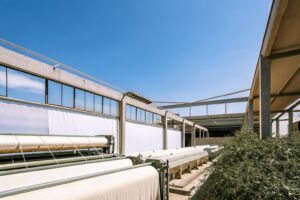
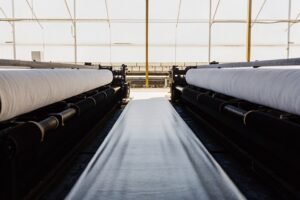
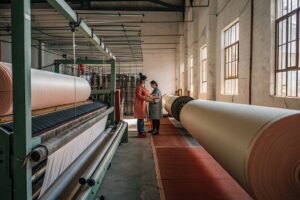
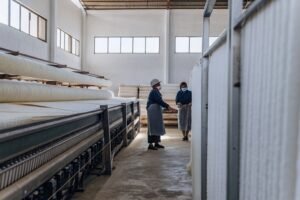
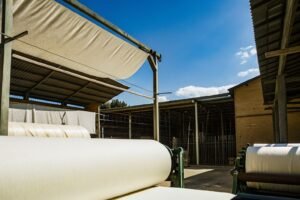
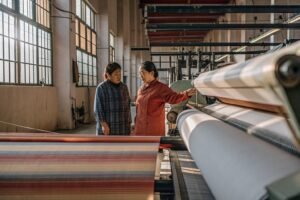
At Shanghai Fumao, we do not guess. We do not cut corners on water. We have a continuous PH monitoring system on our final wash boxes. The fabric does not leave the rinse line until the conductivity meter shows the residual salt and alkali are gone and the PH is within spec.
How Do Reactive Dye Fixatives Leave Alkaline Residue on Cotton?
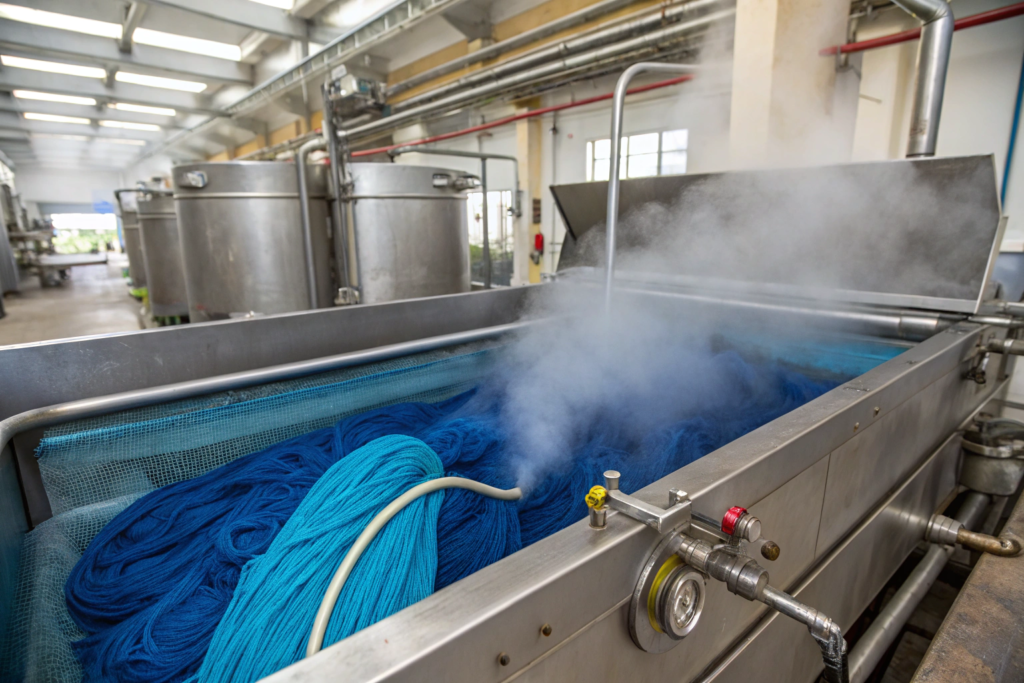
This is the specific chemical reaction that trips up so many mills. When you dye cotton with Reactive Red 120 or Reactive Blue 19, you are forming a covalent bond between the dye molecule and the cellulose fiber. That bond requires a high PH to activate. We call this the "fixation stage." We run the dye machine at 60 to 80 degrees Celsius with a PH of 11.0 to 11.5.
But here is the problem. Not all the dye reacts. Some of it just sits there, "hydrolyzed." This hydrolyzed dye is not bonded. It is just stuck to the surface of the yarn. If you have high PH, this un-fixed dye stays on the fabric. If you have neutral PH, it washes off. So, lazy mills do a "short wash." They rinse out the loose dye, but they do not rinse out the alkali salts that are soaked into the fiber’s lumen (the hollow center). They figure, "It looks clean. Ship it."
I can always tell when a fabric has residual alkalinity before I even test it. It feels slimy or soapy when wet. A properly neutralized cotton fabric feels soft and slick, almost like it is already dry, even when it is soaking wet. That is the sign of a proper acid neutralization step.
If you are a buyer and you want to dig into this, you can find detailed technical breakdowns on how to calculate reactive dye hydrolysis rates and washing off requirements in textile chemistry journals. The math shows that you need at least three separate rinse cycles with a temperature drop between each one to properly clean cotton.
Can Improper Scouring Before Bleaching Trap Residual Caustic Soda?
Yes, and this is even more dangerous because it happens before the fabric is even dyed. Scouring is the process of boiling the greige fabric in a strong alkali bath (usually caustic soda NaOH) to remove natural waxes, pectins, and seed husks from cotton. Without scouring, the fabric is hydrophobic (it repels water) and you cannot dye it evenly.
The problem is that cotton loves caustic soda. It absorbs it like a sponge. If the scouring bath is not properly drained and neutralized, the fabric enters the bleaching bath already saturated with alkali. Then you add hydrogen peroxide (an oxidizer) which needs a high PH to work. You are compounding the alkali load.
We once had a batch of heavyweight cotton canvas come back from our own dye house with a PH of 9.8. This was in August 2025. My QC manager flagged it immediately. We traced it back to a faulty drain valve on the scouring kier. The fabric was sitting in a puddle of residual caustic soda for 10 minutes before the rinse cycle started. That 10 minutes of dwell time was enough to drive the PH deep into the fiber structure. We had to re-run the entire batch through a hot acetic acid neutralization bath to bring it down to 6.5.
If we had shipped that canvas to a US bag maker, those bags would have rotted at the rivets and grommets within a year. The metal corrosion from alkaline fabric is a real, documented issue.
How Does Neutral PH Prevent Textile Degradation in Long-Term Storage?
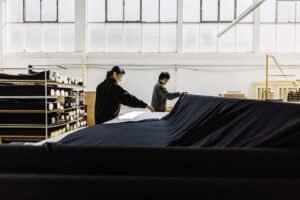
Let’s shift from skin health to fabric health. This is the part of the conversation that saves you money on inventory write-offs. You know that roll of beautiful printed viscose challis you bought for Spring ’26 but decided to hold for Spring ’27? If the PH is off, it will be dust by the time you go to cut it.
The degradation mechanism is called acid hydrolysis (if the PH is too low) or alkaline degradation (if the PH is too high). Cellulose, the building block of cotton, linen, viscose, and lyocell, is a long chain of glucose molecules. Acids attack the oxygen bridge between these molecules. They snip the chain. Alkaline conditions attack the reducing ends of the chain, causing it to unzip. In both cases, the Degree of Polymerization (DP) drops. The fiber gets shorter and weaker.
I have seen this happen in real time. A client stored 3,000 yards of 100% linen in a humid Florida warehouse for 14 months. When they pulled it, the fabric tore like wet paper. They tested the PH. It was 4.2. What happened? The mill had over-applied a citric acid softener to give it a "cool hand." They did not buffer the acid. Over a year in humid heat, that acid slowly ate the linen fibers. The fabric lost over 60% of its original tensile strength just sitting there.
At Shanghai Fumao, we warranty our fabric for 12 months of shelf life because we know the PH is between 5.5 and 7.0. That is the neutral zone where cellulose is stable. It does not rot. It does not yellow. It stays strong.
Why Do Museums Require PH 7-8 for Archival Cotton Storage?
If you want to know the gold standard for fabric preservation, look at museums. The Textile Conservation Foundation and the Smithsonian have strict guidelines. They do not store antique quilts at PH 5.5. They store them at a slightly alkaline PH 7.5 to 8.0.
Why? Because acid is the primary enemy of aged textiles. Even the air itself has carbon dioxide, which forms weak carbonic acid. Over decades, that acid yellows and embrittles the cloth. A slightly alkaline buffer neutralizes that acid attack before it damages the fiber.
Now, you are not a museum. But the principle applies to your deadstock inventory. If you are buying high-end silk organza or delicate cotton voile for a bridal collection, you should be asking for archival-grade storage specs. That means acid-free tissue paper and fabric that has been finished with a neutral to slightly alkaline PH. We actually offer a specific "Archival Finish" for our premium cottons. It is a wash with a very mild sodium bicarbonate buffer. It leaves the fabric at PH 7.2. It feels identical to a standard finish, but it will not yellow in storage.
If you are interested in how to test vintage textiles for acid degradation using PH strips, there are some great resources on textile conservation blogs. They show you how a simple surface test can predict if a fabric is about to shatter.
Does Low PH Accelerate Yellowing in Stored White Polyester Blends?
Let’s talk about white shirts. The bane of every buyer’s existence is opening a box of white poly-cotton poplin six months later and finding it has turned a nasty shade of cream or, worse, bright yellow. You blame the warehouse. You blame the packaging. You should be blaming the acidic PH.
Polyester itself is PH stable. But the optical brighteners and the softeners applied to the cotton portion are extremely PH sensitive. Most yellowing in storage is caused by phenolic yellowing. This happens when Butylated Hydroxytoluene (BHT) —an antioxidant used in plastic packaging bags—reacts with nitrogen oxides (NOx) in polluted air. And guess what catalyzes that reaction? Acidic conditions. A fabric with a low PH (4.0-5.0) acts like a magnet for that yellowing reaction.
I dealt with this for a US uniform company in November 2024. They had 20,000 white shirts go yellow in the sleeves. It was a disaster. We did a root cause analysis. The fabric PH was 5.1. The plastic poly bags were the cheap kind with high BHT. The combination was a yellowing bomb. We switched them to our neutral PH finish (6.5) and BHT-free poly bags. The next shipment stayed white for over a year.
(Here is a tip from the mill floor: If you get a yellowed white shirt, try hanging it in direct sunlight for an hour. UV light breaks down the phenolic yellow compound. It works about 60% of the time. It is better than re-dyeing.)
Which US Regulatory Standards Mandate PH Testing for Apparel?
Here is where the lawyers get involved. You might not care about chemistry, but you better care about compliance. In the United States, there is no single federal law that says "Thou Shalt Not Sell Alkaline Shirts." But there are de facto mandatory standards driven by retailer requirements and product liability law. If you sell to Walmart, Target, Nike, or Amazon, they have a Restricted Substances List (RSL) that specifies PH ranges.
The industry benchmark standard in the US is AATCC Test Method 81 (PH of the Water-Extract from Wet Processed Textiles). This test tells you the surface PH of the fabric. The acceptable range per most US retailer manuals is 4.0 to 7.5 for most apparel, with a tighter spec of 5.5 to 7.0 for infant wear and intimate apparel.
If you import fabric that is PH 9.0, you are technically selling a product that causes skin irritation. Under US product liability law, if a customer has a documented allergic reaction and you did not test the PH, you are liable. Your insurance company will not be happy. I have seen small brands get wiped out by a single class-action lawsuit over a "burning rash" from cheap leggings.
At Shanghai Fumao, we test to AATCC 81 on every single dye lot. We keep the test reports for three years. We do this not just because it is good practice, but because our US clients demand the Certificate of Analysis (COA) before they release payment. It is non-negotiable.
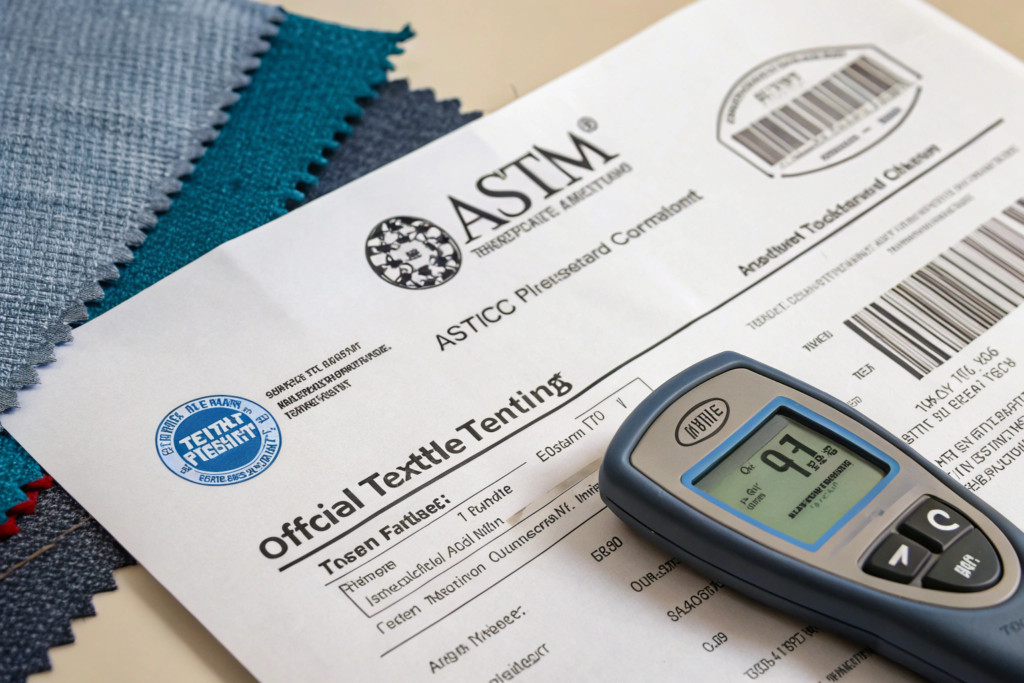
What Is the AATCC 81 Standard for Textile Surface PH?
Let’s get specific, because this is the piece of paper you need to ask for. AATCC 81 is a simple but precise test. You take a 10-gram sample of fabric. You cut it into tiny pieces. You boil it in 250 ml of distilled water (which is PH 7.0) for 10 minutes. This hot water extracts the residual chemicals from the fiber. Then you let it cool to room temperature and stick a calibrated PH meter into the water. You read the number.
A reading of 6.5 is ideal. A reading of 8.5 is a failure for most US retailers. A reading of 3.5 is a failure (the fabric is too acidic and will degrade).
I have a client, a buyer for a large US department store, who has a simple rule: "If the COA shows PH > 7.5, the container does not leave the port of Shanghai." That is how serious they are. They know that alkaline fabric equals customer returns.
If you are new to this and want to understand how to perform AATCC 81 PH test on fabric at home, you can find simplified guides using a coffee maker and PH strips. It is not as accurate as a lab meter, but it will tell you if the fabric is in the danger zone (bright purple/blue on a strip). It is a great quick check for a pre-production sample.
Why Do US Infant Wear Laws Require PH Between 5.5 and 7.0?
Babies have thin, sensitive skin. Their acid mantle is not fully developed. They are also prone to diaper rash and eczema. If you put a baby in a onesie with a PH of 8.5, you are asking for a contact dermatitis nightmare.
This is why the Consumer Product Safety Commission (CPSC) and the stricter OEKO-TEX Standard 100 certification have a tight PH window of 4.0 – 7.5 for baby clothing (with a recommended target of 5.5 – 7.0). It is not just about the dye. It is about the formaldehyde scavengers and softeners.
I worked with a US startup in May 2025 that was doing organic cotton baby swaddles. Beautiful design. Great marketing. Their first production run from another factory in China came back at PH 8.2. They had to pull the entire inventory. It was a $45,000 mistake. They came to us for the re-order. We ran a double neutralizing rinse and used a cationic softener that works in a neutral bath. We delivered at PH 6.4. The fabric was softer, safer, and actually cost less to ship because we did not have to air freight a replacement order.
If you are in the baby space, do not mess around. Demand a PH test report with your shipment. It is the cheapest insurance you can buy.
How Can Buyers Verify Fabric PH Before Container Shipment?
You are sold. You get it. PH matters. But how do you, sitting in an office in Manhattan or Los Angeles, know that the fabric in Keqiao is actually neutral? You cannot trust a word a salesman says. You need verification. You need a system.
The first step is pre-production sample testing. Do not wait for the bulk shipment. When we send you a lab dip or a handloom, you should cut a 4×4 inch swatch and test it yourself or send it to a third-party lab like SGS or Bureau Veritas. It costs about $50 per test. It is the best money you will spend.
The second step is inline inspection. At Shanghai Fumao, we have a PH checkpoint right after the drying cylinders. Our QC team takes a wet sample from the middle of the roll, puts it in a beaker of distilled water, and checks it with a Hanna Instruments portable meter. If it is off, we stop the line and adjust the neutralization bath. We do not wait until the roll is finished and packed. That is the difference between process control and final inspection.
The third step is the Final Certificate of Analysis (COA) . We email you a PDF of the actual AATCC 81 test result for your specific dye lot. You can match the lot number on the COA to the lot number on the fabric roll label. If a supplier cannot give you that, they are not testing.
Which Portable PH Meters Work Best for On-Site Textile QC?
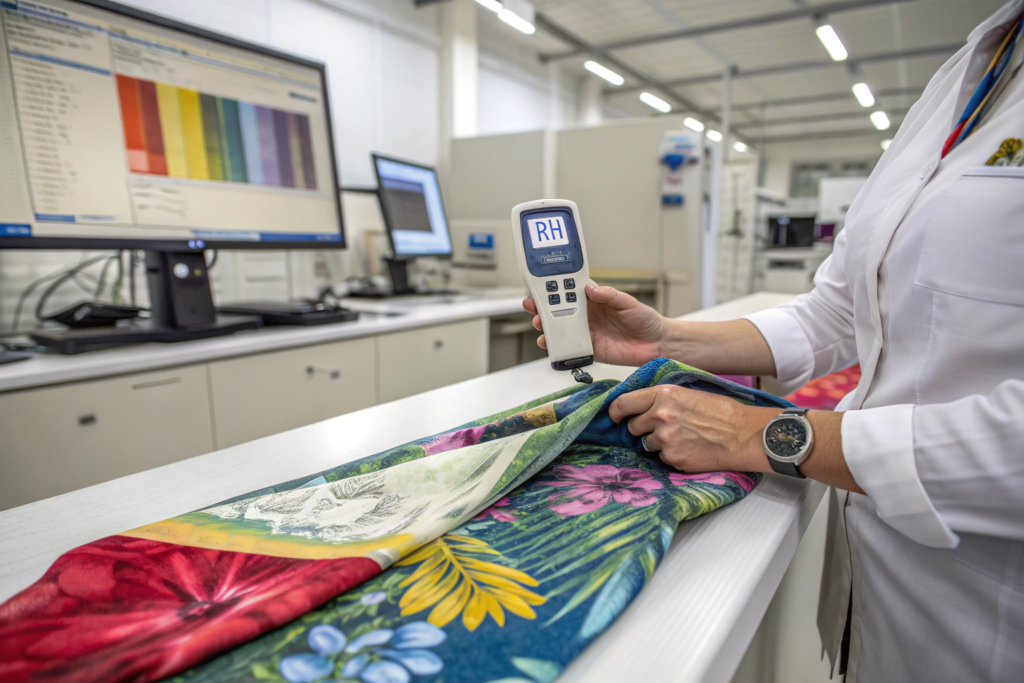
If you are a traveling buyer visiting a mill in Asia, you should have a portable PH meter in your bag. Do not rely on those little paper strips. They are useless with colored dye liquor because the dye stains the strip and you cannot read the color change. You need a digital meter with a spear-tip electrode.
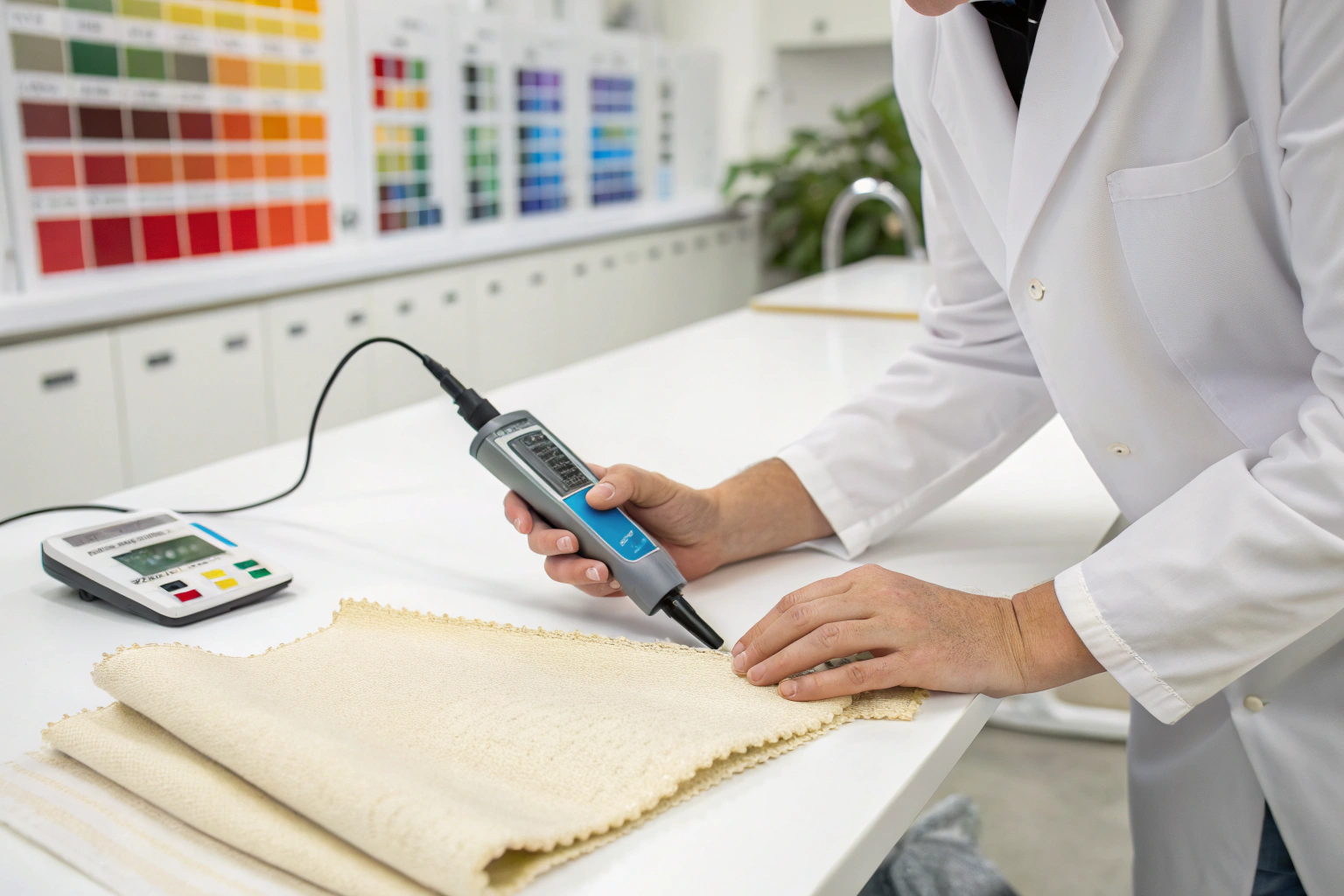
The industry standard for textile wet processing is the Hanna Instruments HI9813-6 or the Apera Instruments PH60S. The key feature you need is a spear tip. This allows you to pierce a folded piece of wet fabric to get a reading directly from the surface of the cloth. You cannot just dip a glass bulb probe in a bucket of rinse water. You need to measure the fabric surface PH.
Here is a quick guide on what to look for:
- Spear Tip Electrode: Essential for piercing fabric.
- ATC (Automatic Temperature Compensation): PH changes with temperature.
- Calibration Solutions: Always carry PH 4.0 and PH 7.0 buffer solutions.
I had a client visit us last year who was a chemical engineer in a previous life. He pulled out his own meter and checked a roll we had just finished. It read 6.7. Our inline meter read 6.6. He nodded and said, "Okay, we can do business." That is the level of trust you build when you are transparent about your process. If you want to learn how to calibrate a spear tip PH meter for textile surface testing, there are good video tutorials on industrial QC forums. It takes two minutes and it ensures your reading is accurate.
Can Buyers Use Vinegar Rinses to "Fix" Alkaline Fabric Post-Arrival?
I get this question in my inbox a lot: "My fabric arrived and smells weird/is causing rashes. Can I just wash it in vinegar?" The answer is maybe, but probably not.
Yes, vinegar (acetic acid) will neutralize surface alkali. If you are a small Etsy seller with 20 yards of cotton, you can soak it in a tub with a cup of white vinegar and then rinse it. That will drop the PH and remove the soapy hand. But if you are a brand with 5,000 yards of cut-and-sew fabric, this is a logistical and financial nightmare. Who is going to unroll 5,000 yards, wash it, dry it, and re-roll it? The cost of that labor and water will eat up any savings you got from the cheap price.
Worse, vinegar rinsing does not fix the core problem. Remember the caustic soda trapped in the fiber lumen? A quick surface rinse with vinegar will neutralize the outside, but it will not reach the deep alkali. The first time the garment gets sweaty or washed, that deep alkali will migrate to the surface. The rash will come back. The smell will come back.
I tell my clients: Do not accept a bad batch. If the fabric is out of PH spec, it is a major defect. Send it back. That is what the AQL inspection and COA are for. You have the right to reject goods that do not meet spec. A vinegar rinse is a band-aid on a broken leg. It is not a solution for professional apparel production.
Conclusion
Let’s bring this back to the bottom line. Fabric PH is not an abstract chemistry concept. It is a direct driver of customer satisfaction, product liability, and inventory value. Ignoring it is like buying a car without checking the oil. It might run for a while, but the engine is going to seize.
We have seen how alkaline residue from reactive dyes can cause skin rashes and how acidic finishes can rot your deadstock. We have looked at the AATCC 81 standard that governs US retail compliance. And we have talked about the simple, practical steps you can take to verify PH before your container leaves the dock. The takeaway is simple: Demand a Certificate of Analysis. If your supplier cannot produce a PH test report with a number between 5.5 and 7.0, you are gambling with your brand.
At Shanghai Fumao, we have built our entire quality system around predictable chemistry. We have continuous PH monitors on our wash lines. We have a CNAS-certified lab that tests every single dye lot. We do this because we sell to the US market, and we know that a chargeback from a retailer for "skin irritation" is a death sentence for a vendor relationship. We protect our clients by protecting the PH balance of their fabric.
If you are ready to source fabric that is not just beautiful but also biocompatible and shelf-stable, let’s have a conversation. We can run a trial order with full AATCC 81 certification. You will see the difference in the hand feel and smell of the fabric immediately. Reach out to our Business Director, Elaine. She can coordinate lab dips and provide our standard PH compliance documentation. Email her at elaine@fumaoclothing.com. Stop worrying about the chemistry and start selling the clothes.