
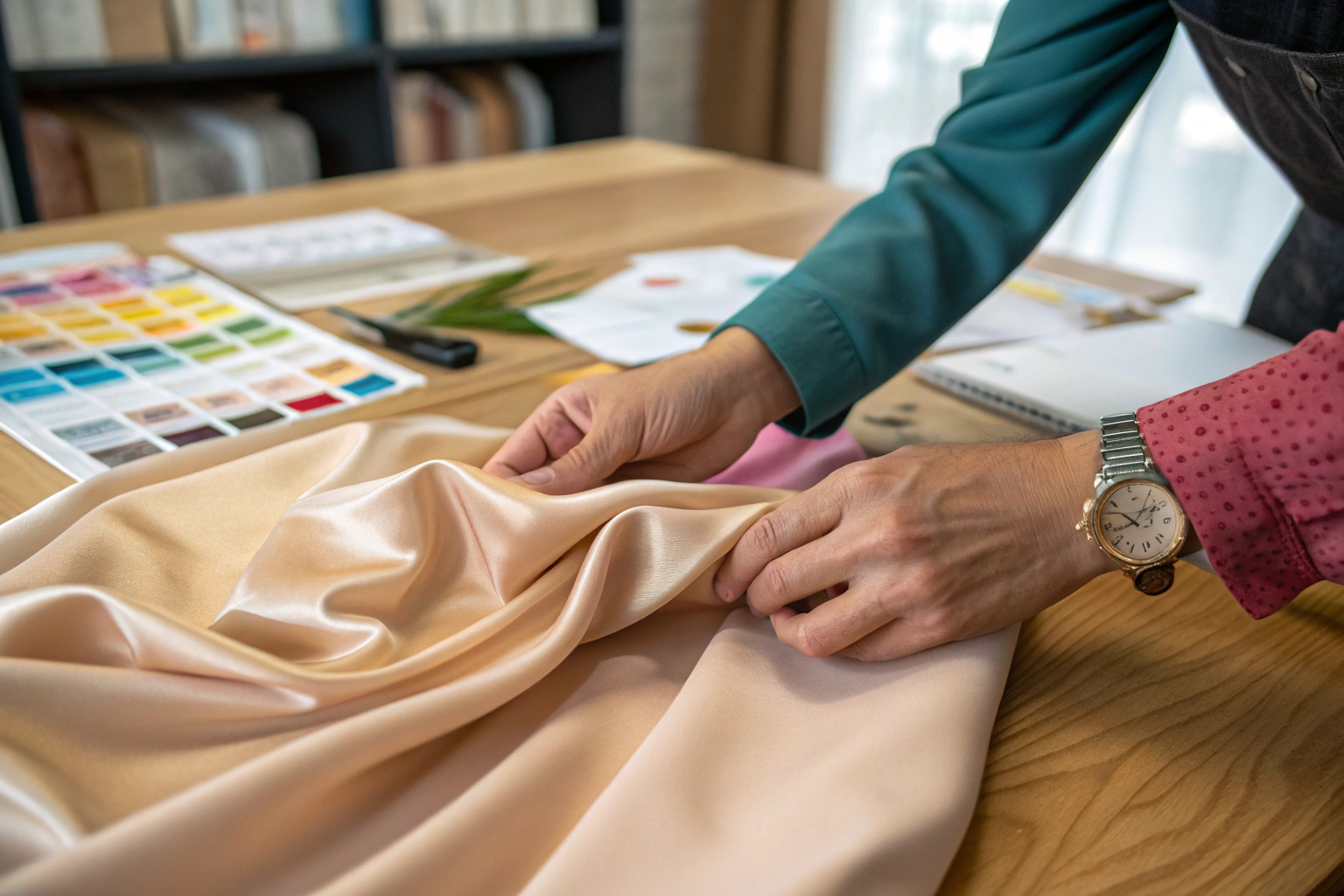
I cannot tell you how many emails I have received that say something like "I want it to feel soft but structured" or "Make it like the Zara premium line but cheaper." When I read those words I know we are about to enter a world of pain. You know exactly what you want in your head and in your fingertips. But when those words travel across the ocean and land in a WeChat message to a technician who has been working looms since before the internet existed they mean absolutely nothing. "Soft" could mean a cashmere sweater or a wet paper towel. "Structured" could mean a military canvas or a cardboard box. This language gap is where great collections go to die.
The secret to communicating hand feel across a language barrier and a cultural gap is removing adjectives entirely and replacing them with measurable physical data and physical reference standards. At Shanghai Fumao we stopped using words like "drapey" or "crisp" in our internal tech packs about five years ago. It was a game-changer. Instead we talk about bending length in centimeters and coefficient of friction values. More importantly we use a library of physical swatches that both sides can hold. When a buyer says "I want the hand feel of this 2023 sample but in a lighter weight" we can actually build that fabric because we have the baseline data locked in. You cannot describe a symphony with a text message. You have to send the sheet music.
Now before you think I am suggesting you need to become a textile engineer to order fabric let me walk you through exactly how we bridge this gap. You do not need a PhD in polymer science. You do need a vocabulary shift and a process for providing objective feedback. I have seen independent designers with zero technical background nail the perfect Lyocell Twill drape on their first attempt using the method I am about to share. And I have seen major corporate buyers with teams of technicians mess it up because they relied on vague poetry instead of hard data. This is about getting exactly what you want the first time and not having to settle for "close enough" because you could not explain "fluid but not clingy" in a way that translates through Google Translate.
What Objective Terms Replace Vague Hand Feel Words
Words are the enemy of precision when it comes to fabric hand. I learned this the hard way when I was younger and more naive. I told a dye house manager that a Cotton Sateen sample felt "a little bit crunchy." He nodded and said "Okay I fix." What I got back felt like sandpaper. He had taken "crunchy" to mean I wanted more body and stiffness. What I actually wanted was less residual alkali from poor washing. The word failed me.
You have to switch to a vocabulary that has a fixed agreed-upon definition in the textile world. The good news is that these objective terms are actually easier to use than flowery adjectives once you learn them. They describe physical properties that can be measured and replicated. When you use these terms with a factory like ours you signal that you are a professional buyer who cannot be fooled by a temporary silicone finish.

How Does Bending Length Define Fabric Stiffness Accurately
Bending length is the single most useful measurement for communicating what people call "structure" or "body" or "drape." It answers a simple question. How far does a strip of fabric extend horizontally before it bends under its own weight and touches the ground. A low bending length means the fabric droops quickly. It feels fluid and clingy like Viscose Jersey. A high bending length means the fabric stands out away from the body like Organza or stiff Denim.
I keep a simple chart on the wall of our development office in Keqiao that breaks down the ranges we use internally.
| Bending Length (cm) | Hand Feel Description | Typical Fabrics |
|---|---|---|
| Under 1.5 cm | Fluid liquid-like drape very little body | Lightweight chiffon silk habotai |
| 1.5 cm to 2.5 cm | Soft drape with some movement moderate body | Rayon challis modal jersey tencel twill |
| 2.5 cm to 3.5 cm | Crisp hand holds shape moderate stiffness | Cotton poplin linen shirting medium canvas |
| Over 3.5 cm | Stiff boardy significant structure | Heavy canvas denim organza taffeta |
When a client tells me they want a fabric with "better drape" I immediately ask them to compare their current fabric to a standard reference point. If they hold up a swatch and say "It bends like this but I want it to bend like that" we can measure both and give them a target number. This completely eliminates the guessing game.
Here is a real example from September 2025. A Los Angeles based womenswear designer was struggling with a Cupro Twill that she said felt "too limp" for her trousers. She sent us a cutting of the current fabric and a cutting of a competitor trouser she loved. We measured both in our lab. Her current fabric had a bending length of 2.1 cm. The target fabric measured 2.7 cm. We adjusted the finishing process at the mill adding a very light resin treatment to increase the bending length without affecting the soft surface hand. She approved the new sample in one round. If you want to understand the full testing methodology behind this measurement the Shirley Stiffness Tester method for measuring fabric bending length and flexural rigidity provides the exact ASTM D1388 procedure we follow in our lab.
What Does Coefficient of Friction Tell You About Surface Smoothness
Surface friction is what people really mean when they say a fabric feels "silky" or "slippery" or "grippy" or "dry." It is not about weight or thickness. It is about how the fabric surface interacts with your skin. A high friction fabric like Sweatshirt Fleece or Terry Cloth feels cozy and absorbent. A low friction fabric like Satin or Tencel feels cool and slippery.
The problem with describing friction verbally is that everyone has a different baseline. My calloused hands from handling fabric bolts all day perceive smoothness differently than the soft hands of a luxury boutique buyer. We need a number. The coefficient of friction or COF is that number.
In practical terms for fabric sourcing here is how I break it down for clients.
- High COF (Above 0.40): The fabric drags against skin. Good for activewear where you want the garment to stay in place. Good for toweling where you want absorption. Feels "dry" or "peachy."
- Medium COF (0.25 to 0.40): Standard comfortable hand feel. Typical for most cotton shirting and basic knits. Not slippery not grippy.
- Low COF (Below 0.25): The fabric slides easily against skin and other fabrics. Good for linings and layers. Feels "silky" or "cool to the touch."
I had a client in early 2026 from Canada who was developing a luxury sleepwear line. She kept saying she wanted the fabric to feel "like slipping into cool sheets." That is a beautiful marketing line but it is useless for the knitting mill. I translated her words into a specification. We needed a bending length under 1.8 cm for fluidity and a COF under 0.22 for that slippery cool sensation. We ended up using a high-twist Lyocell Satin with a proprietary enzyme wash that reduced surface friction by 18% compared to standard finishing.
At Shanghai Fumao we actually test friction on both the face and back of the fabric because sometimes you want a slick face and a grippy back for seam stability. This level of detail is what separates a fabric that just looks good on a hanger from one that performs beautifully on the body. For those interested in the science behind why certain finishes create that cool dry hand feel measuring surface friction of textiles using the Kawabata Evaluation System provides an academic deep dive into the mechanical properties that define what we call "hand."
How To Create A Physical Hand Feel Reference Standard
You would not order paint by saying "Make it a nice blue." You would hold up a Pantone chip and say "This one. PMS 2945 C." Fabric hand feel needs the same kind of physical reference system. Words will always fail. Physical objects do not lie and they do not get lost in translation. Every serious fabric development project I have worked on in twenty years has eventually come down to two people holding two pieces of cloth and saying "More like this. Less like that."
Building a hand feel reference library sounds like something only a giant corporation would do. It is actually simple and cheap and it will save you more money than you can imagine in failed sampling rounds. I have helped small Etsy sellers with zero technical background build reference kits that allowed them to communicate clearly with our mill in Keqiao. The process is not complicated. It just requires a little bit of discipline and a willingness to touch a lot of fabric.

Which Off The Shelf Fabrics Make The Best Touchstone Swatches
You do not need to develop your own proprietary fabric library from scratch. You just need to find commercially available fabrics that represent the specific hand feel characteristics you want and use them as your touchstones. I call this the "Like This But" method.
Here is a list of common commercial fabrics that I recommend clients use as reference points because they are widely available and relatively consistent in hand feel year after year.
| Fabric Reference | Bending Length Range | COF Range | Best Used For Describing |
|---|---|---|---|
| Standard Cotton Lawn | 2.0 – 2.4 cm | 0.30 – 0.35 | Crisp lightweight blouse weight |
| Standard Rayon Challis | 1.4 – 1.8 cm | 0.28 – 0.32 | Fluid drapey dress weight |
| Standard Cotton Twill | 2.8 – 3.2 cm | 0.35 – 0.40 | Structured bottom weight |
| Standard Poly Chiffon | 0.9 – 1.3 cm | 0.18 – 0.22 | Very fluid sheer weight |
| Standard Interlock Knit | 1.8 – 2.2 cm | 0.32 – 0.36 | Soft stable t-shirt weight |
The process is straightforward. Go to a fabric store or order swatches online. Find a fabric that has the hand feel you want for your project. It does not need to be the right color or the right fiber content. It just needs to feel right in your hand. Buy a yard of it. Cut it into 8×8 inch swatches. Label them with a permanent marker. Send one to the mill and keep one for yourself.
When you communicate with the factory you say "I want the hand feel of this reference swatch but in a heavier weight" or "Same drape as this swatch but with a softer surface finish." This gives the factory technician a physical target to aim for. They can measure the reference swatch in their own lab and then measure their development samples against those same numbers.
This method solved a six-month development nightmare for a client of ours in 2024. She was trying to develop a sustainable Recycled Polyester Satin for bridal wear. She had rejected seven rounds of samples because the hand feel was "not right." She could not explain why. We asked her to send us a swatch of something she loved. She sent a small cutting of a virgin polyester satin from a high-end brand. We measured it. We replicated the exact surface friction and bending length in our recycled yarn construction. The eighth sample was approved immediately. For more ideas on building your own reference library how professional fabric buyers create and maintain physical swatch libraries for sourcing consistency offers practical tips from the industry.
How Should You Photograph Drape To Communicate Digitally
Physical swatches are best but sometimes you need to make a decision based on a photo or a video. A flat scan of fabric tells you exactly nothing about hand feel. A crumple shot tells you everything. I cannot stress this enough. Stop sending flat lay photos to your factory. Start sending drape photos.
At Shanghai Fumao we require our development team to take three specific photos of every new sample before sending it to a client. These photos communicate more about hand feel in two seconds than a paragraph of text ever could.
- The Hand Crumple: Hold the fabric in your fist for five seconds then release it onto a flat surface. Take a photo immediately. A stiff fabric will hold sharp creases. A resilient fabric will spring back open. A limp fabric will collapse into a soft puddle. This single photo tells the factory whether your fabric has "recovery" or "memory."
- The Drape Over Edge: Lay the fabric over the edge of a table or a chair back. Photograph it from the side. This shows the bending length visually. The factory can literally see the angle at which the fabric breaks and falls.
- The Suspended Center: Pin the center of a 12-inch square of fabric to a wall or a board. Photograph how the edges hang. A soft fabric will fold in on itself tightly. A stiff fabric will hold a wider cone shape.
I had an urgent situation in October 2025 with a client in Australia who needed to approve a Hemp and Organic Cotton Blend Canvas for bag production. Shipping a physical swatch would take a week we did not have. I sent her the three photos described above along with the lab data for bending length. She was able to compare the drape over edge photo to a photo of her current production fabric taken the same way. The visual comparison matched the lab data. She approved production that same day. The bags arrived on time for her holiday market launch. For a deeper understanding of how to capture fabric behavior visually photography techniques for capturing fabric drape and texture for ecommerce product listings provides a great overview even if it is focused on retail rather than production.
Navigating Cultural Communication Gaps In Hand Feel
The cultural gap in describing fabric is real and it is deep. I have spent two decades straddling the line between Western design language and Chinese manufacturing execution. I have seen deals fall apart and friendships strained because of a misunderstanding about what "soft" means. The issue is not that one side is right and one side is wrong. The issue is that we have been trained in completely different systems of evaluation.
In the West designers are taught to use evocative sensory language. "This fabric feels like a summer breeze." In China textile technicians are taught to use precise mechanical data. "The warp tension was 22 cN and the weft density is 68 picks per inch." Neither language is better. They are just different. My job and your job if you want to succeed in sourcing is to become bilingual. You need to learn just enough of their language to be understood clearly.

Why Does The Word Soft Cause So Many Sampling Failures
The word "soft" is the single most dangerous word in the textile sourcing vocabulary. I wish I could ban it entirely from all communication with mills. The problem is that "soft" describes at least five completely different physical properties that sometimes conflict with each other.
Here is what a Chinese mill technician hears when you say "soft" depending on the context and their own past experience.
- Interpretation A (Surface Softness): They add more silicone softener. The fabric gets slipperier but also weaker and potentially yellows over time.
- Interpretation B (Compressional Softness): They reduce the yarn twist or fabric density. The fabric gets thicker and squishier but also pills more and develops holes faster.
- Interpretation C (Bending Softness): They reduce the fabric stiffness. The fabric drapes more fluidly but loses its shape and structure.
I worked with a children’s wear brand in 2023 who rejected five rounds of Organic Cotton Jersey samples because they were "not soft enough." The mill kept adding silicone softener. The fabric kept getting greasier and greasier but the buyer was still unhappy. I finally got on a call with the buyer and asked her to describe "soft" without using the word soft. She said she wanted it to feel "cushiony and plush like a baby blanket." I translated that for the mill as "increase fabric thickness by 15% and use a low-twist yarn with a brushed finish." The next sample was approved immediately.
The solution is to ban the word "soft" from your vocabulary when talking to factories. Replace it with specific physical descriptors. Say "I want lower bending resistance" or "I want more surface smoothness" or "I want more compression thickness." If you absolutely must use the word soft pair it with a physical reference swatch so the technician has a target to aim for. For more on this communication challenge why soft is the most misunderstood term in textile sourcing and how to avoid it offers additional perspective from industry veterans.
How Do You Give Feedback That Leads To Actionable Mill Adjustments
Giving feedback on a sample that is almost right but not quite right is an art form. The wrong feedback sends the mill down a rabbit hole of adjustments that ruin other properties of the fabric. The right feedback gets you exactly what you want in one more round.
I use a simple framework that I teach to all of our clients at Shanghai Fumao. It is called the "Keep Change Compare" method.
- Keep: Start by stating clearly what is already working perfectly. Do not skip this step. It is crucial for mill morale and it prevents them from accidentally fixing something that is not broken. Say "The weight is perfect. Do not change the weight."
- Change: State the single specific physical property you want to adjust. Use objective language not adjectives. Do not say "Make it softer." Say "Reduce bending length by approximately 0.5 cm."
- Compare: Provide a reference point for the desired change. Use your physical swatch library or your drape photos. Say "I want the drape to look like Photo B while keeping the surface texture of the current sample."
Here is a real example of feedback that worked. A client in London was developing a Cupro and Linen Blend for summer suiting. She said "The sample is great. The color is perfect. The weight is right. But when I hold it up it feels a little too floppy for trousers. I want it to hold a crease better but still feel cool on the skin. Can we make it about 20% crisper without making it scratchy?"
That feedback is gold. It tells me exactly what to adjust. We increased the warp tension slightly during weaving and added a very light wash-away stiffener that would last through garment construction but soften with the first home wash. The client received the revised sample two weeks later and approved it for production the same day.
The key is to limit your change requests to one or two variables per sampling round. If you try to change the weight and the drape and the surface texture all at once the mill cannot isolate which adjustment caused which result. You will end up in an endless cycle of samples that get further and further from your target. Change one thing. Measure the result. Then change the next thing. This methodical approach feels slower but it actually gets you to production much faster.
Using Lab Data To Confirm Hand Feel Matches Spec
The final step in nailing hand feel is verification. You have done the hard work of translating your sensory desires into objective specs. You have sent physical reference swatches. You have used the Keep Change Compare method to refine the sample. Now the mill sends you a lab dip or a strike-off and says "This matches what you asked for." How do you know they are telling the truth? How do you know they did not just send you a one-off sample that they cannot replicate in bulk production?
This is where lab data becomes your best friend and your legal protection. At Shanghai Fumao we provide a full test report with every development sample over 50 yards. Not because clients demand it but because it protects us too. It creates a shared record of exactly what was agreed upon. If the bulk production comes in different we can compare the data and identify exactly where the variance occurred. Without this data you are just arguing about feelings. With this data you are having a factual conversation about measurable deviations.

Which ASTM Tests Verify The Hand Feel You Requested
You do not need to run a full battery of tests on every sample. That gets expensive fast. But for critical hand feel characteristics there are three key ASTM tests that give you the verification you need for under a few hundred dollars per sample.
Here is the test menu I recommend for hand feel verification.
| Hand Feel Property | ASTM Test Method | What It Tells You | Acceptable Variance |
|---|---|---|---|
| Stiffness / Drape | ASTM D1388 | Bending length in cm | +/- 0.2 cm from spec |
| Thickness / Loft | ASTM D1777 | Thickness under pressure in mm | +/- 5% from spec |
| Surface Friction | ASTM D1894 | Coefficient of friction | +/- 0.03 from spec |
| Compression | ASTM D6571 | Compressibility and recovery % | +/- 8% from spec |
I had a situation in August 2025 where a client rejected a bulk shipment of Tencel Twill claiming it felt "stiffer" than the approved sample. The mill insisted it was the same. We pulled the test reports for both the approval sample and the bulk production. The bending length on the approval sample was 2.4 cm. The bending length on the bulk production was 2.9 cm. That is a significant variance outside the acceptable range. The mill had increased tension on the stenter frame to hit a width target and accidentally stiffened the fabric. Without the ASTM D1388 data we would have been arguing about whether 0.5 cm of bending length actually matters. With the data the mill accepted responsibility and issued a credit for the difference in value.
For those who want to understand what goes into a proper fabric test report a guide to ASTM textile testing methods for fabric performance and quality assurance provides the official documentation for all the methods we use in our CNAS-accredited lab.
How Do You Document Hand Feel For Repeat Orders Six Months Later
This is the challenge that separates professional brands from hobbyists. You nail the fabric for your Spring 2026 collection. It sells out. You want to reorder the exact same fabric for Spring 2027. But the mill has changed their yarn supplier. The dye house has a new wastewater treatment system. The finishing plant has a new manager. The fabric you receive next year feels different even though the spec sheet says it is the same.
You need a documentation system that preserves the hand feel standard across time. Here is what I recommend every brand do before they sign off on a successful development sample.
- The Master Swatch File: Cut three 12×12 inch swatches from the exact approved sample. Label them with the date the style number and the words "HAND FEEL MASTER DO NOT DISCARD." Store one in a sealed plastic bag away from light. Keep one in your office. Send one to the mill with instructions to keep it in their quality archive.
- The Data Snapshot: Save a digital copy of the ASTM test results for the approved sample. Include the specific lot numbers of yarn and dye used if possible. This data becomes your baseline for future comparison.
- The Visual Record: Take the three drape photos I described earlier in this article using the approved sample. Save them in a folder named "Hand Feel Standards 2026."
I have a client who has been ordering the same Cotton Modal Jersey from us for seven years. Every year before we run her reorder we pull the master swatch from our archive and compare the new bulk fabric to the original standard. If there is any detectable difference we adjust the finishing process until they match. This level of consistency is why she has never had to explain to her customers why this year’s t-shirt feels different from last year’s.
For more ideas on long-term quality management how to maintain fabric consistency across multiple production seasons and repeat orders provides insights from larger brands who manage these challenges at scale.
Conclusion
Explaining fabric hand feel to a factory does not require you to become a poet or a textile engineer. It requires you to stop using words that have no fixed meaning and start using physical references and measurable data that translate across any language barrier. The process breaks down into four clear steps. First replace vague adjectives like "soft" with objective terms like bending length and coefficient of friction. Second create a physical reference library of swatches that you can send to the mill so they have a literal target to aim for. Third use the Keep Change Compare method to give feedback that leads directly to actionable adjustments rather than more confusion. Fourth verify the results with ASTM test data and document your approved standard so you can replicate it forever.
The mills in Keqiao where Shanghai Fumao operates are capable of producing almost any hand feel you can imagine. The limiting factor is almost never their technical ability. The limiting factor is the clarity of the instructions they receive. When you send vague poetry they send back a guess. When you send a swatch and a spec sheet they send back exactly what you asked for.
If you have been struggling with fabric that feels "almost right but not quite" or if you have a specific hand feel in mind for your next collection that you do not know how to describe I invite you to reach out. Send us a cutting of something you love. Tell us what you want to change about it. We will measure it in our lab and send you back a sample that matches your target. Our Business Director Elaine handles these technical development requests personally. You can reach her at elaine@fumaoclothing.com. She will walk you through the process and make sure your next fabric order feels exactly the way you imagined it in your head. That is not just marketing talk. We really can do that.








