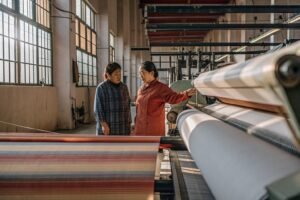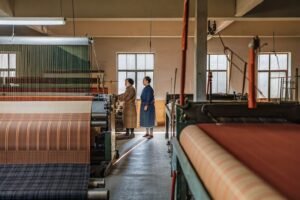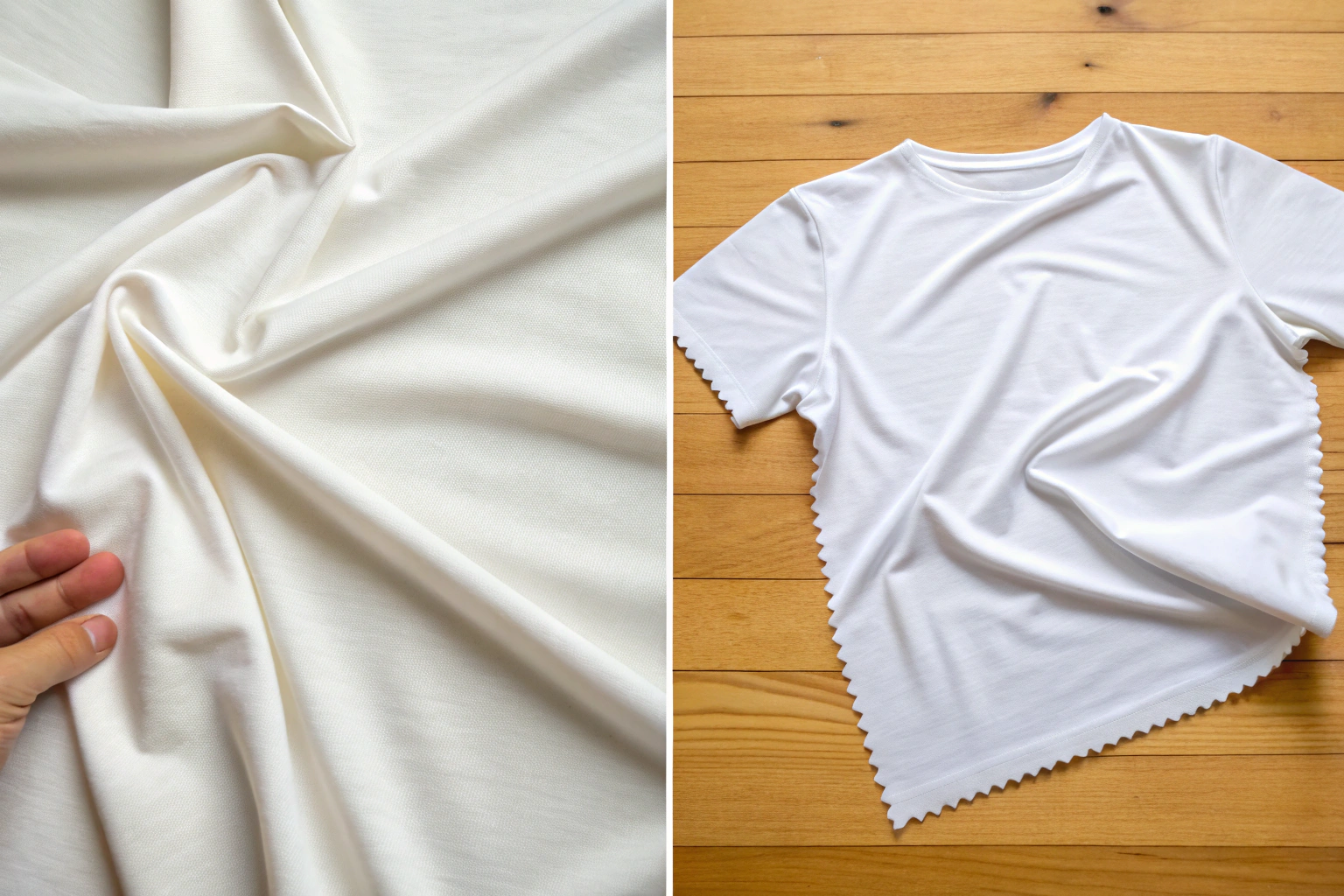
You have been there. You pull your favorite cotton T-shirt out of the dryer. It used to fit perfectly. Now it looks like it belongs to your kid brother. The sleeves are too short. The hem is riding up. Or maybe you are looking at a fresh stack of work shirts, and you just know that by 10:00 AM, they will look like you slept in them. Wrinkled. Shapeless. As the owner of a fabric mill that supplies both 100% cotton and blended fabrics, I see this tug-of-war every single day. Brands love the story of "Pure Cotton." It sounds natural. It sounds premium. But their customers hate the reality of shrinkage and ironing. The problem is that pure cotton, for all its virtues, has some serious structural weaknesses. It absorbs water like a sponge, which means it wrinkles like crazy and shrinks like a wool sweater in hot water.
Here is the straight answer on CVC. CVC stands for Chief Value Cotton. It is a blend where cotton makes up the majority of the fabric (usually 60% to 80%), and Polyester makes up the rest. This is not the cheap, shiny, plastic-feeling "50/50" blend from the 1970s. This is a modern engineered fabric that takes the best parts of cotton—the softness, the breathability, the natural hand feel—and reinforces them with the hidden strength of polyester. The result? A fabric that shrinks less, wears longer, and holds color better than pure cotton, while still feeling like a high-quality cotton garment against your skin. At Shanghai Fumao, we have seen our CVC business grow 40% year-over-year, especially with US uniform brands and workwear lines that cannot afford returns due to shrinkage.
But this is not just a simple "polyester is stronger" story. The way we blend the fibers, the specific type of polyester we use, and the finishing processes are what make the difference between a premium CVC tee and a cheap, clingy mess. I want to walk you through the exact mechanics of why this blend works, where it fails, and how to spec it correctly for your specific product. Stick with me, because this is about understanding the true cost of "pure" versus "practical."
Why Does CVC Fabric Shrink Less Than 100% Cotton?
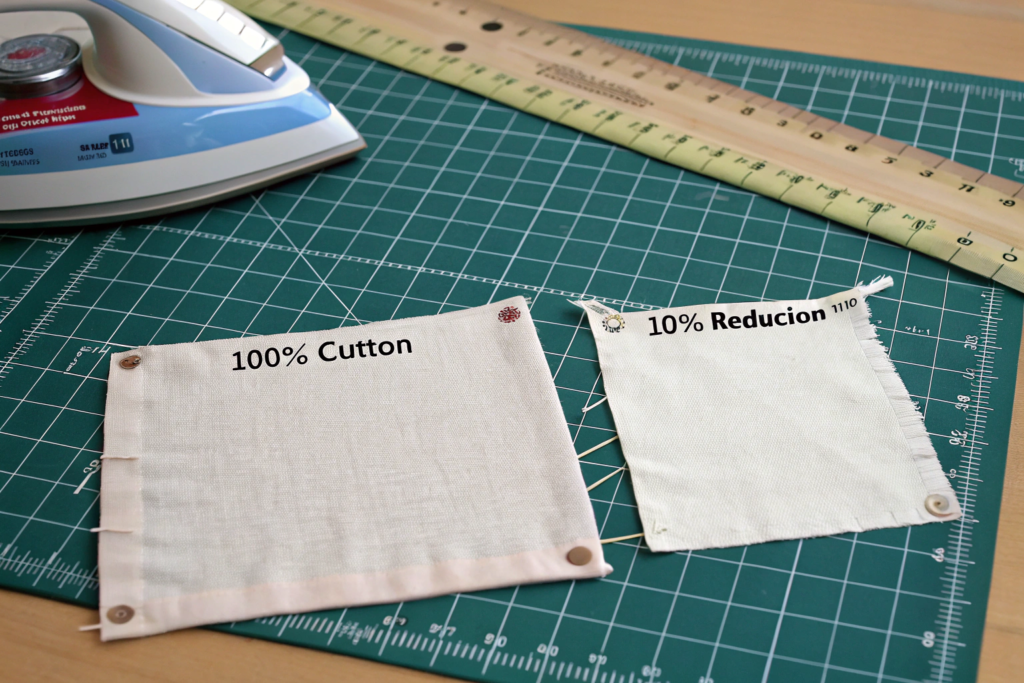
Let me tell you about the single biggest complaint we get from brands using pure cotton. It is not about softness. It is not about pilling. It is Shrinkage. They order a size Large T-shirt with a body length of 29 inches. They wash it once for quality control. It comes out 27.5 inches. That is a 5% shrinkage. The customer puts it on, and it is now a crop top. Returns flood in. Ratings tank.
This happens because of the fundamental chemistry of Cellulose. Cotton is pure cellulose. Cellulose loves water. When you wash a cotton T-shirt in hot water, the water molecules penetrate the amorphous regions of the fiber. The fiber Swells in diameter. As it swells, the yarn has to contract in length to accommodate that extra girth. This is called Relaxation Shrinkage. It is the fabric releasing the tension we put on it during knitting and finishing.
Polyester is Hydrophobic. It hates water. It does not swell. When you blend 40% polyester into the cotton yarn (a 60/40 CVC), you are inserting a skeleton of Dimensionally Stable fibers into the yarn structure. When the cotton portion of the yarn tries to swell and shrink, the polyester portion says, "No. I’m not moving." It acts like a rebar inside concrete. The concrete (cotton) might want to crack and shift, but the steel (polyester) holds the structure in place.
In our lab at Shanghai Fumao, we test shrinkage according to AATCC 135. We do a standard 3-cycle wash and dry. Here is the real-world data on our 26/1 jersey fabrics:
| Fabric Type | Composition | Average Length Shrinkage (3 Washes) | Average Width Shrinkage (3 Washes) |
|---|---|---|---|
| Pure Cotton (Combed) | 100% Cotton | 5% – 7% | 4% – 6% |
| CVC (Chief Value Cotton) | 60% Cotton / 40% Polyester | 2% – 3% | 1.5% – 2.5% |
| Poly-Cotton (PC Blend) | 35% Cotton / 65% Polyester | < 1% | < 1% |
You can see the progression. The more polyester, the less shrinkage. But CVC hits the sweet spot. It eliminates the majority of shrinkage—the kind that ruins a garment’s fit—while still keeping cotton as the dominant fiber touching the skin. This means you can cut a size Large with confidence. The customer washes it. It still fits like a Large. That is brand trust you cannot buy with marketing. That is engineering.
How Does Polyester Content Prevent Relaxation Shrinkage?
Let me get a little more technical here because understanding the mechanism helps you spec the right fabric. There are actually two types of shrinkage at play: Relaxation Shrinkage and Progressive Shrinkage.
Relaxation shrinkage happens on the first wash. It is the fabric "relaxing" from the stretched state it was in during finishing. Progressive shrinkage happens over many washes. The cotton fibers slowly felt and compact together.
Polyester prevents both. But how? It is not just about being a stiff rod inside the yarn. It is about Friction. Cotton fibers are soft and have a rough, scaly surface. When they swell and contract with water and heat, they slide past each other easily. They ratchet themselves into a tighter, shorter position.
Polyester fibers are smooth and round. They have a Low Coefficient of Friction. When blended intimately with cotton, the polyester fibers act like tiny ball bearings. They prevent the cotton fibers from locking together and felting. The cotton slides over the polyester instead of grabbing onto other cotton fibers. This dramatically reduces the cumulative shrinkage over the life of the garment.
We also use a specific type of polyester called Low-Pill Polyester. It is engineered to have a slightly lower tenacity so that any pills that form break off easily and don’t stay on the fabric. But that is a topic for another section.
Does CVC Require Heat Setting to Control Shrinkage?
Yes. Absolutely. This is a step that cheap mills skip to save money, and it is why some CVC fabrics still shrink more than they should. You cannot just knit the yarn and dye it and call it a day. You must Heat Set the fabric.
Heat setting is exactly what it sounds like. We run the finished, dyed fabric through a Stenter Frame—a massive oven that stretches the fabric to the exact width we want and bakes it at a precise temperature. For CVC blends, we use a temperature of 190°C – 195°C for 45-60 seconds.
What happens inside the oven? The polyester fibers reach their Glass Transition Temperature. The molecular chains in the polyester relax and then re-crystallize in their new, stretched position. This locks the dimensional stability into the fabric permanently. If you skip this step, or if you run the oven too cool (say 170°C to save energy), the polyester never fully "sets." The first time the customer puts the shirt in a hot dryer, the polyester will shrink right along with the cotton. You have wasted the benefit of the blend.
At Shanghai Fumao, we monitor the Fabric Temperature, not just the oven air temperature. We use an infrared pyrometer to ensure the fabric surface hits that 190°C sweet spot. This is the kind of process control that ensures our CVC shrinkage is consistently under 3%. For more on this, check out how to optimize heat setting temperature for CVC knit fabric dimensional stability.
How Does CVC Compare to Pure Cotton in Durability and Tear?
Let me share a story from a workwear client in Texas. They make uniforms for mechanics and delivery drivers. These guys are rough on clothes. They crawl under trucks. They snag on metal edges. They wash their shirts in industrial machines with harsh chemicals. The client was using a 100% cotton twill work shirt. The feedback was consistent: the shirts were "blowing out" at the elbows after six months. They would tear right across the back when the driver reached for a box.
We switched them to a 60/40 CVC Twill. Same weight. Same color. Same cut and sew specs. The complaint rate on durability dropped by over 70% in the first year. Why? Because polyester is a Filament Fiber at heart, even when cut into staple lengths for spinning. It has an inherent Tenacity (breaking strength) that is roughly 2x to 3x higher than cotton.
Cotton tenacity is about 2.5 – 3.5 grams per denier. Polyester tenacity is 4.5 – 6.5 grams per denier. That means a yarn made with 40% polyester can withstand significantly more pulling force before it snaps. But durability is not just about breaking the yarn. It is about Abrasion Resistance. Remember the smooth, round surface of the polyester fiber I mentioned? That surface acts like a shield. When the fabric rubs against a concrete floor or a rough seatbelt, the soft cotton fibers would normally abrade and break off. The polyester fibers slide and deflect the abrasive force. They protect the cotton. The fabric surface stays intact longer.
We test this in our lab using a Martindale Abrasion Tester (ASTM D4966) . We rub the fabric against a standard wool abrasive until it shows "first thread break."
| Fabric Type | Composition | Martindale Cycles to Failure |
|---|---|---|
| Pure Cotton Twill (8 oz) | 100% Cotton | 18,000 – 22,000 cycles |
| CVC Twill (8 oz) | 60% Cotton / 40% Polyester | 30,000 – 35,000 cycles |
| Heavy CVC Canvas (10 oz) | 60% Cotton / 40% Polyester | 45,000+ cycles |
That 50% increase in abrasion cycles is the difference between a shirt that looks worn out after one winter and a shirt that lasts two years of hard labor. For workwear and uniforms, this is the only metric that matters.
What Is the Tensile Strength Difference in CVC Blends?
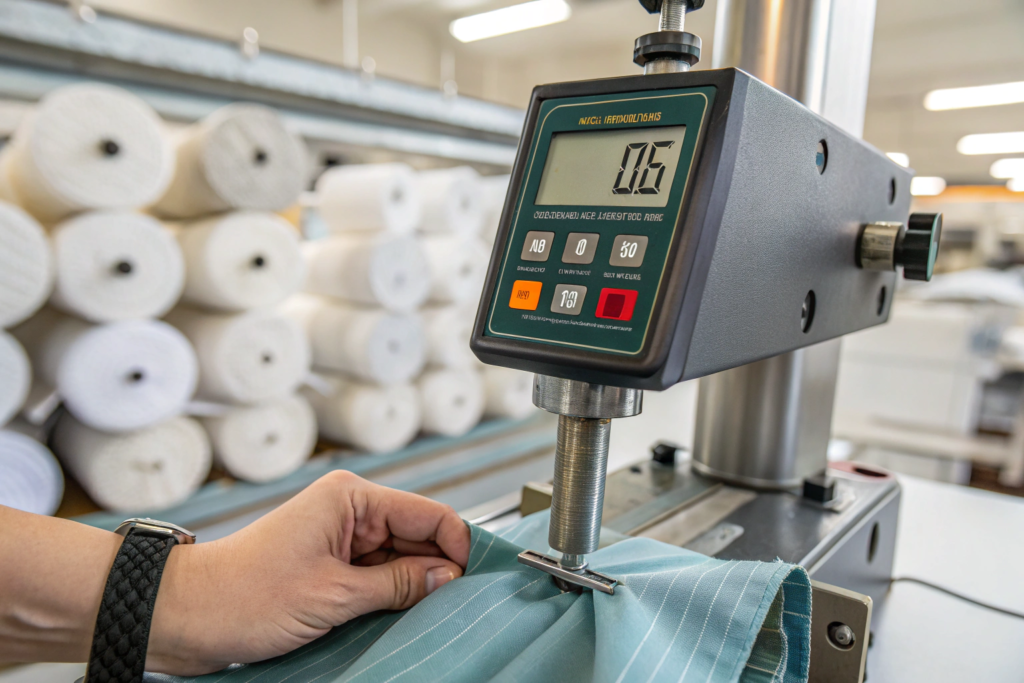
Let me put some specific numbers on tensile strength. We use an Instron Tensile Tester following ASTM D5034 (Grab Test) . We clamp a 4-inch wide strip of fabric and pull it apart at a constant rate. The machine measures the peak force in Pounds-Force (lbf) .
For a standard 5.5 oz/sq yd jersey knit (T-shirt weight):
- 100% Cotton (30/1): Warp breaking strength approx 45 – 50 lbf.
- 60/40 CVC (30/1): Warp breaking strength approx 70 – 80 lbf.
That is a 50-60% increase in tensile strength. This is critical for Seam Performance. The fabric is stronger, but so is the seam. The yarns resist pulling out of the stitching. You know those tiny holes you get in your cotton T-shirts right where the belt buckle rubs? That is Yarn Slippage. The polyester in CVC locks the yarns together and prevents that shifting. The shirt looks new for much longer.
How Does CVC Resist Pilling Compared to 100% Cotton?
This is the great irony of CVC. People assume that because it has polyester, it will pill more. That used to be true. Old 50/50 blends were notorious for pilling. They looked like a cat hairball after five washes. But modern Low-Pill Polyester has flipped the script.
Here is the science. Pilling happens in three stages:
- Fuzz Formation: Fibers work loose from the yarn due to abrasion.
- Entanglement: Those loose fibers tangle together into a ball.
- Anchorage: The ball stays attached to the fabric by a few strong anchor fibers.
In 100% cotton, the anchor fibers are cotton. Cotton is weak. The pill stays attached, gets bigger, and looks terrible. In a CVC blend with low-pill polyester, the anchor fibers are polyester. But we engineer this polyester to have a Lower Tenacity (specifically for staple fiber). When the pill forms, the polyester anchor fiber is weak enough that it breaks off under normal wear and washing. The pill falls off. The fabric surface stays clean.
We run a Random Tumble Pilling Test (ASTM D3512) . We put fabric samples in a cork-lined drum and tumble them for 60 minutes. Then we rate the surface from 1 (Severe Pilling) to 5 (No Pilling) .
- 100% Cotton (Carded) : Rating 2.5 – 3.0 after 60 min.
- 100% Cotton (Combed) : Rating 3.5 – 4.0 after 60 min.
- CVC (with Low-Pill Poly) : Rating 4.0 – 4.5 after 60 min.
The CVC looks better, longer. This is a massive advantage for dark colors like navy and black where pills are super visible. You can learn more about how to evaluate pilling resistance in CVC blended knit fabrics using ASTM D3512.
What Are the Dyeing and Colorfastness Advantages of CVC?
Here is a problem that drives brands crazy. You spec a bright, electric blue T-shirt. The lab dip looks amazing. The bulk production arrives. It looks… dull. Kind of dusty. Not the pop you paid for. That is the cotton effect. Cotton is a thirsty fiber. It drinks up dye, but it also has an irregular, rough surface that Scatters Light. This makes the color look matte and slightly hazy. It is beautiful in a vintage way, but terrible if you want Saturation.
CVC fabric solves this problem because of the polyester component. Polyester fibers are smooth and round. They have a High Refractive Index. When you dye the cotton portion of the CVC yarn, the undyed polyester fibers remain white (or slightly tinted). These white, round fibers act like millions of tiny Retro-Reflectors embedded in the yarn. They bounce light back out of the fabric.
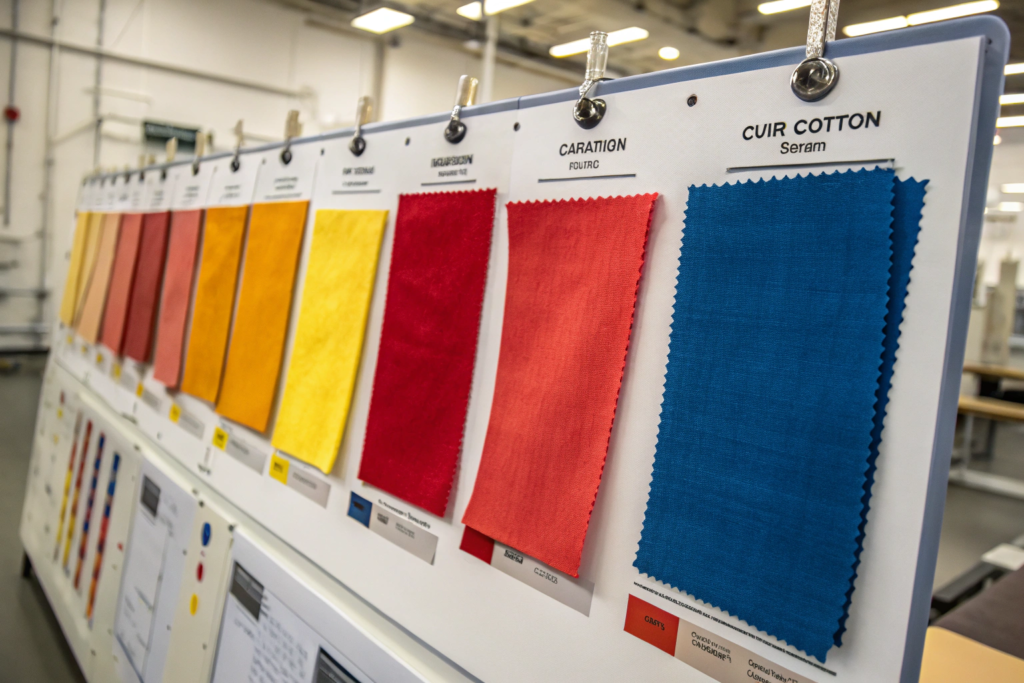
The result is a visual phenomenon called Increased Apparent Color Depth. The blue looks bluer. The red looks redder. It has a Crispness and Clarity that pure cotton cannot achieve without mercerization. This is why so many sports team uniforms and corporate polos use CVC. That logo needs to pop on camera and under stadium lights. CVC delivers that.
But there is a massive manufacturing caveat here. You cannot dye CVC in a single bath like you dye cotton. If you just throw CVC in a reactive dye bath, the polyester stays completely white. The fabric looks "frosty" and "heathered" even when you wanted a solid color. To get a true solid shade, you must use a Two-Bath Dyeing Process or a One-Bath Two-Step Process. This involves dyeing the polyester with Disperse Dyes at 130°C under pressure, and then dyeing the cotton with Reactive Dyes at 60°C. It takes longer. It costs more. But the solid color is perfect.
At Shanghai Fumao, we have optimized this for our CVC program. We use a Reverse Dyeing Sequence. We dye the polyester first at high temp. Then we reduction clear to remove surface disperse dye. Then we dye the cotton. This prevents the disperse dye from staining the cotton and creating a dull, muddy shade. It is a precise, technical process that gives you that vibrant, "expensive" look.
Why Does CVC Hold Color Better After Multiple Washes?
Colorfastness is the other half of the dyeing story. It is not just about how it looks on day one. It is about how it looks after fifty industrial launderings. And this is where CVC absolutely destroys 100% cotton.
Cotton fades because of Abrasion and Hydrolysis. The dye sits on the surface of the fiber. Washing and rubbing scrapes the dyed surface off. Hot water and detergent can actually break the chemical bond between the reactive dye and the cellulose.
In a CVC blend, the polyester fibers are Solution-Dyed or dyed with high-energy disperse dyes that are locked inside the polymer structure. They do not wash out. They do not fade. As the cotton portion of the fabric slowly fades over years of use, the polyester portion remains exactly the same color. It acts as a Color Scaffold. It holds the visual shade together.
I saw this firsthand with a hotel chain client. They use pure cotton sheets and CVC duvet covers. After 100 wash cycles, the cotton sheets were a pale, sad version of their original taupe. The CVC duvet covers still looked 80% of the way to new. The difference was stark. For hospitality and healthcare, where image is everything, that color retention is non-negotiable.
How Do You Achieve Solid Dyeing on CVC Without a Frosty Look?
I touched on this, but let me give you the exact recipe for avoiding the "frosty" or "heather" look when you want a solid color on CVC. It comes down to three things: Fiber Selection, Dye Selection, and Heat.
- Fiber Selection: Do not use Optical Bright polyester in the blend. Optical brighteners make the polyester glow blue-white under UV light. They will make the final fabric look chalky and light. Use Semi-Dull or Full-Dull polyester round fibers. They scatter less light and blend in better.
- Dye Selection: You must use Low-Energy Disperse Dyes that have good Reserve Shade properties. This means the disperse dye you use on the polyester must be a close visual match to the reactive dye you will use on the cotton. If you dye the polyester bright red and the cotton dark burgundy, the mismatch will show as a frosty haze.
- Heat: The cotton must be Mercerized or at least Causticized before dyeing. This swells the cotton fiber and increases its transparency and dye uptake. A swollen cotton fiber blends visually with the polyester better than a flat, ribbon-like raw cotton fiber.
Here is a quick cheat sheet for buyers:
| Desired Look | Polyester Component | Dye Method | Result |
|---|---|---|---|
| Solid, Deep Black | Semi-Dull Polyester | Two-Bath (Disperse then Reactive) | Jet black, minimal frosting. |
| Vintage Heather | Optical White Polyester | One-Bath (Cotton Reactive Only) | High-contrast salt-and-pepper look. |
| Bright Athletic Red | Full-Dull Polyester | Two-Bath with Reserve Shade matching | Saturated, crisp, team-uniform red. |
For more technical depth, see this guide on how to prevent frosting and achieve solid shades in CVC fabric dyeing.
When Should You Avoid CVC and Choose Pure Cotton Instead?
I have spent this whole article singing the praises of CVC. But I would be doing you a disservice if I did not tell you when CVC is the wrong choice. This fabric is not a magic bullet. There are specific applications where pure cotton is not just better—it is essential. Using CVC in these situations leads to customer complaints and, in some cases, actual danger.
1. High-Heat Industrial Applications (Welding, Foundry Work)
This is a safety issue, not a comfort issue. Polyester Melts. Cotton Chars. If a spark from a welding torch lands on a pure cotton work shirt, it will leave a small burn hole. If that same spark lands on a CVC shirt, the polyester fibers will melt and Drip. That molten plastic sticks to skin. It causes severe, deep burns. Do not use CVC for welding jackets, fire-resistant gear, or any application near open flame. You need 100% cotton (or specifically treated FR fabrics). I turn away business every year from clients who want "cheap CVC" for welding shirts. I will not make it. It is not safe.
2. Premium Towels and Bathrobes
Remember the physics of absorption? Cotton loves water. Polyester hates it. If you make a towel out of CVC, you are reducing the Absorbency by the exact percentage of polyester in the blend. A 60/40 CVC towel will only soak up 60% as much water as a pure cotton towel of the same weight. It will feel slick and it will just push water around your skin. Towels must be pure cotton.
3. Next-to-Skin for Extreme Sensitivities
While modern CVC is soft, some people with extreme eczema or chemical sensitivities prefer the breathability of 100% organic cotton. Polyester is still plastic. It can trap heat slightly more than pure cotton. For a luxury loungewear line or baby clothing marketed as "All Natural," the story of 100% cotton is part of the value proposition. The customer is paying for purity. Give it to them.
Is CVC Suitable for Sensitive Skin and Baby Clothing?
This is a nuanced answer. Most standard CVC is perfectly fine for normal adult skin. It is soft, durable, and widely used in kids’ school uniforms because it is durable.
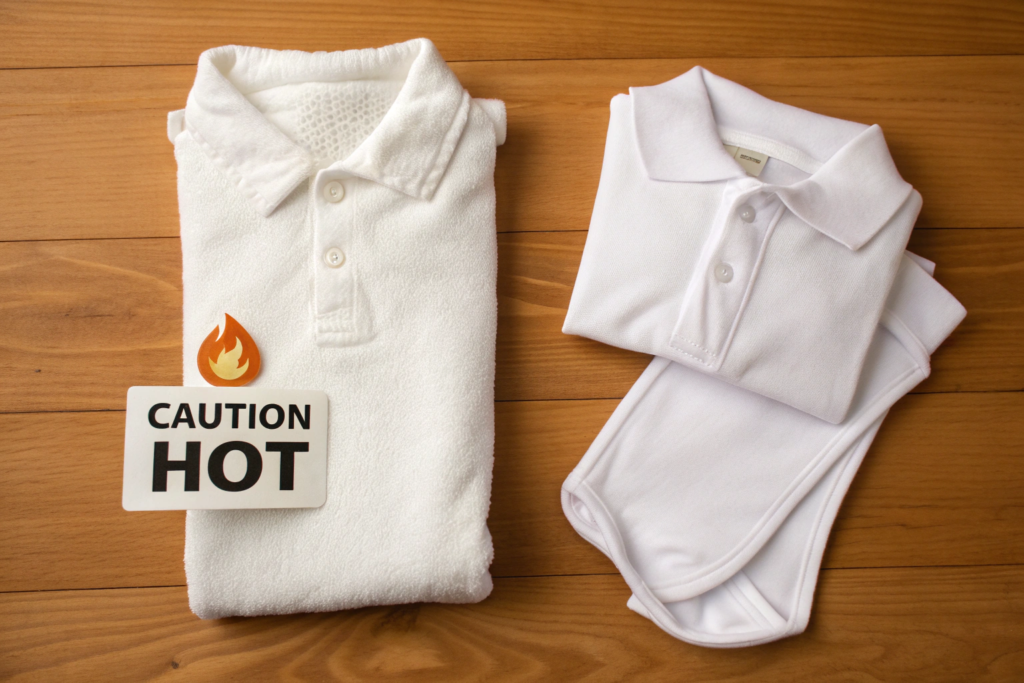
However, for Infant Clothing (0-12 months) , pure cotton is still the gold standard. Babies have very thin, permeable skin. They also tend to overheat easily. Cotton’s superior Air Permeability and Moisture Absorption make it safer and more comfortable for a baby’s delicate microclimate.
We have a specific Organic Cotton Interlock fabric that we recommend for baby layette. It is 100% GOTS certified cotton. It is not as durable as CVC, but babies outgrow clothes in three months anyway. They do not need a shirt to last 50 washes. They need it to be soft and non-irritating for 90 days. That is the trade-off.
How Does Breathability Compare in Humid Climates?
Let me put some lab data behind this. We test Air Permeability using ASTM D737. We measure how many cubic feet of air pass through a square foot of fabric per minute (CFM). We also test Moisture Vapor Transmission Rate (MVTR) .
| Fabric Type | Composition | Air Permeability (CFM) | MVTR (g/m²/24hr) |
|---|---|---|---|
| Pure Cotton Jersey (5.5 oz) | 100% Cotton | 55 – 65 | 850 – 900 |
| CVC Jersey (5.5 oz) | 60/40 CVC | 45 – 50 | 750 – 800 |
| PC Jersey (5.5 oz) | 35/65 Poly-Cotton | 35 – 40 | 650 – 700 |
You can see the trend. Polyester reduces airflow. It is a Tighter, Denser Fiber. In a humid climate like Singapore or Miami, that 15% reduction in breathability can be felt. You will feel slightly more clammy in a CVC tee than in a pure cotton tee on a 95°F day with 90% humidity.
For this reason, we often recommend a Summer Weight CVC for humid climates. We drop the yarn count to a 40/1 and use a High-Gauge Knit (28GG). This makes the fabric thinner and more porous, compensating for the polyester’s density. It is still more durable than cotton, but it breathes almost as well. You can learn more about how to select breathable CVC blends for hot and humid climate apparel.
Conclusion
The choice between CVC and pure cotton is not a moral one. It is an engineering one. We have seen that pure cotton brings natural softness, unmatched absorbency, and a classic story. But it comes with baggage: shrinkage, wrinkles, and a shorter lifespan under hard use. CVC, with its clever blend of cotton’s comfort and polyester’s hidden skeleton, solves those practical problems. It delivers dimensional stability so the shirt fits wash after wash. It provides abrasion resistance so the elbows do not blow out. And it holds color with a vibrancy that pure cotton struggles to match.
The key is the ratio and the quality of the components. A cheap 60/40 CVC is still a great fabric. A premium 60/40 CVC with low-pill poly, combed cotton, and proper heat setting is a world-class performance textile. At Shanghai Fumao, we help you navigate this middle ground. We do not push you to CVC if you are making baby blankets. We do not let you use pure cotton if you are making mechanic uniforms.
It is about understanding the end use. It is about knowing the data on shrinkage, tensile strength, and colorfastness. It is about making a decision based on how the garment will actually live in the real world.
If you are weighing the options for your next production run—whether it is a workwear line that needs to survive industrial laundries or a fashion tee that just needs to keep its shape—let’s look at the specs together.
You can reach our Business Director, Elaine, directly at elaine@fumaoclothing.com. Tell her what you are making and what your biggest quality complaint is right now. She will get you swatches of both pure cotton and CVC so you can feel the difference and see the data for yourself.