
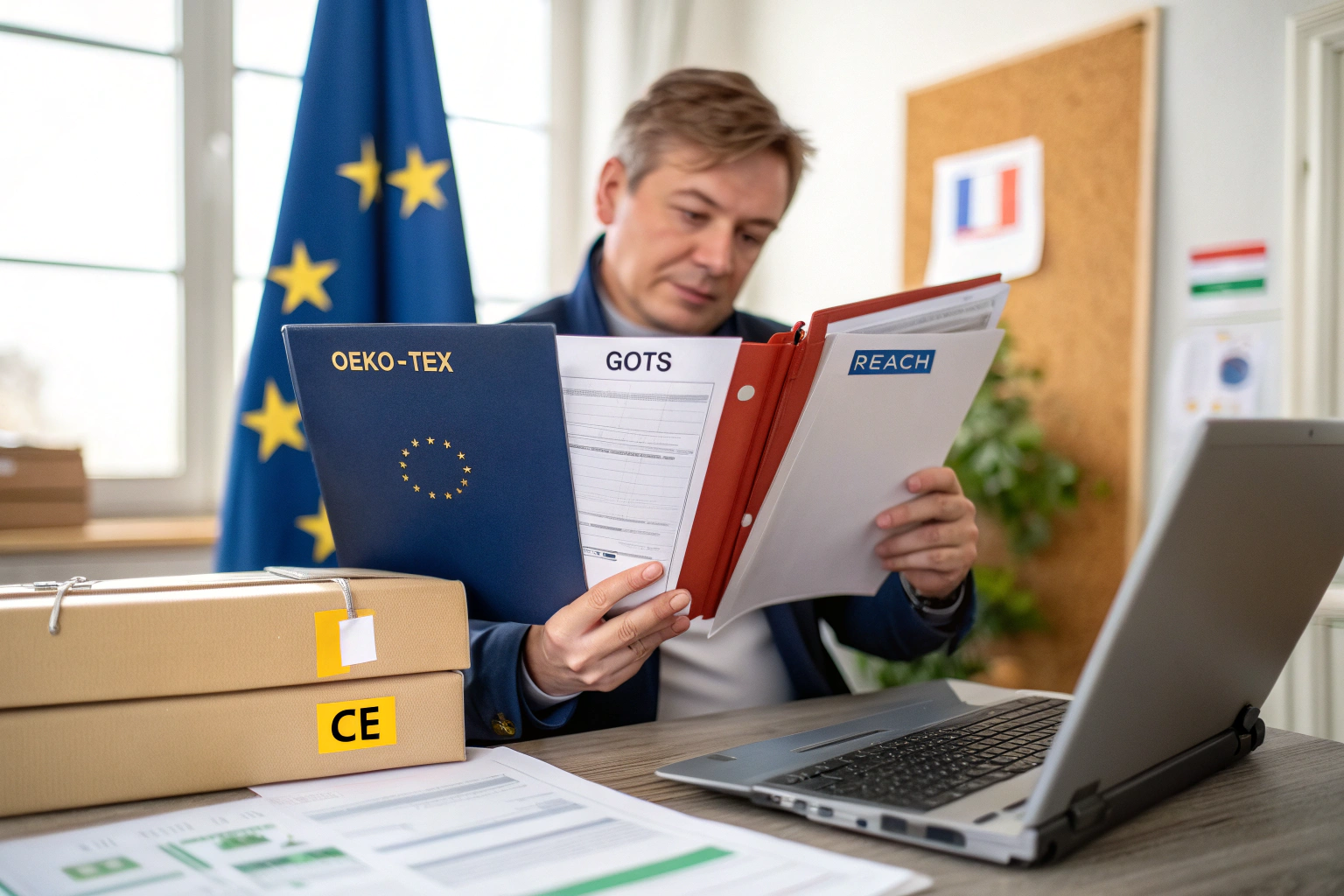
I’m going to be very direct with you because I’ve seen too many small brands and even established mills lose thousands of dollars on this exact issue. You cannot just ship fabric to Europe. Not anymore. Not like you can to the US.
The European Union has built a Regulatory Fortress around its consumer market. And the walls of that fortress are made of Paperwork and Chemistry . If your shipment arrives at the Port of Rotterdam or Hamburg without the correct certifications it will not just be delayed. It will be Rejected at the Border . You will pay for return shipping or destruction. You will lose the client. And your name will be flagged in the system.
I’ve been exporting from Shanghai Fumao to Europe for two decades. We’ve navigated the transition from the old EU Directives to the current REACH and Green Deal frameworks. The complexity has increased tenfold but the principle remains the same. Prove It or Don’t Ship It.
In this article I’m going to give you a clear roadmap of the mandatory and market-expected certifications required to sell fabric into the EU. This is not legal advice. I’m a mill owner not a lawyer. But this is the practical reality of what our forwarding agents and customs brokers demand before they will even book a container for Milan or Berlin.
What Is the OEKO-TEX Standard 100 and Why Is It Mandatory
If you only get One Certification for Europe make it this one. OEKO-TEX Standard 100 .
Legally it is not a government requirement. REACH is the law. But Commercially it is Mandatory . You cannot sell a single meter of fabric to a European clothing brand without it. Their compliance department will not onboard you as a vendor. Their ERP system will not let them cut a Purchase Order.
What It Tests:
OEKO-TEX 100 tests for Harmful Substances in the finished textile . We’re talking about:
- Heavy Metals (Lead Cadmium Mercury).
- Formaldehyde .
- Pesticides (important for cotton).
- Azo Dyes (which can break down into carcinogenic amines).
- PFAS (Forever Chemicals).
The standard has Four Product Classes :
- Class I: Baby Articles (Strictest limits).
- Class II: Direct Skin Contact (Underwear T-shirts Sheets).
- Class III: No Direct Skin Contact (Jackets Coats).
- Class IV: Decoration Material (Curtains Upholstery).
For fabric exporters we usually certify to Class II as a baseline. It covers 90% of apparel applications.
The certification requires an Annual Factory Audit and Sample Testing . You cannot just test one batch of fabric. The certification body (like Hohenstein or Testex ) inspects your Quality Management System to ensure you are not using banned chemicals in production.
At Shanghai Fumao we hold a valid OEKO-TEX 100 certificate for our entire range of core fabrics. We provide a copy of this certificate with every shipment.

How Does REACH Compliance Differ from OEKO-TEX Certification
This is the most common point of confusion. They overlap but they are Legally Different .
REACH (Registration Evaluation Authorisation and Restriction of Chemicals) is EU Law (Regulation EC 1907/2006). It applies to Any Product sold in the EU. It is Mandatory .
OEKO-TEX 100 is a Voluntary Private Standard . It is Market-Driven .
The Analogy: REACH is the Driving License (You must have it to operate). OEKO-TEX is the 5-Star Safety Rating (It proves you are a safe bet).
Key Difference: SVHCs (Substances of Very High Concern). REACH maintains a Candidate List of SVHCs. If your fabric contains more than 0.1% (1000 ppm) of an SVHC you have a legal duty to Inform the Customer and upon request provide Safe Use Instructions within 45 days. OEKO-TEX often has Lower Limits than REACH.
For an exporter the practical approach is: Get OEKO-TEX 100 Class II. This certificate demonstrates Presumption of Conformity with the chemical safety parts of REACH for textiles. It makes customs clearance much smoother.
What Are the Restricted Azo Dyes That Will Get a Shipment Seized
This is the number one chemical reason for seizure at the EU border.
Azo Dyes are synthetic dyes that produce bright vivid colors (especially Reds Oranges and Yellows ). They are cheap and effective. However a specific subset of Azo Dyes can break down to release Aromatic Amines which are Carcinogenic .
The EU Restricts 22 specific Aromatic Amines . The limit is 30 mg/kg (30 ppm) .
If a customs lab tests a red fabric from an unknown supplier and finds Benzidine or 4-Aminobiphenyl above the limit the shipment is Destroyed . No negotiation. No re-export. Destroyed at your cost.
How to Avoid This:
- Buy from OEKO-TEX Certified Mills. We use only High-Fixation Reactive Dyes or Vat Dyes .
- Avoid Suspiciously Cheap Red and Black Fabrics. Cheap black is often made by over-dyeing red rejects.
How to Navigate GOTS Certification for Organic Exports
If you are marketing your fabric as "Organic" to European brands OEKO-TEX is not enough. You need GOTS (Global Organic Textile Standard) .
In the EU the term "Organic" is protected. You cannot just say "Organic Cotton" because you feel like it’s organic. You must prove it through a Chain of Custody Certification .
What GOTS Covers That OEKO-TEX Does Not:
- Fiber Origin: Must be Certified Organic (to EU Organic or NOP standards).
- Social Compliance: The factory must meet ILO Core Conventions (No forced labor fair wages safe working conditions).
- Environmental Management: Wastewater treatment chemical input approval.
The Critical Document: The Transaction Certificate (TC). You need a Scope Certificate (SC) to be a GOTS certified supplier. But for the shipment to clear EU borders as "Organic" you must issue a TC that matches the Commercial Invoice .
European customs officials are trained to look for the TC Number on the import declaration. If you claim "Organic Cotton" and don’t have a valid TC you are committing Customs Fraud .
At Shanghai Fumao we have been GOTS certified for over a decade. We understand the strict segregation required to keep organic and conventional fibers apart.

What Is the EU Organic Regulation Equivalence for Textiles
Here’s a nuance that trips up non-European mills.
The EU Organic Regulation (EC 834/2007) primarily covers Food and Feed . It does Not directly cover Textiles in the same way the USDA NOP does.
However if you want to use the EU Organic Logo (the green leaf with stars) on a textile product you must comply with the processing standards which are effectively GOTS .
In practice GOTS is the Recognized Standard for Textiles under EU Law . If a brand wants to make an "Organic" claim in Europe they ask for your GOTS Certificate .
For raw cotton fiber imports the Organic Content Standard (OCS) or GOTS is sufficient. But for finished fabric GOTS is King .
Why Are Social Compliance Audits Part of European Vendor Requirements
This is a cultural difference between the US and EU markets.
In the US the focus is heavily on Product Safety (Prop 65 Flammability).
In the EU the focus is equally on Human Rights .
European brands are legally obligated under Supply Chain Due Diligence Acts (like the German LkSG or the upcoming EU CSDDD ) to ensure their suppliers are not using Child Labor or Forced Labor .
They will ask for:
- BSCI Audit Report (Business Social Compliance Initiative).
- SMETA Audit Report (Sedex Members Ethical Trade Audit).
- SA8000 Certification .
Even if you are not selling "Organic" fabric a major European retailer will require a Social Audit of your factory before they place an order. They will send a third-party auditor to walk your floor interview workers and check time cards.
If you cannot provide a clean social audit you cannot sell to H&M Zara or Zalando .
What Is the EU Ecolabel and Does Your Fabric Qualify
The EU Ecolabel is the official environmental label of the European Union. It’s a Voluntary Scheme but it carries the weight of government endorsement.
Unlike OEKO-TEX (which is about Safety ) the EU Ecolabel is about Environmental Performance across the Entire Lifecycle .
Criteria for Textiles (Commission Decision 2014/350/EU):
- Fiber Origin: Preference for Organic Cotton Recycled Polyester or Sustainable Viscose.
- Chemical Restriction: Very strict limits on APEOs (Alkylphenol Ethoxylates) which are endocrine disruptors.
- Water and Air Pollution: Limits on COD in wastewater and VOC emissions in finishing.
- Durability: Fabric must meet Dimensional Stability and Color Fastness standards to ensure the garment lasts.
Is It Worth Getting?
For a B2B Fabric Mill the EU Ecolabel is Rare . It’s more common for Finished Consumer Products (Bed Linen Towels).
However if you are a mill specializing in Sustainable Hospitality or Eco-Luxury Bedding the EU Ecolabel is a powerful differentiator. It allows hotel chains to meet their green procurement targets.
At Shanghai Fumao we have aligned our manufacturing processes with the EU Ecolabel criteria for our Tencel and Organic Cotton lines even though we don’t formally certify every SKU. We can provide the test data to support a brand’s application.

How to Limit APEOs in Textile Finishing for EU Compliance
APEOs (Alkylphenol Ethoxylates) are Surfactants used in Scouring and Washing . They are incredibly effective at removing oil and wax. They are also Endocrine Disruptors (they mess with hormones).
The EU has banned APEOs in textiles (REACH Annex XVII Entry 46a). The limit is 100 ppm .
The Challenge: APEOs are Ubiquitous in the Chinese chemical supply chain. They can be found in cheap:
- Spinning Oils (used on yarn).
- Leveling Agents (used in dyeing).
- Softeners (used in finishing).
How We Control It:
- We use APEO-Free Certified Chemicals from suppliers like Rudolf Chemie and Tanatex .
- We test our Incoming Greige Fabric for APEO contamination.
- We run Wastewater Tests to ensure we are not flushing APEOs into the river.
If you are buying fabric for export to Europe you must ask for an APEO-Free Certificate from the mill.
What Are the VOC Emission Standards for Coated Fabrics
If you are exporting PU Coated Fabric (e.g., waterproof canvas faux leather) you have an extra layer of regulation.
The EU has strict VOC (Volatile Organic Compound) limits for indoor air quality. Fabrics used in Furniture and Automotive Interiors must meet VOC Emission Standards (like CertiPUR or OEKO-TEX Eco Passport ).
The concern is DMF (Dimethylfumarate) and Toluene . These are solvents used in PU production. They off-gas and cause skin irritation and respiratory problems.
You must use Water-Based PU or Solvent-Free PU for the EU market. This is more expensive but it avoids customs rejection.
How to Prepare Technical Documentation for EU Customs
Certifications are the Keys to the Door . But you still need to know How to Unlock It . That’s the Customs Documentation .
The single most important document for EU fabric imports is the Commercial Invoice . But it cannot be a generic invoice. It must contain specific Customs Data Elements .
Mandatory Data on EU Commercial Invoice:
- HS Code (Harmonized System): The first 6 Digits are global. The EU uses 10-Digit TARIC Codes . You must get this right. A 1% error in duty rate is a 1% margin loss.
- Country of Origin: Legally Binding . "Made in China" is fine but be prepared to prove it if asked (Certificate of Origin).
- Net Weight (kg): EU duty on fabric is often calculated Per Kilogram not per yard. You must list the exact weight.
- Fiber Composition: Exact Percentages . "80% Cotton 20% Polyester" . This is a legal requirement under the EU Textile Labeling Regulation (1007/2011) .
- Value: The Transaction Value . Under-declaring value is Fraud and will result in seizure and a blacklist.

How to Correctly Classify Fabric Under EU TARIC Codes
This is a specialized skill. The EU TARIC system is notoriously complex.
Example: Cotton Woven Fabric.
- HS Code (Global): 5208.32 (Plain Weave >100g/m²).
- EU TARIC Code: 5208.32.16.00 (Specific weight and width restrictions).
The extra 4 Digits in the EU system can change the duty rate from 8% to 12% .
The Risk: If you misclassify the fabric to get a lower duty rate even by accident EU Customs will issue a Binding Tariff Information (BTI) ruling against you. You will owe Back Duties for three years of shipments plus Penalties .
At Shanghai Fumao we use a licensed EU Customs Broker to review our classifications annually. It’s a cost of doing business.
What Is a Supplier Declaration and When Is It Required
A Supplier Declaration is a formal statement from the Mill to the Brand regarding the Origin of the Materials .
It is required if the brand wants to claim Preferential Duty Rates under the EU GSP (Generalized Scheme of Preferences) .
If the fabric is made in China but uses Indian Cotton Yarn the garment might qualify for a lower duty rate when imported into the EU if it meets the Origin Cumulation Rules .
To prove this the brand needs a Supplier Declaration from us stating: "The yarn used in Invoice #123 is of Indian Origin."
We maintain detailed Bill of Materials (BOM) records for this exact purpose. We can issue a Supplier Declaration for any shipment within 24 hours.
Conclusion
Exporting fabric to Europe is an exercise in rigorous documentation and proactive chemistry management. It requires more than just a quality product. It requires a verifiable commitment to consumer safety through OEKO-TEX 100 legal compliance through REACH organic integrity through GOTS and social responsibility through audited working conditions.
The brands that succeed in this market view certifications not as a burden but as a Competitive Moat . Each certificate is a barrier that prevents low-quality low-compliance competitors from entering the market. The cost of certification is the price of admission to a market that values quality and ethics over the lowest possible price.
At Shanghai Fumao we have invested heavily in our compliance infrastructure. We maintain current OEKO-TEX and GOTS certifications. We use APEO-free and REACH-compliant chemicals. We have a dedicated documentation team that ensures every shipment is accompanied by a flawless commercial invoice and technical dossier.
If you are planning to export fabric to Europe and need a mill partner who understands the regulatory landscape please reach out to our Business Director Elaine. She can provide our certification package and advise on the specific documentation required for your product category.
Contact Elaine at: elaine@fumaoclothing.com








