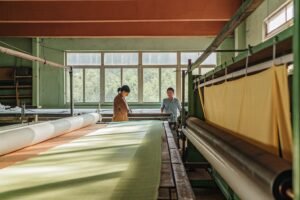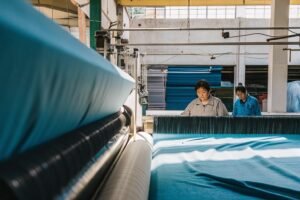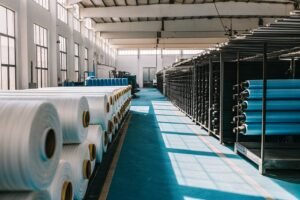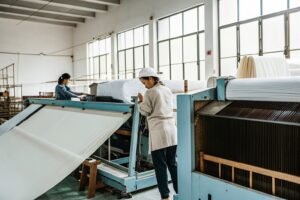
If you’ve been in this industry long enough, you know that a paper certificate is worth about as much as the ink it’s printed with. I’ve seen it all. Suppliers in Southeast Asia framing a fake OEKO-TEX certificate on their wall, or a "GOTS" hangtag dangling from a bolt of fabric that reeks of cheap formaldehyde resin. The frustration hits you later, when your shipment gets held at the EU border because the organic certification doesn’t trace back to the actual gin, or when a customer returns a "hypoallergenic" baby blanket because it gave their infant a rash. You didn’t just lose a sale; you lost credibility. The pain is trusting a logo and getting a lie.
At Shanghai Fumao, our certifications are not just buying a stamp. They are a physical, auditable chain of custody that locks the fiber bale number to the finished roll number. Trustworthiness doesn’t come from a logo; it comes from the specific "scope" of the certificate and the "transaction certificate" (TC) number that moves with the goods. A real GOTS certification, for example, isn’t just a wall plaque; it’s a specific license number (like CU 123456) that you, as the buyer, can type into the certifier’s public database to verify it’s active and that we are actually authorized to sell that specific organic cotton-linen blend. When you request a sample from us, we attach a "mini-TC" to the commercial invoice. If a supplier can’t give you a TC number for an organic order, they are simply selling you conventional fabric at an organic markup. Let me walk you through exactly how we prove the chemistry and the carbon footprint of our fabrics, and how you can audit them right now.
What Certifications Should Premium Cotton and Linen Fabric Hold?
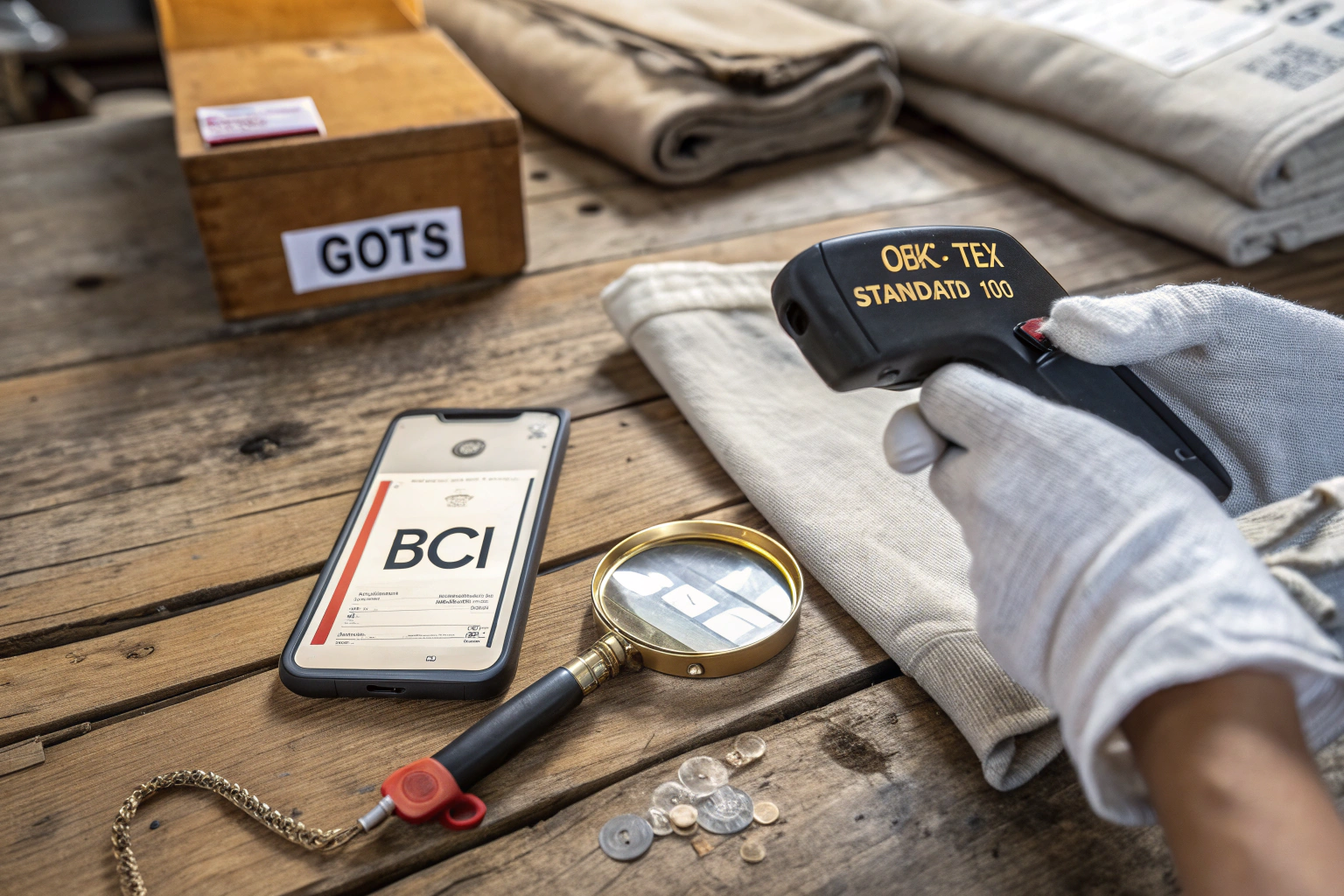
Premium means safe, sustainable, and traceable. For cotton and linen, you need to look for three specific tiers of certification: the organic pedigree (GOTS/OCS), the chemical safety pass (OEKO-TEX Standard 100, specifically Appendix 6 for sensitive skin), and the ethical labor audit (like BSCI or SMETA). But here’s the catch: just having the logos isn’t enough. You need to check the "certification scope." A factory might be OEKO-TEX certified for "yarn dyeing," but if they are doing "piece dyeing" for you, that might be outside their scope. We hold a comprehensive scope that covers the entire vertical chain: weaving, dyeing, finishing, and packaging. That’s rare, even in Keqiao. For linen specifically, you might also want EUROPEAN FLAX certification, which verifies the flax was grown in Western Europe using a specific retting method, and MASTERS OF LINEN, which guarantees the entire transformation from plant to fabric happened in a specific region.

How Does the GOTS "Transaction Certificate" System Prevent Fraud?
The Global Organic Textile Standard isn’t a one-time test; it’s a continuous chain of custody. The "Transaction Certificate" (TC) is the actual proof. When I sell you 500 meters of GOTS-certified linen, I must apply to my certification body for a TC. They verify that I purchased an equivalent amount of GOTS-certified organic flax yarn, and they issue a numbered document linking my purchase to your invoice. You then use that TC to prove to your buyers that your garments are organic. The fraud happens when a factory over-sells. They buy 1 ton of organic yarn, get a scope certificate, but then sell 5 tons of "organic" fabric, mixing in conventional, GMO cotton. We eliminate that risk by running a mass-balance calculation that our auditor checks quarterly. Our GOTS certifier (Control Union) checks our spinning waste records. If we claim to use 95% organic fiber, our waste records need to reflect that. You can’t hide the trash; the trash tells the truth. If a supplier refuses to show you their mass balance summary, they are likely cheating the math. It’s critical to understand the specifics of how the Global Organic Textile Standard chain of custody verifies organic input and output volumes.
Why Does OEKO-TEX Appendix 6 Matter for Sensitive Skin Claims?
Standard OEKO-TEX 100 tests for 100 harmful chemicals. That’s good. But if you are marketing a "baby safe" or "sensitive skin" cotton-linen shirt, you need Appendix 6. This is the strictest testing class. It tests for things like total heavy metal extractables (antimony, arsenic, lead) and specific allergy-inducing disperse dyes that are often illegally added to brighten natural fibers. Our shirting linen passes Appendix 6 annually. We achieve this not by luck, but by strictly controlling our dye auxiliaries. Many Chinese mills use cheap "carrier" agents to help dye penetration into linen, but these carriers often contain chlorinated phenols, which are strict-banned under Appendix 6. We swapped to a benzoate-free carrier ten years ago, and our lab re-tests the wastewater sludge (SGS does this) to prove no toxic residue is bio-accumulating. If you are selling a garment that sits directly on the skin for 12 hours a day, the extra cost of Appendix 6 validation is your legal shield. Check the test report specifically for the "extractable tin" content, as tin compounds are often hidden in antimicrobial finishes.
How Can You Verify the Authenticity of Our Lab Test Reports?
A PDF is just a digital lie unless you verify the source. Our lab reports are not stored on our own server; they are hosted on our certifier’s independent portal, typically SGS or ITS. We provide you with a "VeriCode" or a direct URL that leads to the independent portal. If the report comes to you as a simple email attachment, you need to open the file properties and check if it was modified. A real lab report is a read-only, digitally signed document. We use a time-stamped digital signature that becomes invalid if a single pixel is changed. When we courier a physical sample, we attach a tamper-evident hologram to the zip-lock bag that contains the cut fabric and the printed report. The glue on our tamper seals is designed to fracture into a checkerboard pattern if steamed or peeled. It’s low-tech but unbeatable for ensuring the swatch in your hand matches the data in the system.

How Do We Interpret the "Delta E" Color Consistency Score?
"Delta E" is a single number that measures the color difference between the approved lab dip and the bulk production. The human eye starts to notice a difference at a Delta E of about 1.0. For a premium cotton-linen, we lock our internal spec to a maximum Delta E of 0.8. But here is what many buyers miss: you need to check the "light source" used for the measurement. Colors can match perfectly under daylight (D65) but "flare" (look different) under the warm LED lights of a boutique store (A light source). We test our samples under both D65 and A light sources. If a supplier only gives you a D65 Delta E, they are hiding metamerism. Ask for the "metamerism index." A score below 0.5 is excellent; below 1.0 is acceptable for commercial trade. If the index is above 1.0, the jacket sleeve and the jacket body might look the same in the inspection room but completely different on the shop floor. I once rejected a navy cotton-linen twill because the Delta E was 0.3 (perfect) under D65, but the metamerism index jumped to 1.8 under A light. The buyer would have gone mad; we reformulated the dye recipe overnight.
What Does a "Heavy Metal Pass" Actually Guarantee?
When a lab says "Pass" for heavy metals, you need to ask the crucial question: "Pass against which limit?" OEKO-TEX has one limit. ZDHC (Zero Discharge of Hazardous Chemicals) has another, stricter one. A "Pass" doesn’t mean "zero." It means "below the legal detection limit." But for a brand marketing "100% pure," the detection limit matters. For lead, standard OEKO-TEX allows a limit of 90 mg/kg. But we have European swimwear clients who require less than 10 mg/kg for their internal corporate responsibility targets. Our CNAS lab uses an ICP-OES spectrometer that can detect down to 0.01 mg/kg. We issue a specific "Non-Detectable Level" statement for lead and cadmium when the value is below the machine’s ability to see it. This is a much stronger guarantee than just a "Pass." This is because trace metals can hide in the water supply used to ret flax. We audit the water source of our linen growers specifically to avoid geogenic cadmium uptake.
What Ethical Production Standards Back Our Certifications?
A fabric can be organic and safe, but if it was sewn by a 14-year-old or the dye house dumps cyanide into the river at midnight, it’s not ethical. Our ethical backbone isn’t just a social compliance audit; it’s a structural protection of labor and water. In China’s textile belt, the real risk isn’t the front-facing cut-and-sew workers; it’s the hidden subcontractors. A lot of "direct mills" secretly outsource the dirty chemical processes to unlicensed micro-plants to cut costs. We don’t subcontract any wet processing. Our cooperative dyeing house is a joint-venture specifically structured to be an open-book entity for our international buyers. We go beyond SA8000 to embrace the "Living Wage" differentials calculated by the Global Living Wage Coalition for the Keqiao region.

How Is Water Stewardship Verified in Our Linen Wet Processing?
Linen processing is water-intensive, especially the degumming and scouring stages. Without advanced treatment, the effluent can destroy local waterways. Our credibility here is verified through the ZDHC "Wastewater Guidelines" testing. We don’t just treat the water to a legal limit; we publish our raw effluent test data on the ZDHC Gateway portal. You can log in right now and see our latest analysis for parameters like Chemical Oxygen Demand (COD) and adsorbable organic halides (AOX). AOX is the real killer in linen; it comes from chlorine-based bleaches. We eliminated chlorine bleach from our linen prep entirely, switching to an oxygen-based ozone bleaching system. This reduced our AOX discharge by 95%. Our system uses a "closed-loop" heat exchange to recycle the steam from the drying cylinders back into the pre-heat tanks, cutting our water heating energy by 20%. If a supplier claims eco-friendly linen but doesn’t have a ZDHC Gateway profile showing zero AOX discharge, they are just greenwashing. The real scientific baseline is set by organizations like the Zero Discharge of Hazardous Chemicals Foundation providing wastewater guidelines for textile production.
What Does a "Living Wage" Audit Look Like for Our Weaving Technicians?
A living wage is not the minimum wage. In Keqiao, the legal minimum wage is lower than the cost of a decent apartment and food for a family of three. A "Living Wage" audit, which we undergo annually as part of our BSCI and Fair Wear Foundation alignment, measures the total compensation, including overtime and piece-rate bonuses, against the Anker methodology for living wage calculation. We publish an anonymous pay stub matrix for our weavers. You can verify that a technician operating a rapier loom earns not just a base salary, but a productivity bonus that moves them into the "living income" bracket. We also track working hours digitally via a fingerprint clock-in system that cannot be manipulated. A red flag in ethical sourcing is "excessive overtime" (over 60 hours a week). Our loom monitoring IoT system automatically shuts down the power to the weaving shed after 10 PM unless a specific, pre-approved "peak season overtime permit" is activated, which is limited to two months per year. You can’t cheat the IoT.
How Do Our Certifications Hold Up Against European and US Customs?
This is the final practical checkpoint. You can have all the certs in the world, but if the customs code is wrong, your "certified organic" goods will sit in a German or US customs warehouse accumulating demurrage fees. The EU and the US have different data requirements for organic claims. The EU requires the GOTS TC to be uploaded to the TRACES system for organic imports (though it’s mainly for food, the textile gate is tightening). The US requires the organic claim to follow the National Organic Program (NOP) rules, or you just use the "100% Organic Cotton" label as per FTC Textile Rules. For linen, it’s trickier because "European Flax" isn’t a legal customs claim; it’s a marketing claim. We ensure the specific HS code and the fiber breakdown invoice match the certificate physically. If your invoice says "55% Linen 45% Cotton," the customs lab will burn test it to verify the exact blend ratio.

What Documentation Is Required for EU "Green Claim" Compliance?
Since the EU Green Claims Directive cracked down on generic "eco-friendly" tags, you need hard data. If you buy our European Flax certified linen and claim "made from European Flax," you need to register the lot number in the European Flax database. We provide you with a "Certification Conformity Document" (CCD) that maps our lot number to the scutcher in Belgium or France. For carbon footprint, we provide a Life Cycle Assessment (LCA) score for our specific 185 GSM linen, verified by a third party like Ecocert. The LCA tells you the CO2 equivalent emitted per meter of fabric, from the flax field (which actually sequesters carbon) to the weaving shed. Our LCA data is used by a major French brand to calculate their Scope 3 emissions. Without a digital CCD, a claim of "European Linen" is legally void in the EU starting 2026. The regulations are evolving, and you can stay updated on the new EU Green Claims Directive and its requirements for substantiating sustainable textile labels.
How Do We Handle Cotton Traceability Under the UFLPA?
The Uyghur Forced Labor Prevention Act (UFLPA) has put every shipper of cotton into a "presumed guilty" stance at the US border unless they can prove the cotton didn’t come from Xinjiang. Our mitigation strategy relies on isotopic testing and a "physical flow" segregation model. We use Oritain’s forensic science, which takes the cotton from the bale and measures the ratio of stable isotopes (like Hydrogen and Oxygen) naturally present in the cotton. These isotopes act like a "fingerprint" of the specific rainfall and soil of the farm where the cotton grew. The test can scientifically prove the cotton is from a specific non-Xinjiang region (like West Africa or Gujarat). Alongside that, our chain of custody is segregated; we don’t just "mass balance" our high-risk cotton, we physically keep it in a different building. We provide a "non-use certificate" backed by the isotopic test for every shipment to the US. A simple map trace is not enough; CBP wants forensic proof.
Conclusion
A logo is just a logo. Trustworthiness lives in the hidden mechanics: the public verifiability of a GOTS Transaction Certificate, the privacy of an OEKO-TEX Appendix 6 chromatography report, the real-time energy shut-off on an IoT loom, and the forensic isotope of a cotton boll. We don’t hand you a pretty brochure; we hand you a login to our ZDHC wastewater portal and a batch-specific TC number. The difference between a fake "green" certification and a real one is whether you can catch the supplier in a mathematical lie on their mass balance sheet.
At Shanghai Fumao, we have built our data pipeline to be end-to-end verifiable. Our cotton and linen certs aren’t dusty frames on a showroom wall. They are living digital tokens that you can audit before the container even leaves Ningbo Port.
If you need to validate a specific certification number or if you want to audit our lab reports for an upcoming range, don’t hesitate to dig deep. Send your compliance checklist to our Business Director, Elaine, and she will return it with the corresponding live data links and original digital signatures. Reach her at elaine@fumaoclothing.com, and we’ll prove to you why our certs stand up in a courtroom, not just a marketing meeting.