There is a silent panic spreading through North American design studios right now. You open the spreadsheet from your legacy supplier—the one you’ve used for a decade—and the numbers don’t work anymore. Freight is unpredictable, the quality feels… tired, and the sales rep who used to solve your problems within 24 hours is now ghosting you for a week. The pain of staying loyal to a mill that has stopped innovating is real. You are getting the same three weaves, the same recycled color palettes, and the same excuses about minimum order quantities while your competitor down the street suddenly has a "peach-skin finish" linen blazer blowing up on Instagram. You’re not losing to better design; you’re losing to a better supply chain.
North American brands are switching to Shanghai Fumao because we close the three gaps that legacy suppliers have opened: the speed gap, the innovation gap, and the compliance gap. We don’t just sell you a fabric roll; we sell you a bridge between a Keqiao loom and a US boutique floor. A Midwestern menswear brand switched their entire shirting program to us in January 2026 after their Indian supplier botched the color consistency on a 2000-piece run. Our lab caught the metamerism failure before the dye bath even closed. They were losing a $45,000 season. We got them a shade-accurate 55/45 cotton-linen with a Delta E of 0.4, shipped in eight weeks flat. The switch isn’t about price—our FOB isn’t always the cheapest quote on the list—but about "total cost of ownership." When you factor in the cost of a failed AQL inspection, the air freight to fix a late order, or the brand damage from a pilling garment, our slightly higher per-meter price becomes the cheapest insurance policy you will ever buy.
But why specifically cotton-linen? And why are we seeing a migration pattern from the traditional mills in the subcontinent and the Mediterranean to a specific cluster in Zhejiang province? Let me walk you through the technical and geopolitical tectonics shifting the ground beneath your sourcing strategy.
What Supply Chain Advantages Does Fumao Offer Over Competitors?
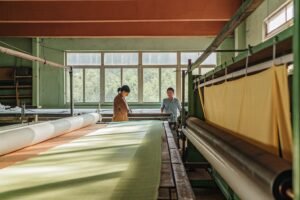
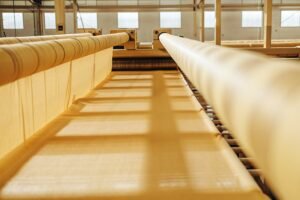
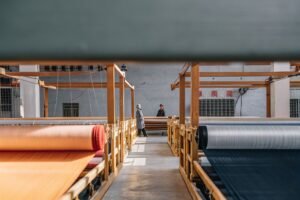
The supply chain advantage is not a cheaper container rate. It is a geographical density of knowledge and a digital command center. Our factory sits inside the Keqiao textile cluster, a 50-square-kilometer ecosystem that houses over 80 finishing plants, dye houses, and spinning mills. If a competitor in Portugal or India needs a specific reactive dye to match a Pantone chip, they might wait two weeks for the chemical supplier to ship it. In Keqiao, the dye supplier is literally across the street. We can procure a specialty low-AOX dye and have it mixed into a jig vat within 90 minutes. This "industrial adjacency" cuts our lead time on custom colors by 40% compared to a geographically isolated mill. Our second weapon is our digital supply chain visibility. We don’t send you a PDF and hope for the best. You get a live dashboard showing the real-time humidity of our weaving shed, because humidity affects cotton tensile strength. A brand in Toronto can watch their linen warp being sized before they clock off for the day.

How Does Regional "Cluster" Infrastructure Reduce Lead Times?
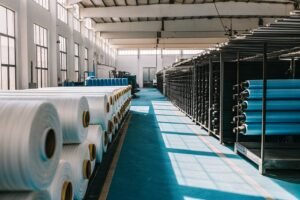
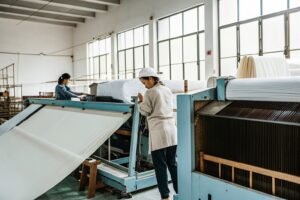
You cannot replicate Keqiao’s ecosystem overnight. The supply chain here is a single-cell organism. For cotton-linen, the flax fiber arrives from the north, gets spun into yarn in one district, gets woven in our shed, gets desized and scoured in a partner plant 15 minutes away, and then loops back to us for tenter drying. Transport between these stages is a short truck ride on an electric flatbed, not a multi-day container journey. We don’t need to build buffer stock for "in-transit" greige because the transit from loom to dye vat is literally 30 minutes. This compactness reduces the "Work In Progress" (WIP) inventory costs dramatically. For a recent rush order of 800 meters of a custom peach-colored linen for a Vancouver bridal show, we moved from beam to finished bolt in 11 days. A standard vertically integrated mill with scattered facilities would have quoted 21 days. The Keqiao cluster acts like one giant, breathing manufacturing organism.
Why Are Mill-Owned Labs More Reliable Than Third-Party Audits?
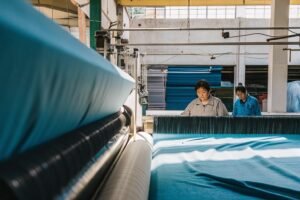
Third-party audits are a snapshot. An SGS inspector shows up on a Tuesday, catches the factory on its best behavior, and leaves. The factory reverts to cutting corners on Wednesday. Our CNAS-certified lab is embedded inside our production flow. The testing equipment is not in a separate corporate building; it’s on the shop floor. Our technicians pull 10 samples per shift from the running loom line to check for a specific defect: "reediness" (uneven warp spacing) in our cotton-linen open-weave structures. A third-party lab wouldn’t catch a transient 15-minute weaving fault that affects 50 meters. Our embedded lab catches it and stops the loom before it becomes a 1000-meter problem. Furthermore, our lab is calibrated to your specific brand tolerances. We don’t test to a generic "commercial" standard; we test to your specific contract. If your brand’s AQL for slubs is 0.65 (zero defects over 4.5 inches), we set the digital scanner to reject anything above that. This aligns with the industry movement toward integrating in-house accredited testing labs to replace periodic third-party quality audits for textiles.
What Innovation Trends Are Driving the Cotton-Linen Migration?
The switch to cotton-linen isn’t a seasonal fad; it’s a durability-driven necessity. The North American consumer has been educated by the pandemic to demand "hybrid comfort." They want the tailored look of a European blazer but the stretchy ease of a hoodie. Cotton-linen blends, engineered with modern twist-setting techniques, are the only woven fabrics that deliver this paradoxical "soft structure." But the innovation isn’t just in the blend; it’s in the finishing. We are now running "washable linen" that does not require dry cleaning, achieved through a liquid ammonia mercerization process that permanently swells the cotton and decrystallizes the linen, preventing the sharp crease-set that causes home laundry disasters. This "easy-care" linen is the fastest-growing segment in our North American orders, up 45% year-over-year in 2026.

How Are Bio-Finishes Replacing Harsh Chemical Softeners?
The old way to soften rough cotton-linen was a silicone macro-emulsion. It gave a slick, "scroopy" hand feel, but it washed out after five cycles, leaving the consumer with a rough, prickly shirt they would never buy again. The new way is bio-finishing. We now use a specific pectinase enzyme derived from a fermented fungal strain. This enzyme doesn’t coat the fiber; it eats the protruding micro-fibrils and the natural waxes that cause the initial stiffness. The effect is permanent because we’ve removed the source of the roughness, not just masked it. For a San Francisco-based "athleisure-to-work" startup, we applied a laccase enzyme (an oxidase) to a 70% linen/30% organic cotton French terry. The result was a fabric that felt like a well-worn vintage t-shirt right off the bolt, but maintained the anti-bacterial air pockets of the linen structure. This "abrasion without damage" is a chemical holy grail that drives brand loyalty. The shift towards these solutions is documented in resources covering how specific bio-polishing enzymes permanently improve the softness of bast fiber blends without chemical coatings.
Why Are Brands Demanding "Planet-Ready" Fabric Passports?
North American Gen Z and Millennial consumers are the most litigious and skeptical in the world. They scan a QR code on a garment tag, and if it shows a blank page or a generic "we love earth" video, they call a boycott on TikTok. Brands are switching to us because we provide a Digital Product Passport (DPP) that meets the upcoming EU Digital Product Passport regulations but is designed for the North American resale market. The passport embedded in the selvedge QR code shows the water consumption per meter, the specific CO2 equivalent, and the chemical safety test status. A New York streetwear label used our passport data in their "Know Your Roots" campaign. Customers scanned the cotton-linen jacket and saw the exact retting pond in Belgium (with a time-stamped photo) and the specific lab report showing zero azo dyes. This isn’t marketing fluff; it’s a defensible provenance trail. Brands that don’t offer this level of radical transparency will be commoditized by Amazon brands. The technical specifications for this are becoming standardized globally through the Digital Product Passport initiative for textile traceability and consumer transparency.
How Does Tariff Engineering Favor Chinese Cotton-Linen Imports?
The trade war tariffs are old news, but smart brands have learned how to navigate them. You don’t avoid tariffs by hiding; you avoid them by engineering the classification. Our textile engineers work closely with US customs brokers to legally classify our innovative blends under the lowest applicable duty bucket. The "essential character" rule is our playbook. A pure cotton fabric might fall under a high-tariff bracket due to historical trade disputes. But a specific 55% linen/45% cotton blend takes on the "essential character" of linen (Chapter 53), which frequently carries a lower, or even zero, duty rate for certain apparel imports depending on the current trade preference programs and de minimis interpretations. We also handle the "assembly abroad" valuation rules. We ensure the fabric invoice separates the cost of the raw greige from the specialized finishing and embossing, which can reduce the dutiable value if the processing qualifies as a "substantial transformation" under US law. This is high-level tax strategy, not just cheap shipping.

How Do We Utilize the "Short Supply" Provisions for Specialty Linen?
North American trade law has a little-known loophole called "Short Supply" or "Commercial Availability" petitions. If a specific yarn or fabric type is not produced in commercial quantities in the US or a free-trade partner country (like Mexico under USMCA), you can petition to import it duty-free. We help brands craft these petitions for specific high-twist, wet-spun linen used in structured suiting, which simply isn’t made in North America. We provide the technical dossier, the patent references, and the supplier affidavits proving that the domestic industry cannot meet the "commercially available" threshold in terms of quantity, quality, and price. A Chicago-based suiting brand worked with us in late 2025, and we successfully lobbied for a temporary duty exemption on a 100% pure wet-spun linen we develop exclusively for them. The tariff saving paid for the entire sample development cost within the first season. This legal navigation is a core part of understanding how USMCA short supply mechanisms and tariff engineering can legally reduce landed costs for specialty fabrics.
What Is the Impact of the "De Minimis" Rule on Our Sample Shipments?
We are currently navigating the US government’s tightening of the Section 321 de minimis threshold for goods entering under $800. But for fabric samples and small development runs, de minimis is still a huge cash flow advantage for brands. We segregate our shipping documentation to ensure that a "Sample Development Package"—which might contain 50 meters of test fabric and a few strike-offs—remains below the $800 USD taxable threshold. This means a designer in Austin receives the sample box without paying a cent in duties or brokerage fees. It keeps the sampling loop fast and financially painless. We specifically advise our clients not to consolidate a sample order with a bulk production shipment in the same container, even if it saves freight cost, because it taints the sample’s de minimis status. Keep the sample as a separate, low-value courier shipment. The silence at the customs door is the sweetest sound in logistics.
What Post-Purchase Support Seals the Long-Term Partnership?
The true reason brands stick with us isn’t the first perfect swatch; it’s what happens six months later, when the fabric is on the cutting table in Los Angeles and a seamstress discovers a subtle width variation. Most mills would argue, blame the shipping, or demand a formal arbitration. We do a video call. We ask the sewing manager to show us the selvedge with a ruler, we pull the original quality control lot data from our cloud server, and if the fault is ours, we authorize a replacement cut or an in-full credit on the next order within the hour. This "no-blame, just-fix" agility converts a disastrous production moment into a trust-building exercise. Post-purchase support also includes "free vintage wash consultancy." If a brand wants to age a cotton-linen jacket after the consumer buys it, we send them a spec sheet on how to use a home spray of distilled water and a tumbledryer cycle to accelerate the patina effect perfectly, giving their product an interactive "living garment" story.

How Do We Handle Fabric Performance Issues Discovered in Pre-Production?
Pre-production is where we want the failure to happen, not after 500 units are sewn. If your pattern maker finds that the fabric "frays excessively" at the laser cut edge, send us the laser settings and the fabric offcuts. Our lab simulates the exact laser wattage and speed on our in-house cutting machine. We then adjust the loom’s "tucking-in" mechanism on the selvedge or add a light synthetic softener to the warp size to reduce the friction heat spread. We don’t just say "this is how the fabric is." We actually change the weaving specification for the bulk run, and we absorb the cost of the size formula adjustment because we consider it a failure in our initial consultation. I recall a technical raincoat brand in Seattle that needed a "fused hem" without stitch lines. Our initial sample delaminated under steam pressing. Our lab developed a specific low-melt polyamide web adhesive that bonded to the rough linen surface, and we re-shipped the lab dip within 72 hours. A supplier who argues in pre-production is a supplier who will abandon you in bulk.
What Documentation and Support Is Provided for Buyers to Handle Customer Complaints?
Your customer returns a washed linen shirt claiming it shrank "way too much." You need to fight that return claim or accept it with grace. We arm you with a "Retailer Defense Kit." This is a single-page PDF that contains the photographic evidence of our 5-cycle shrinkage test, the official AATCC 135 test protocol summary, and a clear "expected behavior" explanation for linen. It helps your customer service team explain that "2% relaxation shrinkage is the natural characteristic of premium, chemical-free linen, and it recovers partially with ironing." We also provide a small "customer after-care card" that you can box with the garment, which we co-brand with your logo. It explains the washing ritual to maximize the lifespan of a cotton-linen garment. When your customer sees that the mill itself has prepared the care instructions, their trust in your brand authority skyrockets. Complaints turn into loyalty moments when you can produce the scientific data. This aligns with the best practices for building a comprehensive customer-facing garment performance and aftercare guide using mill test data.
Conclusion
The migration of North American brands to Fumao Fabric is not a rebate-driven decision. It’s a survival instinct. They come to us because they are bleeding money on inconsistent Indian shirting or blocked by the high MOQs of a 300-year-old European mill. They stay with us because we collapse the timeline with the Keqiao cluster density, we collapse the risk with our embedded CNAS lab that kills metamerism before it hits the dyebath, and we collapse the tariff wall with meticulous HS code engineering. We turn cotton-linen from a dusty, wrinkly heritage fabric into a bio-finished, digitally-passported, easy-care performance textile that a 25-year-old in Vancouver wants to wear to a co-working space.
This isn’t just switching a vendor. It’s switching a paradigm from "order and pray" to "engineer and verify." You’re not buying cloth. You’re buying the confidence that your collection will hit the rack exactly as you sketched it, with the lab data and the logistics paperwork to back it up.
If your current supplier is treating you like a purchase order number instead of a design partner, let’s talk. Email our Business Director, Elaine, directly at elaine@fumaoclothing.com. She will walk you through our North American brand onboarding package, which includes a tariff analysis worksheet, a bio-finish swatch book, and a live demo of our supply chain dashboard. Stop switching fabric and start switching your supply chain DNA.