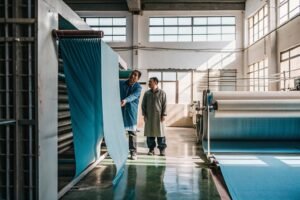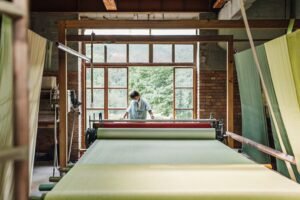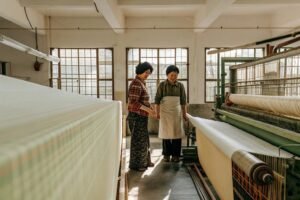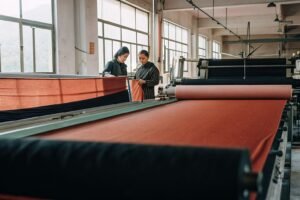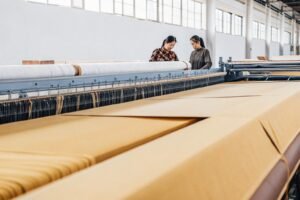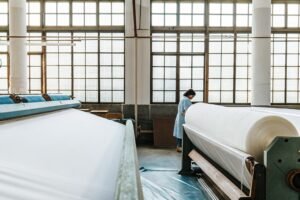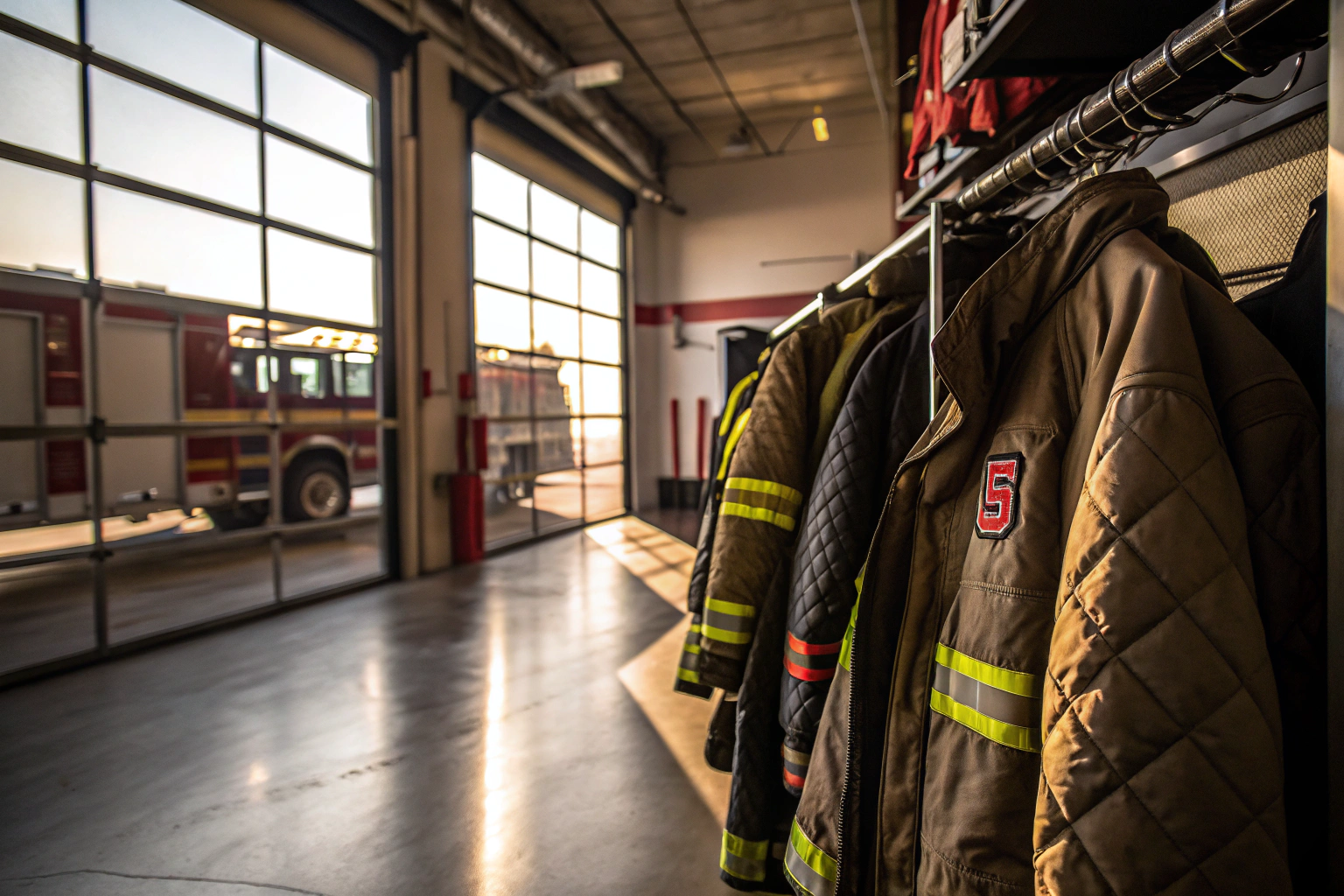
I will never forget the day a firefighter walked into our office in Keqiao. It was 2017. He was a volunteer fire chief from Oregon, on a trip to China. He asked if we could make fabric for turnout gear liners. I said, "We make many fabrics. But this? This is life-saving equipment. We need to be sure." He opened his bag and showed me a liner from his own coat. It was thin, quilted, and had a shiny backing. He said: "This keeps me alive. If it fails, I burn. Can you make it?" That question changed everything for us. We spent the next year learning about thermal protection, moisture barriers, and the standards that save lives.
So, what are the best fabrics for firefighter turnout gear liners? The answer is not one fabric. It is a system. A turnout coat has three layers: the outer shell (heat and abrasion resistance), the moisture barrier (keeps water and chemicals out), and the thermal liner (traps air to insulate). The liner is what touches the firefighter’s body (or their station wear). It must be comfortable, but its main job is to provide thermal insulation. It must keep the heat out long enough for the firefighter to do their job and get out safely. In this guide, I will share what we learned working with that Oregon fire chief and later with professional gear manufacturers. This is not fashion. This is life and death.
What are the key performance requirements for thermal liners?
Thermal liners are not just any fabric. They are engineered to meet strict standards. In the US, the standard is NFPA 1971. In Europe, it is EN 469. These standards specify how much heat the fabric must block, how it must perform when wet, and how it must resist flame. Here are the key properties we test for.
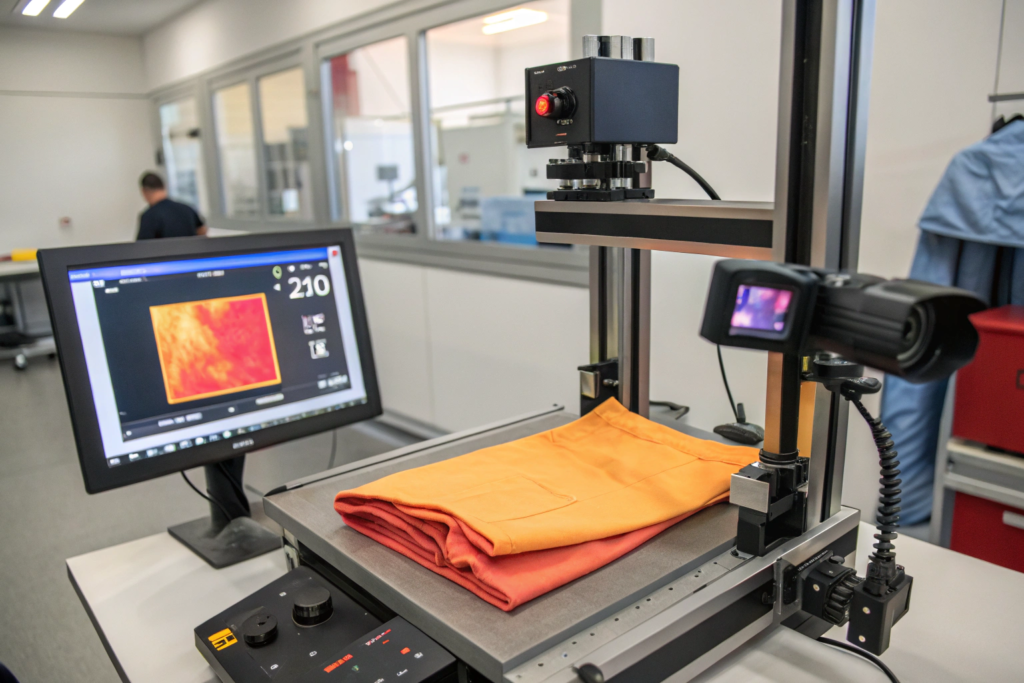
Thermal Protective Performance (TPP): This is the big one. TPP measures how much heat energy the fabric can block before it causes a second-degree burn. The test exposes the fabric to a controlled flame and radiant heat. Sensors on the other side measure temperature rise. NFPA 1971 requires a TPP rating of at least 35. That means the fabric must protect for at least 35 seconds under standard test conditions. High-performance liners can achieve 40 or more. We test every batch. A California manufacturer requires a minimum of 38 from us.
Heat resistance: The liner must not melt, drip, or ignite when exposed to high heat. We test at 260°C (500°F) for 5 minutes. The fabric must not shrink more than 10%, and it must not separate or melt. For aramid blends, this is usually fine. For lower-quality materials, it fails.
Thermal shrinkage: When exposed to heat, some fabrics shrink. If the liner shrinks, it can pull away from the shell and leave gaps. That is dangerous. We test shrinkage at 260°C. We require less than 5% shrinkage in both directions. A Canadian client once received a batch that shrank 8%. We recalled it. No risks.
Flame resistance: The liner must self-extinguish when the flame is removed. We test with vertical flame tests (ASTM D6413). The fabric should not continue burning. It should not melt and drip. Aramid and PBI blends pass easily. Treated cotton does not pass for long.
Comfort and breathability: Firefighting is intense work. Firefighters sweat. If the liner does not breathe, they overheat. But breathability cannot compromise protection. So we use materials that wick moisture away from the body while blocking heat. This is a balance. We work with mills that specialize in comfort technology for protective gear.
Durability after washing: Turnout gear gets dirty. It gets washed. The liner must maintain its properties after many washes. We test after 25, 50, and 100 washes. Some liners lose protection after multiple washes. Good ones do not. A New York FDNY contractor requires testing after 50 washes. We provide the data.
What materials are used in thermal liners?
The best thermal liners use a combination of high-performance fibers. Here are the common ones.
Aramids (Nomex, Kevlar): This is the backbone. Aramids do not melt. They char and thicken when exposed to heat, which actually increases protection. Nomex is used for its thermal resistance. Kevlar adds strength. Most liners are a blend or a face cloth of aramid.
PBI (Polybenzimidazole): PBI is even more heat-resistant than aramid. It does not burn in air. It is often blended with aramid for liners. PBI feels more comfortable against skin. It is used in high-end turnout gear. A German manufacturer we work with uses a PBI/aramid blend for their premium line.
Lenzing FR (viscose with FR treatment): This is a cellulosic fiber with built-in flame resistance. It is softer and more comfortable than aramid. It is often used in the face cloth (the part that touches the firefighter). But it does not have the same high-heat resistance as aramid, so it is usually part of a blend.
Modacrylic: Often blended with other fibers for comfort and FR properties. But alone, it is not enough for NFPA 1971.
The batting (insulation layer): Inside the liner, there is often a batting or foam. This is the insulation. Common materials are Nomex batting or aramid felt. Some use a foam that is flame-resistant. The batting is quilted between the face cloth and the backing fabric.
The backing fabric: The outer side of the liner (touching the moisture barrier) is often a lightweight aramid or PBI fabric. It must be smooth to reduce friction with the moisture barrier.
How does the liner work with the moisture barrier?
The liner does not work alone. It is part of a system. The moisture barrier sits between the outer shell and the thermal liner. Its job: keep water, chemicals, and some heat out. The liner’s job: keep heat out. They must work together without interfering.
Attachment: The liner is usually attached to the moisture barrier with quilting or spot bonding. This keeps them aligned. If they separate, protection gaps appear. We ensure our liner fabrics have good adhesion for quilting. A slippery fabric is hard to quilt. We adjust the finish to allow bonding.
Slip resistance: The liner should not slide against the moisture barrier. Friction can cause wear. We test the coefficient of friction. If it is too low, we suggest a different weave or finish.
Breathability interaction: The moisture barrier is often semi-permeable (allows sweat vapor out but blocks liquid). The liner must not block that vapor transmission. So we use open weaves or breathable batting. A French manufacturer tests total heat loss (THL) of the whole system. We help them achieve high THL ratings.
Compatibility with moisture barrier membranes: Some moisture barriers have delicate membranes. The liner must not abrade them. We test abrasion against typical moisture barrier materials. If we see wear, we adjust the liner fabric.
What is the typical construction of a thermal liner?
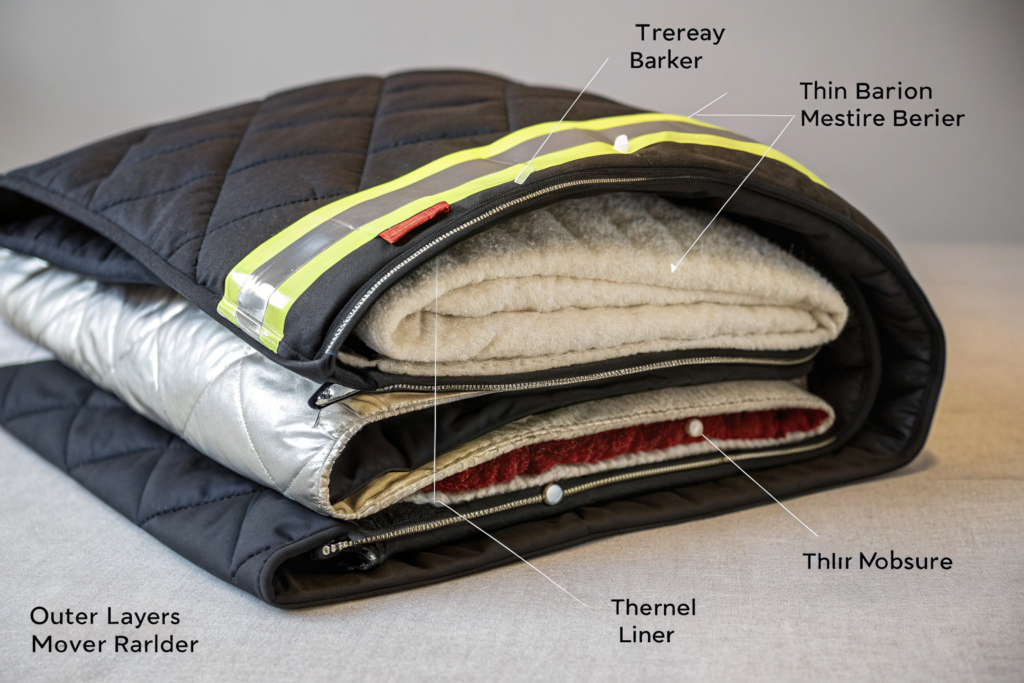
Thermal liners are not single-layer fabrics. They are composites. Here is a typical construction:
Face cloth: The layer against the firefighter. Usually a woven or knit fabric of FR fibers. It should be soft, moisture-wicking, and durable. Often a blend of aramid and Lenzing FR. Weight: around 4 to 6 oz per square yard.
Batting/insulation layer: The middle layer. Often a needled felt or non-woven of aramid fibers. Sometimes a foam (but foam is less common now because it can melt). Weight varies: 2 to 4 oz per square yard for moderate insulation, up to 8 oz for extreme cold.
Backing cloth: The layer facing the moisture barrier. Usually a lightweight woven aramid. It protects the batting and provides stability. Weight: 2 to 3 oz per square yard.
Quilting: These three layers are stitched together in a pattern (diamond, square, or parallel lines). The quilting keeps everything in place. The thread must also be FR. We use Nomex thread.
Total weight: A complete thermal liner composite weighs 8 to 15 oz per square yard, depending on insulation level.
What are the NFPA 1971 requirements we must meet?
NFPA 1971 is the bible for turnout gear in North America. If you want to sell to US or Canadian fire departments, you must meet it. Here are the key requirements for liners.
Thermal Protective Performance (TPP): As I said, minimum 35. But the test is for the composite (liner + moisture barrier). So we work with moisture barrier manufacturers to ensure the combination passes. We cannot just test our liner alone.
Total Heat Loss (THL): This measures breathability. It must be at least 205 W/m² for the composite. Higher is better for comfort. We design liners to maximize THL while maintaining TPP. It is a trade-off. More insulation means less breathability. We find the balance.
Flame resistance: The liner composite must have a char length of less than 4 inches (100mm) and no after-flame. We test each batch.
Heat and thermal shrinkage: After 5 minutes at 260°C, shrinkage must be less than 10%. We aim for 5%.
Physical properties: Tear strength, tensile strength, seam strength. All must meet minimums. The liner must survive the rigors of firefighting.
Labeling requirements: Each finished garment must have a label with certification info. We provide fabric roll tickets with our lot numbers so manufacturers can trace.
Third-party certification: NFPA requires certification by an accredited lab (like UL or Underwriters Laboratories). We work with manufacturers who submit finished gear for certification. Our fabric is part of their certification package. We provide all test data they need.
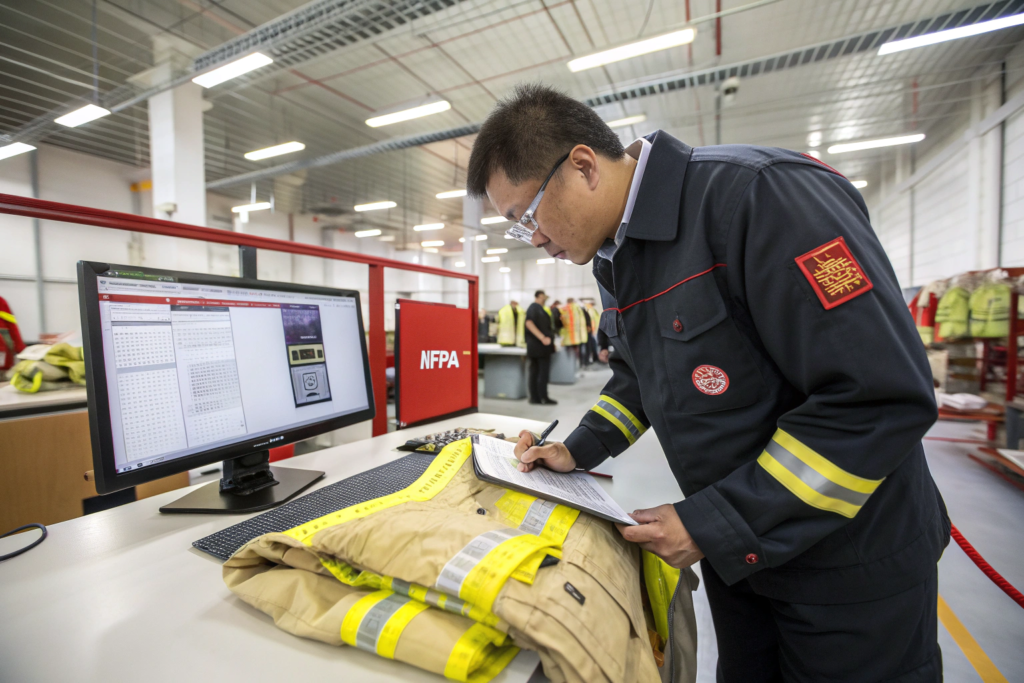
What about European EN 469?
EN 469 is similar but not identical. The test methods differ. For example, EN 469 uses a different heat exposure test. But the principles are the same: thermal insulation, flame resistance, and breathability. We have supplied fabric to European manufacturers who certify to EN 469. We adjust our materials to meet both standards for global clients.
What are the common mistakes when sourcing liner fabrics?
I have seen many mistakes over the years. Some cost money. Some could cost lives. Here are the worst.
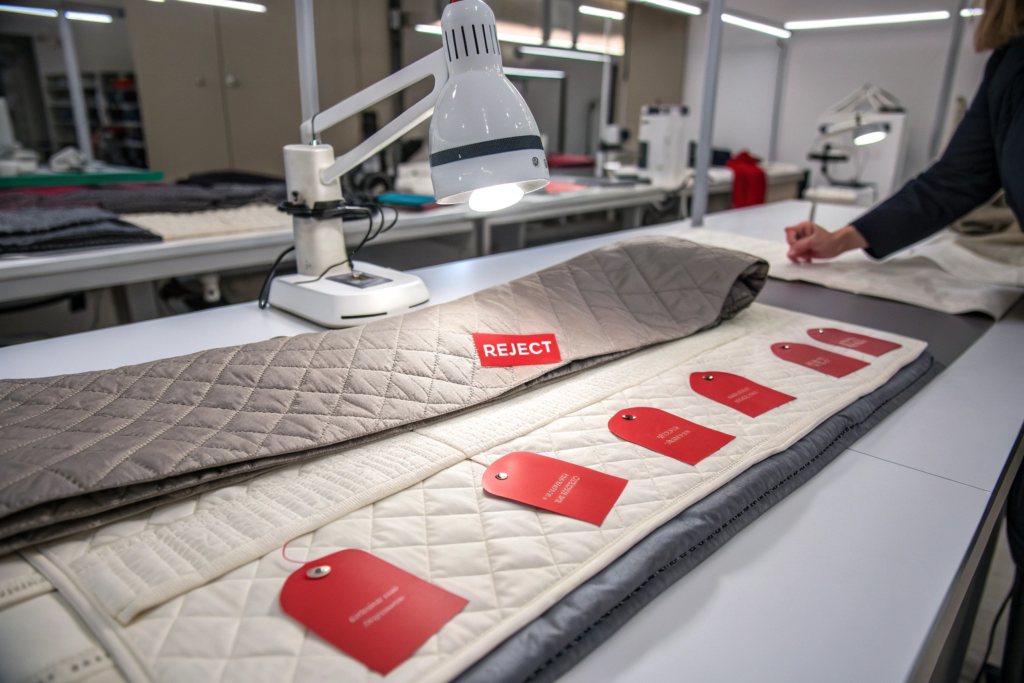
Using non-FR threads: The quilting thread must be FR. If it melts, the quilting fails, and the batting can shift. A client once used polyester thread (cheaper). In a heat test, the thread melted and the layers separated. We rejected the whole batch. They learned.
Ignoring shrinkage after washing: Some liners pass initial tests but shrink after washing. When the gear is washed, the liner shrinks and pulls away from the shell. That leaves gaps. We test after multiple washes. Always.
Inconsistent batting density: If the batting is not uniform, some areas have less insulation. That creates hot spots. We measure density across the width. We reject rolls with variation over 5%.
Poor quilting pattern: The quilting must be tight enough to keep batting in place but not so tight it compresses the insulation. We work with manufacturers to find the right pattern. A US client had a liner with quilting too far apart. The batting shifted after a few uses. We redesigned the pattern together.
Assuming all aramid is the same: There are many grades of aramid. Some are for industrial use, not NFPA. We only use aramid certified for protective clothing. We have mill certificates for every batch.
Not testing the system: The liner is part of a system. Testing the liner alone is not enough. We encourage clients to test the full composite (shell + moisture barrier + liner) under their expected conditions. A Canadian client tested and found that their chosen moisture barrier reduced TPP more than expected. We adjusted the liner to compensate.
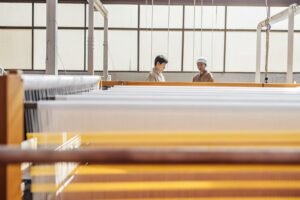
How do we test liner fabrics in our lab?
We have a dedicated protective textile lab. Here is our process:
Incoming inspection: Every roll of raw fiber or yarn is tested. If the yarn is weak, the fabric will be weak.
Greige inspection: After weaving or knitting, we check for defects. No thin spots, no holes.
Finishing inspection: After FR treatment and any finishes, we test flame resistance. If it fails, we retreat or reject.
Composite testing: We quilt samples with standard batting and test TPP and THL. We do this in-house and also send to third-party labs for certification.
Wash testing: We wash samples 25 times and retest. If properties degrade, we investigate.
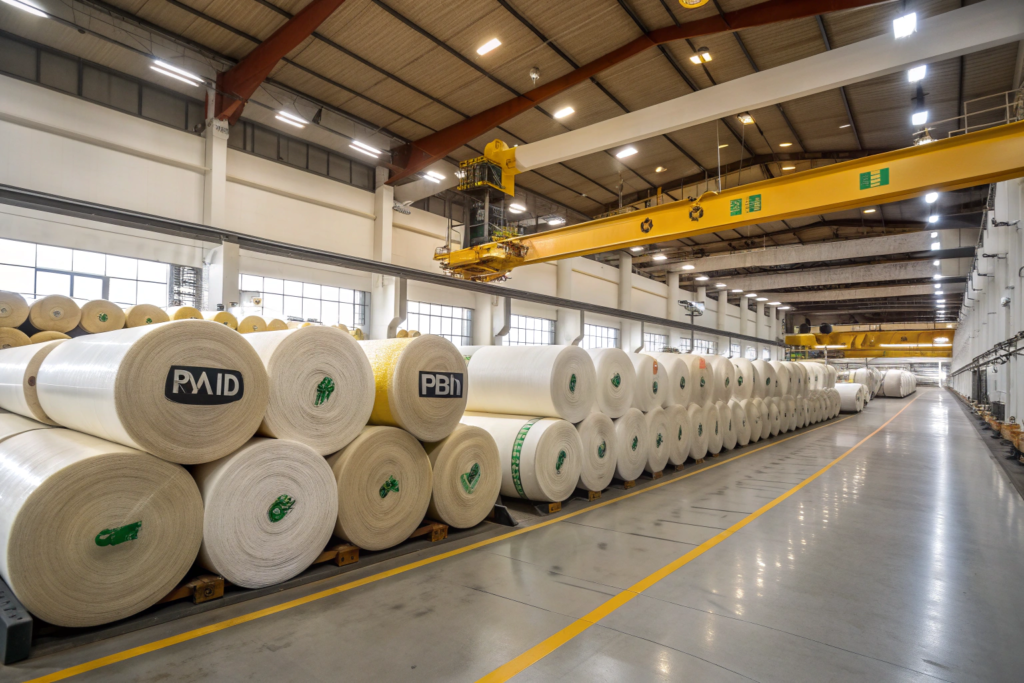
Lot tracking: Every roll gets a unique number. We track it from yarn to finished fabric. If a problem is found, we can trace it back.
What are the sourcing and MOQ considerations for liner fabrics?
Protective textiles are not off-the-shelf. They require specialized production. Here is what to expect.
Minimum Order Quantities: For custom liner fabrics (specific blend, weight, width), MOQs are high. Typically 5,000 to 10,000 meters per specification. This is because the yarns are specialty and the mills need to run efficiently. For standard liner constructions, we may have stock or shorter runs.
Lead times: Custom development takes time. From concept to first production: 4 to 6 months. This includes yarn sourcing, weaving trials, finishing trials, and testing. Production lead time after approval: 8 to 12 weeks.
Sampling: We can make small samples (1 to 5 meters) for testing. Cost is higher per meter, but necessary. We credit sampling cost against production orders.
Color: Most liners are natural (off-white, light tan) or black. Color adds cost and complexity because dyes can affect FR properties. We use pigments that are FR-safe.
Width: Typical widths for liner fabrics are 60 inches (150cm) to allow efficient cutting. We can adjust, but width changes cost.
Certification support: We provide all test data, mill certificates, and traceability documents needed for NFPA or EN certification. This is included.
How do we handle pricing for protective textiles?
Pricing for liner fabrics is higher than regular textiles. Here is why:
Raw material cost: Aramid and PBI fibers are expensive. Aramid costs 10 to 20 times more than polyester. PBI costs even more.
Specialized weaving: These fibers are tough on machinery. Weaving is slower, waste is higher.
Finishing: FR treatments and quality testing add cost.
Testing: We test every batch extensively. That costs time and money.
Certification: Third-party certification adds cost.
Typical liner fabric prices range from $15 to $40 per meter, depending on composition and weight. For PBI-rich blends, even higher. A US manufacturer pays around $22 per meter for their standard aramid liner. They sell finished turnout gear for $2,000 to $3,000 per set. The math works.
Conclusion
Firefighter turnout gear liners are not a commodity. They are life-saving equipment. The firefighters who wear them trust that they will work. That trust must be earned. At Shanghai Fumao, we take this responsibility seriously. We do not cut corners. We test, we verify, we document. We have spent years learning from firefighters, from manufacturers, and from our own mistakes. We know the standards. We know the materials. We know what it takes to keep people safe.
If you are a manufacturer of turnout gear, or if you are sourcing for a fire department, we can help. We supply liner fabrics that meet NFPA 1971 and EN 469. We work with certified mills. We provide full traceability. We understand that a life depends on what we make.
Contact our Business Director, Elaine, directly. She manages our protective textiles division and has worked with fire gear manufacturers in the US, Canada, and Europe. Email her at elaine@fumaoclothing.com. Tell her about your requirements, your standards, and your volumes. She will guide you through the process, from sampling to certification to production. And with our logistics support, shipping is smooth, whether you are in North America, Europe, or anywhere else. Because at Shanghai Fumao, we believe in protecting those who protect us. Every day.