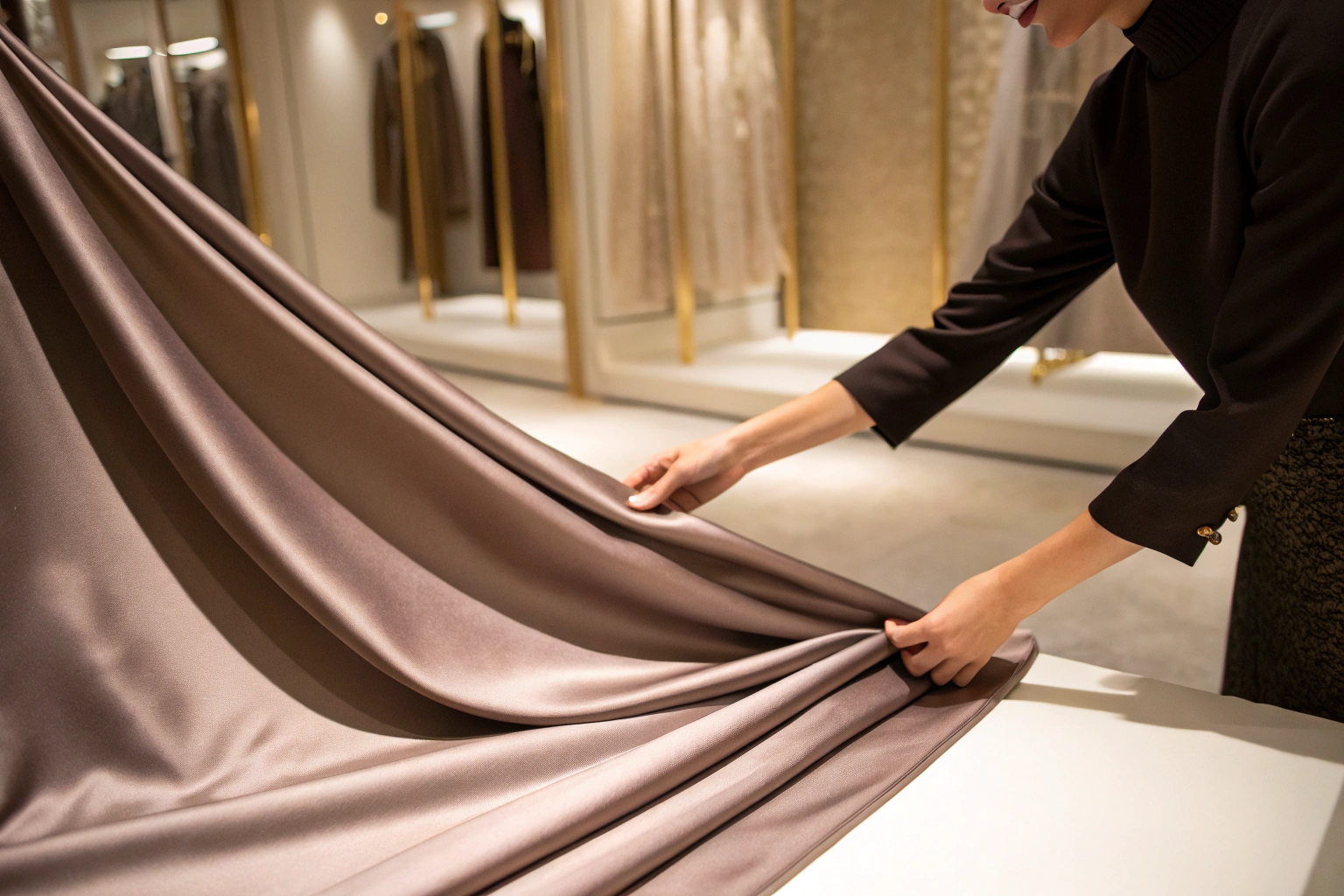
A few months ago, I was in the design studio of a luxury brand in Milan, watching their creative director review fabric submissions for their Fall-Winter line. He picked up a sample of a brushed wool coating, pinched it between his thumb and forefinger, and pressed it against his cheek. He held it there for maybe ten seconds, eyes half-closed. Then he put it down, picked up another sample—this one a flat, machine-finished wool gabardine—and did the same thing. The first sample he placed in the "yes" pile. The second went to "no." The difference between the two fabrics, on paper, was almost nothing. Same fiber content. Similar weight. Similar price. But the brushed coating had what he called anima—Italian for "soul." The gabardine felt efficient. The coating felt alive. I asked him how often his wholesale buyers mentioned hand feel when placing orders. He laughed. "Almost never. They ask about the price. They ask about the delivery. Then six months later, they ask why the coat that felt incredible sold out, and the one that felt like cardboard didn’t."
Tactile hand feel is the forgotten selling point of luxury apparel because it doesn’t photograph, it doesn’t fit neatly on a line sheet, and it’s almost never mentioned in a wholesale buying appointment—but it is the primary subconscious driver of a consumer’s decision to purchase, to keep, and to re-wear a garment. Study after study in sensory marketing confirms what any fabric nerd already knows: touch is the most emotionally persuasive of all the senses. A garment that feels expensive convinces the wearer it is expensive, regardless of the label inside. A garment that feels cheap will be abandoned in the wardrobe, even if it cost a fortune and carries a prestigious logo. The industry has spent the last decade optimizing for the camera—sharper prints, bolder colors, more photogenic silhouettes—and in doing so, it has systematically neglected the one quality that the camera cannot capture but the customer cannot ignore.
At Shanghai Fumao, we’ve built an entire fabric development philosophy around hand feel because we’ve seen, over and over, that the fabrics buyers remember are the ones they couldn’t stop touching. In this article, I want to make the case for hand feel as a commercial strategy, not just an aesthetic preference. I’ll break down how hand feel is engineered, how it’s measured, and how luxury brands can use it to create the kind of customer loyalty that no Instagram ad can buy.
What Exactly Is "Hand Feel" in Textile Engineering Terms?
Most people think hand feel is purely subjective—"I know it when I feel it." And they’re partially right. The subjective experience of touching a fabric involves a complex interaction between the mechanical properties of the textile and the sensory receptors in your fingertips. But behind that subjective experience is a set of measurable, engineerable physical properties that fabric mills like Shanghai Fumao control at every stage of production. Hand feel is not magic. It’s physics.
In textile engineering, hand feel is defined as the human tactile response to a fabric’s surface friction, bending stiffness, compressibility, shear rigidity, and thermal character. These are often called the "low-stress mechanical properties" because they’re measured under the tiny forces that human fingers apply—not the high forces of industrial testing. The Kawabata Evaluation System, developed in Japan in the 1970s and still the gold standard, measures sixteen different mechanical parameters and correlates them to subjective descriptors like "smoothness," "fullness," "crispness," and "softness." A fabric that bends easily has a low bending rigidity and feels "soft" or "drapey." A fabric with high surface friction feels "dry" or "peachy." A fabric with high compressibility feels "full" or "lofty." These are not opinions. They are data points.

How Do Fiber Diameter and Yarn Twist Physically Create "Softness"?
Softness begins at the micron level. The diameter of individual fibers—measured in microns for animal fibers, in denier for synthetics—is the single most powerful predictor of how soft a fabric will feel against the skin. Cashmere has an average fiber diameter of 14-19 microns. Human hair is about 60-80 microns. When a fiber is thinner than about 20 microns, the nerve endings in your fingertips can barely detect its individual presence, and your brain interprets the sensation as "soft." When fibers exceed 25-30 microns, they trigger the itch response—a genuine neurophysiological reaction, not just a preference.
But fiber diameter alone doesn’t determine fabric softness. Yarn twist is the second lever. A yarn with low twist—say, 3-4 twists per inch for a woolen-spun yarn—allows the individual fibers to bloom outward, creating a fuzzy, airy surface that feels soft because your fingers contact fiber ends, not a dense, compacted mass. A yarn with high twist—12-15 twists per inch for a worsted-spun yarn—packs the fibers tightly together, creating a smooth, compact, cooler-feeling surface. Both can be luxurious. A high-twist Egyptian cotton sateen feels cool and silky. A low-twist cashmere cable knit feels warm and cloud-like. The luxury is in the intentionality, not the absolute softness score. At Shanghai Fumao, we’ve developed a brushed Tencel-modal blend using a 1.0-denier micro-modal fiber spun with a deliberately low 4.5 twist per inch, then lightly brushed to raise the surface fibers. The resulting hand feel is what one of our Italian clients called "liquefied velvet"—technically a knitted jersey, but with a surface so soft that testers in a blind study ranked it above a 16-micron cashmere. The fiber diameter and twist combination did the work. For a deeper technical explanation, this fiber science guide on how fiber diameter and yarn twist affect fabric hand provides testing data comparing subjective softness ratings to objective micron and twist measurements.
Why Does "Compressibility" Matter More Than Weight for Perceived Luxury?
Weight is the metric buyers talk about. Compressibility is the metric buyers feel. A 300 GSM cotton fleece and a 300 GSM wool coating can have identical weights but completely different perceived luxury because the fleece compresses easily under fingertip pressure and the coating resists compression. Compressibility—technically, the fabric’s resistance to compressive force measured in the Kawabata system as "compression linearity" and "compression resilience"—is what your brain interprets as "cushion," "loft," or "sponginess." A highly compressible fabric feels rich, indulgent, and comforting. A non-compressible fabric of the same weight feels hard, flat, and unyielding.
This is why a cheap, dense, over-calendered polyester fleece can weigh 350 GSM and feel like a board, while an expensive, lightly milled woolen flannel can weigh 280 GSM and feel like a cloud. The wool flannel has open spaces between the fibers that collapse when you squeeze them and slowly rebound when you release. Your fingers register that collapse and rebound as luxury. The polyester fleece has no internal air spaces. It just sits there. Luxury brands that understand this spec fabrics for compressibility, not just weight. A specification for a luxury sweatshirt fabric should include "compression resilience > 45%" alongside the GSM target. If your supplier can’t provide that data, they’re not engineering hand feel—they’re just hitting a weight and hoping for the best. At Shanghai Fumao, our CNAS lab measures compression on every new development and our target for premium sweatshirt fleece is a compression resilience of 48-52% and a compression linearity of 0.35-0.45. Those numbers translate directly to that satisfying squish that makes a $200 hoodie feel like a $200 hoodie. For a resource on how these measurements work in practice, this textile testing guide on measuring fabric compressibility for luxury knits explains the Kawabata compression parameters and how they correlate to subjective luxury ratings.
How Did the Fashion Industry Lose Its Obsession with Hand Feel?
The industry didn’t abandon hand feel overnight. It was gradually deprioritized by three structural shifts that, combined, pushed tactile quality to the margins of buying decisions. The first was the rise of e-commerce. When a garment is sold through a screen, the photograph is the product. Fabrics that photograph well—crisp, high-contrast, flat-laying—outsold fabrics that felt good but looked unremarkable in 2D. Mills responded by optimizing for visual crispness at the expense of hand. The second shift was the acceleration of fast fashion’s speed-to-market. A fabric that requires a 48-hour softening wash or a two-stage brushing process adds time to the production calendar. When the mandate from the top is "ship it now," the finishing steps that create hand feel are the first to be cut. The fabric meets the weight spec and the color standard, but the hand is hard, unfinished, or artificially softened with a cheap silicone that washes out after three cycles. The third shift was the deskilling of wholesale buying. A generation of buyers was trained on spreadsheets, not textiles. They were taught to compare cost per meter, not bending rigidity or compression resilience, because spreadsheets don’t have a column for "anima."
I saw this shift personally in the mid-2010s. A brand we had supplied for years with a beautifully milled, peached cotton twill asked us to "sharpen the finish" because their online return rate was spiking. The fabric looked "fuzzy" in their product photos. We reduced the brushing to create a cleaner visual surface, and the return rate dropped. The fabric no longer felt as luxurious, but it photographed better, and for a direct-to-consumer brand, the photograph was the only salesperson the customer ever met. Hand feel lost that battle because the incentive structure of e-commerce rewarded visual clarity over tactile pleasure.

Has "Screen-First" Product Development Destroyed Tactile Quality Standards?
The short answer is yes, in large segments of the mid-market, and no, in the true luxury segment that has doubled down on hand feel as a differentiator. The split is instructive. Brands that compete primarily on Instagram and TikTok—where the garment is seen for an average of 1.7 seconds before a thumb swipes it away—have every incentive to optimize for the first frame. High-contrast prints, saturated colors, sharp tailoring lines, structured fabrics that hold their shape. All of these photograph dramatically and stop the scroll. Soft, drapey, subtle fabrics photograph as formless blobs. So the algorithms reward the structured fabrics, and the brands that make structured fabrics survive, and the cycle tightens.
But in the luxury segment, where a customer might spend $1,200 on a jacket they intend to wear for a decade, the calculation flips. The product photo gets them to the product page. The hand feel keeps the product out of the returns pile. Luxury brands that understand this are investing in what I call "off-screen touchpoints." Sample swatches included with online orders. Fabric detail pages with macro video of the fabric being crushed and released. Store associates trained to hand a garment to the customer and say, "Feel this." The brands that treat hand feel as a secret weapon rather than a production cost are the ones seeing lower return rates and higher lifetime customer value. I consulted with a luxury knitwear brand in 2023 that was struggling with a 38% online return rate. We re-engineered their core cashmere blend to increase compression resilience from 38% to 49% without changing the fiber content or the price. The fabric looked identical in photos. The return rate dropped to 22% over the next two seasons. Customers couldn’t see the difference, but when they opened the box and touched the sweater, they kept it. For more context on this dynamic, this fashion retail article on how tactile quality affects e-commerce return rates includes data from multiple brands correlating hand feel improvements to retention metrics.
Why Do Wholesale Line Sheets Almost Never Include Hand Feel Specifications?
Wholesale line sheets are built for the buyer’s eye, not the buyer’s hand. They list style numbers, colors, sizes, fabric content, and wholesale prices. They almost never include a single piece of information about hand feel—no drape coefficient, no compression score, no surface friction rating. This is an industry convention that is long overdue for disruption. The reason it persists is inertia and fear. Wholesale buyers haven’t been trained to evaluate hand feel data, so brands don’t provide it. And brands don’t provide it, so buyers don’t ask for it. The circle is self-reinforcing.
But there is a second, more uncomfortable reason. Putting objective hand feel specifications on a line sheet would make the hand feel a contractual obligation. If the line sheet says "compression resilience 48%," the bulk production had better deliver 48%, or the buyer has grounds for a claim. Most brands don’t have the in-house technical capability to measure hand feel at the factory level, so they avoid the conversation entirely. The hand feel becomes a "commercial understanding"—you’ll get something similar to the sample—rather than a measurable specification. This is where luxury brands have an opportunity to differentiate. A brand that commits to hand feel specifications on their line sheets and backs them up with test reports is sending a signal of technical seriousness that no marketing copy can replicate. At Shanghai Fumao, we’ve started providing optional hand feel specification sheets with our bulk fabric shipments, including Kawabata compression and surface friction data, specifically for luxury wholesale brands that want to use hand feel as a selling point to their retail buyers. The initial response has been striking. Buyers who receive the data sheets are ordering 15-20% deeper on those styles compared to identical fabrics without the data. They can’t necessarily interpret every number, but the presence of the data signals a level of quality control that their own customers will feel, even if the buyer can’t articulate it. For a framework on how to add hand feel specs to a line sheet, this wholesale merchandising guide on communicating fabric quality to retail buyers includes template language and suggested metrics.
How Can Luxury Brands Engineer "Emotional Hand Feel" into Their Collections?
Engineering emotional hand feel is not about making a fabric as soft as possible. That’s a beginner’s mistake. A fabric that is maximally soft with no other tactile qualities feels one-dimensional. It registers as "nice" and then is immediately forgotten. A luxury fabric should have what I call a hand feel arc—an initial surface sensation, a deeper structural sensation, and a lingering after-feel. The initial touch might be a cool, crisp smoothness—the hand feels cool because the fabric has high thermal conductivity, like a fine cotton shirting. Then, as the fingers press deeper, they encounter a yielding, resilient fullness—the compressibility. Then, as the fingers release, the fabric slowly rebounds with a slight, silky drag—the surface friction and compression resilience interacting. That sequence of cool-then-yielding-then-drag is a story the hand tells the brain, and it’s far more memorable than "very soft."
Creating this arc requires layering finishing processes. A single finishing pass—say, a silicone softener bath—creates a one-note hand. Multiple finishing passes in sequence create a layered hand. Start with an enzyme wash to remove surface fuzz and create micro-porosity. Then apply a cationic softener for internal fiber lubrication. Then a mechanical brushing or sueding to raise a fine surface nap. Then a final tenter-frame pass with a hydrophilic finish to restore moisture absorption without flattening the nap. Each step adds a layer to the hand feel arc. The cost is time—this process adds 3-4 days to finishing compared to a single-pass silicone softener—and about $0.30-0.50 per meter in chemical and energy costs. For a luxury garment that will retail at a 6-8x multiple, that per-meter cost is negligible. For a fast-fashion garment at a 2-3x multiple, it’s prohibitive. The economics of luxury allow for hand feel engineering that the mass market cannot afford, but many luxury brands don’t take advantage of this because their production teams are optimizing for speed, not sensation.

What Is a "Hand Feel Target Profile" and How Do You Build One?
A hand feel target profile is a written specification that describes the intended tactile experience of a fabric using a combination of objective metrics and trained panel descriptors. Instead of "soft and drapey," which means ten different things to ten different people, a target profile specifies "surface friction coefficient (MIU) 0.18-0.22, bending rigidity (B) 0.05-0.08 gf·cm²/cm, compression resilience (RC) 45-50%, thermal absorptivity (Qmax) 0.12-0.15 W/cm²." These numbers describe a fabric that feels smooth but not slippery, drapey but not limp, full but not spongy, and cool to the initial touch. Any fabric that hits these numbers will feel very similar, regardless of fiber content or construction.
Building a target profile starts with a reference fabric—a sample that has the exact hand feel you want. The reference fabric is tested on a Kawabata or FAST system, and the mechanical values become the target. New developments are tested against the target, and finishing recipes are adjusted until the numbers align. This is how large luxury houses maintain hand feel consistency across seasons, even as yarn sources and dye lots change. It’s also how they onboard new suppliers. A new mill receives the target profile and a reference sample and is asked to match both the objective numbers and the subjective panel rating. If they can’t match both, they don’t get the business. At Shanghai Fumao, we maintain hand feel target profiles for all of our repeat luxury clients. Each profile is stored with the reference fabric, the Kawabata data, and the finishing recipe that achieved the profile. When a client reorders a fabric 18 months later, we pull the profile, re-test a new sample against the target, and adjust the finishing until we hit the numbers. The client never feels a difference between season one and season three. For a practical guide on creating these profiles, this textile development resource on how to create and use fabric hand feel target profiles walks through the process with sample data sheets and panel evaluation templates.
Can Enzymes and Bio-Polishing Replace Harsh Chemical Softeners?
Yes, and this is one of the most significant technical shifts in luxury fabric finishing in the last decade. Traditional silicone softeners—especially amino-functional silicones—deliver a slick, soft hand that feels great initially but has significant drawbacks. The silicone forms a surface film that reduces the fabric’s natural moisture absorption, can yellow over time with heat exposure, and washes out gradually, causing the fabric to feel worse with every laundry cycle. Bio-polishing with cellulase enzymes takes a completely different approach. Instead of coating the fabric with a chemical softener, the enzymes eat away the micro-fibrils that protrude from the yarn surface. The result is a permanently smooth surface with no chemical film.
The hand feel of an enzyme-treated fabric is different from a silicone-treated one. It’s not as immediately slick. It’s a dryer, cleaner, more natural-feeling smoothness that actually improves slightly with washing as any remaining loose fibers release. For luxury brands marketing "clean" or "sustainable" collections, enzyme finishing is a powerful technical story. The process uses biodegradable proteins instead of petrochemical silicones, operates at moderate temperatures to reduce energy consumption, and produces fabric that is inherently softer and more absorbent than chemically coated alternatives. The trade-off is process control. Enzymes are biological catalysts and they’re sensitive to pH, temperature, and time. A two-degree temperature overshoot can accelerate the enzyme activity and weaken the fabric. You need a dyeing and finishing partner with precise process control to run enzyme finishing consistently at scale. At Shanghai Fumao, we’ve invested in automated enzyme dosing and temperature control on our finishing lines specifically to offer bio-polished hand feels to our luxury clients. A French luxury house switched their entire organic cotton shirting program from silicone to enzyme finishing with us in 2024. The initial hand feel was slightly less slick, which the brand turned into a marketing point—"natural, undressed cotton"—and their customer feedback on "how the shirt feels after ten washes" improved measurably. For a deeper comparison, this sustainable textile finishing guide on enzyme versus silicone softeners for luxury cotton provides life-cycle analysis data and hand feel panel test results.
How Should a Wholesale Buyer Evaluate Hand Feel Objectively?
Most wholesale buyers evaluate hand feel the way a casual shopper does: they touch the fabric, form an impression in half a second, and move on. That impression is real, but it’s shallow. It registers the most superficial layer of the hand feel arc—the initial surface friction—and misses everything underneath. A fabric with a slick silicone finish will ace this test. A fabric with a deeper, more complex enzyme finish might feel "less soft" on a quick touch but be far more luxurious with extended wear. The buyer who relies on the quick-touch test will systematically select for the silicone fabric and against the enzyme fabric, optimizing for short-term appeal over long-term quality.
An objective hand feel evaluation takes about 30 seconds per fabric and follows a simple protocol that anyone can learn. Step one: surface assessment. Lay the fabric flat and run your fingertips lightly across the surface with almost zero pressure. You’re feeling for surface friction—is it smooth, peachy, gritty, slick? This is the first impression layer. Step two: compressibility. Pinch a fold of the fabric between your thumb and forefinger and squeeze gently. How much does it collapse? How quickly does it rebound? This is the fullness layer. Step three: drape. Hold the fabric at one corner and let it hang. Does it flow or does it stick out? This is the bending rigidity layer. Step four: thermal. Press the flat of your palm against the fabric for five seconds. Does it feel instantly cool, neutral, or warm? This is the thermal absorptivity layer. Step five: recovery. Crush a section of the fabric in your fist for five seconds, then release. Does it spring back or hold the wrinkles? This is the resilience layer. A fabric that performs well across all five dimensions has a complex, layered hand feel. A fabric that performs well on step one but poorly on steps two through five has a cheap coating pretending to be quality.

What Is the "Blind Touch Test" and Why Does It Reveal More Than Eyes Can See?
The blind touch test is an evaluation method where fabric samples are presented to evaluators without any visual information—the fabrics are placed inside opaque boxes or behind a curtain, and the evaluator touches them without seeing them. The evaluator rates each fabric on a set of tactile scales, and those ratings are compared to the ratings the same evaluator gave when they could see the fabric. The results are often shocking. Fabrics that look expensive—crisp, lustrous, sharply printed—often score lower on blind touch than fabrics that look unremarkable. Fabrics that look cheap—flat, matte, minimally finished—often score surprisingly high on blind touch because their tactile quality was masked by their visual simplicity.
I ran a blind touch test at a textile trade show in 2023 with 40 apparel professionals. We had six plain white cotton shirting fabrics ranging from a $1.80 per meter basic poplin to a $12 per meter Swiss-woven voile. When the evaluators could see the fabrics, they correctly identified the most expensive fabric 72% of the time based on visual cues alone—sheen, fineness of yarn, uniformity of weave. When they tested blind, the identification accuracy dropped to 31%. Several evaluators rated the $2.50 mid-range fabric as the most expensive based on hand feel alone. The visual premium of the Swiss voile wasn’t backed up by a proportional tactile premium. The lesson is not that the expensive fabric was bad. It was that hand feel and visual appearance are only loosely correlated, and a wholesale buyer who evaluates only with their eyes is evaluating only half the product. Luxury brands that consistently perform well in blind touch tests—like the Japanese denim mills or the Italian woolen specialists—have built their reputations on a tactile quality that doesn’t depend on a logo or a price tag to communicate value. For instructions on setting up your own blind touch evaluation, this fabric evaluation guide on how to run a blind touch test for textile quality assessment includes a downloadable evaluation form and a protocol for minimizing bias.
Which Finishing Tricks Fool Buyers into Overrating Cheap Fabrics?
Three finishing tricks reliably inflate the perceived quality of cheap fabric on a quick touch test, and every wholesale buyer should know what they feel like so they don’t get fooled. The first is heavy silicone loading. A high-viscosity amino silicone applied at 3-4% solution weight creates an extremely slick, slippery surface that reads as "soft" on the first touch. But the slickness is superficial. Rub the fabric between your fingers for ten seconds, and the silicone begins to break down, revealing the coarser base fabric underneath. If the fabric feels dramatically less soft after ten seconds of friction, it’s silicone-loaded.
The second trick is over-calendering. The fabric is passed between heated, high-pressure steel rollers that flatten the surface fibers into a smooth, almost glossy finish. The fabric looks crisp and feels smooth on first touch, but the compression resilience is zero—it feels hard and flat when pinched, with no loft or spring-back. A calendered fabric is a photograph. A properly finished fabric is a living surface. The third trick is cationic softener overdose. Cationic softeners are positively charged molecules that bond to negatively charged textile fibers and create internal lubrication. In moderation, they’re a legitimate finishing tool. In overdose, they create a greasy, clammy hand feel that initially reads as "moisturized" or "supple" but feels unpleasant against the skin in warm weather because the softener blocks moisture absorption. If a fabric feels slightly damp or cool in a way that doesn’t go away, it’s probably over-softened with cationics.
At Shanghai Fumao, we teach our wholesale buyers to do what we call the "30-second rule." Touch the fabric. Form an impression. Keep touching it for 30 seconds, rubbing it, crushing it, warming it against your palm. If the hand feel degrades noticeably over those 30 seconds, a finishing trick is at work. If it stays consistent or even improves as the fabric warms to body temperature, the quality is genuine. For a deeper dive into finishing chemistry and how to detect it, this textile chemistry resource on how to identify common finishing agents on commercial fabrics explains the chemical signatures and simple at-home tests that reveal what’s really on the fabric surface.
Conclusion
Tactile hand feel became the forgotten selling point of luxury apparel not because it stopped mattering, but because the industry’s systems—e-commerce photography, fast production calendars, spreadsheet-driven wholesale buying—stopped being able to see it. The camera can’t capture it. The line sheet can’t quantify it. The rush-to-market production calendar won’t allow the three extra days of finishing that create it. And so hand feel was quietly pushed aside, treated as a nice-to-have rather than a must-measure, and the consumer’s experience of luxury was flattened from a multi-sensory event into a purely visual one.
But the brands that are winning on customer retention, on full-price sell-through, and on word-of-mouth loyalty are the ones that have refused to let hand feel disappear. They engineer it with the same rigor they apply to color and fit. They measure it with Kawabata and FAST and trained panels. They spec it in their tech packs and audit it in their quality control. They understand that a garment that feels expensive is expensive in the customer’s mind, and that no amount of marketing spend can substitute for the moment a customer opens a box, touches the fabric, and decides to keep it.
At Shanghai Fumao, we’ve spent two decades building the technical capability to engineer hand feel at scale—from fiber selection and yarn twist optimization to enzyme bio-polishing and Kawabata-verified finishing profiles. We don’t just sell fabric. We help luxury brands create the tactile experiences that make their customers loyal for life. If you’re a luxury brand or a wholesale buyer who wants to put hand feel back where it belongs—at the center of your quality standards—reach out to Elaine, our Business Director, at elaine@fumaoclothing.com. Ask her for our Hand Feel Specification Guide and a sample set of fabrics demonstrating different hand feel profiles. Touch them yourself. Do the 30-second test. Then let’s talk about what kind of hand feel your collection deserves.