You found the perfect pattern for a unstructured blazer. You sourced a beautiful, soft fabric with a subtle herringbone weave. The color is a rich, dusty olive. You send it to your tailor. A week later, he calls you. "This fabric," he says with a sigh, "it’s beautiful. But it’s dress weight. It won’t hold the lapel roll. It’ll wrinkle if you look at it. It’s for trousers, not a jacket." Your heart sinks. You just spent $400 on fabric that is fundamentally wrong for the garment you envisioned. You confused Hand Feel with Performance.
Fabric weight is not just a number on a spec sheet. It is the Gravity of a garment. It dictates how the fabric drapes, how it breathes, how it tailors, and how it moves with the body. In men’s wear, where the silhouette is built on structure and the garments are often worn for years, choosing the wrong weight is a cardinal sin. A jacket made from lightweight shirting flannel looks like pajamas. Trousers made from heavy overcoating feel like cardboard tubes. The weight of the cloth is the character of the garment.
I’m Jack, and I run Shanghai Fumao. While we supply fabrics across all categories, I have a particular passion for men’s wear because the margins for error are so small. A women’s blouse can forgive a draping mistake. A men’s tailored jacket cannot. The shoulder must sit clean. The chest must have body. The drape must be clean. I’m going to break down exactly why GSM and Ounces matter, and how to select the right weight for the right tailored piece, so you never have to hear those dreaded words from your tailor again.
What Does GSM and Oz Mean for Tailored Jackets and Trousers?
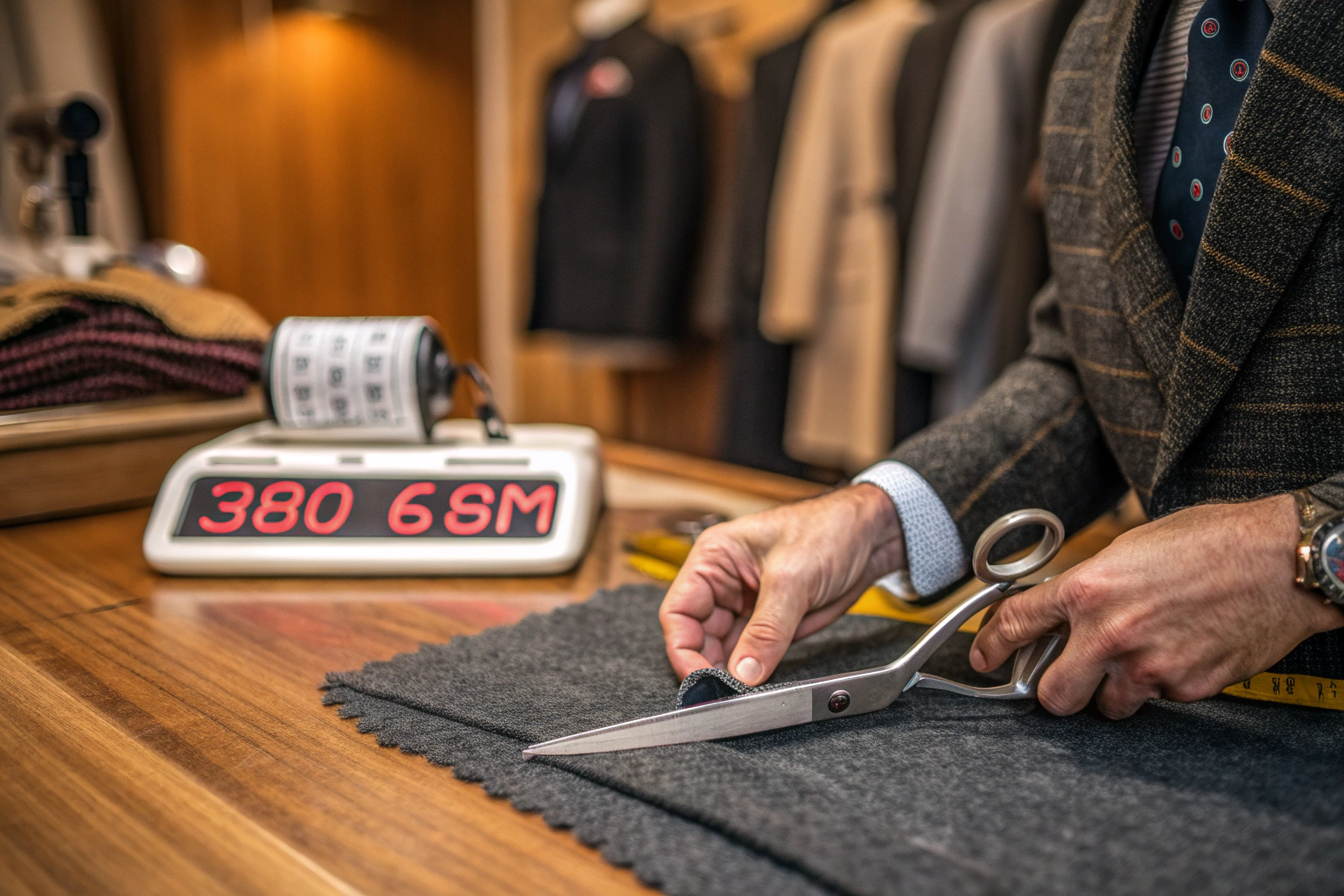
Before you can select the right cloth, you have to speak the language of weight. In the textile industry, weight is measured in two primary systems: GSM (Grams per Square Meter) and Oz (Ounces per Square Yard) . You’ll see both used interchangeably, especially when dealing with international suppliers.
- GSM (Metric): This is the weight of a 1 meter by 1 meter square of fabric. It’s the most precise and universal measurement. A high GSM means a heavier, denser, usually warmer fabric. A low GSM means a lighter, more breathable fabric.
- Oz (Imperial): This is the weight of a 1 yard by 1 yard square of fabric. It’s the traditional measurement for suiting and shirting, especially in the UK and US. You’ll hear tailors talk about a "10-ounce tweed" or a "14-ounce flannel."
Here’s a quick conversion: 1 Oz = 33.9 GSM. So a 10 Oz fabric is roughly 340 GSM. That’s a solid, year-round weight for a jacket. But the number alone doesn’t tell the whole story. The Weave Structure and Fiber Content interact with the weight to create the final performance. A 300 GSM open-weave linen feels and wears much cooler than a 300 GSM tight-worsted wool.
At Shanghai Fumao, we always list both GSM and Oz on our suiting spec sheets. We also include the Thickness in millimeters (mm) as a separate data point. Why? Because a fluffy woolen flannel might have a high thickness but a low GSM (because it’s full of air). A dense worsted gabardine might have a high GSM but a low thickness. You need all three data points to truly understand the Hand and Drape of the cloth.

How Do You Convert Fabric Weight to Seasonal Wearability?
This is the practical question every buyer needs to answer. You don’t want a winter suit that feels like a summer shirt, and you don’t want a summer blazer that causes heatstroke. Here is the general framework we use at Shanghai Fumao when advising clients on men’s tailored wear.
| Fabric Weight (GSM) | Fabric Weight (Oz) | Seasonal Suitability | Tailoring Application |
|---|---|---|---|
| 180 – 230 GSM | 5 – 7 oz | High Summer / Tropical | Unlined or half-lined jackets, travel blazers, lightweight trousers. Will wrinkle easily but breathes. |
| 240 – 290 GSM | 7 – 8.5 oz | Spring / Early Fall | The classic "Year-Round" weight for indoor/office wear. Holds a crease but stays comfortable. |
| 300 – 380 GSM | 9 – 11 oz | Three-Season (Fall/Winter/Spring) | The ideal blazer weight. Enough body for a soft shoulder but not too stiff. Excellent drape. |
| 390 – 500 GSM | 12 – 15 oz | Winter / Cold Climate | Heavy flannels, tweeds. Drapes like armor. Requires a strong tailor to manage the bulk at seams. |
| 500+ GSM | 16+ oz | Deep Winter / Outerwear | Overcoating. Too heavy for trousers or jackets unless you are building a coat. |
I had a client from New York in September 2024 who wanted a "winter suit." He picked a beautiful 240 GSM Super 120s wool. He loved the hand feel. I had to caution him: "This is a boardroom suit for a heated office. If you’re walking ten blocks in Manhattan in January, you will freeze. You need 350 GSM flannel at minimum." He took my advice. He later emailed me in February saying it was the best decision he made. The suit had the Gravitas to stand up to the wind. That’s the difference understanding weight makes. You can verify these seasonal guidelines by reading a guide to suiting fabric weights and their appropriate seasonal use and how to choose the right fabric weight for custom suits.
Why Does Weight Matter More for Trouser Drape Than Jackets?
Trousers are the unsung heroes of men’s wear engineering. A jacket hangs from the shoulders. Gravity helps it drape. Trousers hang from the waist and must drape cleanly down the leg against the skin and over the knee. If the fabric is too light (under 240 GSM), it will "Pool" around the ankles and create Knee Bags within an hour of sitting down. It lacks the structural mass to pull itself straight.
Furthermore, lightweight trousers tend to Cling to the leg due to static electricity, especially in dry winter air. This destroys the clean, straight line of a tailored trouser. A heavier weight (300+ GSM) has enough Mass to resist static and gravity to pull the wrinkles out when you stand up.
At Shanghai Fumao, we recommend a minimum of 280 GSM (8.5 Oz) for dress trousers that are meant to hold a crease and look sharp all day. For casual chinos or five-pocket pants, you can go lighter (220 GSM) because the expectation of "crispness" is lower. But for a proper worsted trouser, weight is your friend. It’s the secret to that elegant, uninterrupted line from hip to hem. You can find more technical detail in resources about the physics of fabric drape and its relationship to weight and stiffness.
How Does Fabric Weight Influence the Structure of a Jacket?
The weight of the outer cloth dictates the Architecture of the jacket underneath. You cannot pair a heavy, 500 GSM tweed with a wispy, soft canvas interfacing. The tweed will overpower the canvas, causing the chest to collapse and the lapels to roll flat. Conversely, if you pair a lightweight, 200 GSM silk/linen blend with a stiff, heavy canvas, the jacket will look like a cardboard box with sleeves. The inner structure and the outer cloth must be in Dialogue.
This is the art of tailoring that is often invisible to the buyer. You see the fabric on the roll. The tailor sees the Internal Engineering Challenge. At Shanghai Fumao, when we develop fabrics specifically for men’s wear, we test them with different interfacing weights to ensure they are "tailorable." We want to know: Does this fabric Pucker when a pad stitch is applied? Does the seam allowance create a visible ridge (a Seam Impression) on the face of the cloth?
Heavier fabrics (12 Oz and above) are actually easier to tailor in many ways. They hide stitches. They mold with steam. They forgive small imperfections in the cutting. Lightweight fabrics are the true test of a tailor’s skill. Every stitch shows. Every wrinkle in the canvas telegraphs through to the surface. This is why a well-made summer jacket in lightweight wool often costs more to tailor than a heavy winter tweed, even if the fabric itself is cheaper.

When Does Fabric Weight Require a Full Canvas vs. Half Canvas?
This is a direct correlation. The heavier the cloth, the more it needs the Internal Support of a full chest piece. A heavy fabric wants to droop under its own weight. The canvas counteracts that gravity.
- Lightweight (200-280 GSM): Half-Canvas or Unstructured. A full canvas in a lightweight jacket is often too stiff. It creates a "floating" effect where the body of the jacket doesn’t move with the wearer. A soft, lightweight hymo or even a fused front (gasp, yes, sometimes appropriate) allows the fabric to drape fluidly like a shirt.
- Midweight (300-400 GSM): Full Canvas or High-Quality Half-Canvas. This is the sweet spot. A medium-weight canvas provides the perfect balance of structure and comfort. This is the "Soft Tailoring" look popular in Italian menswear.
- Heavyweight (400+ GSM): Full Canvas Mandatory. You cannot make a durable, well-fitting coat from heavy tweed without a full floating chest piece. The canvas must be robust enough to hold the lapel roll and prevent the heavy cloth from collapsing onto the wearer’s chest.
At Shanghai Fumao, we ask our tailoring clients: "What is the intended silhouette?" If you want a soft, Neapolitan shoulder, we point you to a 280-320 GSM wool. It will mold to the shoulder without padding. If you want a structured, English drape cut, we point you to a 400 GSM worsted flannel. The weight of the cloth is the shoulder expression. You can read a masterclass on this by exploring the difference between full canvas, half canvas, and fused jacket construction and how to choose the right interfacing weight for different tailoring fabrics.
Why Do Heavy Fabrics "Tailor" Better at the Shoulder?
Have you ever seen a cheap suit where the shoulder line looks wavy, or you can see the outline of the shoulder pad through the cloth? That’s called Roping or Show-Through. It happens because the outer fabric is too light and too limp to hide the internal pad.
A heavy fabric (400+ GSM) has Opacity and Density. It acts like a smooth, thick skin over the skeleton of the shoulder pad and canvas. The tailor can shape the shoulder with steam and pressure, and the heavy wool will Hold That Shape for the life of the garment. It has a Memory. A lightweight cotton or linen jacket will lose its shoulder shape after one wearing in the rain or humidity. The fibers relax and the structure sags.
(Here’s a bit of insider knowledge: When we develop a new wool coating at Shanghai Fumao, we do a Steam Molding Test. We drape the fabric over a rounded form, steam it heavily, and let it dry. We measure the angle of the drape before and after. A good tailoring fabric will retain 80% of the molded shape. A poor one will bounce back flat. This is why our heavier suiting fabrics are trusted by bespoke tailors.)
What Is the Ideal Fabric Weight for a Men’s Dress Shirt?
Shirting is a different universe from suiting. The weight range is much narrower and the tolerances are much tighter. A difference of 20 GSM in a shirting fabric is immediately noticeable in how it wears and how it irons. Men’s dress shirt weights generally fall between 100 GSM and 180 GSM. Below 100 GSM, you’re in sheer voile territory (beautiful but fragile). Above 180 GSM, you’re in Oxford cloth or flannel territory (too heavy for a tie and jacket).
The ideal weight for a classic, year-round dress shirt that pairs well with a suit and tie is 120-140 GSM. This is the sweet spot. At this weight, the fabric is opaque enough to not show your undershirt, light enough to tuck into trousers without creating a bulky "muffin top" effect at the waistband, and dense enough to hold a crisp ironed finish for at least half a day.
At Shanghai Fumao, our most popular shirting is a 100/2 x 100/2 Poplin at 135 GSM. The "2-ply" yarn (two strands twisted together) gives it strength and a subtle luster. The weight gives it Body. It doesn’t feel flimsy. When a man puts it on, he feels Put Together. That psychological effect of a well-weighted shirt is real. A shirt that feels like tissue paper makes the wearer feel cheap.

Is a Heavier Oxford Cloth Better Than a Lightweight Poplin?
It’s not "better." It’s Different. It’s about Context.
- Oxford Cloth (150-180 GSM): This is the button-down shirt fabric. It’s heavier, more textured, and more durable. It’s the workhorse of the Ivy League. However, its weight and texture make it Inappropriate with a formal worsted suit. The collar roll is too soft, and the fabric is too thick to sit smoothly under a suit jacket. It looks bulky. It belongs with chinos, jeans, and tweed jackets.
- Poplin/Broadcloth (120-140 GSM): This is the dress shirt fabric. It’s smooth, lightweight, and tightly woven. It slides effortlessly under a suit jacket. It takes a crisp iron. It is the Correct Choice for business formal and evening wear.
I had a client from London in early 2025 who insisted on making all his custom shirts in a beautiful, heavy 170 GSM Royal Oxford. He loved the "heft" of the fabric. Three months later, he ordered a new batch in our 135 GSM Poplin. He admitted, "The heavy shirts were great on weekends, but under a suit jacket, I felt like I was wearing a sweater and a jacket. I was overheating and the collar never sat right." Weight dictates the Layering Compatibility. For more on this classic distinction, you can read the difference between oxford cloth, poplin, and broadcloth dress shirts and how to select the appropriate shirt fabric weight for different occasions.
How Does Fabric Weight Affect Collar Roll and Cuff Stiffness?
This is the detail that separates a $50 shirt from a $200 shirt. The Collar and Cuffs are the interfaces between the fabric and the world. They need Structure. If the base fabric is too light (under 110 GSM), the collar points will curl up after two washes, regardless of how much interfacing you put inside. The fabric simply lacks the Inherent Rigidity to support the shape.
A heavier weight (135 GSM+) provides a better Foundation for the fused or sewn interlining. It creates a collar that stands up away from the neck and frames the tie knot beautifully.
At Shanghai Fumao, we have a specific internal test for shirting: The Collar Point Curl Test. We cut a collar, interface it, wash it five times, and then lay it flat. We measure the distance the point has lifted off the table. A good weight fabric combined with good interfacing will have less than 5mm of lift. A poor combination will have 15mm. That’s a "flyaway" collar. It looks sloppy. And it’s usually a result of skimping on fabric weight to save $0.50 a yard. You can learn about the technical construction of shirt collars by reading how shirt collars are constructed using interlinings and fused fabrics.
How to Select the Correct Weight for Outerwear and Overcoats?
This is where fabric weight becomes Engineering. An overcoat is not a piece of clothing. It is a Portable Shelter. Its primary function is to block wind, retain body heat, and drape with enough authority to create a powerful silhouette. You cannot achieve this with suiting weights. You must enter the realm of Coating.
Coating fabrics start where suiting fabrics end. The minimum viable weight for a proper overcoat is 450 GSM (14 Oz) . That’s a lightweight topcoat for fall. A true winter warrior is 600 GSM to 900 GSM (18 Oz to 26 Oz) . At these weights, the fabric is no longer "draped" like a suit. It is Sculpted. It holds its shape even when not on the body. It stands up by itself in the corner.
At Shanghai Fumao, we offer a range of coating weights. We help clients select based on their local climate. A buyer in Atlanta needs a 450 GSM wool/cashmere blend for chilly evenings. A buyer in Chicago needs 700 GSM pure wool melton for walking the dog in February. The wrong weight here isn’t just an aesthetic failure. It’s a Functional Failure. The coat fails at its one job: keeping the wearer warm and dry.

What Is the Minimum GSM for a Wool Overcoat That Holds Its Shape?
I would argue 500 GSM (15 Oz) is the absolute floor. Below that, the coat will feel like a long cardigan. It will wrinkle excessively in the sleeves from bending your arms. The lapels will not roll crisply; they will flop open. The hem will not have that beautiful, weighty Sway when you walk.
The magic of a great overcoat is in the Swing Weight. That’s not a technical textile term, but it’s how tailors describe it. It’s the momentum of the coat as you move. A 700 GSM coat swings with you. It has a pendulum effect that feels luxurious and substantial. A 400 GSM coat just hangs there limply.
We produce a 650 GSM Double-Faced Wool Coating at Shanghai Fumao that is a bestseller for custom clothiers. It’s heavy enough to be unlined (saving bulk) but dense enough to resist wind. It requires a strong sewing machine and a sharp needle to penetrate the thickness. We often have to warn small cut-and-sew shops about this: "This fabric is a beast. Make sure your machines can handle the ply." That’s the kind of weight that builds a reputation for quality. You can explore the specifics of these fabrics by reading about the properties of melton wool and other heavy coating fabrics for outerwear and a guide to selecting the appropriate weight for bespoke overcoats.
Why Does Lining Choice Depend on Outer Fabric Weight?
This is the final, crucial detail. The lining is the Interior Bearing Surface. It must be strong enough to withstand the friction of the heavy outer cloth without tearing.
- Heavy Coating (600+ GSM): Requires a heavy-duty lining. We recommend Bemberg Cupro Twill or High-Density Viscose Satin. A cheap polyester lining will shred at the armhole seams within a month because the heavy wool is constantly pulling and abrading it. The seams will "grin" (pull apart).
- Lightweight Coating (450 GSM): Can use a lighter Bemberg Plain Weave or Ersatz Silk (Rayon). The stress on the seams is lower.
At Shanghai Fumao, we provide Lining Compatibility Recommendations with every coating fabric. We’ve seen too many beautiful coats ruined by a lining that was too weak for the shell. The lining rips, the customer thinks the coat is "poor quality," and the tailor gets blamed. It’s usually a mismatch of material weights.
Conclusion
Fabric weight is the invisible architecture of every great men’s wear garment. It’s the difference between a jacket that commands respect and one that looks like an afterthought. It’s the reason a trouser leg hangs straight and a collar stands proud. Ignoring weight is like building a house without knowing the strength of the lumber. It might stand for a season, but it won’t last.
Understanding GSM and Ounces gives you a superpower as a buyer or designer. It allows you to look at a spec sheet and feel the garment in your mind. You can anticipate the drape, the warmth, and the tailorability before you ever touch the cloth. At Shanghai Fumao, we are obsessed with these details because we know our fabric is the foundation upon which tailors build their art.
If you are developing a men’s wear collection or planning a custom project and you need guidance on selecting the precise weight for your vision, we are here to help. We can provide weight samples, drape videos, and technical data to ensure the cloth matches the cut. Reach out to our Business Director, Elaine. She works closely with our men’s wear clients to find the perfect balance of hand, weight, and performance. You can email her at elaine@fumaoclothing.com. Let’s make sure your next garment has the gravity it deserves.