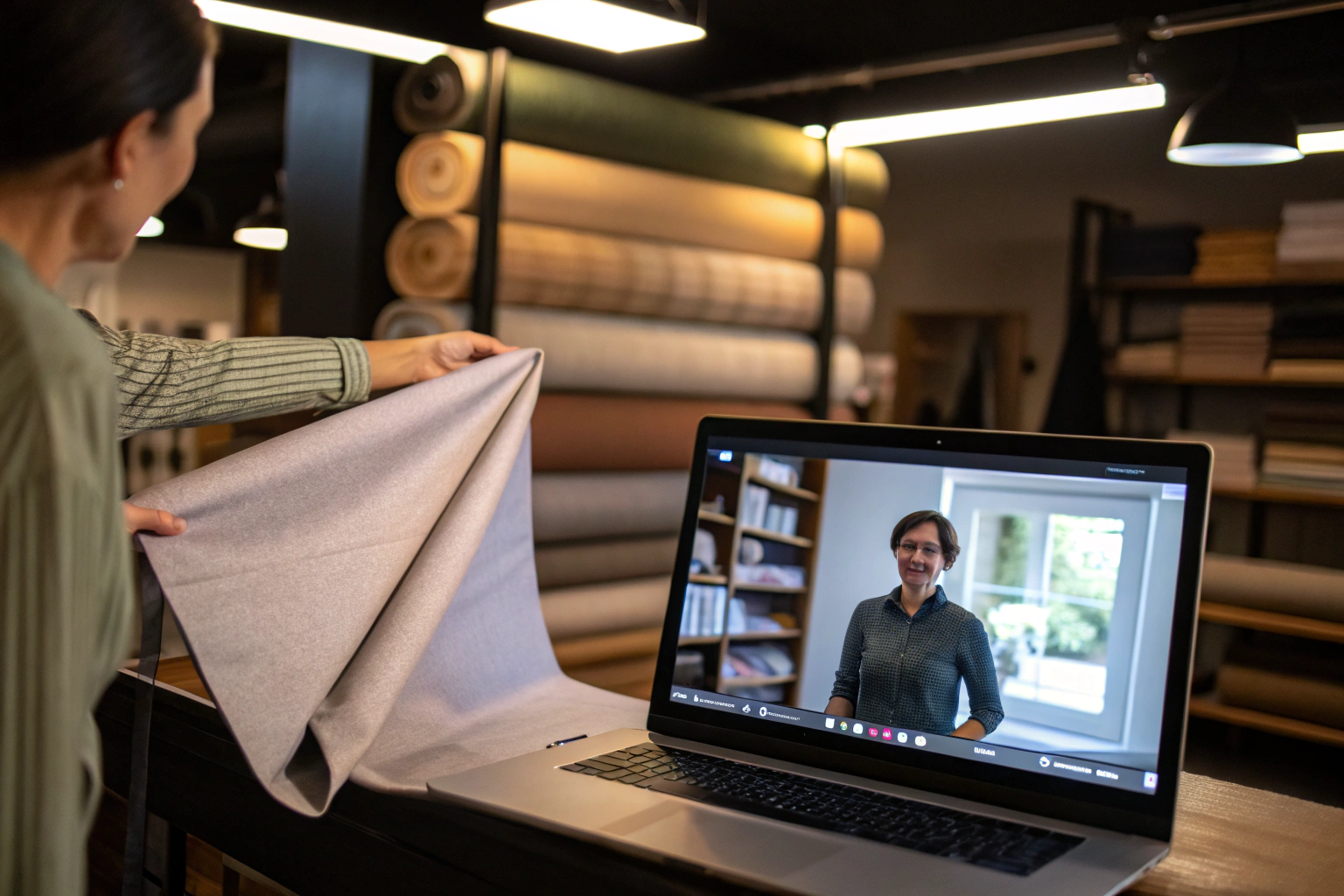
I have a confession to make. I’ve spent twenty years in the textile industry, and I’ve probably sent over 200,000 emails. And you know what? I’d estimate about 150,000 of them were a complete waste of time. Not because the information was wrong, but because email is a terrible medium for selling a tactile, visual, three-dimensional product like fabric. You’re trying to judge the drape of a silk charmeuse through a compressed JPEG attachment. You’re trying to gauge the hand feel of a brushed fleece through 12-point Arial font. It’s like trying to appreciate a symphony by reading the sheet music. You get the notes, but you completely miss the music.
At Shanghai Fumao , we’ve seen the sourcing landscape change dramatically. Five years ago, a buyer would send a 20-email thread about a single swatch. They’d ask for a lab dip photo. We’d send it. They’d say, "It looks too red." We’d say, "It’s the lighting in the photo studio." They’d say, "Please re-shoot in natural light." We’d wait for a sunny day in Keqiao (which, during rainy season, could be a week). We’d re-shoot. They’d say, "Still not sure." Three weeks of emails. One decision.
Then came the pandemic. Everyone was forced onto Zoom and WeChat video calls. And a funny thing happened. Our sample approval rate tripled. Our order error rate dropped to near zero. And our client relationships actually got stronger. We discovered that the "inefficiency" of a 15-minute video call was actually the most efficient tool in our entire sales arsenal. This isn’t about being old-fashioned or "high-touch." It’s about physics. Light, shadow, and movement. You cannot email those.
Let me show you why picking up the phone and turning on the camera is the single biggest competitive advantage you can have when sourcing from China.
Why Do Fabric Colors Look Different in Photos vs. Video Calls?
This is the number one source of friction in global textile sourcing. Color. You send us a Pantone number: 19-4052 Classic Blue. We send you a lab dip. You hate it. You say it’s "too purple." We look at the physical dip in our lightbox under D65 daylight, and it’s a dead match for the Pantone chip. So who is lying? Neither of us. The camera on the iPhone 13 that our intern used to snap the photo in the hallway is lying to you.

How Does Digital Camera White Balance Distort Fabric Dye Lots?
Let me get a little technical, but I’ll keep it simple. Your camera sensor and my camera sensor don’t see the world the way your eyeballs do. They have to guess what "white" is. That’s called White Balance.
When I take a photo of a Navy Blue Wool Coating in our office with fluorescent lights, the camera adds Yellow/Green to compensate for the artificial light. The Navy Blue now looks like a murky teal.
When I take a photo of a Cream Silk Chiffon near a window, the camera sees all that daylight and adds Blue to cool it down. The Cream now looks like a stark, cold white.
I can spend 20 minutes in Photoshop color-correcting that image. But then your monitor is calibrated differently than mine. Maybe your screen has "Night Mode" on, adding a warm orange tint. Maybe you’re looking at it on a dimmed laptop battery saver mode.
Email Cycle of Doom:
- Email 1: Send Lab Dip Photo (Color is off by 10%).
- Email 2: Client says "Too green."
- Email 3: We re-shoot with a color card. (Color is now off by 5% in the other direction).
- Email 4: Client says "Closer but still unsure."
- Total Time Elapsed: 4-7 Days.
The Video Call Fix (15 Minutes):
I get on a call with you. I hold the fabric up to the camera. I say, "Look, I’m holding a pure white piece of paper next to it. Now, look at the fabric compared to this white standard." Your brain instantly recalibrates. You see the relative color. You say, "Oh! I see the blue undertone now. That’s perfect."
I can also walk the fabric over to the window. "This is what it looks like in shade." Then I walk under the fluorescent lights. "This is what it looks like in a store." In 90 seconds, I’ve given you more accurate color data than 50 emails could.
This is why we invested in a VeriVide Lightbox with a 4K Webcam mount. It’s not just for internal QC. It’s for you. On a video call, I can put the swatch in the box, hit the D65 light, and you see exactly what I see in the controlled lab environment. For more on how to properly color calibrate your monitor for accurate fabric viewing during video sourcing calls, there are some great guides out there, but honestly, just asking to see it against a white sheet of paper solves 80% of the problem.
Can You Judge Fabric Drape and Hand Feel Through a Video Call?
Obviously, you can’t touch the fabric through the screen. I won’t insult your intelligence by suggesting you can. But you CAN judge Drape and Movement, which is 70% of what "hand feel" actually means for a designer.
The Failure of Static Photos:
A photo of a Jersey Knit laying flat on a table tells you nothing. Is it stiff like a cardboard box? Or is it fluid like liquid metal? You can’t tell. It’s just a flat shape.
The Power of Video Motion:
On a video call, I can do the "Drape Test." I hold the corner of the fabric up and let the rest fall. You watch how the folds form.
- Stiff Poplin: Folds are sharp, angular, and hold their shape. It looks crisp.
- Viscose Crepe: Folds are soft, rounded, and collapse gently. It looks slinky.
- Wool Coating: It doesn’t fold; it bends. You see the thickness and body.
I can also do the "Scrunch Test." I take a handful of the fabric and squeeze it tight for 5 seconds. Then I let go. On video, you see the wrinkles form. You see how deep they are. You see if they fall out immediately (good for travel) or if they stay crushed (good for a "lived-in" look).
I recall a specific instance in November 2024 with a Chicago-based dress designer. She needed a fabric with "memory"—something that would hold a pleat. We sent photos of a Polyester Taffeta. She said it looked too soft. I got on a video call, crumpled the swatch in my fist live, and then opened my hand. The fabric sprang back open with almost zero wrinkles and a loud crinkle sound. She heard the sound through the mic. She said, "That’s the one. I can hear the structure." Try conveying that sound in an email.
How Does a Video Call Reduce Sampling and Approval Timelines?
Time is money. We all say it. But in textile sourcing, time is also Opportunity Cost. Every day you spend waiting for a revised lab dip or a new handloom sample is a day your fabric isn’t on the cutting table. And in Keqiao, where production slots fill up faster than a hot pot restaurant on a Friday night, a 2-week delay in approval can push your bulk delivery back by 6 weeks.

Why Is Real-Time Lab Dip Adjustment Faster Than Email?
The traditional Lab Dip process is a slow, trans-Pacific ping-pong match.
The Old Way:
- We ship physical lab dips via DHL (3 days + $40 cost).
- You receive them, look at them under your office lights (which are probably 3500K warm white).
- You write comments: "Dip A needs to be 10% darker. Dip B is too yellow."
- We receive comments, try to interpret "10% darker," mix new dye, re-dye the swatch.
- Ship again (3 days + $40).
- Repeat 2-3 times.
Time: 2-3 Weeks. Shipping Cost: $120-$200.
The Video Call Way (The Shanghai Fumao Method):
We book a 20-minute video call. I have the "Dip Set" in my hand. I put it in the lightbox.
I hold up Dip A (The first attempt).
You say, "It’s close, but it needs more depth. Can we add a touch more black?"
I literally turn to our dye lab technician, who is standing off-camera, and say, "Add 0.05% Black."
While we chat about the Premier League or the weather in California, the tech is in the beaker room. 8 minutes later, he comes back with a small wet patch. I steam it dry with an iron live on camera.
I hold up Dip A (Revised) .
You say, "Perfect. Approved."
Time: 20 Minutes. Shipping Cost: $0.
This isn’t a hypothetical. We do this every single week at Shanghai Fumao . We call it "Live Dye Kitchen Access." It requires trust and a bit of setup, but for brands on a tight development calendar, it’s a game changer. You are no longer waiting for the postman. You are in the dye kitchen with us.
Can a Factory Walkthrough Video Prevent Quality Control Surprises?
This is the dark fear of every importer. You’ve seen the glossy photos on Alibaba. The factory looks like a NASA cleanroom. You place a $20,000 order. The fabric arrives, and it’s full of holes, stains, and the edges are cut like a drunk person used the scissors.
The Scam: "Virtual Factory Audits" that are just a 3D rendered tour or a video filmed in 2018.
The Antidote: Live, Unscripted Walkthrough via WeChat or WhatsApp Video.
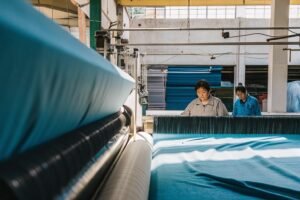
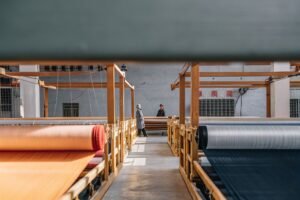
I insist on this for new clients with large orders. I walk them through the mill. I don’t turn off the camera when we walk past the "messy" part.
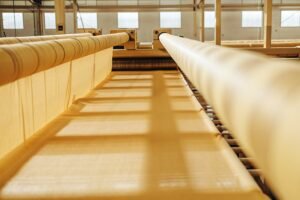
- The Weaving Shed: I show the looms running. Are they modern rapier looms or ancient shuttle looms? You can hear the difference. A quiet, fast click is modern. A loud, earth-shaking CLACK-CLACK-CLACK is 30-year-old tech.
- The Inspection Table: I ask the QC manager to unroll a piece of your bulk fabric live. I point the camera at the edge of the fabric. You look for skewing or bowing. You look for stray threads.
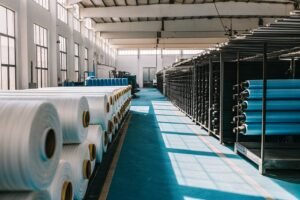
- The Warehouse: I show the storage. Is the fabric on shelves off the floor? Is it covered in plastic to prevent dust?
In January 2025, a Canadian outerwear brand was about to place a re-order. They had a quality issue with the previous supplier (not us) regarding color streaks in the coating. On a video call, I walked them over to our coating inspection machine. I showed them the infrared sensors that detect thickness variations of 0.01mm. I showed them the real-time graph on the monitor. They placed the order on the spot. Why? Because seeing is believing. An email saying "We have good QC" is worthless. Seeing the machine operate and hearing the alarm go off when a flaw is detected? That’s evidence.
What Questions Should You Ask During a Fabric Supplier Video Call?
Alright, you’re convinced. You’re going to hop on a video call. Great. But don’t just wing it. This is your chance to gather intelligence that you can never get from a price list or a spec sheet. A video call is a live audit. You need a checklist. Here are the three questions I recommend every buyer ask while the camera is rolling. These are the questions that separate the professional buyers from the hobbyists.

Should You Ask to See the Reverse Side of the Fabric Live?
Yes. Always. This is non-negotiable.
Remember our earlier blog post about Yarn-Dyed vs. Piece-Dyed? This is where you verify that live. On a photo, a supplier can easily Photoshop the back of a fabric or send you a photo of a different fabric’s back.
What to look for on video:
- Printed Fabric: Ask them to flip it over. If the back is solid white or pale gray, it’s a Surface Print. It will fade and crack. If you see a faint "shadow" of the pattern, it’s a Penetration Print (higher quality).
- Coated Fabric: Ask to see the back. Is it shiny? Is it flaking off? Have them stretch the corner of the fabric live. A good PU coating will stretch with the fabric. A cheap coating will crack and show white stress marks immediately.
- Knit Fabric: Ask them to stretch it width-wise live. Does it recover instantly? Or does it stay stretched out and "baggy"?
I had a US swimwear brand on a call in February 2025. They asked to see the back of the "Eco-Friendly Gloss" nylon. When the supplier flipped it over live, the back was a dull, matte grey instead of matching the front shine. The buyer realized it was a laminate, not a true dye. That question saved them from ordering 2,000 meters of delaminating swimwear.
Why Is It Crucial to Discuss Minimum Order Quantity on Camera?
MOQ is the most lied-about number in the textile industry. A sales rep will email you: "MOQ 500 meters." You place an order for 500 meters. Then the "but" comes. "But for this color, it’s 800m." "But for this print, it’s 1,200m."
On Video, You Can Negotiate Visually.
I find it much easier to explain MOQ constraints on video because I can show you why.
If you want 50 meters of a custom stripe, I can point the camera at the Warping Creel. I can show you the massive machine with hundreds of spools of yarn. I can say, "Look at this machine. To set this pattern up, we have to thread 2,400 individual yarn ends. It takes a technician 8 hours. That’s why the MOQ is 1,500 meters. It’s not a policy. It’s physics."
When you see the complexity of the setup, you understand that the MOQ isn’t a scam. It’s the reality of industrial production. And often, because we’re on video and the conversation is fluid, we can find a workaround. "Okay, I can’t do 50 meters of a custom stripe. But what if we use this stock stripe from the shelf? I’ll hold it up. See? It’s 90% the same look. MOQ on that is only 200 meters."
This kind of visual problem-solving is impossible via email. Email invites "No." Video invites "How about this instead?"
How to Build Trust with a Chinese Fabric Supplier Over Video?
This is the unspoken, intangible benefit of the video call that no spreadsheet can quantify. Guanxi (relationship). It’s the Chinese concept of relationships and trust. Business in China, especially in a traditional industry cluster like Keqiao Textile City, still runs on trust. Contracts matter, but relationships matter more. And you cannot build a relationship over 100 emails.

Can a Video Call Help Verify the Factory’s Actual Location?
I’m going to let you in on a dirty secret of the industry. There are "Trading Companies" in downtown Shanghai skyscrapers who claim to own mills in Keqiao. They have beautiful websites with stock photos of looms. When there’s a problem with the quality, they point fingers at the "factory" (who you can’t talk to).
The "Window Test" on Video:
Ask the sales rep to walk to the window. Just a simple request. "Hey, can you show me the view from your office?"
If they are in a Keqiao mill, the view will be: Other factory roofs, piles of fabric rolls in a yard, a hazy sky, and maybe a truck backing up. You’ll hear the constant hum of machinery.
If they are in a Shanghai trading office, the view will be: A high-rise building across the street, a Starbucks, and a metro station.
Real World Example:
A UK startup was sourcing Tencel twill from a "supplier" they found on Alibaba. They had a bad feeling. They asked for a video call. The rep was in a pristine, silent office. The buyer asked to see the "warehouse." The rep said, "The warehouse is 2 hours away, I can’t go now." Red flag. They walked away.
When they came to Shanghai Fumao , the first call I did was from the dye house floor. I was wearing earplugs. I had to shout over the sound of the stenters. The buyer laughed and said, "Okay, you’re a real factory." That sound of noise is the sound of authenticity.
Does Face-to-Face Conversation Improve Payment Term Negotiation?
Payment terms are the final frontier of sourcing stress. Everyone wants 30% deposit, 70% against B/L copy. But what if the order is small? What if you’re a startup?
Email negotiation on payment is transactional.
"Can we do Net 30?"
"No. Company policy."
End of conversation.
Video negotiation on payment is relational.
On a call, I can see you. You’re a real person with a real brand. You’re not just an email address. I can hear the passion in your voice when you talk about your collection. I can see the samples you’ve already made on your desk behind you.
Because of that visual connection, I’m more willing to go to our finance department and argue for an exception. "Hey, this is a good guy from Texas. He’s launching his first line. The order is small, but he’s got a great concept. Can we do 50% deposit, 50% before shipment instead of 70/30?"
I’ve done this dozens of times. Not because I’m a soft touch, but because the perceived risk is lower. On a video call, I can read your non-verbal cues. Are you shifty? Are you confident? It’s basic human psychology. We trust people we can see. It’s why banks have offices instead of just PO boxes.
Conclusion
We live in an age of AI chatbots, automated re-order emails, and digital supply chain dashboards. And yet, the most powerful tool for sourcing fabric from 6,000 miles away is still a grainy, occasionally laggy video call. Why? Because fabric is analog. It has weight, texture, and color that shift with the light. It drapes and crinkles and sounds a certain way. Email flattens all of that. Email turns a beautiful, complex, three-dimensional material into a flat, 2D representation that is almost always a lie.
A simple sales rep video call is better than 100 emails because it restores the Context. It lets you see the white balance, hear the loom noise, and judge the character of the person on the other end of the deal. It collapses 3-week color approval cycles into 20-minute conversations. It turns "Company Policy" into "Let me see what I can do for you."
At Shanghai Fumao , our WeChat and WhatsApp are always open for video. We don’t hide behind generic inboxes. We want you to see the fabric, see the mill, and see us. Because we know that once you do, the emails become a lot shorter and the orders become a lot smoother.
So next time you’re stuck in an endless email thread about a lab dip or a drape question, just reply with one line:
"Can we jump on a 10-minute video call?"
It might just save your production calendar.
Ready to see the fabric for real? Schedule a video walkthrough of our Keqiao showroom with our Business Director, Elaine. She’s got the camera, the lightbox, and the fabric ready to go.
Email Elaine to book a time: elaine@fumaoclothing.com
Stop emailing. Start seeing.