
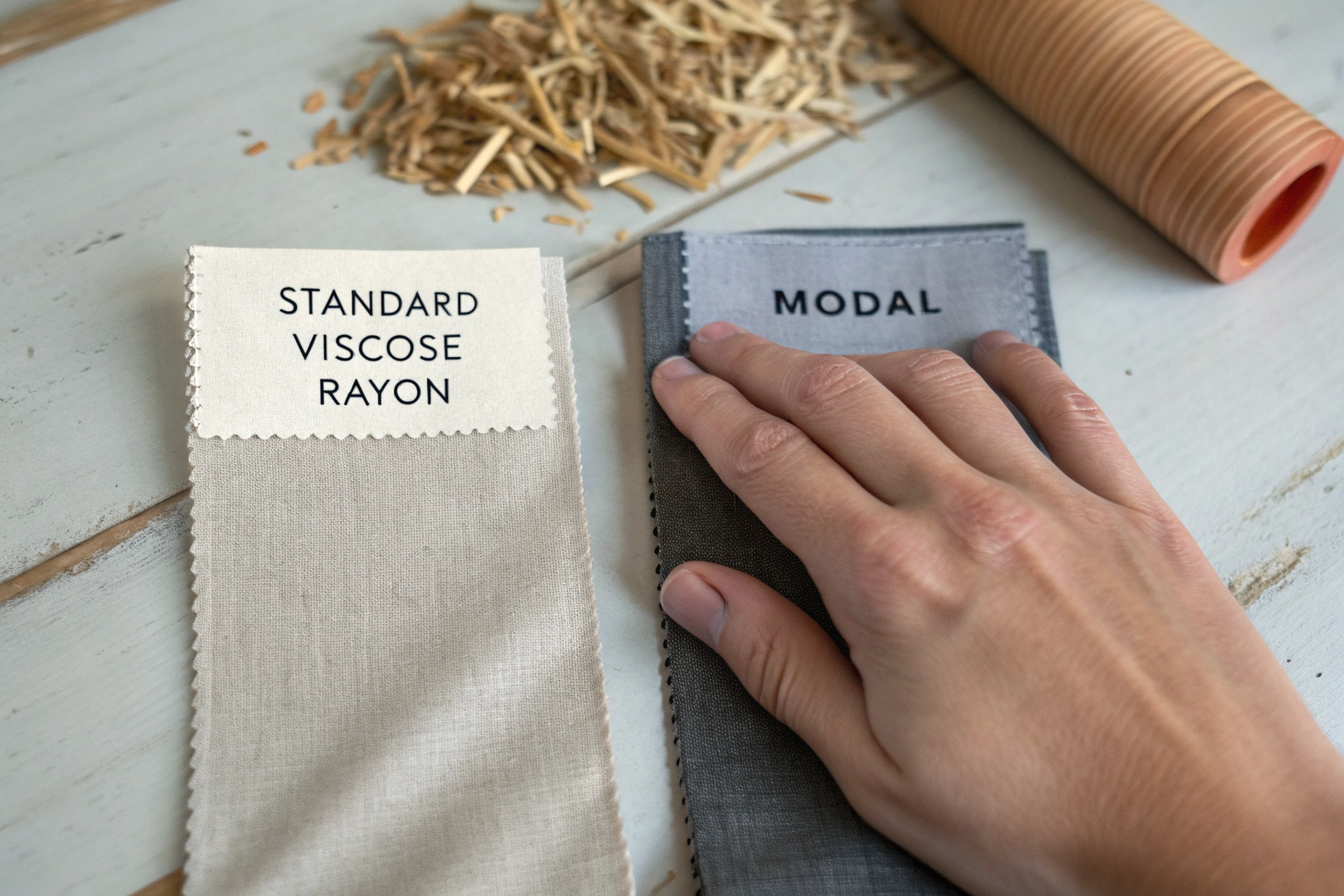
You are sourcing a new line of loungewear. The designer keeps rejecting the standard rayon samples. "It feels okay," she says, rubbing a swatch between her fingers, "but it does not have that modal softness. I want the fabric that feels cool and buttery the second you touch it." You look at the two spec sheets. Both say "100% regenerated cellulose." Both are priced in a similar range for "premium" rayon. You cannot see the difference on paper, but your fingers know it instantly. One feels like a decent blouse. The other feels like a luxury skin treatment.
Modal is softer than regular rayon because it is made from a different source material that produces a purer cellulose with a longer polymer chain, spun through a different process that creates a more uniform fiber cross-section and a smoother surface. The raw material, the manufacturing chemistry, and the physical fiber structure all contribute to a softness that standard viscose rayon cannot match. The difference is measurable—in fiber fineness, in wet strength, and in surface friction—and it is perceptible to the consumer within a second of touching the fabric. At Shanghai Fumao, I develop fabrics in both standard viscose and modal, and I guide brands toward modal when the hand feel is the primary selling proposition. I am going to explain the material science behind modal’s softness, the manufacturing differences that create it, and how to verify you are getting genuine modal and not a viscose substitute.
What Raw Material Difference Makes Modal Inherently Softer?
Modal is a specific type of rayon, but not all rayon is modal. The difference starts at the raw material source. Standard viscose rayon can be made from a wide variety of cellulose sources—bamboo, eucalyptus, pine, spruce, hemlock, or even cotton linter waste. The pulp quality varies enormously depending on the source and the processing. Modal is made exclusively from beechwood, harvested from sustainably managed forests in Europe, and processed into a high-purity dissolving pulp that is optimized for fiber production. The beechwood source material is not a marketing story. It produces a cellulose with fundamentally different properties than the mixed-source pulp used for standard viscose.

Why Does Beechwood Cellulose Produce a Longer Polymer Chain?
Cellulose is a natural polymer made of repeating glucose units linked by beta-1,4-glycosidic bonds. The length of the polymer chain—the degree of polymerization—determines the strength, the flexibility, and the softness of the resulting fiber. A longer polymer chain means the fiber can be drawn finer without breaking, and the fiber surface is smoother because there are fewer chain ends protruding.
Beechwood cellulose, as processed for modal production by Lenzing AG, has a higher average degree of polymerization than the mixed-source pulp used for standard viscose. The beechwood trees are harvested at a specific age, and the pulping process is optimized to preserve the cellulose chain length. The result is a pulp that can be spun into a fiber with a linear density as fine as 0.8 to 1.0 denier per filament. Standard viscose fibers typically range from 1.2 to 2.0 denier per filament. A finer fiber bends more easily. It has a lower cross-sectional area, so it requires less force to deform. When you touch a modal fabric, your fingers are pressing against thousands of ultra-fine, flexible fibers that yield with almost no resistance. That is the physical sensation of softness.
How Does "High-Wet-Modulus" Chemistry Contribute to Softness?
Modal is classified as a high-wet-modulus rayon, a category defined by its ability to retain strength and dimensional stability when wet. Standard viscose loses roughly 40% to 50% of its tensile strength when saturated with water. Modal retains approximately 70% to 80% of its dry strength. This wet strength difference is not just a durability feature. It affects softness during wear.
When you wear a modal garment against your skin, the fabric absorbs moisture vapor from your body. A standard viscose fabric weakens as it absorbs moisture. The fibers become limp, lose their resilience, and can feel flat and clammy. A modal fabric retains its fiber integrity. The fibers remain springy and resilient even when damp. The fabric continues to feel soft, dry, and pleasant against the skin throughout the day. This moisture-stable softness is what the textile industry calls "dry touch" or "cool touch," and it is one of the main reasons modal is preferred over standard viscose for activewear, underwear, and loungewear.
How Does the Modal Spinning Process Differ from Viscose Spinning?
Modal is produced using a modified viscose process. The basic chemistry—converting cellulose into a soluble derivative, extruding it through a spinneret, and regenerating the cellulose in an acid bath—is the same as viscose. But the process parameters are different. The cellulose solution is more concentrated. The spinneret has finer holes. The coagulation bath is formulated to slow down the regeneration, allowing the fiber to be stretched more before it solidifies. This additional stretching, combined with the finer extrusion, produces a fiber with a smoother surface, a rounder cross-section, and a higher degree of molecular orientation than standard viscose.

Why Does "Fiber Fineness" Directly Translate to Tactile Softness?
Fiber fineness is measured in denier per filament, or dpf. A lower denier means a finer fiber. The relationship between fiber fineness and perceived softness is non-linear. A fiber that is 20% finer does not feel 20% softer. It feels dramatically softer because the bending rigidity of a fiber is proportional to the fourth power of its diameter. A fiber with half the diameter has one-sixteenth the bending rigidity.
Modal fibers are typically 0.8 to 1.3 dpf. Standard viscose fibers are typically 1.5 to 2.5 dpf. The modal fiber is roughly half the diameter of the viscose fiber in some cases. This means the modal fiber bends with roughly one-sixteenth the force. Multiply this across thousands of fibers in a fabric surface, and the collective tactile experience is dramatically softer. The consumer’s fingertip detects almost no resistance. The fabric feels like it is melting under the touch.
How Does a "Round Cross-Section" Create a Smoother Fabric Surface?
The cross-sectional shape of a fiber determines how it interacts with neighboring fibers and with the skin. Standard viscose fibers, depending on the coagulation bath conditions and the spinneret design, often have an irregular, serrated, or kidney-bean-shaped cross-section. This irregularity creates micro-scale texture on the fiber surface. When these fibers are spun into a yarn and woven or knitted into a fabric, the surface has a slight granular roughness.
Modal fibers are engineered to have a round, smooth cross-section, achieved by optimizing the coagulation bath chemistry and the spinneret hole geometry. A round fiber packs more smoothly against neighboring round fibers. The yarn surface has fewer projecting edges. The fabric surface reflects light more evenly, creating a subtle luster. Against the skin, a round fiber glides rather than dragging. The combination of fine denier and round cross-section is what gives modal its signature "buttery" hand feel.
How to Verify You Are Getting Genuine Modal, Not a Viscose Substitute?
Modal is a branded fiber. The name "Modal" is a trademark of Lenzing AG, the Austrian company that invented and still dominates the production of this fiber type. Fabrics labeled "modal" should contain Lenzing Modal fibers, not generic high-wet-modulus rayon from another source. The brand distinction matters because Lenzing Modal is produced to a consistent quality standard, with a guaranteed fiber fineness, wet strength, and sustainability certification. Generic "modal-like" fibers may be marketed under the term, but they do not have the same performance or the same verification trail.

What Is the "Lenzing Modal Certificate" and How Do You Check It?
A genuine Lenzing Modal fabric should come with a Lenzing Certificate of Origin or be produced by a mill that is a Lenzing-licensed partner. The certificate confirms that the fiber used in the fabric is authentic Lenzing Modal, produced in Lenzing’s facility in Austria or its licensed production sites. The certificate will have a lot number, a fiber type designation, and a traceable supply chain reference.
You can verify the certificate by contacting Lenzing directly or by checking with your fabric supplier for their Lenzing license number. At Shanghai Fumao, I am a Lenzing-licensed partner, and I provide the Lenzing fiber certificate with every modal fabric lot. If a supplier claims "modal" but cannot produce a Lenzing certificate, they are either using a non-Lenzing high-wet-modulus rayon—which may or may not perform similarly—or they are using standard viscose and mislabeling it. Ask for the fiber certificate before you pay for a modal fabric.
How Does the "Formic Acid-Zinc Chloride Test" Distinguish Modal from Viscose?
The chemical solubility test under ASTM D276 or AATCC TM20 can distinguish modal from standard viscose based on their different degrees of polymerization and different dissolution rates. Modal, with its longer polymer chains and higher crystallinity, dissolves more slowly in a 90% formic acid and zinc chloride solution than standard viscose. Standard viscose dissolves quickly. Modal persists longer.
This test requires a small amount of chemical reagent and careful timing, so it is best performed by a textile testing lab. But the result is definitive. If you suspect a supplier has substituted viscose for modal, send a fabric sample to an ISO 17025-accredited lab and request a fiber identification test that distinguishes modal from viscose. The lab report will state whether the fiber is viscose rayon or modal/high-wet-modulus rayon. The cost is roughly $100 and the turnaround is about a week. It is the ultimate verification when a certificate is unavailable or suspicious.
Conclusion
Modal feels softer than regular rayon because it is made from beechwood cellulose with a longer polymer chain, spun into a finer fiber with a rounder cross-section, and processed with a modified viscose process that stretches the fiber more before it solidifies. The finer fiber—as low as 0.8 denier per filament compared to 1.5 to 2.5 for standard viscose—bends with dramatically less force, and the round cross-section creates a smoother surface that glides against the skin. Modal retains its softness when damp because of its high wet modulus, unlike standard viscose which weakens and loses resilience. Genuine modal is a Lenzing-branded fiber, and the Lenzing certificate is your assurance that the fabric contains authentic modal fiber, not a generic substitute.
At Shanghai Fumao, I develop modal fabrics in weights from lightweight 120 GSM single jersey to heavyweight 400 GSM french terry, in 100% modal and modal-rich blends with cotton, Tencel, and recycled polyester. Every modal lot ships with the Lenzing fiber certificate and our internal mill test report. If you are developing a product where hand feel is the primary selling point, and you want to experience the difference between standard viscose and genuine modal for yourself, please contact our Business Director, Elaine. She can send you a modal swatch pack with different weights and blends, along with the corresponding Lenzing certificates. Email her at strong>elaine@fumaoclothing.com. Let us build a fabric that feels as good as it looks.








