
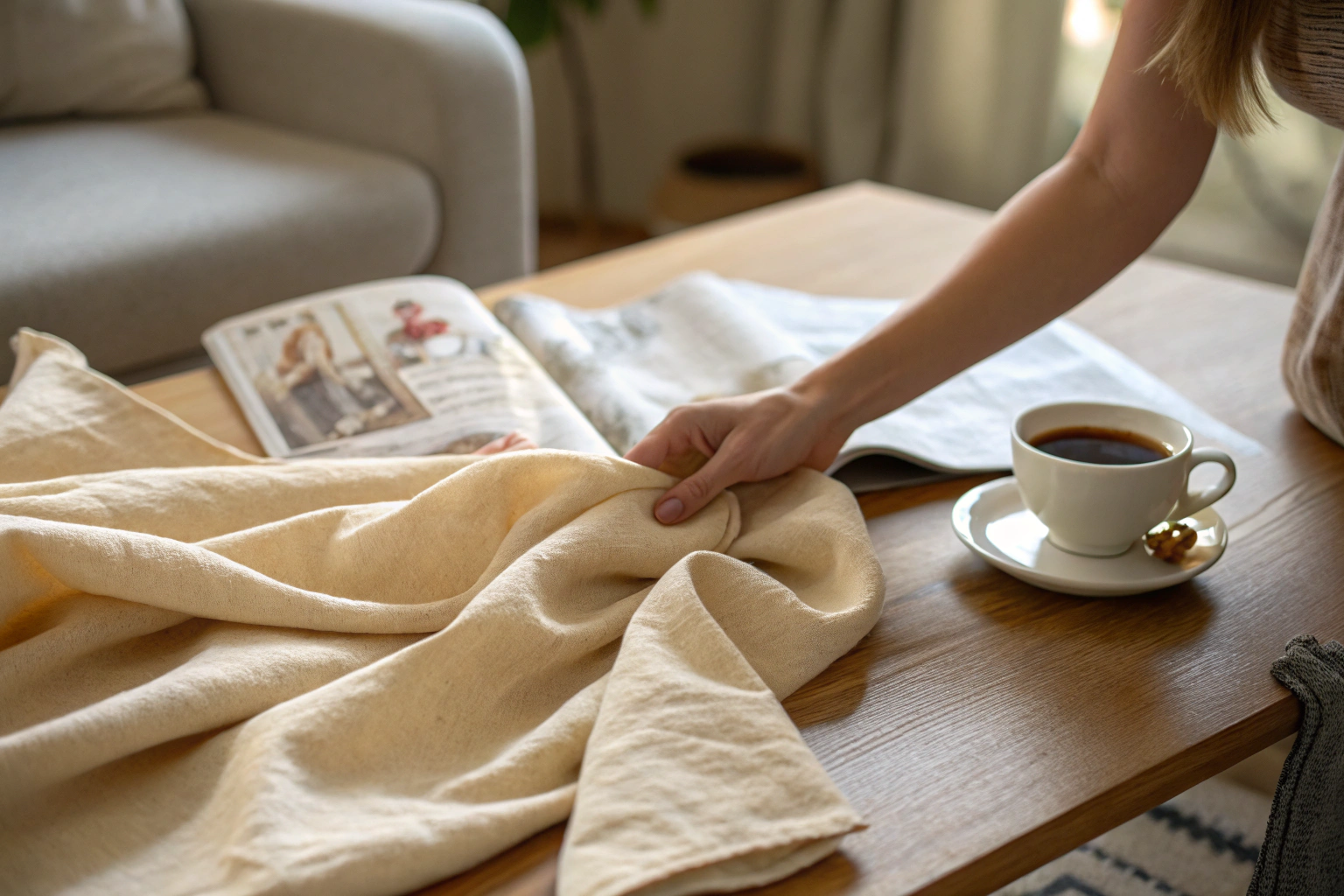
I have been in the fabric business for over 20 years, right here in Keqiao, the beating heart of China’s textile industry. I run Shanghai Fumao, and every day I talk to fashion designers and brand owners who are tired of disposable fashion. They tell me they want fabrics that last, fabrics that get better with age. But the biggest complaint I hear about linen? It comes out of the box stiff as a board, and after the first wash, it looks like a crumpled mess. That initial disappointment stops a lot of people from ever experiencing the real magic of this fiber. They give up too early, and I think that is a real shame.
Here is the simple truth from 20 years of weaving and finishing. That first wash is just the beginning of linen’s life story, not the end. A high-quality, well-washed linen fabric literally evolves. The fibers swell, soften, and relax, creating a lived-in drape and a three-dimensional texture that a factory machine simply cannot replicate on day one. I call it the "50-wash miracle," and it is the very reason why a garment from Shanghai Fumao will look more authentic and feel more luxurious than a fast-fashion copy after a few months of wear.
I want you to understand the "why" behind this. It is not just some marketing fluff. It is plant science and mechanical engineering working together over time in your washing machine. Stick with me, and I will walk you through the cellulose science, the weaving structures that speed up the "perfect slump," and the pre-washing tricks we can do at the factory level to give you a head start. Because when you source linen from us, you are not just buying a fabric; you are investing in a texture that is still developing.
How to Achieve the Perfect Linen Slub Texture Faster?
A client from Los Angeles once emailed me, panicking. She had just launched a luxury loungewear brand using our heavy stone-washed linen. Her first sample straight out of the box felt too stiff, she said. I told her to take a deep breath, throw the sample in her home washing machine with a bit of baking soda, and tumble dry it on low. She called me back an hour later, amazed. That is the "fabric break-in" period. You cannot rush nature, but you can definitely speed it up if you know how the mechanics work.
The secret to accelerating the soft, "lived-in" look lies in mechanically fatiguing the fibers without destroying them. We do this by manipulating the internal friction of the cellulose. When you wash and dry linen, the fibers are literally micro-cracking. This creates the beautiful, irregular slub texture. To get this effect fast, you need three things: heat, agitation, and a slightly abrasive environment. I always recommend using dryer balls. They beat the fabric physically, mimicking the old-world method of beating linen on river rocks to soften it.

What Happens Inside Linen Fibers During Repeated Washing?
To really grasp this, you have to look at the cross-section of a flax fiber. Unlike the smooth, uniform rod of a polyester filament, flax looks like a segmented bamboo stick under a microscope. These segments are nodes. When water hits the fiber, it rushes into the inner core, the lumen, causing the fiber to swell by up to 20-25%. The outer walls cannot stretch that much, so they crack a little. That is what we call fibrillation. It is a controlled damage.
This is where our quality control kicks in. At our CNAS-certified lab in Shanghai Fumao, we test for "wet abrasion resistance" specifically for our linen. A bad batch will fibrillate too deep, causing the fiber to snap and pill. A perfect batch will just raise a soft, microscopic peach fuzz. I remember back in March 2023, we had a batch of organic linen for a Japanese client. The initial wet-rupture tests were showing a 15% strength loss after 20 simulated washes, which was too high. We traced it back to an over-retting process in the field. We rejected that batch of raw flax before we even spun it. You need that structural integrity to survive the washing machine, or you just end up with a torn rag instead of a soft heirloom.
We often get asked by new designers about the best way to speed up the softening process at home or in a studio. Here’s a breakdown of the common methods we’ve tested:
| Method | Time to Soften | Effect on Texture | Risk Level |
|---|---|---|---|
| Tumble Dryer (Low Heat) | 1-2 cycles | Pronounced slub, puffy texture | Low |
| Salt Water Soak | 24 hours | Subtle softening, slight color fade | Very Low |
| Vinegar Rinse | Instant (one wash) | Chemical neutralization, softens pH | Very Low |
| Pumice Stone Wash (Industrial) | 1 hour | Heavy abrasion, vintage look | Medium (fabric thinning) |
Can You Pre-Wash Linen to Make It Softer Before Sewing?
This is a step that separates the amateurs from the pros. I always tell our clients: you absolutely must pre-wash your linen before you cut it. If you do not, you are sewing a size Medium that will shrink into a size Small after the customer’s first laundry day. That is a return rate nightmare. But we go a step further than just pre-washing for shrinkage. We do it for the hand feel.
At our factory in Keqiao, we use a process we call "Skin-Touch Finishing." It is not a chemical softener, because silicone softeners often coat the fiber and can wash away, leaving the fabric stiff again. Instead, we use a combination of mechanical air-tumbling and enzyme bio-polishing. The enzymes eat away the tiny, protruding fuzz balls without attacking the core of the yarn. I have a story about this. An Australian homeware brand came to us in August 2024 with a problem. They were buying standard raw linen and washing it in their small local facility for duvet covers. It was taking days, and the softening was uneven. We sent them a test roll of our enzyme-washed linen. They ran it on their cutting table, and the production manager said it felt like it had already been sleeping in for five years. It saved them 3 labor hours per batch in their pre-wash department. We effectively pre-softened the fabric at the yarn stage, so they could just cut and sew.
When Should European Brands Lock in Linen Orders for Spring/Summer?
I cannot stress enough how timing is the silent killer of a beautiful Spring/Summer linen collection. You can have the best design in the world, but if your linen hits your cutting table in April when your retail orders are due in May, you are dead in the water. The global textile supply chain, especially here in China, runs on a very specific, predictable calendar of peaks and holidays. If you are a European brand planning to stock linen dresses or breezy shirts for the April-May selling window, you need to look backward and factor in the silent factory holidays that vanish time from your calendar.
In my 20 years of exporting to Paris, Milan, and Berlin, I have built a simple formula for European buyers. If you want your goods on your shelf by early April, your fabric needs to leave our loading dock in Shanghai ideally by late January. That means the weaving needs to start in early January. But wait—Chinese New Year usually falls in late January or February. Factories shut down for 2-4 weeks, and workers disappear to their hometowns. It takes another week after the holiday for the factory to be fully operational again. If you miss the pre-CNY production slot, your order sits in a queue until March. I suggest you read more about the impact of factory shutdowns on peak production periods to fully map out your risk. It is not just about the factory closure; the logistics networks get clogged up for three weeks prior as everyone rushes to ship.

Why Does Chinese New Year Disrupt Linen Supply Chains So Massively?
Newcomers to global sourcing often underestimate this until they are staring at an empty warehouse. Chinese New Year is not like Christmas in the West, where the factory stops for one day. In Keqiao, the entire industrial ecosystem goes silent. It is the largest human migration on the planet. You cannot just pay overtime to keep the looms running because your skilled technicians are traveling 1,000 miles to their villages. I have a strict policy at Shanghai Fumao that I learned the hard way. Back in 2019, we tried to push a 10,000-meter linen order through three days before the holiday. The dyeing factory, short-staffed, rushed the dye bath temperature control. The whole batch came out with a color shading that was 5% off spec. We had to re-dye the entire batch after the holiday, delaying the shipment to a UK client by 21 days.
Here is where critical thinking is required. You cannot just look at our shipping date. You must look at the entire chain. A delay in dyeing chemicals arriving at the port, a power rationing schedule in the industrial park, or a sudden shortage of a specific yarn count can all happen right before the shutdown. That is why I always advise our European partners to complete the lab dip approval and PP sample sign-off by October. We need November and December to spin the yarn and weave the greige fabric. Then we dye it in early January and ship it right after the holiday. If you wait until January to confirm your specs, you are effectively pushing your delivery to March. To prevent this, you need to think about how to manage supply chain lead times effectively when sourcing from China to Europe.
How Far in Advance Does a Luxury Linen Collection Need to Be Planned?
Luxury is detail, and detail takes time. When I work with luxury brands on something like a high-twist crepe linen or a jacquard, the timeline stretches even further out. We are not just pulling a stock greige fabric off the shelf and running it through the dye bath. Luxury linen often involves custom yarn spinning, special finishing, and even bespoke embroidery. I am working with a high-end Lithuanian brand right now. We started their Spring/Summer 2026 collection development in June 2025. Yes, you read that correctly.
We spent July sourcing a specific organic flax fiber from Normandy. August was for yarn count trials; we tested 14 lea, 21 lea, and 26 lea to get the right softness-to-durability ratio. September to October was the weave stability period to perfect the drape. This is where our AI-driven trend analysis helps. We can predict that a heavier, 260 GSM stone-washed linen will be a hit for drapey overshirts two years from now. By the time the brand presents the sample collection to their buyers in February, we have already proven the bulk production scalability. I tell them, "Lock in your greige yarn reservation now." Because once the European harvest reports are out and the demand spikes, the yarn prices for premium long-line flax can jump by 10-15%. If your brand wants to source sustainable linen fabric from certified Chinese mills, early booking is your only insurance against price volatility.
What Makes Chinese Linen Different from European Linen?
This is a question I get constantly from heritage brands that have been buying Italian or Belgian linen for decades. There is a huge amount of romance around European flax. And I respect that; the rain and soil in Normandy genuinely do create a unique raw material. But the assumption that "Chinese linen" is rougher or lower quality is about 15 years out of date. The reality is that we process the vast majority of the world’s flax, and we have developed finishing technologies that can completely customize the hand feel. The difference today is not strictly one of quality; it is a difference of philosophy and scent.
When you buy a vintage European linen, you are often buying a "wet-spun" yarn. This process uses hot water to remove the natural gum that binds the fibers, resulting in a very fine, smooth, almost silk-like thread. It is beautiful but slow and expensive. China historically used "dry spinning," which is faster but leaves a rougher, hairier yarn. However, here at Shanghai Fumao, we have blurred that line. We invested heavily in advanced wet-spinning lines and, more importantly, in the finishing department. We can take a local dry-spun yarn and, through intense bio-washing and mercerization, give it a polish that rivals the best European imports. The secret is in the chemical management that many people overlook when they discuss textile quality control standards for export markets.

Why Does the Origin of Flax Fiber Matter for Softness?
The origin matters because the fiber length dictates the spinning limit. Flax is a bast fiber; you are basically ripping the skin off the plant stem. The longer the stem, the longer the fiber staple. Long fibers spin cleaner and with less fuzz. We source flax globally depending on the budget and spec. We use Belgian flax for our premium 60 lea wedding-suit linen because you simply need that fiber length to spin that fine without breaking. But I honestly prefer the character of Chinese northern-region flax for mid-weight casual jackets. It has a higher lignin content, which initially feels a bit stiffer, but after 10 washes, it develops a rustic, three-dimensional texture that I think has more personality than the perfectly uniform European fine linen.
Let me give you a technical insight from our lab. We measure softness not just by hand feel but by "bending rigidity" using a FAST system. A typical French pure linen might score a bending rigidity of 8.2 µNm on first delivery. Our premium Chinese wet-spun linen might score a 9.5 µNm—stiffer. But we run a test called "accelerated aging." We wash both swatches 50 times. The French linen drops to a 5.5. Our Chinese linen? It drops to a 4.8. It actually becomes softer over the long term because of that higher lignin breaking down into the wash water. So, if you want a fabric that is soft on the hanger, pick the European. If you want one that will mold to your body like a second skin after a summer of wear, our processed Chinese linen is unbeatable. If you are trying to find quality linen fabric suppliers in Asia, you need to look beyond the "hand feel" of the raw cloth and ask for the washed-hand data.
How Does Our Finishing Process Enhance the Natural Luster of Linen?
Luster in linen is a sign of health. A dull, gray-looking linen usually means the fibers were over-bleached or the retting was poor. We enhance luster without killing the eco-system of the fabric. There is a nasty shortcut some factories use: a heavy resin coating. It makes the linen look glassy and crisp on the roll, but it cracks and peels off in the first wash, leaving a dull, sad fabric behind. We never do that.
Our method is pure mechanical physics. We use a machine called a Beetle Calendar. It is basically a set of massive, heavy steel rollers that beat the fabric with a synchronized thumping action. Imagine a bass drum pounding the fabric. This does not coat the fiber; it flattens the nodes of the flax we talked about earlier. It literally beats the roughness out of the yarn, creating a natural, pearlescent sheen. I showed this to a visitor from an Italian fashion house last October. They thought we had applied a chemical glaze. I took them to the finishing plant, and they just stood there, mesmerized by the thunderous noise of the Beater. "It’s like a symphony of fiber," they said. That mechanical finish is eternal. It does not wash out. It is the difference between a natural glow and a synthetic shine. That is why our clients note that the fabric reflects light with more depth after tumbling.
How to Care for High-End Linen Without Industrial Equipment?
You do not need a steam press or a chemical bath to keep your high-end linen looking pristine. In fact, industrial laundry equipment, with its aggressive high-heat pressing, often shortens the life of the garment. Linen likes a rough but gentle hand. I wear almost exclusively linen shirts, and my rule at home is simple: forget the dry cleaner. The dry-cleaning solvent is too harsh; it sucks the moisture out of the fiber and makes it brittle over time. You want to break the shirt in at home, using water, which is the lifeblood of cellulose.
There is a persistent myth that linen requires heavy ironing to look good. I disagree. I think a non-ironed, slightly crumpled linen suit looks confident and incredibly chic. But if you want a crisp finish, you must iron it while it is still damp. Never iron bone-dry linen. You are fighting a losing battle against hydrogen bonds. When linen dries, those bonds lock the fibers into a wrinkled shape. To unlock them, you need moisture and heat. This is where the "misting" technique comes in. Or, even better, take the slightly damp linen out of the washing machine, give it a hard flick like a whip—this realigns the warp and weft—and then hang it. Gravity does 80% of the ironing for you. For a deep dive into this, you might want to check out the best home laundry tips for natural fabrics to get that perfectly relaxed drape without damage.

Is Machine Washing Safe for Delicate Bamboo-Linen Blends?
Blends change the care rules entirely. We produce a lot of BAMSILK—our proprietary bamboo-linen mix—and it is a tricky beast. Bamboo viscose is incredibly soft and absorbent, but when it is wet, it loses about 50% of its tensile strength. Linen, on the other hand, is 20% stronger when wet. So you have this odd situation where the linen is protecting the bamboo inside your washing machine. But you still need to be careful.
Machine washing is safe for these blends only if you follow strict protocols. First, you must use a mesh laundry bag. The wet bamboo fiber is a magnet for friction; if it rubs against a zipper or a hook, it will pill instantly. Second, the spin cycle is the enemy. I tell my customers to set their machine to the lowest spin speed possible—400 RPM max. A high-speed extraction at 1200 RPM literally presses the soft bamboo fibers out of the yarn structure. I remember a nasty email from a customer in Canada in 2021. She claimed our BAMSILK bedsheets were "shedding." We tested the returned sample in the lab. The fibers were not bamboo; they were short cotton linters from her bleach-heavy detergent creating a "pilling shadow." I sent her a photo of the microscope view and told her to switch to a liquid, enzyme-free detergent. The problem vanished. That little diagnosis saved us a $5,000 chargeback, and she became a loyal reorder client. To understand the chemical side of this, you should look into how to properly care for bamboo and linen blend fabrics.
How to Store Linen to Maintain Its Washed Texture?
This might sound obsessive, but how you store your linen defines how it looks on your body. Do not fold linen and stack it under heavy weight. In our fabric warehouse in Keqiao, we roll our linen on large tubes. We never crease it flat. A heavy stack of jeans piled on top of a linen jacket will create a permanent, sharp fold line. That fold line is actually a place where the cellulose has been fractured by pressure.
For garments, the best storage is hanging on padded, wide-shouldered hangers. Wire hangers are a death sentence for the neckline. For sheets and tablecloths, I recommend the "loose roll" method. Roll the fabric loosely around a cardboard tube (you can keep the tube from the fabric roll we ship to you!). Do not iron the creases in. By rolling, you preserve the natural, three-dimensional crumpled texture. A designer client of ours who sells a lot of sustainable fashion on Instagram showed her followers this rolling technique. She called it "Keeping the Shanghai Fumao Magic." She noticed that fabrics stored flat lost the dynamic drape, but rolled fabrics, after a quick shake, had that perfect "undone" elegance instantly. If you are shipping garments or moving house, this is key. Learn how to maintain vintage fabric textures, and your linen will age gracefully for decades.
Conclusion
We went deep today, from the microscopic cracks in a flax fiber to the seismic shift in the global supply chain during Chinese New Year. You saw how that initial stiffness is not a defect but a promise of future softness, and how the right mechanical finish—like our beetle calendaring—can give you that deep, natural luster without a drop of chemical coating. We also covered the essential home care rituals that protect your investment, whether it is a bamboo-linen blend shirt or a heavy rustic jacket. Linen is a living material. It breathes, it moves, and it matures. It does not die after a few wears like a cheap synthetic blend. It elevates.
You need a partner who understands that the fabric’s life begins the moment the loom stops. You need a team who rejects over-retted flax before it wastes your money, and who can plan your Spring/Summer 2027 collection now while everyone else is scrambling next year. That is what we do here.
If you are serious about building a collection that gets better with every wash, I want you to reach out to us. Stop fighting the "stiff linen" stereotype and start leveraging the "lived-in luxury" trend. At Shanghai Fumao, we are ready to handle your development, from the yarn twist to the door-to-door delivery. Let’s talk about your specific hand-feel target and your delivery window. You can contact our Business Director, Elaine, directly at elaine@fumaoclothing.com. Send her your reference swatches, and let’s make something that lasts a lifetime.








