
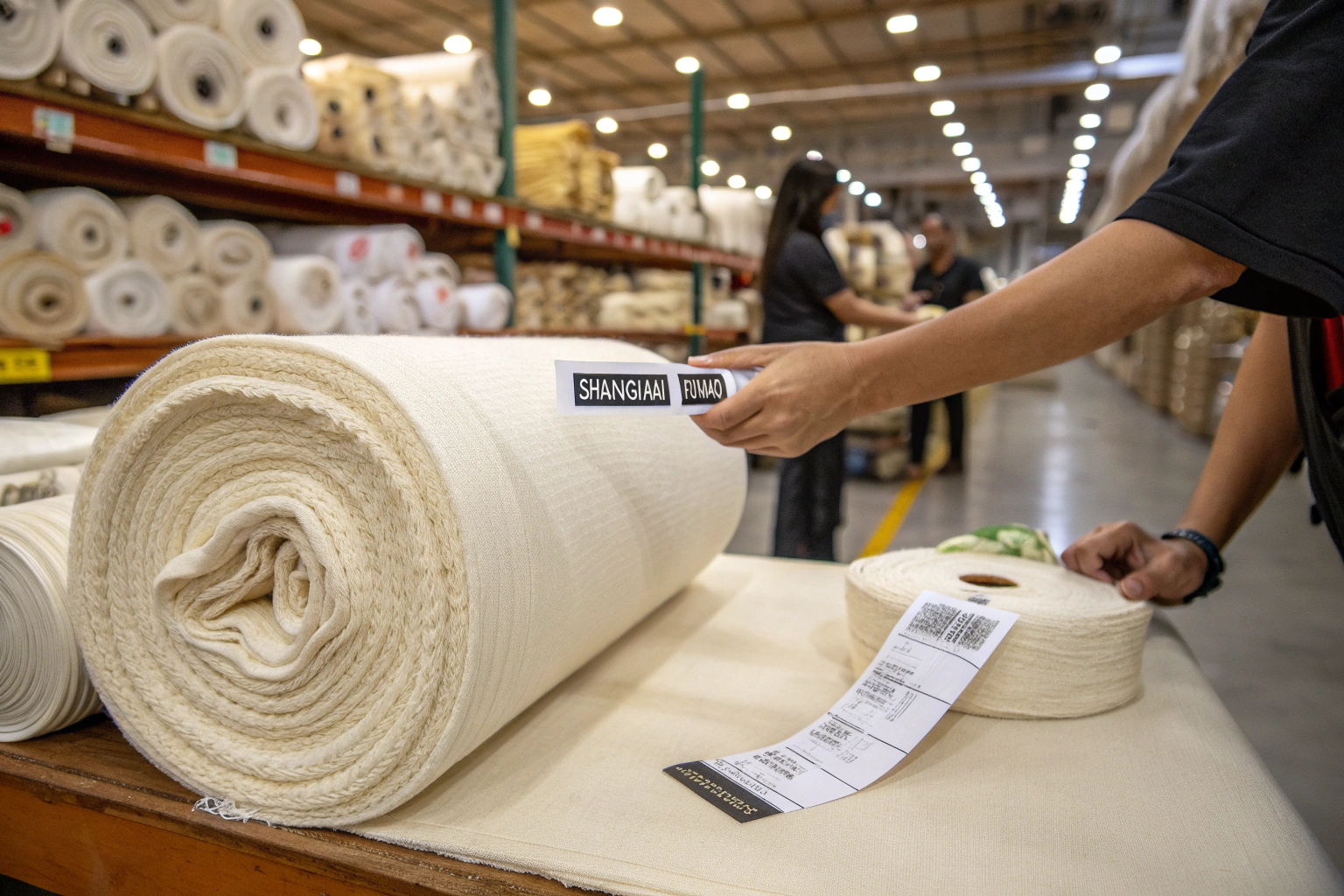
A distributor in Los Angeles who buys our cotton lycra jersey called me last year with a confession. "I sell your fabric for three times what I pay you," he said, "and I cannot keep it on the shelf. My buyers don’t even ask about the price anymore. They just ask when the next shipment lands." Then he paused and added the part that stuck with me. "I know they could find you on Alibaba if they searched hard enough. But they don’t. They want to buy from me. And I want to understand why that keeps happening so I don’t mess it up."
That question is the core of modern textile distribution. The internet was supposed to disintermediate the middleman. Buyers were supposed to go direct to the mill, cut out the markup, and pocket the savings. But the opposite happened in many segments. Distributors who buy from Shanghai Fumao are thriving, marking up our fabric 2.5x to 3.5x and building loyal customer bases who return season after season. The reason is not that buyers are lazy or uninformed. It is that distributors solve four specific, painful problems that direct mill sourcing creates, and they solve them so effectively that the markup represents genuine value, not a friction tax.
What Immediate Availability Problem Do Distributors Solve That Direct Mills Cannot?
The most expensive fabric in the world is not the high-priced Italian wool. It is the fabric that arrives two weeks after your production deadline. A mill’s minimum lead time, even a fast mill like ours, is a structural reality. We dye to order. We finish to order. We do not hold inventory of every color in every construction because the SKU count would be astronomical and the working capital cost would sink the business.
Distributors invert this model. They take a calculated inventory risk on a curated selection of our best-selling qualities and colors. They buy 5,000 meters of our 240gsm cotton lycra jersey in black, white, navy, and charcoal, and they stock it on their shelves in Los Angeles, London, or Sydney. When a local activewear brand wins a rush order for 200 leggings that need to ship in seven days, the distributor has the fabric ready to cut that afternoon. The brand does not care about the 3x markup in that moment. They care about capturing the revenue from a rush order that would have been impossible to fulfill otherwise. The markup is not a material cost. It is a speed insurance premium.
How Does a Distributor’s Shelf Stock Eliminate the 30-Day Mill Lead Time for Repeat Orders?
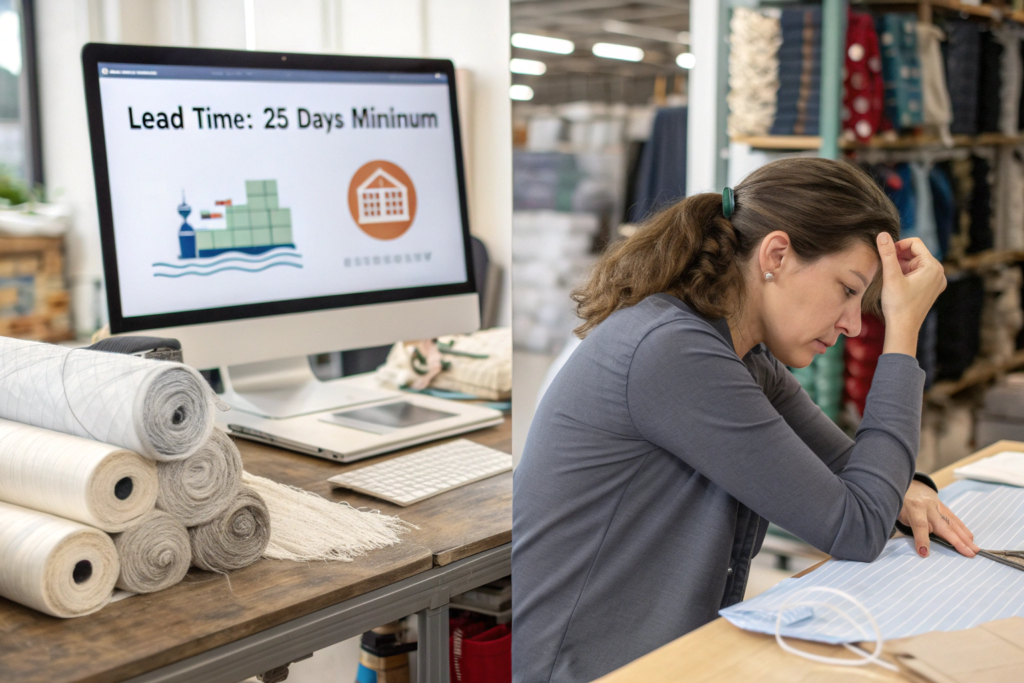
A direct mill reorder for dyed fabric, even for a repeat color with a locked recipe, takes time. The dyeing schedule is booked. The finishing line has a queue. The fabric must cool and relax after calendering. The inspection takes time. The documentation takes time. Even with our fastest expedited production, a repeat order rarely ships in less than 15 days from order confirmation, and 25 days is a more realistic standard.
A distributor who stocks your fabric collapses that 25-day timeline to zero. The fabric is already dyed, finished, inspected, and sitting on a shelf, measured by the meter. The brand sends a purchase order. The distributor cuts the fabric from the roll, packages it, and ships it the same day. The fabric arrives at the brand’s cutting table in 48 hours. This speed enables a completely different business model for the brand. They can operate with lower inventory, accept shorter-lead-time orders from their own wholesale customers, and respond to viral trends without gambling on a 5,000-meter mill minimum order.
I have seen brands build their entire production strategy around distributor availability. They keep a small safety stock of core colors from the distributor, and they only place direct mill orders for their large seasonal volume commitments where the 25-day lead time is accounted for in the calendar. The distributor and the mill are not competitors in this model. They are complementary inventory layers serving different order profiles. The brand pays a premium for the inventory service, but the premium is less than the cost of carrying their own safety stock or losing a rush order.
What Is the Real Cost of Waiting 25 Days for a Direct Mill Order Versus Paying the Markup?
The math of lead time cost is brutal and often ignored by buyers who fixate on the per-meter price. Let us assume a mid-sized brand places a $15,000 rush order from their own retail customer: 500 units of a simple garment, wholesale price $30 per unit, total order value $15,000. They need 500 meters of fabric. The direct mill price is $6 per meter. The distributor price is $18 per meter. The mill lead time is 25 days. The distributor ships today.
If the brand orders from the mill, the fabric costs $3,000. But the fabric arrives in 25 days. The retail customer cancels the rush order because they needed the garments in 21 days. The brand loses $15,000 in revenue. The $3,000 fabric cost saved is irrelevant against a $15,000 revenue loss. If the brand orders from the distributor, the fabric costs $9,000. The fabric arrives in two days. The garments are produced and delivered on time. The brand earns $15,000 in revenue, minus $9,000 in fabric cost, leaving $6,000 in contribution margin before labor. The distributor markup was $6,000, and the brand still made $6,000 that they would have made zero on if they had ordered direct.
This is not a hypothetical. It is the standard unit economics of time-sensitive apparel production. The distributor markup is the price of revenue capture. For brands that operate on a seasonal replenishment model with predictable demand, direct mill ordering makes sense. For brands that serve a market where speed is a competitive weapon—fashion, activewear, influencer collaborations, event merchandise—the distributor is the only viable supply chain partner.
| Sourcing Option | Fabric Cost (500m) | Lead Time | Rush Order Outcome | Net Profit Impact |
|---|---|---|---|---|
| Direct Mill | $3,000 | 25 days | Order cancelled, $0 revenue | -$3,000 (fabric wasted or stockpiled) |
| Distributor | $9,000 | 2 days | Order fulfilled, $15,000 revenue | +$6,000 contribution margin |
| Difference | +$6,000 cost | -23 days | Revenue salvaged | +$9,000 net advantage |
Why Do Small Brands Pay a Premium for Pre-Curated Quality Assurance?
The first time a small brand orders fabric directly from an overseas mill, they experience the terror of the unopened box. The container arrives. The fabric looks correct on the outside of the roll. But what is inside? Are there shade bands? Are there weaving defects in the middle of the roll? Does the hand feel match the lab dip they approved six weeks ago? The brand has no in-country quality control infrastructure. They shipped fabric across an ocean without a third-party inspection. They unrolled the fabric and held their breath.
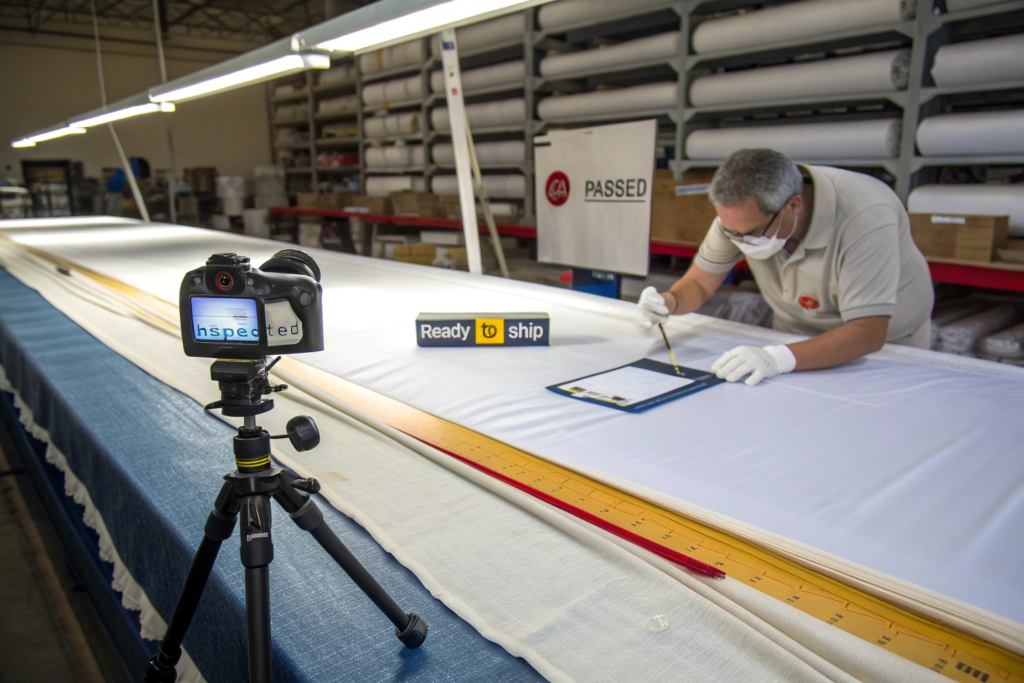
Distributors absorb this risk. They are the quality control layer between the mill and the small brand. They receive the container, unroll the fabric, inspect it under proper lighting, identify and cut out defects, and re-roll only the first-quality yardage. The brand buys fabric that has already been inspected and approved by someone with textile expertise. The markup includes a quality insurance premium, and for a brand that cannot afford a single batch of defective fabric, that premium is a bargain.
How Does In-Person Inspection Catch Shade Variation That Photos Can Hide?
Shade variation is the silent killer of garment quality. A fabric roll may match the lab dip perfectly at the head end and drift subtly toward a different shade by the tail end. The difference is invisible in a cell phone photo. It is barely detectable under warehouse lighting. It becomes screamingly obvious only when the cut panels are sewn together and two adjacent pieces show a visible seam-line contrast.
A competent distributor inspects for shade variation by unrolling a significant portion of every roll—not just the outer layer—and comparing the head, middle, and tail under a D65 lightbox. They use a gray scale or a spectrophotometer to quantify the variation. If the roll shows a Delta E shift of more than 0.8 from end to end, they either reject the roll outright or segment it into smaller lots with a clear shade label so the brand can cut each lot separately and avoid mixed-shade garments.
A direct mill buyer without in-country QC cannot do this. They receive a photo of the fabric from the mill’s inspection table, but the photo is taken under unknown lighting, with an uncalibrated camera, and compressed through WhatsApp. The photo is a representation, not a verification. The distributor’s in-person inspection is the verification. For a detailed guide to these inspection standards, this explanation of how 4-point fabric inspection systems catch defects before cutting describes the methodology that professional distributors apply to every roll.
What Happens When a Direct Mill Shipment Arrives With a 7% Defect Rate?
Seven percent is not a catastrophic defect rate for bulk fabric. It is within the range of normal for many mills, especially for complex finishes or dark solid colors that show every weaving irregularity. But for a small brand that ordered exactly 500 meters to cut exactly 500 garments, a 7% defect rate is a disaster. They now have 465 meters of usable fabric and 35 meters of waste. They are 35 garments short of their order commitment. They cannot reorder 35 meters from the mill because the minimum order quantity is 1,000 meters, and the 25-day lead time would miss the delivery window anyway.
A distributor solves this problem in two ways. First, they have already inspected the fabric and culled the defects, so the brand pays only for first-quality yardage. The defect rate is the distributor’s problem, not the brand’s problem. Second, the distributor stocks extra yardage of core qualities. If the brand is 35 garments short, the distributor can supply an additional 40 meters from shelf stock within 24 hours. The brand completes their order on time.
The direct mill alternative is grim. The brand must either ship 35 units short and face a chargeback from their customer, or place a panic reorder for a full minimum quantity, paying rush charges and air freight, and still delivering late. The distributor’s markup looks very reasonable when compared to the cost of a short shipment chargeback from a major retailer, which can include not just the value of the missing units but punitive deductions for the retailer’s lost sales and administrative costs.
What Local Logistics Advantage Do Distributors Offer That Container Shipping Cannot Match?
Ocean freight is a miracle of cost efficiency. You can move a 40-foot container from Shanghai to Los Angeles for about $2,000 at current spot rates, which works out to roughly $0.02 per kilogram. That efficiency enables global textile trade. But it comes with a brutal trade-off: time, complexity, and minimum scale.
A container makes economic sense when you are moving 5,000 kilograms or more. For a small brand that needs 200 kilograms of fabric, the container is not efficient. It is a logistical burden. They must either pay for a full container that is 95% empty space, or ship LCL (less than container load) and accept the delays, handling damage, and per-kilogram premium that consolidating multiple shipments into one container entails. The distributor eliminates this entire logistics layer. The fabric is already in the country, already customs-cleared, already broken down into small-order-friendly quantities. The brand pays a domestic shipping rate, receives the fabric in days, and never thinks about a bill of lading.

How Does the "No Minimum Order" Policy Change Cash Flow for Inventory-Light Brands?
The mill minimum order exists for a reason. Setting up a dye bath, threading a weaving loom, and scheduling a finishing line have fixed costs that must be amortized over a minimum yardage. Our minimums are low by industry standards—500 meters per color for most constructions—but 500 meters is still a significant cash outlay for a small brand. At $6 per meter, that is $3,000 for a single color in a single fabric. A brand that needs four colors ties up $12,000 in fabric inventory before a single garment is sold.
Distributors break the minimum order constraint. They sell by the meter or by the roll. A brand can buy 50 meters of black, 30 meters of navy, and 20 meters of olive, totaling 100 meters and an invoice of $1,800 at the distributor’s marked-up price. The total cash outlay is 85% lower than the mill minimum, even though the per-meter price is 3x higher. For a cash-constrained brand, total cash preservation is more important than per-unit cost minimization.
This low-minimum model also enables rapid prototyping and market testing. A brand can buy 10 meters of a new fabric, sample a few garments, test them with customers, and only commit to a larger purchase if the market validates the product. They cannot do this with a mill. The mill requires a commitment before the first meter is woven. The distributor provides an option value—the right, but not the obligation, to scale—and option value commands a premium in any market.
What Hidden Costs of International Shipping Are Invisible in the Mill’s Per-Meter Price?
The mill’s FOB price of $6 per meter looks attractive on a spreadsheet. But the spreadsheet is not the invoice. Between the FOB price and the fabric arriving at the brand’s cutting table, a cascade of additional costs intervenes.
Ocean freight for LCL shipments adds $0.50 to $1.50 per kilogram, which translates to roughly $0.30 to $0.90 per meter for a midweight cotton fabric. Marine insurance adds 0.5% of the cargo value. Customs duties on woven cotton fabric entering the US under HTS code 5209.42 add 8.4% of the CIF value. A customs bond, if the shipment value exceeds $2,500, adds a flat fee of $50 to $100. The freight forwarder’s documentation fee, the terminal handling charge at the destination port, and the trucking cost from port to warehouse add another $200 to $500 per shipment. If the brand does not have a customs broker on staff, the broker’s fee adds another $150 to $300.
For a small shipment of 200 meters, these fixed and semi-fixed costs do not amortize. The landed cost per meter can easily double from the FOB price once all logistics costs are included. The distributor’s markup starts to look less like a premium and more like the fully loaded cost of moving fabric across the world, compressed into a simple, single-line invoice. For a breakdown of these costs, this guide on calculating the true landed cost of imported textiles for small apparel brands itemizes every hidden line.
| Logistics Cost Element | Direct Mill LCL (200m) | Distributor Domestic (200m) | Notes |
|---|---|---|---|
| Per-Meter Fabric Price | $6.00 | $18.00 | Distributor price is 3x FOB |
| Ocean Freight & Insurance | $1.20 | $0.00 | Included in distributor margin |
| Customs Duty (8.4%) | $0.60 | $0.00 | Distributor pays duty on bulk import |
| Broker, Drayage, Handling | $2.50 | $0.00 | Fixed fees heavily burden small shipments |
| Total Landed Per Meter | $10.30 | $18.00 | Effective premium shrinks to 1.75x |
| Delivery Time | 28-35 days | 1-3 days | Time value not captured in price |
How Do Fabric Distributors Build "Brand" Trust That a Mill’s Website Cannot Replicate?
A mill’s website can communicate capability. It can show product images, list certifications, and display a contact form. But it cannot communicate the feeling of holding a fabric swatch in your hand while an expert says, "I know what you are trying to make. Let me show you the three fabrics that will work, and the two that definitely will not." That moment of trusted guidance is the distributor’s core value proposition, and it is something no Alibaba listing can replicate.
Distributors build relationships over years. They learn their customers’ aesthetic, their price sensitivity, their production capabilities, and their pet peeves. They become an outsourced fabric sourcing department for brands that are too small to have an internal sourcing team. When a brand trusts a distributor’s recommendation, they are not just buying fabric. They are buying years of accumulated expertise about what works and what fails, and they are paying a premium to avoid the failures they have never experienced but the distributor has seen a hundred times.

Why Does a Distributor’s "Do Not Buy This for That" Advice Justify Their Markup?
I once listened to a distributor in London spend 20 minutes on the phone with a young designer who wanted to buy a specific viscose twill for a structured blazer. The distributor could have just taken the order. The fabric was in stock. The sale would have been profitable. Instead, he said, "That twill is too soft for a structured blazer. The collar will collapse. You need a cotton-linen blend with a fusible interlining. I have one in stock, it costs 20% more per meter, but your blazer will actually look like a blazer, not a bathrobe."
That advice cost the distributor a sale on the viscose twill. It earned him a customer for five years and counting. The designer did not just buy the cotton-linen blend. She came back for every collection. She referred three other designers. She trusted the distributor to protect her from her own inexperience. The markup on the fabric she bought was not just a margin on a commodity. It was a fee for expert risk management, paid willingly and renewing annually.
A mill can offer technical data sheets. We cannot offer the same kind of application-specific, "I have seen this fail" advice to every small buyer who calls. Our sales team handles hundreds of clients across dozens of product categories. The distributor handles a local market and a curated product range, and they know exactly how each fabric performs in the hands of their specific customer base. This specialization is valuable, and it commands a price.
Can a Distributor’s "Cut Sample First" Policy Save You From a $5,000 Sewing Disaster?
A common distributor service that mills rarely offer is the "sample length" policy. A brand buys 5 meters of fabric at the distributor’s marked-up price, cuts and sews a prototype, wash-tests it, wear-tests it, and evaluates the result. Only after the prototype passes all tests does the brand return to buy the bulk yardage for production.
The 5-meter sample might cost $90 at the distributor price versus $30 at the direct mill price. The $60 difference is the cheapest insurance policy in the apparel business. If the fabric shrinks unexpectedly, the brand has lost $90 and a prototype, not $5,000 and a full production run. If the fabric handles differently under the brand’s sewing machines than expected, the brand learns this on a sample, not on 500 production units.
A direct mill minimum order of 500 meters, by contrast, forces the brand to commit to production quantities before they have thoroughly tested the fabric. The brand can request a sample yardage from us directly, and we provide it, but the sample lead time plus the production lead time often exceeds the brand’s development calendar. The distributor collapses this timeline by having the sample yardage in stock and shipping it immediately. The brand tests, approves, and scales all within a single season, never having gambled on an untested material.
Conclusion
The 3x distributor markup on Fumao fabric is not a tax on ignorance. It is the price of four services that direct mill sourcing cannot efficiently provide to small and mid-sized brands. It is the price of immediate availability, converting a 25-day lead time into same-day pickup. It is the price of pre-inspected quality, shifting defect risk from the brand to the distributor. It is the price of localized logistics, eliminating ocean freight complexity and minimum order constraints. And it is the price of expert curation, the voice on the phone that says "use this fabric, not that one, because I have seen both of them fail and succeed in the real world."
Distributors who buy from Shanghai Fumao sell out because they solve problems, not because they resell commodities. Their markup is the visible price of invisible value. The brands who buy from them understand the math. They are not overpaying for fabric. They are buying a supply chain service bundle that happens to be denominated in a per-meter price.
If you are a fabric distributor looking for a reliable, quality-consistent mill partner to supply the foundation of your curated inventory, we would like to talk. We work with distributors in multiple regions who value our consistent quality, our broad product range, and our willingness to support the distributor model with protected territories and rapid reorder capability. Contact our Business Director, Elaine, at elaine@fumaoclothing.com to discuss our distributor partnership program. We supply the fabric. You supply the service. The markup takes care of itself.








