I was on a call with a Danish sustainable fashion brand in early 2024. They loved the drape of our viscose twill. The price was right. The color match was perfect. Then they asked the question: "Is this made in a closed loop, and can you prove it?" I could have given a vague, reassuring answer. A lot of mills do. "Yes, we follow environmental standards. Yes, we have certifications." But this buyer was smart. She wanted the mass balance audit. She wanted to trace the solvent from chemical input to recovery unit. She wanted to see the loop.
That conversation pushed us to formalize what we had already been building. For two years, we had been transitioning our viscose supply chain away from conventional open-loop production toward fully closed-loop systems. Not because it was easy or cheap, but because we could see the regulatory noose tightening around conventional viscose and because the quality of closed-loop fibers was simply better—stronger, cleaner, more consistent. At Shanghai Fumao, we do offer sustainable viscose made in a closed loop, and more importantly, we can provide the traceability evidence that separates genuine environmental performance from green marketing.
What Does "Closed-Loop" Actually Mean in Viscose Manufacturing?
Let me start with the raw truth about conventional viscose. Traditional viscose production dissolves wood pulp in carbon disulfide and sodium hydroxide to create a spinning solution. When that solution is extruded into an acid bath to regenerate the cellulose fibers, the carbon disulfide is released as a toxic gas. In an open-loop factory—and there are still many operating across Asia—that gas is vented into the atmosphere or scrubbed minimally. The workers breathe it. The surrounding community breathes it. The groundwater absorbs the sodium sulfate byproduct. The fabric that emerges is soft and beautiful, but its manufacturing history is ugly.
A closed-loop process fundamentally changes this chemistry. The carbon disulfide is not vented. It is captured inside a sealed system of condensers, adsorption towers, and distillation columns. The chemical is recovered at rates exceeding 99% and reinjected back into the dissolving stage. The sodium sulfate byproduct is crystallized and sold as a raw material for glass and detergent manufacturing. The water used in the spinning bath is treated and recirculated. The loop is not perfectly closed—no industrial system is—but it approaches circularity far closer than the traditional linear model of "use once, vent, and dilute."

How Does the Lenzing ECOVERO System Differ From Generic "Eco" Viscose Claims?
The term "eco viscose" has been abused so badly that it is almost meaningless. I have seen mills label their standard viscose as "eco" because they planted a few trees near the factory or switched from coal to natural gas for their boilers. This is greenwashing, and it makes genuine sustainable producers furious.
The Lenzing ECOVERO system is the most rigorous closed-loop viscose standard on the market, and it is the primary certified fiber we source for our sustainable viscose fabrics. The difference between ECOVERO and generic viscose is measurable and audited. ECOVERO production reduces water consumption by up to 50% compared to generic viscose. It reduces carbon emissions by up to 50%. The wood pulp is sourced exclusively from FSC or PEFC certified sustainably managed forests, not from old-growth or endangered forest ecosystems. And the entire supply chain is traceable through a physical mass balance system, verified by an independent third-party auditor, not a self-declaration.
We can identify every single meter of ECOVERO fabric we ship with a unique lot number that traces back through our dyeing and weaving processes to the specific Lenzing production batch. This traceability matters because the EU’s upcoming Digital Product Passport regulation will require exactly this level of supply chain transparency for all textile products sold in the European market. Brands using generic "eco" claims without auditable evidence will face regulatory risk. Brands using certified closed-loop fibers with full traceability will be positioned for compliance.
Can the Carbon Disulfide Recovery Rate Really Exceed 99.5% in Modern Facilities?
I was skeptical of the 99% recovery claim when I first heard it. It sounded like a marketing rounding error, a way of saying "almost all" without being accountable for the remaining fraction. So I visited a closed-loop viscose plant in 2023 and asked to see the recovery unit control room.
The data was live on the screen. The CS2 recovery rate for that production week was 99.7%. The 0.3% loss was not being vented. It was being captured in a secondary activated carbon adsorption system that scrubbed the final exhaust stream before it reached the atmosphere. The total fugitive emission was measured in parts per million, monitored continuously by a ring of sensors around the plant perimeter. This was not marketing. This was process control.
The technology that makes this possible is a multi-stage recovery train. The spinning bath gases are first passed through a condenser that recovers about 85% of the CS2 by simple cooling. The remaining vapor goes through a sulfuric acid scrubber that removes hydrogen sulfide, then through an activated carbon bed that adsorbs the residual CS2. The carbon bed is periodically regenerated with steam, and the desorbed CS2 is condensed and returned to the process. The overall recovery efficiency is a function of how many stages you install and how well you maintain them. A well-invested, well-maintained closed-loop plant achieves 99.5% to 99.8% recovery. A poorly maintained plant with the same design might only achieve 95%. The hardware is necessary but not sufficient; the operational discipline is what closes the gap. You can read a detailed technical explanation of how carbon disulfide recovery systems operate in modern viscose manufacturing to understand the chemical engineering behind these figures.
| Production Parameter | Conventional Viscose | Closed-Loop Viscose (ECOVERO) | Sustainability Impact |
|---|---|---|---|
| CS2 Recovery Rate | ~50% (partial capture) | >99.5% (full closed-loop) | Eliminates toxic air emissions |
| Water Consumption | 200-300 liters/kg | 100-150 liters/kg | 50% reduction in water use |
| Wood Pulp Sourcing | Often uncertified, mixed sources | FSC/PEFC certified only | Zero deforestation risk |
| Carbon Footprint | ~2.5 kg CO2-eq/kg | ~1.2 kg CO2-eq/kg | 50% reduction in GHG emissions |
Why Does Closed-Loop Viscose Feel Different on the Skin Than Cotton?
I grew up in the textile industry believing that cotton was the gold standard of comfort. And for many applications, it still is. But I have watched the athleisure and loungewear markets shift toward viscose and its variants for one simple reason: the way it moves against the body is fundamentally different from cotton, and consumers have learned to associate that movement with luxury.
Closed-loop viscose is a regenerated cellulose fiber. Chemically, it is nearly identical to cotton—both are cellulose polymers made of glucose units linked together. But physically, the fiber structures are completely different. Cotton is a natural staple fiber with a twisted, ribbon-like morphology and a hollow central channel. Viscose is a continuous filament fiber with a smooth, cylindrical surface and a serrated cross-section. These physical differences, not the chemistry, drive the sensory experience.

What Is the Thermal Effusivity Difference That Makes Viscose Feel "Cool" to the Touch?
There is a measurable physical property that explains why viscose feels cool against the skin while cotton feels neutral or slightly warm. It is called thermal effusivity, also known as the "cool touch" coefficient. It measures how quickly a material absorbs heat from a warmer object—in this case, your skin.
Viscose has a higher thermal effusivity than cotton. When you press a viscose fabric against your body, it pulls heat away from your skin faster than cotton does. That rapid heat transfer is interpreted by your nerve endings as "coolness." It is the same principle that makes a marble floor feel cold under bare feet while a wooden floor feels warm, even though both are at the same room temperature. The marble has higher thermal effusivity.
But there is a moisture dimension as well. Viscose is more hydrophilic than cotton. It can absorb about 12-14% of its weight in moisture vapor before it feels damp, compared to 8% for cotton. This higher moisture regain capacity means viscose actively pulls perspiration vapor away from the skin and spreads it across the fabric surface for evaporation. The combination of high thermal effusivity and high moisture regain creates the characteristic "cool and dry" sensation that makes viscose so popular for summer dresses, linings, and next-to-skin loungewear.
How Does the Smooth Fiber Surface Reduce Micro-Abrasion for Sensitive Skin Applications?
Cotton feels soft, but it is soft in the way a well-worn cotton sheet is soft—there is still a microscopic texture from the staple fiber ends and the convoluted fiber shape. For most people, this texture is imperceptible. For people with eczema, psoriasis, or sensory processing sensitivities, it can be a source of constant low-grade irritation.
Viscose filament fibers have no free fiber ends. They are continuous strands extruded to any desired length. The surface is glassy-smooth under a scanning electron microscope, without the projecting fibrils that characterize even the finest cotton. When a viscose fabric moves against the skin, the contact is a smooth plane sliding against another smooth plane. There is minimal mechanical exfoliation of the stratum corneum.
This is why you see viscose and lyocell increasingly specified for medical textiles, baby clothing, and luxury bedding marketed to people with skin conditions. The fiber does not just feel softer in a subjective panel test; it objectively causes less transepidermal water loss and less skin redness in controlled dermatological studies. For a fashion brand, this is a functional selling point that differentiates a product in a crowded market. "Gentle on eczema-prone skin" is a claim that drives purchase decisions for a significant and underserved consumer segment.
For further reading on this topic, this study on the skin comfort and micro-abrasion properties of regenerated cellulose fibers versus cotton provides dermatological data that validates what the hand-feel test suggests.
| Skin Comfort Attribute | Cotton | Closed-Loop Viscose | Wearer Perception |
|---|---|---|---|
| Thermal Effusivity | Moderate (~150 Ws½/m²K) | High (~200 Ws½/m²K) | Viscose feels cooler initially |
| Moisture Regain | ~8% | ~12% | Viscose stays dry longer |
| Surface Friction | Moderate (staple fiber ends) | Very low (continuous filament) | Viscose glides, does not abrade |
| Fiber Geometry | Twisted ribbon, hollow lumen | Smooth cylinder, serrated edge | Viscose more uniform in texture |
What Certification Should You Look For to Avoid Greenwashing in Viscose?
Greenwashing in the viscose market is not a minor problem. It is the dominant marketing strategy for a significant portion of the industry. Factories that run open-loop processes with minimal environmental controls still print "ECO VISCOSE" on their header cards because there is no legal definition of the term in most jurisdictions.
As a buyer, you cannot rely on a supplier’s verbal assurance. You need auditable, third-party verified certifications that trace the fiber from the forest to the finished fabric. The certification landscape is complex and overlapping, but three standards carry genuine weight for viscose specifically. Understanding what each covers—and what it does not cover—is essential for making claims to your own customers that will survive scrutiny.
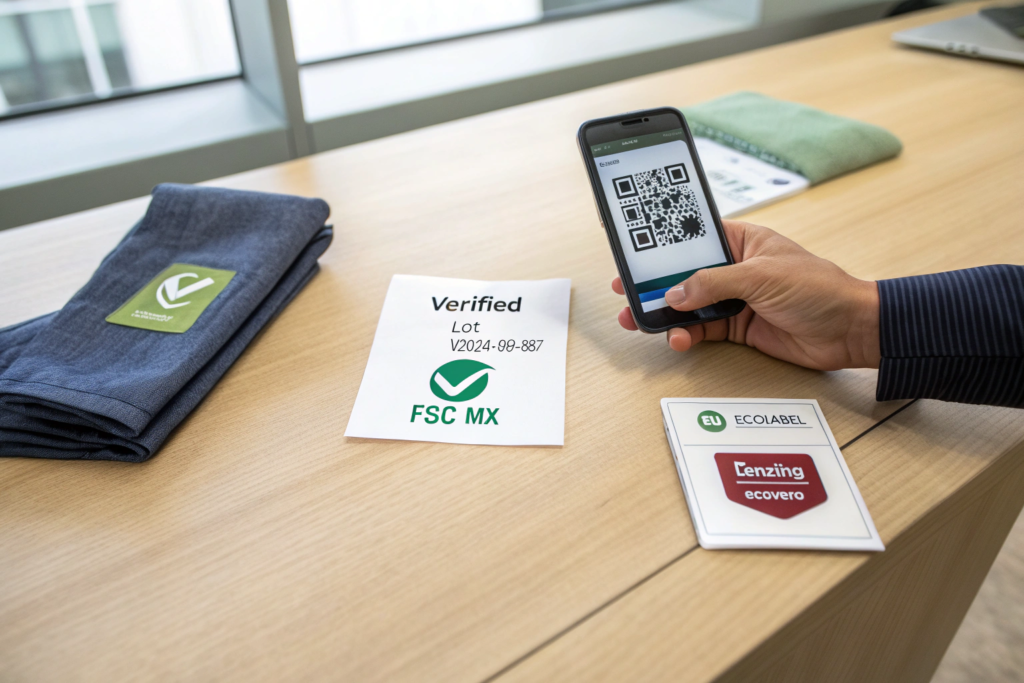
Is the FSC Label Enough, or Do You Need the EU Ecolabel for Full Transparency?
The FSC label is the most recognized forest certification in the world. It verifies that the wood pulp used to make the viscose came from a forest managed to environmental, social, and economic standards. This is critically important. It prevents the scenario where your beautiful sustainable dress is made from wood pulp harvested from an ancient Indonesian rainforest or an illegally logged Russian boreal forest. FSC certification is the baseline for responsible fiber sourcing.
But FSC certification stops at the forest gate. It does not address what happens inside the viscose factory. It does not measure the carbon disulfide emissions, the water treatment, the chemical recovery rate, or the working conditions in the spinning room. An FSC-certified viscose can still be produced in an open-loop factory that vents toxic gas into the air. The fiber started responsibly, but the manufacturing process is environmentally destructive.
This is where the EU Ecolabel for textile products fills the gap. The EU Ecolabel is a full lifecycle certification. It sets limits on air emissions, water pollution, chemical oxygen demand in wastewater, and the use of hazardous substances throughout the production process. For viscose specifically, it requires that the sulfur emissions to air are less than 120 grams per kilogram of fiber produced, and that the zinc content in the wastewater is below 0.3 milligrams per liter. These are specific, quantitative thresholds that differentiate a closed-loop facility from an open-loop one. Our closed-loop viscose fabrics carry both FSC and EU Ecolabel certification, because the two standards are complementary, not redundant.
How Can the Higg MSI Score Help You Compare Viscose Against Polyester Objectively?
The debate between viscose and polyester is often conducted on vibes. "Plastic is bad, natural is good." But vibes are not lifecycle assessment. If you want to make a legitimate environmental claim to your customers, you need data that accounts for the entire production chain from raw material extraction to finished fabric.
The Higg Materials Sustainability Index (MSI) is the most widely used tool for this comparison. It assigns a single aggregated score to each material based on global warming potential, eutrophication, water scarcity, abiotic resource depletion, and chemistry. The scoring is imperfect and subject to ongoing methodological debate, but it is the best comparative framework the industry currently has.
Here is what the data shows. Conventional polyester scores worse than closed-loop viscose on global warming potential because polyester is derived from petroleum and its production releases significant CO2. Closed-loop viscose scores worse on water consumption because growing trees and dissolving pulp require water, even if the closed-loop process recycles most of it. On eutrophication—the runoff of nutrients that causes algal blooms—conventional viscose scores poorly because of the sodium sulfate effluent, but closed-loop viscose scores much better because the sulfate is recovered and sold. The takeaway is not that one fiber is universally superior. The takeaway is that "closed-loop" is the operative variable that shifts viscose from a high-impact material to a moderate-impact material. You can explore the comparative scores and methodology in this guide to using the Higg MSI for sustainable material selection in apparel design. If your brand is making comparative sustainability claims, you should be referencing MSI data, not marketing clichés.
| Certification | What It Covers | What It Does NOT Cover | Verification Method |
|---|---|---|---|
| FSC (Forest Stewardship Council) | Forest management, chain of custody for wood pulp | Factory emissions, chemical use, water treatment | Third-party audit of forestry and pulp operations |
| EU Ecolabel | Full factory emissions, wastewater, chemical use limits | Forest sourcing (covered by complementary FSC) | Third-party audit of viscose manufacturing facility |
| Lenzing ECOVERO Brand | FSC sourcing + closed-loop production + traceability | Independent verification (relies on Lenzing internal systems + EU Ecolabel audit) | Physical mass balance audit, lot-number traceability |
What Garment Categories Gain the Most From the Drape of Sustainable Viscose?
Not every garment is improved by making it in viscose. I have seen brands put viscose into structured blazers that need interfacing to hold their shape, and the result is a wrinkled mess. I have seen viscose t-shirts that stretch out of shape after one wear because the fabric was not properly stabilized. The material is incredible, but it is not universal.
Closed-loop viscose has a specific set of physical properties that make it exceptional for certain garment categories and frustrating for others. Its primary attributes are fluid drape, high surface luster, low elastic recovery, and high moisture absorbency. The garment categories that exploit these attributes are the ones where viscose outperforms cotton and polyester decisively.
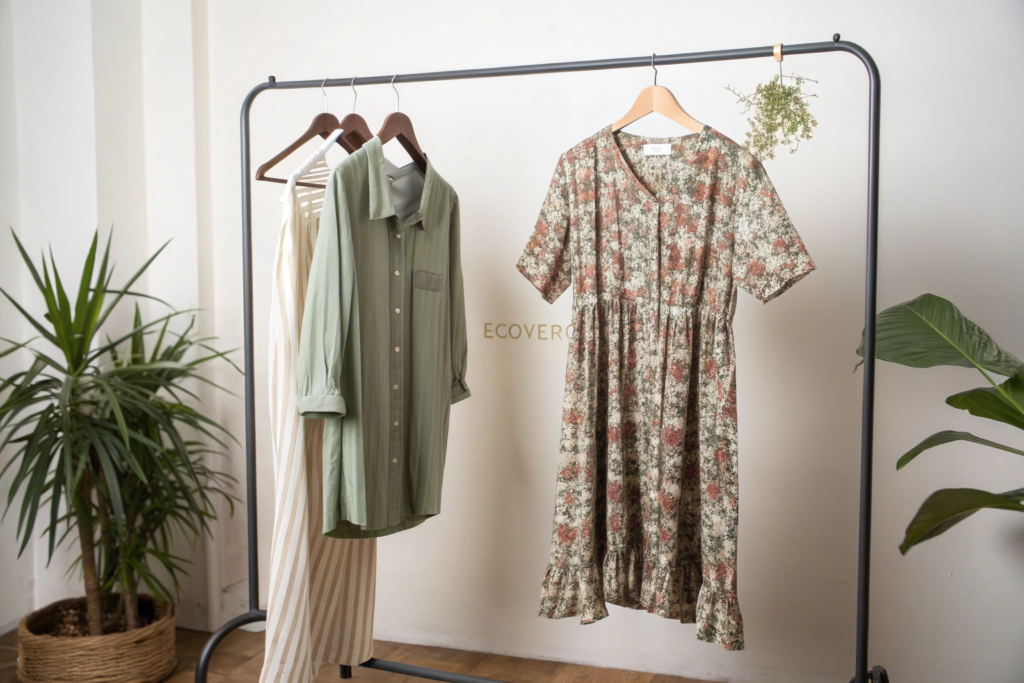
Why Is Woven Viscose Challis a Dominant Choice for Bias-Cut Midi Dresses?
The bias-cut midi dress is the garment that separates good viscose from great viscose. Cutting on the bias—45 degrees to the grain line—transforms a woven fabric from a rigid, stable sheet into a liquid, body-following drape. The diagonal orientation of the warp and weft yarns allows the fabric to stretch and mold without elastane.
This cut demands a fabric with a low flexural rigidity and a high surface smoothness. The fabric must bend easily under its own weight to create the characteristic ripple and flow of a bias garment. Viscose has a flexural rigidity that is significantly lower than cotton of the same weight. A 120gsm viscose challis drapes like a 80gsm cotton voile but with more body and opacity. The smooth filament surface also means the fabric does not catch on itself as it moves; the folds open and close silently and without friction.
Our most popular sustainable viscose for bias-cut dresses is a 135gsm challis with a plain weave and a soft pebble finish achieved through a light enzyme wash. It is heavy enough to hang gracefully without being sheer, light enough to ripple in a breeze, and the closed-loop fiber takes reactive dyes with a depth and clarity that cotton cannot match. A solid black viscose challis looks like liquid obsidian. A solid cotton black of the same weight looks dusty and muted by comparison. For a brand that builds its aesthetic on movement and color saturation, viscose challis is not an option; it is the central material proposition.
How Does Viscose Twill Outperform Cotton in Loungewear and Sleepwear Applications?
The loungewear boom that began in 2020 and never really ended has been a massive tailwind for viscose. Consumers now expect their at-home clothing to feel as luxurious as their out-of-home clothing, and they have learned to associate the cool, silky hand of viscose with a premium loungewear experience.
Viscose twill is the specific construction that works best for loungewear sets. The twill weave gives the fabric more body and structure than a challis, so a wide-leg lounge pant holds its shape rather than collapsing into a puddle. The diagonal wale of the twill creates a subtle texture that catches light and adds visual depth. And the twill’s natural mechanical stretch—the weave allows the yarns to shift slightly under tension—provides enough give for comfort without requiring elastane.
For sleepwear, the moisture management properties of viscose become particularly relevant. Sleep is associated with significant insensible perspiration. The average person loses about 200 milliliters of water through the skin during an eight-hour sleep period. Cotton absorbs this moisture and holds it, which is why cotton pajamas can feel damp and clammy by morning. Viscose absorbs the moisture, spreads it across a much larger surface area, and releases it to the atmosphere more efficiently. The wearer stays drier and more thermally stable throughout the night.
For a deeper exploration of these applications, this guide on how to select the right viscose fabric weight and weave for different garment categories provides practical, category-specific recommendations from a production perspective.
| Garment Category | Recommended Viscose Construction | Target GSM | Key Performance Attribute |
|---|---|---|---|
| Bias-Cut Dress | Plain weave challis, enzyme washed | 130-150 | Fluid drape and color depth |
| Wide-Leg Lounge Pant | Twill weave, brushed or peached | 160-190 | Body with drape, subtle texture |
| Sleepwear Set | Satin weave or fine twill | 120-140 | Smooth hand, moisture transport |
| Summer Shirt | Poplin or fine twill | 110-130 | Crisp but breathable, cool touch |
Conclusion
The question "do you offer sustainable viscose made in a closed loop" is the right question, but it is only the beginning of the due diligence. The real questions are: Which closed-loop system? What is the recovery rate? Can you trace the fiber from forest to finished fabric? What certifications back up your claims? And does the fabric actually perform better in the garments my brand produces?
At Shanghai Fumao, we have answers to all of these questions, backed by data and documentation, not marketing language. We source our closed-loop viscose primarily through the Lenzing ECOVERO system because it offers the most rigorous combination of certified forest management, audited chemical recovery, and physical traceability. We can provide the FSC certificate for the wood pulp, the EU Ecolabel for the manufacturing facility, the Higg MSI score for the material, and the lot-number traceability that connects your fabric to the specific production batch. And we can show you, in physical swatches, how the fabric moves, feels, and performs in the garment categories where viscose excels.
If you are developing a collection that demands the drape, luster, and skin comfort of viscose—and you need it backed by verifiable sustainability credentials—we should talk. We can send you a Sustainable Viscose Sample Pack with swatches of our ECOVERO challis, twill, and satin in multiple weights and finishes, along with the full certification documentation and a traceability audit trail for each fabric. Contact our Business Director, Elaine, at elaine@fumaoclothing.com to request your pack. Let us make your next collection flow with fabric that feels good and is made responsibly.