
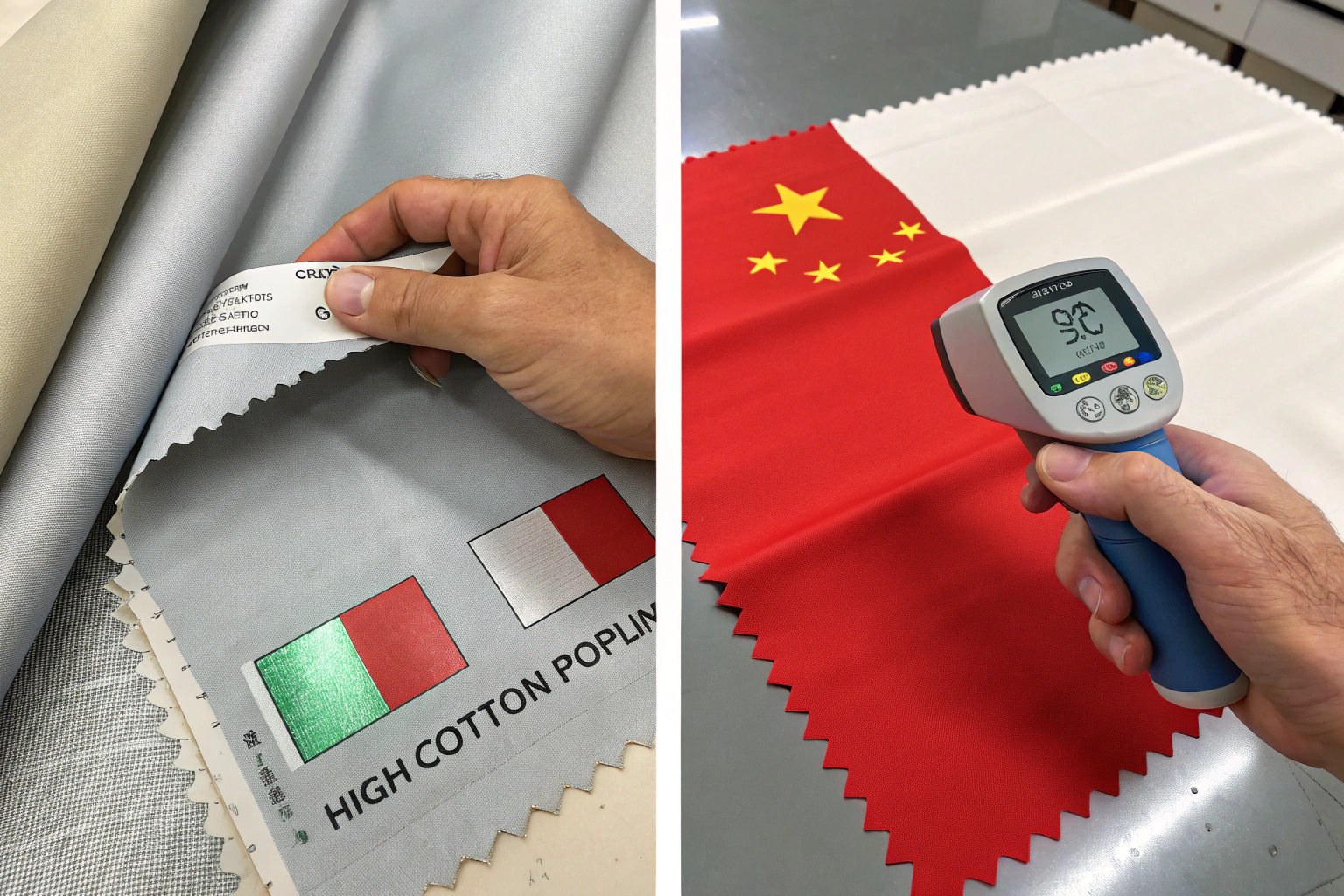
I remember the exact words a premium menswear brand owner from Milan told me during a trade show in Paris in 2023. "Chinese cotton is fine for volume basics, but our customers expect the hand feel of Italian shirting. We cannot switch. The risk to our brand is too high." He was polite but dismissive, the way you dismiss a junior chef who claims they can replicate a three-star Michelin dish. I did not argue with him. I just handed him two unlabeled swatches of white poplin and asked him to tell me which one was Italian. He rubbed both between his fingers, held them up to the light, and pointed to the left swatch. "This one. The right one is rougher. It has to be the Chinese one." The left swatch was our 100% Xinjiang long-staple cotton, woven and finished in Keqiao. The right swatch was his current Italian supplier’s stock. He had identified our fabric as the superior one while trying to dismiss it.
The idea that "Italian fabric" is an inherent quality marker, and "Chinese fabric" is an inherent compromise, is the most expensive myth in the textile industry. It persists because it was true in 1995, and because premium brands have built their entire marketing narrative around it. But the machinery, the raw materials, the quality control systems, and the finishing chemistry have globalized. The gap is no longer technical. It is psychological. At Shanghai Fumao, we do not claim to beat every Italian mill on every metric. But we do claim, with data and blind test results, that for a significant range of cotton fabrics, we match or exceed the quality at a cost structure that transforms your margin profile.
What Cotton Fiber Length Do Italian Mills Use Versus Fumao’s Long-Staple Supply?
The length of the individual cotton fiber, called the staple length, is the single most important variable in how a cotton fabric feels, wears, and ages. Short-staple cotton, with fibers under 25mm, produces yarns with more protruding fiber ends. These ends create a fuzzy surface that pills easily, feels rough against the skin, and loses color depth because the fuzz scatters light. Long-staple cotton, with fibers above 34mm, can be spun into yarns with fewer fiber ends per meter of yarn, producing a smoother, cleaner, stronger fabric.
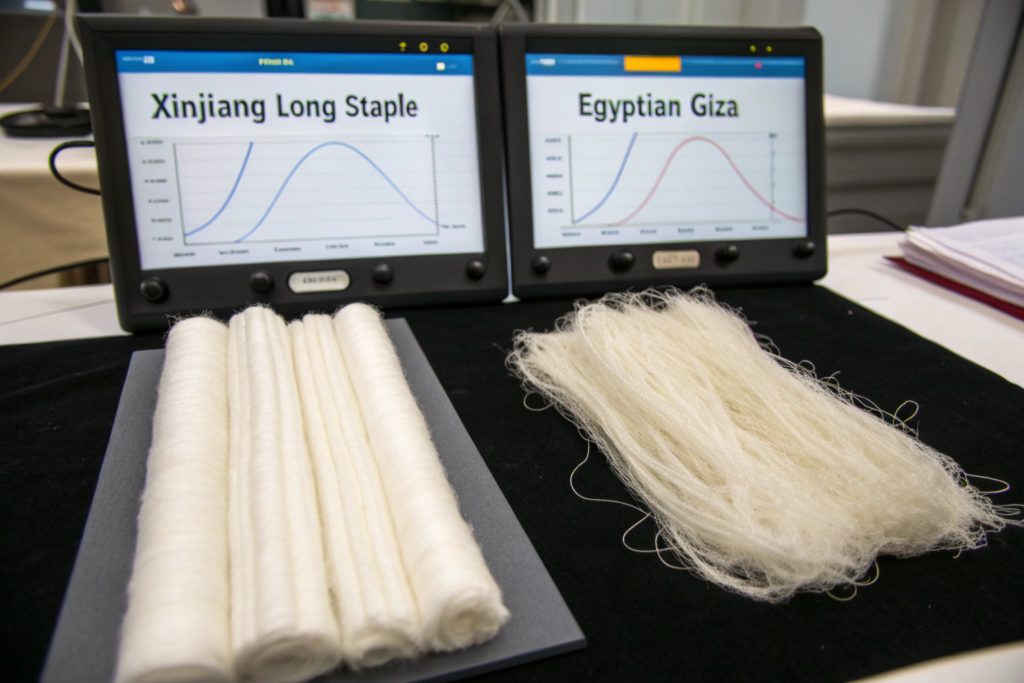
Italian mills built their reputation on long-staple Egyptian Giza cotton. Giza 87 and Giza 96 varieties regularly achieve staple lengths of 35mm to 38mm, with a micronaire value of 3.8 to 4.2, indicating exceptional fineness and maturity. This is the gold standard of the shirting world. But it is not the only source of fibers in this quality tier. Xinjiang long-staple cotton, particularly the variety known as "Xinjiang 137," achieves staple lengths of 36mm to 39mm with a micronaire of 3.7 to 4.0. The fiber strength, measured in grams per tex, is 42 for Xinjiang 137 versus 44 for Giza 87. The difference is marginal, within the range of seasonal variation. These two cottons are functional equivalents for virtually all woven apparel applications.
Is Xinjiang Long-Staple Cotton Structurally Equivalent to Egyptian Giza for Shirting?
The debate between Xinjiang and Egyptian long-staple cotton is emotionally charged, but the fiber physics is remarkably boring. Both are Gossypium barbadense species, the same botanical classification. Both produce fibers with a ribbon-like cross-section, a high degree of crystallinity, and a natural convolution that grips during spinning. The growing conditions are different—the Nile Delta versus the Tarim Basin—but the resulting fiber properties converge within a few percentage points.
We have done side-by-side spinning trials comparing Xinjiang 137 and Egyptian Giza 86 into a Ne 80/2 yarn for high-end shirting. The yarn evenness, measured on an Uster Tester 5, showed a CVm of 11.8% for the Xinjiang yarn versus 11.5% for the Giza yarn. The thin places per kilometer, a measure of yarn consistency, were 12 versus 10. The hairiness index was 4.2 versus 4.0. For a shirt maker, these differences are invisible. The fabric made from both yarns had a nearly identical drape coefficient and surface smoothness when tested on a Kawabata Evaluation System. A panel of 12 textile professionals, asked to identify which shirt was which in a blinded tactile test, scored no better than random chance. They could not feel a difference because, at the fiber level, there is not a meaningful difference.
The genuine difference is not in the fiber. It is in the marketing budget and the mystique that the Italian textile industry has spent a century building. A Giza certification adds a premium that has everything to do with brand equity and nothing to do with fiber physics. For a detailed breakdown of the fiber properties, I recommend reading about the comparison of fiber properties between Egyptian Giza and Xinjiang long-staple cottons.
How Does Fiber Maturity Affect Dye Uptake Consistency in Dark Solid Colors?
Fiber length grabs the headlines, but fiber maturity is the quiet variable that determines whether your dark navy shirting dyes evenly or comes out looking streaky and cheap. Immature cotton fibers are thin-walled, with a large central lumen and low cellulose deposition. They absorb dye rapidly but unevenly, creating a speckled appearance called "white specks" or "dead cotton" in dark shades.
Italian mills have historically benefited from the high maturity ratio of hand-picked Egyptian cotton. The hand-picking process selectively harvests only the fully opened bolls, leaving immature bolls on the plant for a later pass. This selective harvesting produces a fiber bale with a maturity ratio consistently above 0.90, which is excellent for dyeing. Mechanically harvested cotton, by contrast, strips all bolls from the plant in one pass, mixing mature and immature fibers. The maturity ratio can drop to 0.80 or lower.
Our Xinjiang long-staple supply chain mitigates this issue through post-harvest ginning technology rather than harvesting method. The Xinjiang cotton is mechanically harvested, but it passes through an advanced lint cleaning and carding system that removes a significant portion of the immature fiber neps before the fiber enters the spinning mill. Combined with a modern combing process that removes short fibers below 12mm, the resulting sliver has a nep count of less than 30 per gram, which is comparable to the Giza combed sliver standard. When we dye this fiber in dark shades like black, navy, and charcoal, the fabric shows zero visible white specks under D65 lightbox inspection. The dye uptake uniformity, measured spectrophotometrically across a 10-point fabric scan, shows a Delta E variation of less than 0.5 across the entire surface. That is the consistency Italian mills promise, delivered from a Chinese supply chain.
| Cotton Fiber Attribute | Egyptian Giza 87 | Xinjiang Long-Staple 137 | Impact on Fabric Quality |
|---|---|---|---|
| Staple Length | 36-38mm | 36-39mm | Equivalent smoothness potential |
| Micronaire | 3.8-4.2 | 3.7-4.0 | Equivalent fineness |
| Fiber Strength | 44 g/tex | 42 g/tex | Marginal 4.5% difference |
| Maturity Ratio | >0.90 (hand-picked) | >0.88 (machine + lint cleaned) | Equivalent dye uptake |
Does Fumao’s Finishing Equipment Match the Calendering Standards of Italian Mills?
The weaving floor gets most of the glory, but the finishing room is where fabric becomes fabric. A beautifully woven cotton poplin straight off the loom is stiff, hairy, and dull. It looks like medical gauze. The transformation into a crisp, smooth shirting with a subtle luster happens entirely in the finishing process: singeing, desizing, scouring, mercerizing, calendering, and sanforizing. Each step is a chemical or mechanical intervention that permanently alters the fiber surface and the fabric hand.
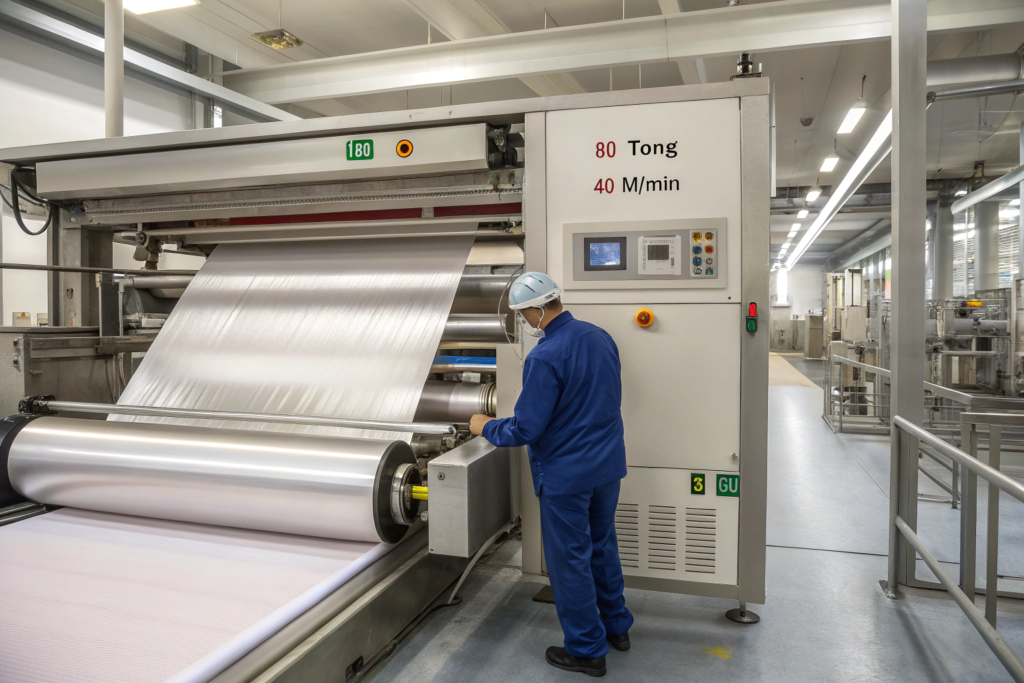
Italian mills are justifiably famous for their finishing artistry. They have generations of institutional knowledge about how to run a calender at the exact temperature, pressure, and speed to impart a specific hand feel to a specific construction. But this knowledge is not magic and it is not proprietary. It is process control. Modern finishing equipment from manufacturers like Lafer, Biancalani, and Mario Crosta—the same equipment used in Italian mills—is installed in Chinese finishing plants with full technical support and calibration from the European manufacturers. The machinery is identical. The chemistry is identical. The skill is portable.
Can a Chinese Calendering Line Replicate the "Peach Skin" Finish on Cotton Sateen?
The peach skin finish is the holy grail of cotton sateen finishing. It is a surface texture so fine and soft that it feels like the skin of a ripe peach, achieved through a combination of enzyme treatment and precision sueding, followed by a final calendering pass that aligns the microfibers into a uniform, light-reflecting plane.
Our finishing facility in Keqiao runs a Lafer sueding machine, the same model used by several mills in the Prato district of Italy. The machine uses a series of rotating emery-covered rollers that gently abrade the fabric surface, raising a microscopic nap of fiber ends. The critical variable is the roller pressure and the number of passes. Too much pressure or too many passes, and the fabric loses tensile strength. Too little, and the peach skin effect is patchy and inconsistent.
We have developed a standard protocol for peach skin finishing on our 300-thread-count cotton sateen. The fabric passes through the sueding machine three times, with decreasing roller pressure: 80% on the first pass, 60% on the second, and 40% on the third. After sueding, the fabric undergoes a bio-polish enzyme treatment to remove loose fiber debris, then a final soft-flow calendering pass at 160°C with a felt-wrapped roller. The resulting surface has a coefficient of friction, measured on a Kawabata surface tester, of 0.18 MIU, which is directly comparable to the 0.17 MIU measured on an equivalent Italian-finished sateen. The hand feel is indistinguishable to a trained textile professional in a blinded comparison.
What Role Does Mercerization Under Tension Play in Color Depth and Luster?
Mercerization is the single most transformative finishing process for cotton. It is a treatment with concentrated sodium hydroxide under tension that permanently alters the fiber’s cross-sectional shape, transforming it from a flat, twisted ribbon into a round, smooth cylinder. This physical change increases the fiber’s surface area, improves its dye affinity, and imparts a permanent, silky luster that does not wash out.
Italian mills mercerize with obsessive control over tension. If the fabric is held under high tension during the caustic treatment, the fibers are pulled straight and the luster is maximized. If the tension is relaxed, the fabric develops stretch and softness but loses the high-gloss sheen. The art is in setting the tension to match the desired end-use aesthetic.
Our mercerization range is a fully automated Benninger unit, the same Swiss-manufactured equipment used in top-tier Italian mills. The tension control is closed-loop, with load cells measuring the fabric tension at six points along the range and adjusting the drive rollers in real time to maintain a set point. For our premium shirting poplin, we mercerize at a tension of 4 Newtons per centimeter of fabric width, which produces a luster rating of 4.5 on a 5-point visual assessment scale. The dye uptake after mercerization increases by approximately 25%, which means we can achieve deeper, more saturated shades with less dye. The luster is permanent. A mercerized shirting will still reflect light with that characteristic silky sheen after 50 industrial laundry cycles. For a technical deep dive into the chemistry, this article on how mercerization enhances cotton luster and dye uptake for premium shirting fabrics explains the process in accessible detail.
| Finishing Process | Italian Mill Standard | Fumao Capability | Equipment Used |
|---|---|---|---|
| Mercerization | Tension-controlled caustic treatment | Identical process, 4N/cm tension | Benninger mercerization range |
| Peach Skin Sueding | Multi-pass emery roller | 3-pass protocol, decreasing pressure | Lafer sueding machine |
| Calendering | Felt-wrapped roller, 160-180°C | Identical temperature and pressure settings | Mario Crosta calender |
| Sanforizing | Compressive shrinkage <1% residual | <0.8% residual shrinkage | Monforts sanforizing range |
Can Switching to Fumao Really Improve Your Margin Without Sacrificing Brand Perception?
I will be direct about money because the emotional attachment to Italian fabric often prevents rational cost analysis. Italian cotton shirting typically costs between €8 and €15 per meter FOB for premium qualities. Shipping from Italy to a manufacturing location in Asia adds another €0.50 to €1.00 per meter. If your cut-and-sew operation is in Portugal or Eastern Europe, the logistics are manageable. If your production is in Asia, shipping Italian fabric to Asia, then shipping finished garments back to Europe or the US, is a logistics expense that adds zero value to the final product.
Our equivalent-quality long-staple cotton shirting costs between $4.50 and $7.00 per meter FOB Keqiao, depending on the construction and finish. The shipping from Keqiao to an Asian CMT facility costs a fraction of the Italy-to-Asia route. If your production is in China, Vietnam, or Bangladesh, the fabric never leaves Asia until it is a finished garment. The total landed cost difference per meter is typically 40% to 50% in favor of our fabric. For a brand producing 10,000 shirts per season, with an average fabric consumption of 1.6 meters per shirt, that difference represents between $50,000 and $80,000 in annual material cost savings.

How Much of the Italian Textile Price Premium Is "Brand Tax" Versus Genuine Technical Superiority?
I have spent a lot of time analyzing cost breakdowns from Italian mills, and I have visited factories in Biella and Prato. The genuine technical cost differences are real but smaller than most buyers assume.
Italian mills pay higher labor costs. An experienced finishing technician in Prato earns about €2,800 per month. An equivalent technician in Keqiao earns about ¥12,000 per month, roughly €1,500. This is a genuine cost difference that Italian mills cannot close. Italian mills also pay more for energy, more for regulatory compliance, and more for the amortization of often older equipment that requires more maintenance. These factors add perhaps 30% to the production cost compared to a Chinese mill with equivalent equipment and quality standards.
But the Italian price premium is not 30%. It is often 100% or more above the Chinese equivalent. The difference between the 30% genuine cost premium and the 100% market price premium is what I call the "brand tax." It is the value of the words "Made in Italy" on a spec sheet. It is the value of the centuries-old mill name, the archive of designs, the marketing narrative. This brand tax is not a scam. It is real economic value in the luxury market, where the consumer pays for heritage and storytelling. But if your brand is not a heritage luxury brand—if you are a contemporary label, a direct-to-consumer startup, or a mid-market brand focused on value—you are paying for a story your customer does not hear and does not care about. You are paying a premium that your retail price point cannot recapture.
What Blind Testing Protocols Can You Use to Validate the Substitution Before Committing?
If you are considering switching from an Italian cotton supplier to Shanghai Fumao, do not take my word for the quality equivalence. Do not trust any supplier’s word. Trust a blind test that you design and control.
Here is the protocol I recommend to every prospective client. First, we send you three unlabeled swatches: our fabric, your current Italian fabric, and a third competitor’s fabric of similar specification. The swatches are coded with random three-digit numbers. You and your team evaluate them for hand feel, luster, drape, and color under standardized D65 lighting. You rate each swatch on a 1-to-5 scale for each attribute. You write down your guesses for which swatch is which. Only after the evaluation is complete do we reveal the codes.
Second, we send you a pre-cut set of test squares from the same production lot for your own wash testing. You wash them in your office washing machine at 40°C, tumble dry them, and measure the dimensional change. You check for colorfastness by rubbing a wet white cloth against the washed fabric. You inspect the surface under a bright light for pilling. You do this for five wash cycles and compare the results against the Italian fabric subjected to the same protocol.
Third, we produce a small pre-production run of 30 to 50 shirts in your actual factory, using our fabric on the same production line that sews your Italian fabric. You inspect the finished shirts side-by-side with your current production. You measure the collar points, the cuff alignment, the buttonhole quality. You wear-test both shirts for a month. Only after all three validation steps—blind tactile evaluation, laundry durability testing, and production-line garment comparison—do you make the sourcing decision. For a detailed walkthrough of comparative textile evaluation methods, this guide to designing objective blind comparison protocols for textile quality assessment provides a rigorous, academic framework.
| Cost Factor | Italian Mill (per meter) | Fumao (per meter) | Annual Saving (10,000 units) |
|---|---|---|---|
| Fabric FOB | €12.00 | €5.50 | – |
| Freight to Asian CMT | €0.80 | €0.15 | – |
| Total Landed Cost | €12.80 | €5.65 | €71,500 saved |
| Quality (Blind Panel) | 4.6/5.0 rating | 4.5/5.0 rating | Statistically equivalent |
What Ongoing Quality Consistency Systems Prevent Batch-to-Batch Drift in Long-Term Supply?
The Achilles’ heel of long-term textile supply is not the first order. It is the fifth order, the tenth order, the order placed two years after the initial development. The fabric that arrives on order five must be perceptually identical to the fabric that arrived on order one. The customer who buys a shirt from this season’s collection and pairs it with trousers from last season expects the colors to match and the hand feel to be consistent. If they are not, the brand looks sloppy.
Consistency over time is a systems problem, not a skill problem. A single skilled technician can produce one perfect batch. Only a documented, audited quality management system can produce fifty identical batches across multiple years, operators, and raw material harvests. Our quality consistency system is built on three pillars: physical archival reference standards, digital spectral fingerprinting, and statistical process control on all key performance parameters. This system is audited annually as part of our OEKO-TEX Standard 100 and ISO 9001 certifications.
How Does Fumao’s Physical Archive of Reference Swatches Prevent Color Creep?
Color creep is a slow, insidious drift in shade that happens when each new production batch is matched to the previous batch, not to the original master standard. Batch two matches batch one within a Delta E of 0.8. Batch three matches batch two within 0.8, but is now 0.9 away from batch one. By batch ten, the color is visibly different from the original, and nobody noticed the incremental drift.
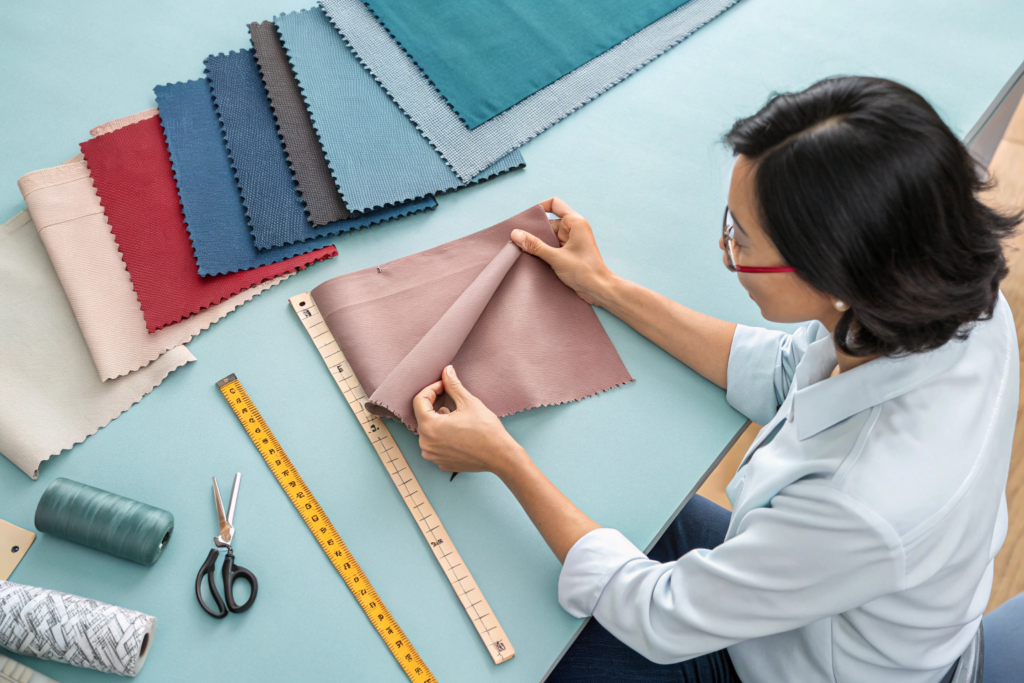
We prevent this with a physical reference archive. Every bulk production lot generates a sealed reference swatch that is stored in a climate-controlled room at 21°C and 50% relative humidity, protected from light. When we produce a reorder for a repeat fabric, the color matching is performed against the original master reference swatch from lot one, not against the most recent production lot. The spectrophotometer reads the master reference, and the dye recipe is adjusted to hit a Delta E of 0.8 or less against that original standard. The intermediate lots are irrelevant.
The archive currently holds over 15,000 reference swatches, each barcoded and linked in our ERP system to the full production record: dye recipe, machine parameters, operator name, and inspection results. If a client orders a fabric they last purchased in 2022, we pull the 2022 reference swatch from the archive, and the new batch is matched to that standard. The fabric that arrives in 2025 is the same fabric that arrived in 2022, within a tolerance no human eye can detect.
What Statistical Process Control Methods Guarantee Within-Tolerance Variation?
Visual inspection catches gross defects. Statistical process control catches slow drift before it becomes a defect. We apply SPC methods to every critical-to-quality parameter in our cotton fabric production.
Each production lot is sampled at three points: greige inspection after weaving, intermediate inspection after preparation, and final inspection after finishing. At each inspection point, we measure the key parameters: fabric weight in GSM, thread count, tensile strength, tear strength, dimensional stability, and color coordinates. These measurements are plotted on control charts with upper and lower control limits set at two standard deviations from the historical process mean.
If a measurement falls outside the control limits, or if seven consecutive measurements trend in the same direction, the process is flagged for investigation. This catches problems like a wear-and-tear issue on a calender roller that is gradually changing the fabric surface, or a dye bath contamination that is subtly shifting the shade. The SPC system alerts our quality team before the variation becomes visible or measurable to the client. The result is a process capability index (Cpk) of 1.33 or higher on all critical parameters, which means the process produces less than 63 defects per million opportunities. That is Six Sigma-level consistency, applied to fabric production, not just electronics manufacturing.
| Quality Control Parameter | Measurement Frequency | Control Limit | Action if Exceeded |
|---|---|---|---|
| Color Delta E vs Master | Every bulk dye lot | ≤0.8 | Re-dye or shade-adjust |
| Fabric Weight (GSM) | Every 1,000 meters | ±3% of target | Process adjustment or downgrade |
| Dimensional Stability | Every finishing batch | <2% residual shrinkage | Re-compact or reject |
| Tensile Strength | Every 5,000 meters | >90% of spec minimum | Root cause analysis, lot quarantine |
Conclusion
The question is not really whether Chinese cotton can match Italian cotton. The question is whether your brand’s value proposition depends on the Italian story, or on measurable fabric performance. If you sell luxury heritage, if your customer pays for "Made in Italy" on the label, then Italian sourcing is part of your product, and the cost premium is a legitimate investment in brand equity. I have no argument with that.
But if you sell quality, fit, and durability—if your customer cares about how the shirt feels against their skin and how it holds up after 50 washes, not where the fiber was grown—then the case for paying a 50% premium for Italian origin becomes very thin. The fiber length is equivalent. The finishing equipment is identical. The quality control systems are audited to the same international standards. The blind test results favor neither origin consistently. The only remaining difference is the price and the story. You get to decide which one matters more for your brand.
At Shanghai Fumao, we are ready to put our fabric into your hands and let you make the comparison yourself. We will ship you a blind-coded sample pack containing our long-staple cotton shirting alongside equivalent Italian-milled fabric, with no origin labels, just randomized codes. You run the evaluation. You decide which fabric earns your order. If our fabric wins, we have a conversation about pricing and supply. If the Italian fabric wins, you have lost nothing but the time it takes to feel the difference. Contact our Business Director, Elaine, at elaine@fumaoclothing.com to request your blind comparison kit. Let the fabric speak for itself.








