
Just when we thought we could finally budget a stable freight cost, the market is slapping us around again. I’m sitting here in Keqiao looking at a spot rate quote that jumped 22% in two weeks for a Shanghai to Los Angeles route. In May it was $2,800 for a 40-foot container. By mid-June, the same forwarder quoted $3,420. No warning. No gradual increase. Just a sharp vertical line on the chart that reminded me exactly of the chaos in 2021. My logistics coordinator walked into my office with the updated rate sheet, and I could see the stress on her face. We had four containers booked for July delivery to US clients, and suddenly our margin on those shipments was getting eaten alive by a cost we can’t control and can barely predict.
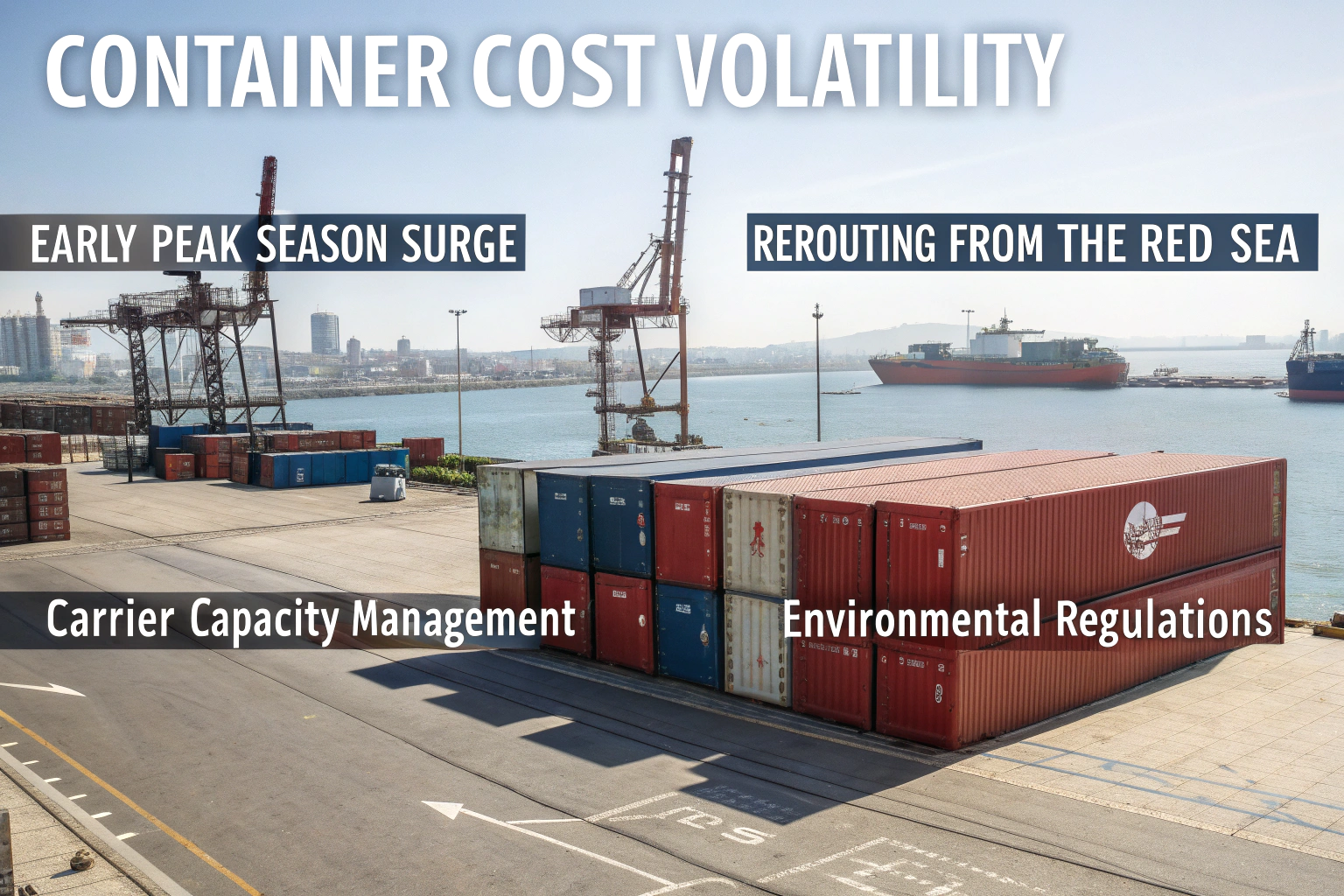
The container cost volatility in mid-2026 isn’t one single factor—it’s a collision of four forces hitting simultaneously. First, the early peak season surge as brands pulled shipments forward to avoid the autumn uncertainty around US East Coast port labor negotiations. Second, the ongoing rerouting of vessels away from the Red Sea, which absorbs roughly 12% of global container capacity just to maintain the same service frequency. Third, the carrier capacity management strategy of blank sailings to prop up rates when demand softens. And fourth, the environmental regulations requiring more expensive low-sulfur fuel and slower steaming speeds, which reduces effective capacity further. These aren’t temporary blips. They’re structural adjustments that make the old model of stable freight pricing look naive.
The practical consequence for fabric buyers is that any quote based on last month’s freight rate is already outdated. You need to build volatility buffers into your landed cost calculations, and you need to understand which levers you can pull when rates spike. The good news is that after 20 years of shipping containers from China, I’ve learned that the worst time to negotiate freight is during a panic. The best time is before the panic starts, and that requires understanding the forces driving the fluctuation so you can anticipate them rather than react to them.
What Is Driving the Early Peak Season Surcharge Spike in June 2026?
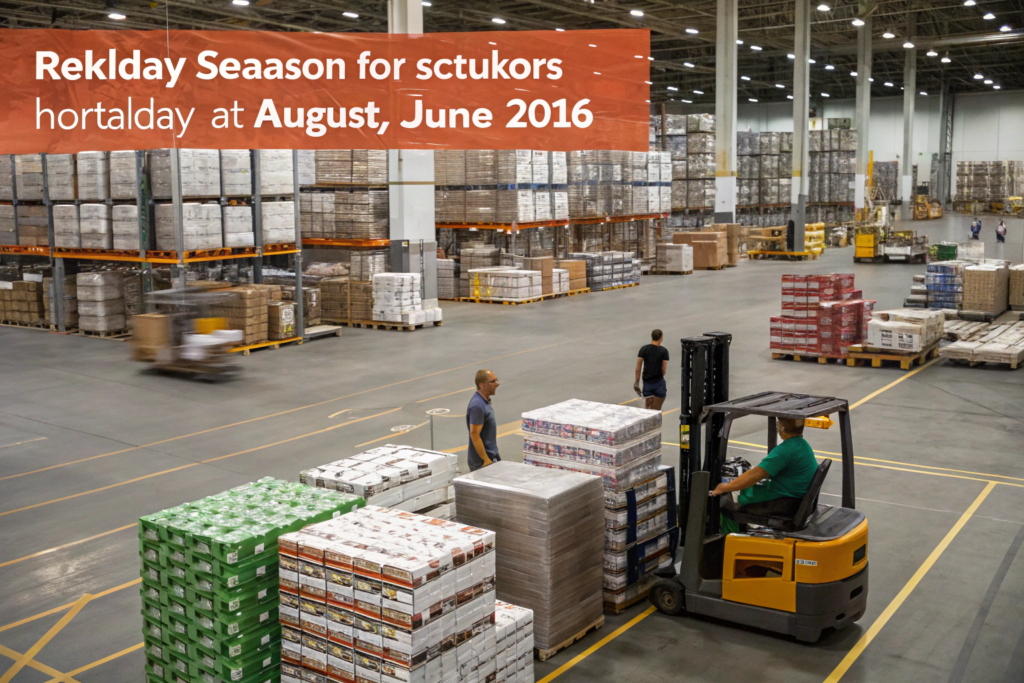
Peak season normally hits in August through October when retailers stock up for the holiday season. But June 2026 is seeing a surge that looks more like late August. The reason is behavioral, not seasonal. Major US importers, burned by the 2024 labor disruptions and watching the expiration of the East Coast port labor agreement, decided to pull their fall inventory forward by 6 to 8 weeks. The result is a demand shock that the container shipping market wasn’t capacity-planned to absorb in June.
When demand spikes ahead of schedule, the carriers respond with a General Rate Increase and a Peak Season Surcharge. The GRI is the base rate hike—typically $400 to $800 per FEU announced with 30 days notice. The PSS is the seasonal premium layered on top, ranging from $600 to $1,200 per container during demand peaks. In June 2026, we’re seeing both applied simultaneously to the transpacific route, pushing spot rates to levels we haven’t seen since the post-pandemic correction. For a container of anti-static lining fabric headed to Long Beach, the combined GRI and PSS added $1,100 to our freight cost compared to the May rate. That’s not a tariff or a tax—it’s purely a capacity-constrained market pricing power move by the carriers.
The early peak season isn’t driven by consumer demand. It’s driven by importer fear of what happens if they don’t get their goods on the water before the labor situation deteriorates.
The underlying labor uncertainty is rational. The International Longshoremen’s Association contract on the US East and Gulf Coasts has been a recurring source of disruption risk. Even the credible threat of a strike or work slowdown in October 2026 is enough to shift shipment schedules months in advance. Importers remember the multi-week backlogs from previous disruptions, and they’re voting with their purchase orders to get goods into the country earlier. This demand pull-forward creates a self-fulfilling prophecy: the surge in June depletes available vessel space, which drives up spot rates, which then forces smaller importers who didn’t pull forward to pay the inflated rate or delay their shipments into what they hope will be a calmer period.
How Are Blank Sailings Being Used by Carriers to Manipulate Spot Rates?
Blank sailing is the carrier practice of canceling a scheduled voyage even when the vessel is available. The stated reason is usually "operational adjustments" or "network optimization," but the economic logic is simpler: if demand softens slightly, removing capacity keeps rates from softening proportionally. It’s the shipping equivalent of OPEC cutting oil production to maintain price levels.
The data from mid-2026 shows that carriers canceled approximately 10% of scheduled transpacific sailings in May and June, even as demand was rising. The canceled sailings created artificial scarcity on specific departure weeks, pushing spot rates up by constricting supply. The mechanism works because the container shipping industry is an oligopoly—three major alliances control over 80% of global container capacity. When one alliance announces blank sailings, the others rarely fill the gap because they benefit from the same rate environment. The canceled voyage capacity doesn’t disappear permanently; it’s often reinstated later when rates have stabilized at the higher level. For a fabric buyer, a blank sailing means your container gets rolled to the next vessel, adding 7 to 14 days of delay and potentially missing your delivery window. The spot rate you locked in might not protect you if the vessel you’re booked on gets canceled and the forwarder needs to rebook at the new prevailing rate. Always confirm with your forwarder whether your booking is on a "protected" vessel or subject to rollover risk. If you’re looking for guidance on how to work with logistics partners during these disruptions, many shippers share their experiences on freight forwarding community forums where you can learn from real cases of how to navigate blank sailings and protect your cargo bookings.
Why Are East Coast Labor Negotiations Already Affecting Rates Before Any Strike?
The mere credible threat of disruption reshapes shipping patterns months before any actual work stoppage. The ILA labor contract negotiations cover ports from Maine to Texas, and the current agreement has a known expiration window in late 2026. The history of these negotiations is not reassuring: the 2024 negotiations went to the brink, and the memory of near-disruption is fresh in every logistics manager’s mind.
This anticipation effect operates through two channels. First, importers are diverting some East Coast-bound cargo to West Coast ports with rail intermodal to the final destination, which adds demand pressure to the already busy transpacific route to LA/Long Beach. Second, carriers are preemptively adjusting their service networks, reducing vessel allocations to East Coast ports in favor of more flexible routing that can pivot around a strike. These adjustments reduce the effective capacity serving East Coast ports even before any disruption occurs, which pushes up the freight rates for those services. For fabric shipments destined for New York or Savannah, we’re seeing a premium of roughly 15-20% over the West Coast rate plus intermodal cost, where historically the premium was closer to 5-10%. The labor negotiation uncertainty has effectively been priced into the East Coast freight market. If you have the warehouse capacity on the West Coast, routing through LA with rail to the East Coast is currently the more cost-stable option, even with the higher inland transportation component. To understand the deeper dynamics of these negotiations, you might review recent analyses on global logistics blogs that break down how ILA contract cycles historically impact freight pricing and what importers can expect in coming months.
How Is the Red Sea Rerouting Still Absorbing Global Container Capacity in 2026?
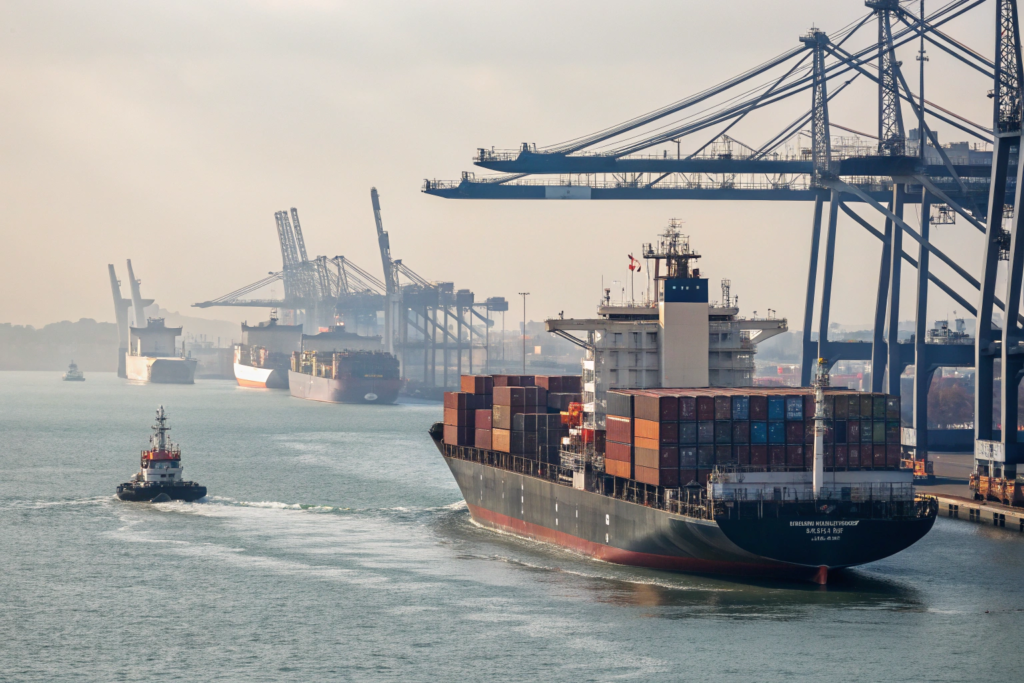
The Red Sea crisis began in late 2023 and, astonishingly, is still with us in mid-2026. Container vessels continue to avoid the Suez Canal route and instead navigate around the Cape of Good Hope, adding roughly 10 to 14 days of transit time and 3,000 to 4,000 nautical miles to the Asia-Europe route. This detour doesn’t just affect Europe-bound cargo—it absorbs global vessel capacity because ships are tied up for longer on each rotation.
The math is straightforward but brutal. A vessel that used to complete a Shanghai to Rotterdam round trip in 70 days now takes roughly 90 days. To maintain the same weekly service frequency, carriers need to deploy more vessels on the same route. Industry estimates suggest the Red Sea rerouting alone has absorbed approximately 8% to 12% of global container vessel capacity. This capacity absorption is the single largest structural factor keeping freight rates elevated above pre-2023 levels across all routes, not just the Europe-affected lanes. When vessels are pulled from other routes to maintain Asia-Europe schedules, the cascading effect reduces available capacity on the transpacific and intra-Asia routes, pushing rates up everywhere.
The Red Sea rerouting isn’t just a Europe problem. Every vessel that spends two extra weeks on the water is a vessel that can’t carry your fabric from Shanghai to LA.
The situation has not normalized because the security conditions in the Red Sea region haven’t improved sufficiently for major carriers to resume transits. The cost of war risk insurance for a vessel transiting the Red Sea can exceed $500,000 per voyage, and even with naval escorts, the crew safety risk remains unacceptable to most European-headquartered carriers. The few carriers that have experimented with resuming limited Red Sea transits have done so cautiously, and any incident immediately triggers another round of diversions. The practical implication for fabric buyers is that the freight cost floor has risen structurally. The pre-2023 rate of $1,500 to $2,000 for a Shanghai to LA container is unlikely to return as long as the Red Sea rerouting persists because the alternative uses for vessel capacity—on higher-paying longer routes—set a higher opportunity cost for transpacific service.
What Is the Cascading Effect of Longer Transit Times on Container Availability in China?
The longer transit times don’t just delay arrivals—they delay the return of empty containers to Chinese export ports. A container that’s on a ship for an extra two weeks is a container that’s not available to be loaded with your next order of anti-static lining in Shanghai. This equipment imbalance has created periodic container shortages at Chinese ports, particularly for 40-foot high-cube containers that are preferred for fabric shipments.
The shortage isn’t uniform across all ports or all carriers, but it’s frequent enough to affect booking reliability. In March 2026, we had a situation where our forwarder in Ningbo couldn’t secure a container for three days because the carrier’s empty inventory at the depot had been depleted by a surge of export bookings the previous week. We had to truck the fabric to Shanghai port instead, adding $200 in domestic transportation cost, because Shanghai had available equipment from a different carrier alliance. The equipment shortage also gives carriers an opportunity to charge a "container imbalance surcharge" on certain routes, which is essentially a fee for the privilege of using a container that’s in short supply. When you’re negotiating freight for mid-2026, ask specifically about equipment availability at the origin port and whether any equipment surcharges apply. A freight rate that looks competitive but can’t be executed because there’s no box to put the fabric in is a theoretical rate, not a real one. Shipping analysts on independent freight market blogs have been tracking these equipment imbalances by port, and their weekly updates can help you anticipate which departure points currently face the worst container shortages.
Could a Ceasefire Agreement Rapidly Normalize Freight Rates, or Is Damage Permanent?
A ceasefire in the Red Sea region would allow carriers to resume Suez Canal transits, but the normalization of freight rates wouldn’t happen overnight. There are three reasons for this. First, carriers would need to reorganize their vessel deployment schedules, which takes weeks to months to implement across a global network. Second, the initial rush to re-transit the Suez would face congestion at both ends of the canal as vessels converge simultaneously, which temporarily keeps rates elevated. Third, and most cynically, carriers have discovered that constrained capacity is extremely profitable, and they have no incentive to flood the market with capacity and crash rates back to pre-crisis levels.
The historical parallel is the post-pandemic freight market normalization in 2023. When demand softened, carriers didn’t immediately drop rates to pre-pandemic levels—they introduced slow steaming and blank sailings to gradually reduce capacity and manage the rate decline. The same dynamic would apply post-ceasefire. Rates would likely decline by 20-30% over 3 to 6 months, but a full return to 2019 rate levels is unlikely because the industry’s cost structure has changed. Low-sulfur fuel compliance costs, higher insurance premiums, and increased vessel operating costs have raised the floor. The practical takeaway is to treat current freight rates as the new normal for budgeting purposes and to view any future rate decline as a margin bonus rather than a baseline expectation. Build your 2026 and 2027 pricing on the assumption that $2,800 to $3,500 Shanghai to LA is the stable range, with seasonal spikes above that. For a longer-term perspective on how geopolitical events reshape shipping cost structures permanently, maritime economics journals often publish detailed post-crisis analyses that are useful for strategic planning beyond the immediate quarter.
What Fuel and Environmental Regulations Are Permanently Raising Shipping Costs?
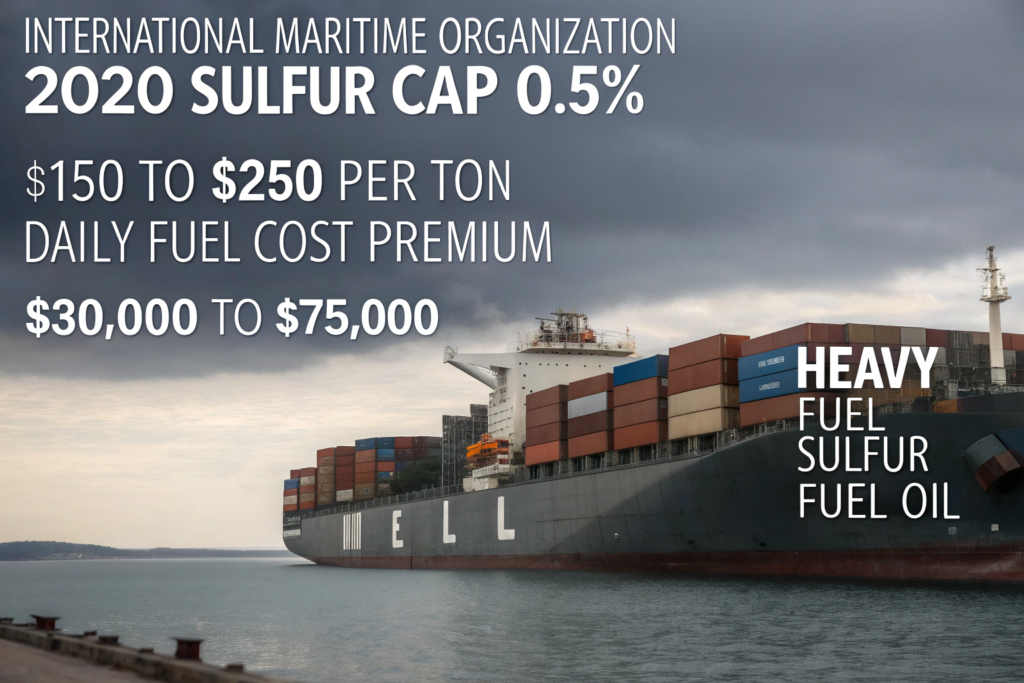
The shipping industry’s environmental compliance costs are not going away. The International Maritime Organization’s 2020 sulfur cap, which limits marine fuel sulfur content to 0.5%, has been fully implemented for years, but the cost differential between compliant low-sulfur fuel and the old heavy fuel oil remains roughly $150 to $250 per ton. A large container vessel burns 200 to 300 tons of fuel per day at sea. The daily fuel cost premium for compliance is $30,000 to $75,000 per day, and that cost flows directly into freight rates.
Beyond the sulfur cap, the IMO’s Carbon Intensity Indicator regulations, which came into force in 2023 and tighten annually, require vessels to achieve progressively lower carbon emissions per cargo-ton-mile. The compliance mechanism is straightforward: older, less efficient vessels must slow down to reduce fuel consumption, which reduces their annual cargo capacity. Slow steaming—running vessels at 16 to 18 knots instead of 22 to 24 knots—adds 3 to 5 days to a transpacific crossing. The slower speed reduces the number of voyages a vessel can complete in a year, effectively reducing global container capacity by 5% to 8% without a single vessel leaving the fleet.
The green transition in shipping is real, and it’s being paid for through your container rate. There is no free decarbonization.
The EU’s Emission Trading System extension to shipping, which began phasing in from 2024, adds a direct carbon cost for voyages calling at European ports. The cost per container for a Shanghai to Rotterdam voyage is estimated at €80 to €120 depending on the vessel’s efficiency rating. This cost is being passed through as a "carbon surcharge" on freight invoices. While this primarily affects Asia-Europe routes, the global nature of vessel deployment means these costs influence carrier decisions about where to deploy their most efficient vessels, which affects capacity availability on all routes. For US-bound fabric shipments, the direct carbon surcharge doesn’t apply, but the indirect effect of vessel redeployment does.
How Much Does IMO 2023 Carbon Intensity Compliance Add to a Typical Fabric Container Cost?
The CII regulation rates vessels on an A to E scale based on their annual carbon emissions relative to their transport work. Vessels rated D for three consecutive years or E for a single year must submit a corrective action plan. The immediate industry response has been widespread slow steaming and increased vessel scrapping of older, less efficient tonnage. The cost impact on a single fabric container is indirect but measurable.
Industry analysts estimate that CII compliance adds approximately $50 to $150 per FEU on the transpacific route, depending on the vessel’s age and efficiency rating. This cost is embedded in the base freight rate rather than appearing as a separate surcharge, so buyers don’t see it as a line item. But it’s real, and it’s structural. The mechanism works through capacity reduction: if a carrier’s fleet average speed drops from 20 knots to 17 knots to meet CII targets, the effective annual capacity of each vessel drops by approximately 15%. To maintain the same total network capacity, the carrier would need to add more vessels, which increases their capital and operating costs, which flows into the freight rate. The CII requirements tighten annually through 2030, meaning this upward cost pressure will continue incrementally each year. For your 2027 and 2028 landed cost projections, assume a 2-4% annual increase in the underlying freight cost component attributable to environmental compliance costs, independent of market demand cycles. To track how specific carriers are managing their CII ratings and what that means for their future pricing strategies, sustainability-focused maritime platforms publish annual carrier scorecards that can inform your forwarder selection.
Are Green Shipping Corridors and Methanol Vessels Actually Reducing Costs Yet?
Green shipping corridors—specific routes where governments and industry collaborate to demonstrate zero-emission shipping—are operational on a limited basis, including a Shanghai to Los Angeles corridor announced in 2023. The first methanol-powered container vessels have entered service, with Maersk leading the deployment of dual-fuel methanol vessels. These developments are genuinely important for the industry’s decarbonization trajectory, but they are not reducing freight costs for fabric buyers in mid-2026.
Green methanol currently costs 2 to 3 times more than conventional low-sulfur fuel oil on an energy-equivalent basis. The vessels that can run on it are new builds with higher capital costs than the vessels they replace. The "green premium" for shipping on a methanol-powered vessel is estimated at $200 to $400 per FEU compared to conventional fuel on the same route. Some forwarders now offer a "green shipping option" where importers can pay a premium to have their cargo on a methanol vessel and receive a verified emissions reduction certificate. This is valuable for brands with Scope 3 emissions reduction commitments, and we’ve had preliminary discussions with a European suiting client about this option for their 2027 collections. But from a pure cost perspective, green shipping is currently more expensive, not less. The cost curve may invert over the next decade as methanol production scales and carbon pricing increases the cost of conventional fuel, but in mid-2026, environmental compliance is a cost driver, not a cost saver. For technical comparisons of methanol versus conventional fuel economics on specific trade lanes, green shipping technology forums provide detailed cost models that break down the per-container premium with real-world voyage data.
What Strategies Can Fabric Buyers Use to Hedge Against Freight Volatility?
You can’t control the ocean freight market, but you can control how you contract for it and how you structure your supplier relationships to reduce exposure. The three most effective strategies I’ve used over the past five years of volatile markets are forward rate agreements with forwarders, DDP pricing from suppliers, and buffer stock planning that decouples your production schedule from spot rate timing.
Forward rate agreements, where you commit a certain volume to a forwarder over a quarter or a year in exchange for a fixed rate, are increasingly available for importers shipping at least 2 to 3 containers per month. The forwarder hedges their exposure with the carriers and gives you a stable rate. You pay a premium over the spot rate in soft markets and get a discount in tight markets. The value isn’t cost minimization—it’s budget predictability. For a suiting brand planning seasonal collections, knowing your freight cost six months in advance is worth more than potentially saving $200 per container if the spot market happens to dip.
The most effective hedge against freight volatility isn’t a financial instrument. It’s a relationship with a supplier who owns the logistics risk.
DDP pricing from your fabric supplier is the ultimate hedge for buyers who don’t want to think about freight markets at all. When Shanghai Fumao quotes a DDP price, the freight risk sits on our balance sheet, not yours. We absorb the spot rate fluctuations because we’re shipping enough volume to negotiate better rates and we have the logistics infrastructure to optimize routing. For a first-time buyer or a brand that doesn’t have a dedicated logistics team, DDP eliminates freight volatility as a planning variable. The trade-off is that DDP pricing includes a risk premium, so you pay slightly more than the expected freight cost in exchange for removing the uncertainty. In a volatile market like mid-2026, that premium often looks like a bargain in hindsight.

How Can Long-Term Supplier Contracts with DDP Terms Neutralize Spot Rate Anxiety?
DDP contracts with a fixed validity period—typically 30, 60, or 90 days—transfer the freight risk from buyer to seller for the duration of that contract. If the spot rate spikes 40% two weeks after you sign the DDP proforma invoice, the supplier eats that increase, not you. This insurance is built into the DDP margin, but for a buyer, the certainty has real cash flow value.
The negotiation power comes from volume commitment. A buyer who can commit to 3 containers per quarter is more attractive to a DDP supplier than a spot buyer ordering one container with no repeat commitment. The supplier can forward-contract their freight with more confidence, reducing their own hedging cost and potentially passing some of that saving through. At Shanghai Fumao, we offer tiered DDP pricing based on volume commitment and contract duration. A 6-month blanket order with scheduled releases gets a better DDP rate than individual spot orders because we can plan our production and logistics around known volumes. The supplier also benefits from removing the administrative overhead of renegotiating freight on every single order. This alignment of interests—buyer wants predictable cost, supplier wants predictable volume—makes the DDP contract structure the most durable hedge against freight volatility in the current market environment. If you’re not yet ready for DDP but want to negotiate better FOB terms, some supplier negotiation forums offer templates and scripts specifically for structuring long-term textile contracts with freight stability clauses.
What Inventory Buffer Models Protect Against Both Cost Spikes and Delivery Delays?
The just-in-time inventory model that dominated textile sourcing for decades is dead in a world of volatile freight and unpredictable transit times. The new model is just-in-case, and the math of how much buffer to hold is a function of your transit time variability and your cost of stockout.
A workable buffer model for US fabric buyers sourcing from China is to maintain 4 to 6 weeks of safety stock beyond your production pipeline demand, plus an additional 2 weeks during the peak shipping season from August to October. This means your warehouse always has enough fabric to cover 6 to 8 weeks of production if a container gets delayed by a blank sailing or a customs exam. The carrying cost of this inventory—warehouse space, insurance, and working capital tied up in fabric—is the premium you pay for production continuity. Calculate it against the cost of a production line stoppage. If a week of idle production costs your business $15,000 in labor and overhead, and 6 weeks of safety stock for your key lining fabric costs $2,000 in annual carrying costs, the buffer is a cheap insurance policy. The strategy is to identify your 3 to 5 highest-volume or hardest-to-replace fabrics—your core anti-static lining, your go-to Bemberg, your signature stretch satin—and buffer those specifically. You don’t need buffer stock on everything; you need it on the fabrics that would stop your production line if they ran out. For detailed inventory modeling spreadsheets that factor in current transit time variability data from major trade lanes, supply chain planning communities often share open-source calculators that you can adapt to your specific fabric categories and demand patterns.
Conclusion
Container shipping costs are fluctuating again in mid-2026 because the industry is navigating a perfect storm of structural and cyclical pressures. The early peak season surge, driven by importer anxiety over East Coast labor negotiations, has collided with the persistent Red Sea rerouting that continues to absorb roughly 10% of global vessel capacity. Carriers are managing the resulting tight market with blank sailings that prevent rates from softening, while environmental regulations around carbon intensity and low-sulfur fuel have permanently raised the operating cost floor. These aren’t temporary disruptions that will resolve next quarter—they represent a new equilibrium where freight rates are higher and more volatile than the pre-2020 baseline.
For fabric buyers, the response to this environment isn’t panic buying or hoping for rates to drop. It’s structural adaptation. Building freight cost buffers into landed cost calculations, negotiating DDP terms that transfer logistics risk to suppliers who have the volume and expertise to manage it, and maintaining strategic safety stock that decouples production schedules from ocean transit uncertainty. The tools exist to operate profitably in this volatility; they just require a different sourcing playbook than the one that worked in the era of stable $1,800 container rates.
At Shanghai Fumao, we’ve invested in making freight volatility our problem rather than our clients’ problem. Our DDP contracts lock in landed costs for 30 to 90 days regardless of spot rate movements. Our volume through major transpacific forwarders gives us rate stability that individual buyers can’t access on their own. And our Keqiao warehouse maintains buffer stock of our most-ordered anti-static lining and suiting fabrics so that repeat orders can ship within 48 hours, avoiding the production lead time delay that compounds the freight transit time uncertainty.
If you’re planning your 2026-2027 fabric procurement and want to take freight guesswork out of your budgeting, reach out to our Business Director, Elaine, at elaine@fumaoclothing.com. She can provide a current DDP landed cost quote with 30-day validity, walk you through our buffer stock availability for your core fabrics, and coordinate a shipping schedule that front-loads your peak season orders before the August rate spikes hit.








