
Two years ago, a European suit brand placed a $90,000 order with us for a custom jacquard lining they’d spent six months developing. The fabric was proprietary, the color was exclusive, and the entire order was useless to anyone else if the deal fell through. They asked for 30% deposit, 70% against documents—our standard terms. But their board pushed back. The brand was mid-size, not a conglomerate. They couldn’t afford to wire $27,000 to a supplier they’d never worked with and then wait eight weeks hoping the fabric shipped on spec and on time. We couldn’t afford to buy $35,000 in specialty yarn and tie up production capacity for a first-time client with no guarantee they’d pay the balance when the goods were ready. The solution that saved the deal—and has saved dozens of deals since—was an irrevocable Letter of Credit at sight.
A Letter of Credit replaces bilateral trust with institutional trust. The buyer’s bank issues a guarantee to pay the supplier’s bank upon presentation of documents that prove the goods shipped in compliance with the LC terms. The buyer knows their money doesn’t move until the shipping documents prove the fabric is on the water. The supplier knows the payment is guaranteed by a bank, not by a buyer who might find a reason to delay or renegotiate. This risk transfer is why LCs have been the backbone of international trade for centuries, and why they’re experiencing a resurgence in the fabric industry as orders get larger, customization gets deeper, and the cost of a payment default or a quality dispute has become too high for either party to absorb casually.
The shift I’m seeing is driven by several factors converging. Fabric orders are increasingly customized—anti-static linings for specific brands, proprietary colorways, exclusive jacquard weaves—which makes the goods worthless to the supplier if the buyer cancels. The macro environment in mid-2026 is uncertain enough that even established brands want the payment security of a bank guarantee. And the banking technology for LCs has improved: digital LCs, faster document processing, and blockchain-based trade finance platforms have reduced the administrative pain that used to make LCs a hassle for orders under six figures. For a high-value, customized fabric order between a buyer and a supplier who haven’t built years of trust, an LC is often the only structure that makes the deal work for both sides.
What Exactly Does an Irrevocable Letter of Credit Guarantee Both Parties?
An irrevocable Letter of Credit is a bank’s promise, not the buyer’s promise. Once the LC is issued by the buyer’s bank and confirmed by the supplier’s bank, it cannot be amended or canceled without the agreement of all parties—the buyer, the supplier, the issuing bank, and the confirming bank. This irrevocability is what makes the LC a guarantee rather than a hope. The buyer cannot change their mind and cancel the LC because they found a cheaper supplier. The supplier cannot change the terms because their costs went up. The deal is locked.
For the supplier, the guarantee is payment upon compliant document presentation. If Shanghai Fumao ships the fabric exactly as described in the LC terms and presents the required documents—the commercial invoice, the bill of lading, the packing list, the inspection certificate, the certificate of origin—the confirming bank pays us, even if the buyer has gone bankrupt in the interim. The credit risk shifts from the buyer to the bank. This is the fundamental value of an LC for a supplier facing a large order from a first-time client. We don’t need to analyze the buyer’s balance sheet or worry about their cash flow. If the bank is sound, the payment is certain. For the buyer, the guarantee is that payment only happens upon proof of shipment. The bank examines the documents before releasing funds. If the documents don’t match the LC terms—if the bill of lading shows a ship date after the deadline, or the inspection certificate is missing—the bank rejects the documents and does not pay. The buyer’s money stays in their account until the supplier gets the documentation right.
The LC doesn’t guarantee quality. It guarantees documentation. That distinction is everything in how you structure the LC terms to protect what you actually care about.
The quality protection for the buyer comes from what documents you require in the LC. An LC that requires a third-party inspection certificate from SGS showing the fabric meets the specified surface resistivity, shrinkage, and colorfastness standards gives the buyer quality assurance before payment. Without that certificate in the document package, the bank doesn’t pay. The LC becomes a quality control tool, not just a payment tool, if you write the document requirements correctly. This is the evolution that sophisticated fabric buyers are adopting: the LC as a combined payment guarantee and quality trigger.

How Does an LC Shift the Risk of Buyer Insolvency from Supplier to Bank?
When a fabric supplier accepts a purchase order on open account terms—ship now, get paid in 30 or 60 days—the supplier is effectively lending the buyer the value of the goods for that period. If the buyer files for bankruptcy protection during those 60 days, the supplier becomes an unsecured creditor standing in line with everyone else, hoping to recover pennies on the dollar. For a $100,000 custom fabric order, that’s an existential risk for a mid-size supplier.
An irrevocable confirmed LC eliminates this risk entirely. The confirming bank—typically a major international bank in the supplier’s country—takes on the obligation to pay upon compliant document presentation. The bank’s creditworthiness replaces the buyer’s creditworthiness. If the buyer goes bankrupt after the goods ship but before payment, the confirming bank still pays. The supplier never becomes a creditor of the buyer for that transaction; they’re a creditor of the bank, and the bank’s credit rating is almost certainly stronger than the buyer’s. This risk shift is particularly valuable for customized fabric orders. If the buyer cancels before production, the supplier is stuck with specialty yarn and proprietary colors. But if the buyer goes insolvent after production but before payment, the LC ensures the supplier gets paid for work already completed and shipped. For suppliers evaluating how to use confirmed LCs to protect against buyer default risk in international textile transactions, trade finance forums often have detailed discussions on structuring LC confirmation with banks that have strong credit ratings and experience in China-export transactions.
What Specific Documents Must Match the LC Terms Exactly for Payment to Release?
The doctrine of strict compliance governs LC document examination. The documents presented must match the LC terms exactly—not substantially, not reasonably, but exactly, down to the punctuation and the date format. A commercial invoice that describes the goods as "polyester anti-static lining fabric" when the LC says "anti-static lining fabric, 100% polyester" is discrepant. The bank can refuse payment. This strictness is the sword and the shield of the LC system. It protects the buyer from paying for goods that don’t match the contract, but it also creates a trap for the supplier who isn’t meticulous about document preparation.
The standard documents in a fabric LC include the commercial invoice, which must describe the goods exactly as the LC describes them—same words, same order, no abbreviations unless the LC uses them. The bill of lading must show the goods shipped on board within the LC’s shipping window, consigned to the order of the issuing bank, marked freight prepaid or freight collect exactly as the LC specifies. The packing list must break down the quantity, weight, and package count in a way consistent with the invoice and the bill of lading. The inspection certificate, if required, must be issued by the named inspection company, dated after the shipment date, and must explicitly state the goods meet the specifications referenced in the LC. The certificate of origin must show the country of origin as stated in the LC. Any document not explicitly required by the LC should not be included—extra documents can create discrepancies if they contradict the required documents. At Shanghai Fumao, we review the LC terms before accepting the order and flag any documentary conditions we cannot meet exactly. We also use a document preparation checklist that maps every required document to the specific LC clause that requires it, so nothing is missed and nothing is added unnecessarily.
Why Are LCs Gaining Popularity Over Open Account for Custom Anti-Static Fabric?
Open account terms—where the supplier ships the goods and invoices the buyer for payment in 30, 60, or 90 days—have been the dominant trade finance method for decades. They’re simple, they’re cheap, and they work well when the buyer and supplier have an established trust relationship. But for custom anti-static fabric, that trust framework is breaking down on both sides, and LCs are filling the gap.
The customization problem is the core driver. When a brand develops a proprietary anti-static lining with a specific carbon stripe pattern, a custom color, and a unique hand feel, the fabric has no resale value. If the buyer cancels after production starts, the supplier cannot sell the fabric to another customer. The supplier’s risk is the full production cost, not just the raw material. A 30% deposit covers the yarn but not the weaving, dyeing, and finishing labor. An LC with payment at sight upon presentation of the shipping documents covers the full invoice value. For the supplier, this is the difference between losing $30,000 and losing $100,000 on a canceled order. For the buyer, the LC provides the mirror protection. The custom fabric is useless to the buyer unless it’s made correctly. The LC structured with a third-party inspection certificate as a required document ensures the buyer doesn’t pay for fabric that doesn’t meet the spec.
Customization kills resale value. When the fabric is worthless to anyone but the original buyer, both sides need a payment guarantee that a handshake can’t provide.
The financial environment of mid-2026 is accelerating the shift. Interest rates remain elevated compared to the pre-2022 era, which means the cost of financing a 60-day open account receivable is higher. Suppliers are less willing to act as banks for their buyers. Brands that used to get 90-day terms are being asked to pay at 30 days or switch to LC at sight. The LC, while more administratively complex, is often cheaper than the working capital cost of a shorter payment cycle or the risk premium of an unsecured open account. I’m seeing mid-size brands that never used LCs three years ago now requesting them as their standard payment method for orders over $50,000. They’ve done the math, and the LC bank fees—roughly 0.5% to 1.5% of the invoice value—are less than the cost of a payment default or the working capital strain of a large upfront deposit.
How Does a Custom Color or Proprietary Weave Increase the Financial Risk for Both Sides?
A custom color for a suiting lining is a financial bet with no hedge. The dye house formulates the color specifically for that order. If the buyer cancels, the dyed fabric can’t be sold as a stock color because it doesn’t match any standard palette. The supplier can over-dye it black, which recovers some value but at a significant loss and with additional processing cost. The same logic applies to a proprietary weave—a jacquard pattern developed for a specific brand, with a specific repeat and a specific yarn combination. The development costs are sunk, and the production fabric is single-client inventory.
The LC structure addresses this risk asymmetry by guaranteeing payment for the supplier once the fabric ships, and guaranteeing specification compliance for the buyer before payment releases. The LC can be structured to include a progress payment trigger: a percentage of the LC value payable against presentation of a mill certificate showing the greige fabric has been woven, with the balance payable against the final inspection certificate and shipping documents. This split structure gives the supplier working capital during production without exposing the buyer to the full value before verification. The buyer’s bank only releases the balance when the SGS inspector certifies the finished fabric meets the custom spec. Both parties are protected at each stage. For the brand developing a proprietary lining, this structure turns an unmanageable risk—paying $90,000 upfront with no guarantee of quality—into a managed risk with verification checkpoints. For more insights into how other fabric developers structure multi-stage LC payments to balance customization risk, textile sourcing forums often have detailed contract templates shared by brands and suppliers who’ve refined their terms over multiple transactions.
What Role Does "Made-to-Order" Production Play in the Shift Away from Open Account?
Made-to-order production is the default for high-end fabric sourcing, not the exception. Stock service exists for basic qualities—black polyester lining, white cotton shirting—but anything with a custom finish, a functional property, or a brand-specific color is made to order. This means the production cycle starts when the order is placed, and the supplier commits resources—loom time, dye bath capacity, finishing line scheduling—that cannot be reallocated if the order cancels.
Open account terms were designed for a world of inventory-based selling, where the supplier held finished goods and shipped from stock. The buyer’s order didn’t trigger production; it triggered shipment. The supplier’s risk was limited to the credit period, not the production period. In made-to-order fabric sourcing, the supplier’s risk starts months before shipment, when the yarn is purchased and the production slot is reserved. The financial exposure gap—the time between when the supplier starts spending money and when the buyer pays—is too long for unsecured credit to be comfortable for either party. The LC bridges this gap by providing a payment mechanism that aligns with the production timeline. The LC is opened before production starts, confirming that the funds are available and the terms are locked. The supplier proceeds with confidence. The buyer knows the payment won’t release until the goods are verified. This alignment of the financial instrument with the production reality is the structural reason LCs are gaining ground for made-to-order fabric. Open account was never designed for it. LCs were.
What Are the Real Bank Charges for a $50,000 Versus $200,000 Fabric LC?
The cost of an LC is not a single fee. It’s a collection of charges from multiple parties: the issuing bank, the advising bank, the confirming bank, and potentially the reimbursing bank. The total cost depends on the LC value, the tenor, the complexity, and the relationship between the buyer and their bank. For a fabric importer evaluating whether an LC is worth the cost, understanding the fee structure at typical order values clarifies the decision.
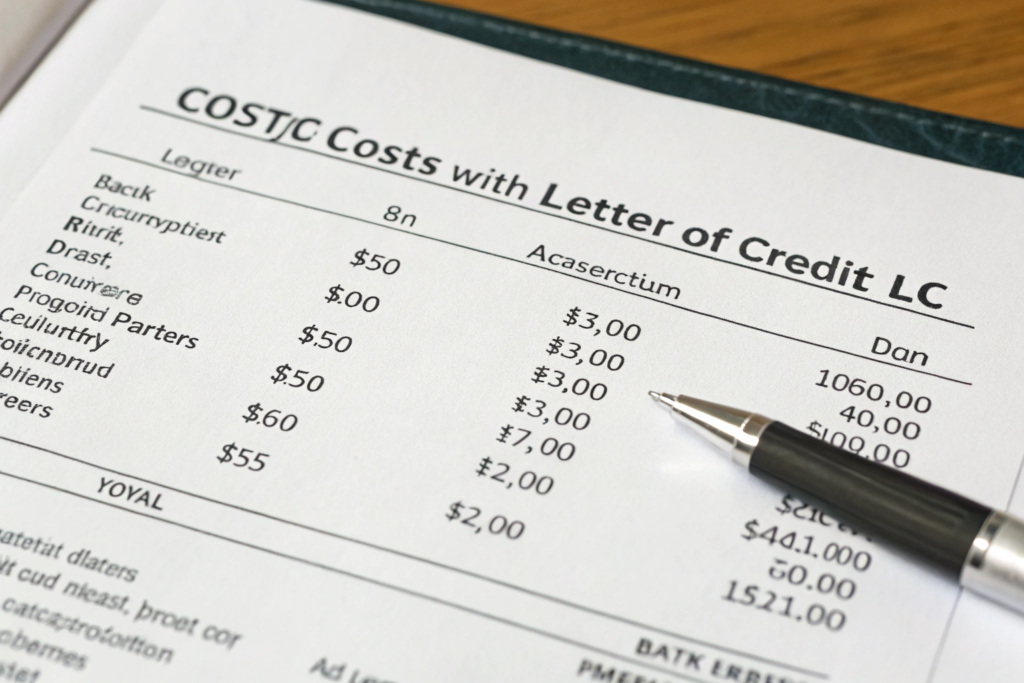
For a $50,000 irrevocable LC at sight from a US bank to a Chinese supplier, the typical fees break down as follows. The issuance fee charged by the buyer’s bank is 0.5% to 0.75% of the LC value, so $250 to $375. The advising fee charged by the supplier’s bank for authenticating and transmitting the LC is typically $50 to $150. The confirmation fee, if the supplier requires the LC to be confirmed by a bank in China, is 0.5% to 1% of the LC value per quarter or portion thereof, so $250 to $500. The document examination fee, charged when the documents are presented, is typically $75 to $150. Amendment fees, if the LC terms need to be changed, are $75 to $150 per amendment. The total cost for a clean, unamended $50,000 LC is roughly $625 to $1,175, or 1.25% to 2.35% of the invoice value. For a $200,000 LC, the percentage costs drop because many of the fees are flat rather than percentage-based. The issuance fee might be negotiated down to 0.3% to 0.5% for a larger transaction with a good banking relationship. The total cost would be roughly $900 to $1,800, or 0.45% to 0.9% of the invoice value.
LC costs scale down as order size scales up. The $200,000 order pays a lower percentage than the $50,000 order because the flat fees spread across more value.
The cost-benefit analysis compares these LC fees to the alternatives. The alternative to an LC is usually a 30% to 50% deposit with the balance on open account. The deposit ties up the buyer’s working capital. For a $50,000 order, a 30% deposit is $15,000 that the buyer can’t use for three to five months while the fabric is in production and transit. The working capital cost of that $15,000, at a 7% annual interest rate over five months, is about $437. The deposit cost, plus the risk of total deposit loss if the supplier fails, often exceeds the LC fee. When you add the intangible value of a bank guarantee, the LC looks like reasonably priced insurance.
How Do Amendment Fees Add Up When Production Timelines Shift Unexpectedly?
Amendment fees are the hidden cost trap in LC transactions, and fabric production is full of timeline surprises. A dye lot fails and needs to be re-run, pushing the shipment date back by two weeks. The LC shipping window closes before the goods are ready. The documents can’t be presented within the LC validity period. Every one of these timeline shifts requires an LC amendment, and each amendment costs $75 to $150 from the issuing bank plus potential advising bank charges.
A single production delay can trigger multiple amendments. The shipping date needs to be extended, which requires an amendment. If the LC expiry date was tied to the original shipping date plus 21 days for document presentation, the expiry date also needs amendment. If the fabric quantity changed slightly because the re-run produced a different yield, the quantity and amount need amendment. Three amendments on a $50,000 LC at $100 each is $300—not catastrophic, but an unplanned cost that adds 0.6% to the transaction cost. The protection against amendment fee accumulation is generous timeline planning. When we negotiate LC terms at Shanghai Fumao, we insist on a shipping window that includes a reasonable buffer for production variability—an extra two weeks beyond the optimal production timeline. We also negotiate the LC expiry date to be at least 21 days after the latest possible shipment date, not the earliest, to give time for document preparation and presentation without a last-minute amendment scramble. The upfront negotiation of realistic, buffered timelines costs nothing and saves hundreds in amendment fees and days of administrative stress.
Can Digital LC Platforms Like Contour Actually Reduce Costs for Mid-Size Fabric Orders?
The traditional LC process runs on SWIFT messages between banks, paper documents, and courier deliveries. It takes 3 to 7 days just to transmit the LC from the issuing bank to the advising bank, and another 3 to 5 days to examine and process the document presentation. Digital LC platforms like Contour, which use blockchain technology for secure, instant document transmission and verification, compress this timeline significantly and reduce the document handling charges.
For mid-size fabric orders in the $30,000 to $100,000 range, digital LCs are starting to change the cost equation. The transmission is instant—the LC is issued and advised in hours rather than days. The document presentation is digital—PDFs uploaded to the platform rather than paper documents couriered between banks. The discrepancy identification is automated—the platform flags mismatches between the presented documents and the LC terms before the submission goes to the bank, reducing the chance of a rejection and a representation cycle that costs time and money. The total cost reduction compared to a traditional paper LC is estimated at 20% to 40% depending on the number of amendments and the complexity. The adoption is still growing—not all banks are on the network, and not all suppliers have the digital infrastructure to participate—but for fabric transactions between mid-size brands and suppliers with access to the platforms, digital LCs are making the LC option cost-competitive with open account for orders where the risk profile previously didn’t justify the administrative burden. For a current comparison of digital LC platforms and their adoption among banks that handle textile trade finance, fintech trade finance communities often publish updated platform reviews with real-world transaction data and cost comparisons against traditional LC processing.
How Do You Negotiate LC Terms That Protect Both Fabric Quality and Payment Security?
The LC terms are negotiable. The standard LC template from a buyer’s bank is not a take-it-or-leave-it document. The supplier can and should negotiate the documentary requirements to ensure they can comply exactly, and the buyer can and should negotiate the inspection triggers to ensure the quality protection they need. The negotiation is the moment when the LC transforms from a generic bank instrument into a tailored contract that reflects the specific risks of a custom fabric transaction.
The supplier’s priority is document feasibility. The LC should not require documents the supplier cannot produce. A common mistake is an LC that requires a "certificate of origin issued by the China Council for the Promotion of International Trade" when the fabric was partially finished in Vietnam and the CCPIT certificate would be inaccurate. The supplier must flag this before accepting the LC. Another common issue is an LC that requires an inspection certificate from an inspection company that doesn’t have an office near the factory, adding cost and delay. The supplier should propose an alternative inspector or negotiate the inspection location. The supplier should also negotiate the document presentation period—the time allowed after shipment to prepare and present the documents. A 21-day period is standard and reasonable; a 7-day period is tight and risky if the courier or the bank processing is slow.
The negotiation is the contract. The LC terms you agree to are the terms you live with. Get them right before the LC is issued, because changing them later costs money and trust.
The buyer’s priority is quality verification. The LC should require a third-party inspection certificate that references the specific quality parameters from the purchase agreement. "Inspection certificate from SGS confirming the fabric meets the specifications in Purchase Order 2026-0421" is vague and gives the supplier room to argue about what "meets" means. "Inspection certificate from SGS confirming surface resistivity below 1.0 x 10^9 ohms per ASTM D257, shrinkage below 3% per AATCC 135, and colorfastness to washing grade 4 minimum per AATCC 61" is specific and enforceable. The buyer should also consider requiring a pre-shipment sample approval clause: a document in the LC package certifying that the buyer has approved a pre-shipment sample, or the LC allows payment against a shipment sample approval instead. This gives the buyer a final visual check before payment releases.
What Are the Most Common Documentary Discrepancies That Delay Payment for Fabric LCs?
The most common discrepancy in fabric LCs is the goods description mismatch. The commercial invoice describes the fabric using slightly different words than the LC, and the bank rejects the documents. The second most common is the late shipment—the bill of lading shows an on-board date after the LC shipping window closed. The third is the late presentation—the documents were presented to the bank after the LC expiry date or the presentation period. The fourth is the missing document—the LC required an inspection certificate, but the supplier forgot to include it or couldn’t get it in time.
Each of these discrepancies triggers a document rejection from the bank. The supplier has a limited window to correct and re-present the documents. If the LC has expired by the time the corrected documents are ready, the supplier needs a buyer waiver to get paid—the buyer instructs their bank to accept the discrepant documents despite the discrepancy. This waiver request puts the buyer in a powerful negotiating position and the supplier in a weak one. The supplier has shipped the goods, the buyer has the documents (or can get them), and the only thing preventing payment is the buyer’s consent to waive the discrepancy. The protection for the supplier is strict document discipline. At Shanghai Fumao, we designate one person on our logistics team to review every LC document against the LC terms word-for-word before presentation. We use a checklist. We’ve shipped thousands of containers on LC terms, and our discrepancy rate is below 2% because we treat document preparation as a separate quality control process, as important as the fabric inspection. For a practical checklist that fabric suppliers can use to verify LC document compliance before presentation, trade finance practitioner forums often share detailed discrepancy avoidance guides with real examples from textile transactions that were rejected and the specific corrections that fixed them.
When Should You Push for a Confirmed LC Instead of an Unconfirmed One?
Confirmation adds a second bank guarantee to the LC. An unconfirmed LC is guaranteed by the issuing bank—the buyer’s bank—only. A confirmed LC adds the guarantee of a bank in the supplier’s country, typically the advising bank. If the issuing bank fails to pay, the confirming bank pays, and then seeks reimbursement from the issuing bank. The confirmation eliminates the cross-border payment risk and the issuing bank credit risk for the supplier.
Confirmation is worth the cost—typically 0.5% to 1% of the LC value—when three conditions exist. First, the buyer’s bank is in a country with political or economic instability, or the bank itself is not internationally rated. A fabric supplier in China receiving an LC from a bank in a country with capital controls or a history of payment delays should insist on confirmation by a major international bank. Second, the issuing bank is small or unknown, even if the country is stable. The supplier has no way to assess the creditworthiness of a small regional bank in the buyer’s country. A confirming bank in China has the resources and the regulatory access to make that assessment and take the risk. Third, the supplier wants to finance the transaction through pre-shipment financing or invoice discounting. Confirming banks are often more willing to provide working capital against a confirmed LC than an unconfirmed one because they have direct control over the payment. For a $200,000 custom anti-static fabric order, the confirmation fee of $1,000 to $2,000 buys the supplier certainty that the payment will arrive regardless of what happens to the buyer’s bank. When that certainty is worth the premium, push for confirmation.
Conclusion
The resurgence of Letters of Credit for high-value fabric orders is a rational response to the changing structure of textile sourcing. As orders become more customized—proprietary colors, exclusive weaves, functional anti-static properties—the financial exposure for both parties has grown beyond what trust and open account terms can comfortably absorb. An irrevocable LC replaces bilateral trust with institutional trust, guaranteeing the supplier gets paid upon compliant document presentation and guaranteeing the buyer doesn’t pay until the shipping documents prove the goods are on the water and the inspection certificate proves they meet the spec.
We’ve walked through the mechanics: the irrevocability that locks the deal, the strict document compliance that protects both sides, and the specific ways an LC can be structured with inspection certificates to provide quality assurance as well as payment security. The cost analysis shows that LC fees, while real, scale down as a percentage of order value and often compare favorably to the working capital cost of a large upfront deposit or the risk premium of an unsecured open account. The emergence of digital LC platforms is reducing the administrative burden and making the LC option accessible for mid-size orders that previously couldn’t justify the paperwork. And the negotiation framework—supplier prioritizing document feasibility, buyer prioritizing quality verification triggers—produces an LC that works as a tailored contract, not a generic bank template.
At Shanghai Fumao, we’ve been shipping fabric against Letters of Credit for over 20 years. We understand the document preparation discipline that keeps our discrepancy rate under 2%. We negotiate LC terms that protect our clients’ quality requirements with specific inspection certificate triggers while ensuring we can comply with every documentary condition exactly. And we work with the major confirming banks in China to offer our clients the option of a confirmed LC when the transaction size and the relationship stage warrant the extra layer of security.
If you’re considering an LC for your next high-value custom fabric order—or if you want to understand how LC terms can be structured to protect your specific quality and payment requirements—reach out to our Business Director, Elaine, at elaine@fumaoclothing.com. She can discuss our LC-compatible documentation package, walk you through the draft terms we’d recommend for your order, and coordinate with your bank to ensure a smooth issuance and document presentation process.








