
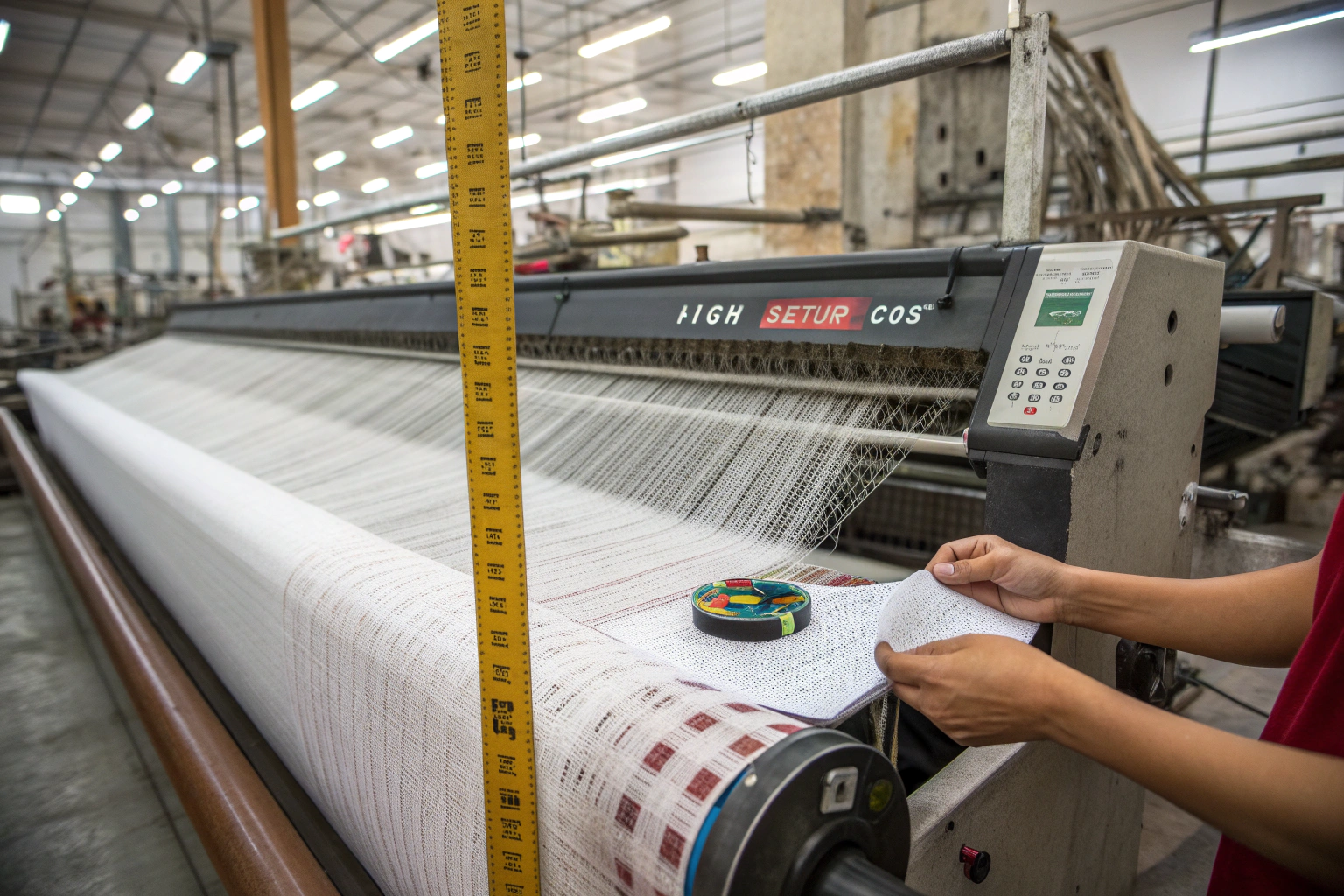
You finally found the perfect fabric. It is a custom jacquard with a recycled polyester warp and a cupro weft, in a geometric pattern that matches your brand aesthetic perfectly. You email the supplier with your spec sheet, excited to get the sampling process started. The reply comes back: "Thank you for your inquiry. Our MOQ for this development is 3,000 meters." Your excitement evaporates. You are a growing brand. You need 500 meters for your capsule collection, not a container-load. You feel rejected, like the industry is built only for giants and you are being shown the door before you even get a seat at the table. The anger mixes with frustration because you know the fabric is right, but the quantity gate is locked.
The high MOQ on custom fabric is not a punishment for small brands. It is a cold, hard mathematical consequence of how textile machinery is designed and how the supply chain is structured. A weaving mill is not a photocopier. It is a sequential, high-setup-cost industrial process where the first meter costs ten thousand dollars in machine time and raw material commitment, and the thousandth meter costs three dollars in yarn. At Shanghai Fumao, I enforce MOQs not because I want to exclude small designers, but because I want to stay in business long enough to serve them when they grow. I want to explain the hidden economics of the warping creel, the dyeing vessel, and the yarn spinner’s minimum lot size so that you understand where the number comes from—and how to negotiate around it.
What Machine Setup Costs Force a High Minimum Run?
The weaving machine does not care about your brand story. It cares about physics, tension, and time. Before a single weft yarn is inserted, the warp—the longitudinal skeleton of your fabric—must be prepared on a warping beam. This process is called "warping," and it is the most time-consuming, labor-intensive, and unskippable step in the entire weaving chain. Whether you order 100 meters or 10,000 meters, the warping creel must be loaded, the threads must be drawn through the heddles and reed, and the loom must be calibrated. The setup time is a fixed cost, and it is massive. A mill cannot amortize that fixed cost over a tiny run without charging you a price per meter that would make your eyes water.
How Many Hours Does It Take to Thread a Jacquard Loom?
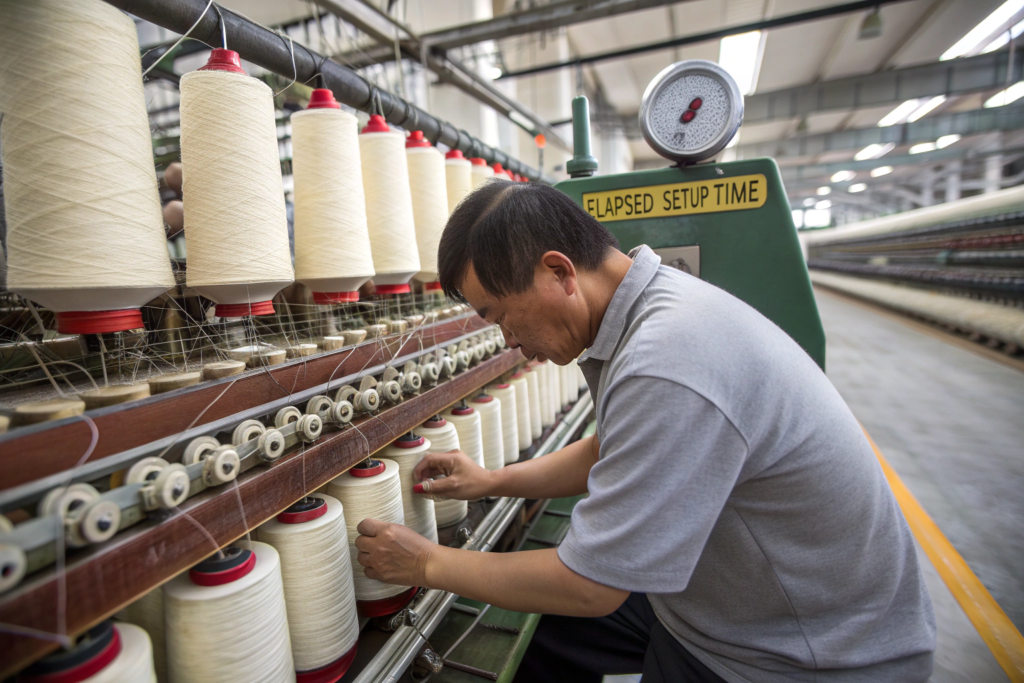
A standard dobby loom threading might take a skilled team of two workers four to six hours. A complex Jacquard loom, where each warp end is individually controlled by a harness of hundreds of hooks, can take two to three full shifts of manual threading. I am talking about 16 to 24 hours of skilled labor, with two technicians standing at the back of the loom, hand-feeding each yarn end through a tiny heddle eye. This is not automatable on most existing machinery, especially for the retro-fitted Jacquard heads that are common in Keqiao.
During those 24 hours, the loom is not producing fabric. It is consuming labor cost and floor space and generating zero revenue. If you order 300 meters of a custom Jacquard pattern, the loom might run for only four hours once it is finally threaded. The setup-to-production ratio is six to one. The mill effectively loses a full day of production capacity for a run that finishes before lunchtime. This is why Jacquard MOQs are typically 1,500 to 3,000 meters. The run needs to be long enough to make the threading time mathematically worthwhile. I once did a 500-meter Jacquard run for a luxury US designer as a favor. I lost money on it. The threading took 20 hours. The weaving took six. I cannot repeat that favor for every small brand, or Shanghai Fumao would be a charity, not a factory.
Why Does the "Drawing-In" Process Create a Setup Fee Floor?
Drawing-in is the manual threading of warp yarns through the heddles and the reed. It is tedious, eye-straining work. A single operator can draw in roughly 1,000 to 1,500 ends per hour on a simple plain weave. On a high-density, fine-count fabric—say, a 100s cotton poplin with 140 ends per inch and a width of 60 inches—you are dealing with 8,400 individual yarn ends. That is five to six hours of uninterrupted, focused labor for one person.
This labor cost is the "setup fee floor." It exists regardless of the order quantity. Some mills will charge an explicit setup fee to small orders to cover the drawing-in cost. Others build it into a higher per-meter price for below-MOQ runs. When I negotiate with a small brand, I sometimes offer to split the setup fee: they pay a $300 to $500 setup charge, and I reduce the MOQ from 2,000 meters to 800 meters. This makes the economics transparent. The buyer sees exactly what they are paying for—the skilled hands threading their dream fabric into existence—rather than an arbitrary volume gate. If you are learning how to negotiate fabric MOQs with a Chinese mill, ask them to unbundle the setup fee from the per-meter price. The conversation changes when both sides look at the real labor cost instead of a round-number volume requirement.
How Do Dyeing Vessel Minimums Dictate Your Color Lot Size?
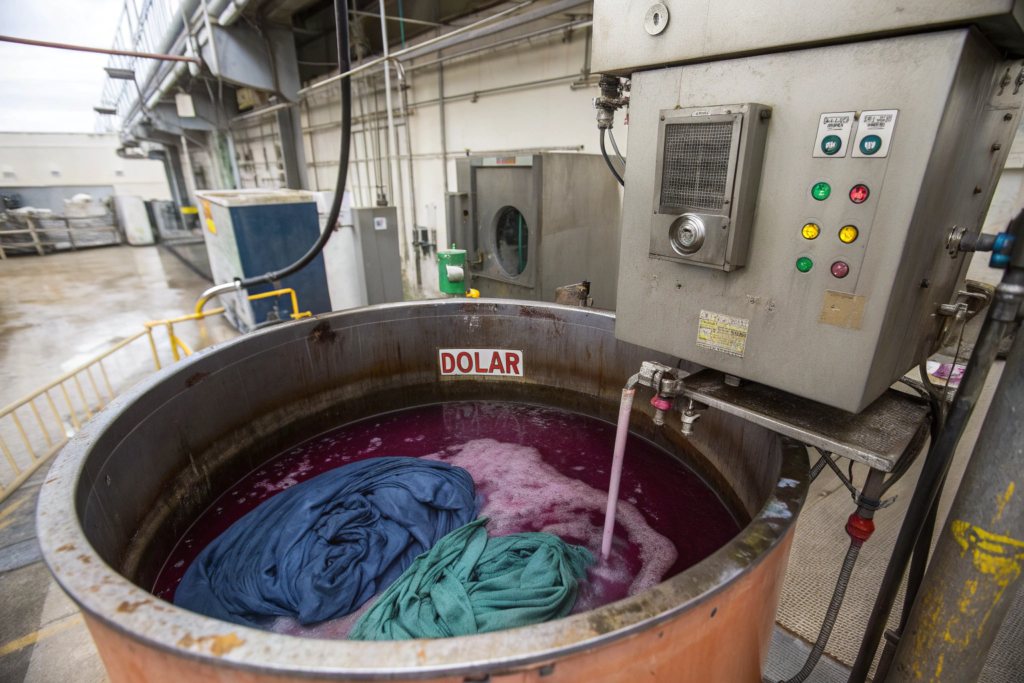
Dyeing is a wet chemical process that happens in sealed, pressurized vessels. These vessels are not infinitely adjustable. A jet dyeing machine has a fixed capacity, typically 100 kg, 250 kg, 500 kg, or 1,000 kg per batch. The machine must be filled to its optimal capacity for the dye liquor to circulate correctly and for the temperature to distribute evenly. Running a 500-kilo vessel with only 100 kilos of fabric inside is not just inefficient. It can produce a bad dyeing result because the fabric-to-liquor ratio is wrong and the chemical concentrations are harder to control. The dye house will refuse the order, or they will charge you the full vessel rate regardless of how much fabric you put in.
What Is the "Liquor Ratio" and Why Does It Set a Physical Floor?
The liquor ratio is the weight of the dye bath water relative to the weight of the fabric. A typical reactive dyeing machine runs at a 1:8 or 1:10 ratio—one kilo of fabric to eight or ten kilos of water. The machine is engineered to circulate this specific volume of liquid through the fabric at high speed. If the fabric load is too small, the liquor ratio shifts, the pump cavitation changes, and the fabric can be damaged by excessive turbulence or uneven chemical distribution.
This is a hard physical floor. The vessel has a minimum loading threshold, usually 60% to 70% of its nominal capacity. A 500 kg vessel needs at least 300 kg of fabric to run safely. If your custom color is a deep navy that requires a heavy dye concentration, the minimum might be even higher because the chemical recipe is calibrated for a full vessel. This is why custom dye lots have higher MOQs than stock colors. A stock white or black can be ganged with other orders to fill the vessel. Your specific Pantone-matched sage green runs alone in its own dedicated vessel, and you must pay for the full capacity whether you use it or not.
Can "Lab Dip" Accuracy Allow for Smaller Dye Runs?
A perfect lab dip does not eliminate the vessel minimum, but it does reduce the risk of a failed dye lot, which is a hidden cost driver behind high MOQs. The lab dip is a tiny beaker simulation of the bulk dyeing process. The dyer mixes 10 grams of fabric in a 100ml water bath, matching your target shade under controlled conditions. The challenge is scaling that recipe up from a beaker to a 500-kilo vessel. The physics change. The heating rate changes. The circulation changes.
A dye house that invests in high-accuracy lab-to-bulk correlation can confidently run smaller lots because their first-pass yield is higher. They do not need to budget for a re-dye in the MOQ calculation. At Shanghai Fumao, we use a spectrophotometer to read the lab dip and the bulk sample, calculating the Delta E (color difference) mathematically. Our target is a Delta E below 1.0 for commercial acceptance. Because we hit this target consistently, we can sometimes accept a 70% vessel load instead of an 80% minimum, because the risk of a failed batch that needs to be stripped and re-dyed is low. This is a technical capability that translates directly into a lower MOQ. Ask your supplier about their first-pass dyeing yield. A high yield means a lower MOQ is possible.
Why Do Specialty Yarns Have a Spinner’s Minimum That Cascades Down?
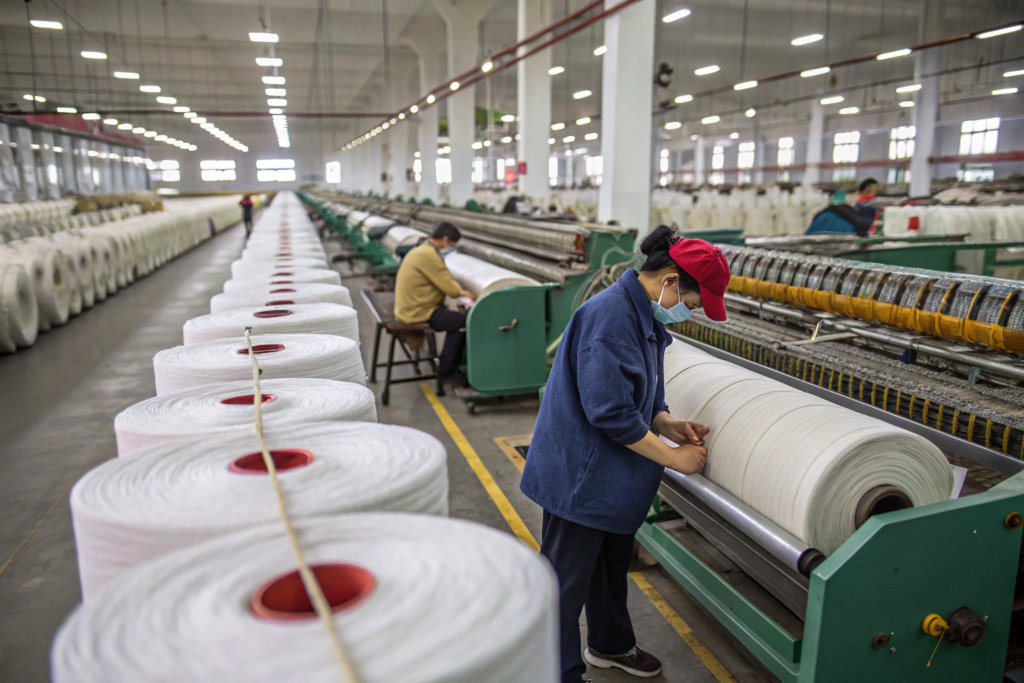
The fabric mill does not make yarn. The dye house does not make yarn. We buy yarn from spinners, and those spinners have their own ruthless minimum order quantities. A commodity yarn like 40s combed cotton is always running, and we can buy it by the kilo with no minimum. But when your custom fabric requires a specialty yarn—a melange heather effect, a specific denier of recycled nylon, a cashmere blend, or a metallic filament—the spinner likely has no stock and no running orders. They must stop a production line, clean the carding machine to prevent contamination, and run your order as a dedicated lot. That spinner’s MOQ cascades directly down to my MOQ, and then to yours.
What Types of Yarn Have the Steepest "Clean-Out" Costs?
White cotton or undyed polyester is a continuous run. The spinner does not need to clean the machine between lots of the same generic fiber. But the moment you introduce a specialty color, a different fiber type, or a contamination-sensitive blend, the "clean-out" penalty kicks in. Dark-colored fibers, like a jet-black acrylic or a deep red viscose, are the worst offenders. If a spinner runs a black acrylic lot, they must completely strip down the carding machine afterward to remove every single black fiber before they can run a white cotton lot for the next customer. This clean-out takes four to six hours of labor and lost production.
Cashmere, mohair, and alpaca are also high-clean-out fibers because their fine, oily hairs contaminate the carding machinery. A spinner will not run a 50-kilo cashmere order if it means losing a full shift to clean the line. The MOQ for a cashmere blend yarn is often 300 to 500 kilos. That is roughly 1,500 to 2,500 meters of a lightweight suiting fabric. My MOQ to you is a direct function of the spinner’s MOQ to me. If you want to understand why your 5% cashmere blend has a 2,000-meter minimum while your 100% cotton has a 500-meter minimum, the answer is sitting in the spinner’s clean-out bay.
How Does "Grey Yarn" Stocking Allow for Lower MOQs on Basics?
The workaround is the "Grey Yarn Bank." A mill that stocks undyed, natural yarn in a wide range of counts and fiber compositions can bypass the spinner’s MOQ for many custom developments. I keep an inventory of core yarns at Shanghai Fumao: 40s compact cotton, 30s organic cotton, 75D recycled poly, 50D nylon, and a few Tencel counts. Because I buy these in bulk for my program business, I have them on the shelf.
When a small brand comes to me with a custom development that uses one of these core yarns, I can pull from my grey yarn bank and skip the spinner’s MOQ entirely. The only minimum is my weaving and dyeing setup. This is why I always guide small brands toward my stocked base yarns for their first custom project. It collapses the supply chain and dramatically reduces the MOQ. A fabric that would require 2,000 meters with a specialty spun yarn might be feasible at 500 meters if we build it on a stocked grey yarn platform.
How to Pool Orders and Use "Stock Service" to Beat the MOQ System?
The MOQ is a physical and economic wall, but it has doors. Smart, small buyers do not try to smash through the wall. They use a side entrance. The two most effective strategies are order pooling—where multiple brands share a production run—and stock service programs—where the factory produces the fabric speculatively and sells it by the roll from inventory. I have used both methods to serve brands that need 200 meters of a custom quality but cannot pay the 2,000-meter MOQ penalty. These strategies require a factory that is willing to manage complexity and hold inventory risk, but they are not acts of charity. They are profitable business models when done right.
What Is a "Group Buy" and How Does It Work Across Different Brands?
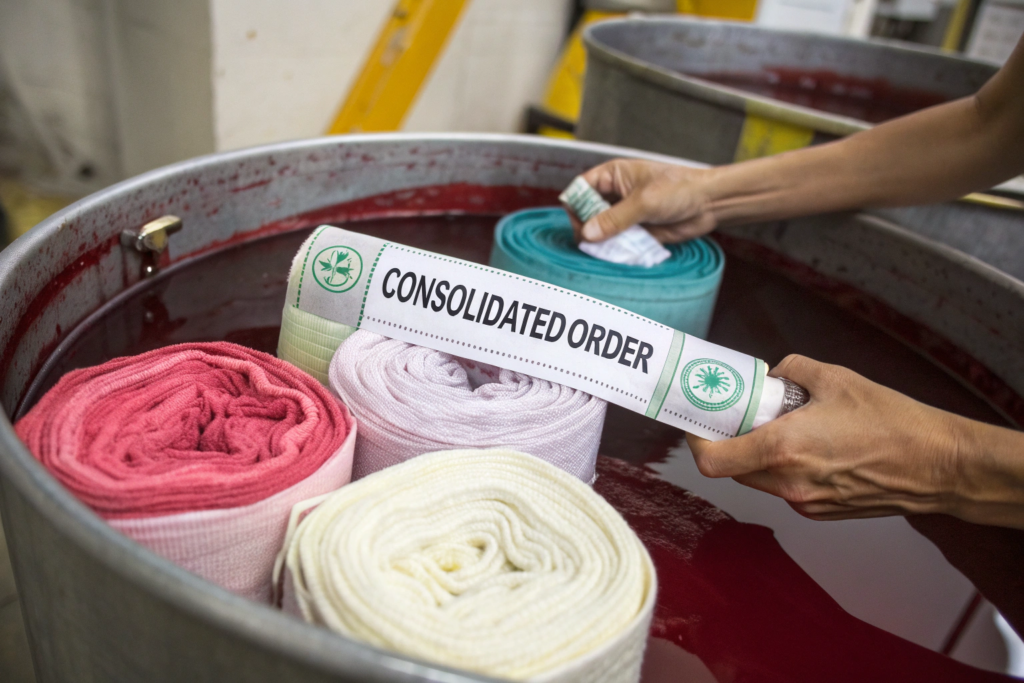
A group buy is when a mill produces a base fabric in a large, efficient run and splits it across multiple buyers who each take a portion. The base fabric is identical—same yarn, same weave, same greige quality. The customization happens downstream: each buyer gets their own dye lot, their own finish, or their own print on top of the shared base.
I run a group buy program for a heavy organic cotton french terry. I produce 5,000 meters of the greige fabric in one efficient run. Five different brands each take 1,000 meters. One dyes it in garment-dyed pastels. Another takes it in a reactive-dyed black. A third prints their signature graphic on it. The weaving MOQ is met by the pooled volume. The dyeing MOQ is met because each brand takes a full vessel load of their custom color. The brands do not need to know each other or coordinate. I manage the allocation and the scheduling. Each brand pays a per-meter price that is close to the bulk rate, even though their individual order would never qualify for it.
How Do Stock Service Programs Offer "No-MOQ" Custom Access?
A stock service program is the ultimate MOQ killer. The factory produces the fabric on speculation, stocks the finished rolls in a warehouse, and sells cut lengths with no minimum order. This is not custom development from scratch. You cannot specify a unique yarn blend or a novel weave structure. But within the stocked range, you get immediate access to high-quality, trend-responsive fabrics with zero MOQ.
At Shanghai Fumao, we run a stock service for our fastest-moving qualities: a recycled poly satin, a Tencel twill, a linen-cotton canvas, and a few seasonal novelties. We produce these in bulk during our valley season, using our own market intelligence to predict demand. We stock the rolls in our warehouse and sell from 50 meters upward. The per-meter price is slightly higher than a custom bulk order because we carry the inventory risk and the warehousing cost. But for a small brand that needs 200 meters immediately for a drop, the price is a bargain compared to paying the full custom MOQ setup fee. This is the bridge between made-to-order and ready-to-wear for fabric buyers.
Conclusion
High MOQs are not a conspiracy against small brands. They are the visible surface of a deep, interconnected chain of industrial constraints. The warping creel takes a full shift to load, regardless of whether you weave 100 meters or 10,000 meters. The dyeing vessel has a fixed liquor ratio that cannot be cheated. The specialty yarn spinner demands 500 kilos to justify cleaning the carding machine of black acrylic fibers. These are not arbitrary numbers pulled from a greedy spreadsheet. They are the physical, chemical, and economic floors of textile production. Understanding them is the first step to negotiating around them.
The workarounds are real. You can ask for an unbundled setup fee to lower the weaving MOQ. You can design your fabric around stocked grey yarns to bypass the spinner’s minimum. You can join a group buy or shop from a stock service program to get bulk pricing on small cut lengths. At Shanghai Fumao, I have built these flexible pathways specifically because I remember what it felt like to be told "no" by a supplier when I was starting out. If you are facing an MOQ wall on a custom development and you want to explore which workaround applies to your specific fabric spec, please reach out to our Business Director, Elaine. She can check our grey yarn inventory, our upcoming group buy schedule, and our stock service availability to find the lowest-cost entry point for your brand. Email her at elaine@fumaoclothing.com. Let us find a way to make your custom fabric happen, without the impossible minimum.








