You have done everything right. You negotiated the fabric price down by 15 cents a meter. You beat the Chinese New Year shutdown by a full week. You even passed the third-party inspection with an A-grade. You pat yourself on the back, thinking you have protected your margin. Then the freight forwarder sends the final bill, and the shipping cost is triple what you budgeted six months ago. Your hard-won fabric discount evaporates into thin air. I have seen this gut punch happen so many times it makes me angry on behalf of every independent brand owner out there. The fabric market is predictable. The logistics market is a casino.
Freight rates for textile imports are unstable because they sit at the intersection of pure panic, geopolitics, and container mathematics. A conversation about tariffs in Washington, a Houthi missile in the Red Sea, or a shortage of truck chassis in Chicago can double your landed cost overnight. And here is the ugly truth: fabric is heavy and bulky. A 40-foot container stuffed with 20,000 meters of denim has a relatively low dollar-per-kilo value compared to electronics. When freight rates spike, the shipping cost can exceed the actual production cost of cheap greige fabric. After twenty years of shipping from our Shanghai Fumao warehouse to every major US port, I have learned that logistics is not a cost center. It is a risk management department disguised as a shipping department.
I want to pull back the curtain on why that freight quote from your forwarder expires in 14 days, what hidden surcharges are lurking in the fine print, and how the smartest fashion buyers I know structure their logistics contracts to sleep better at night. This is not a boring shipping lecture. This is a survival manual for your cash flow.
How Do Geopolitical Conflicts Still Impact Container Freight Rates?
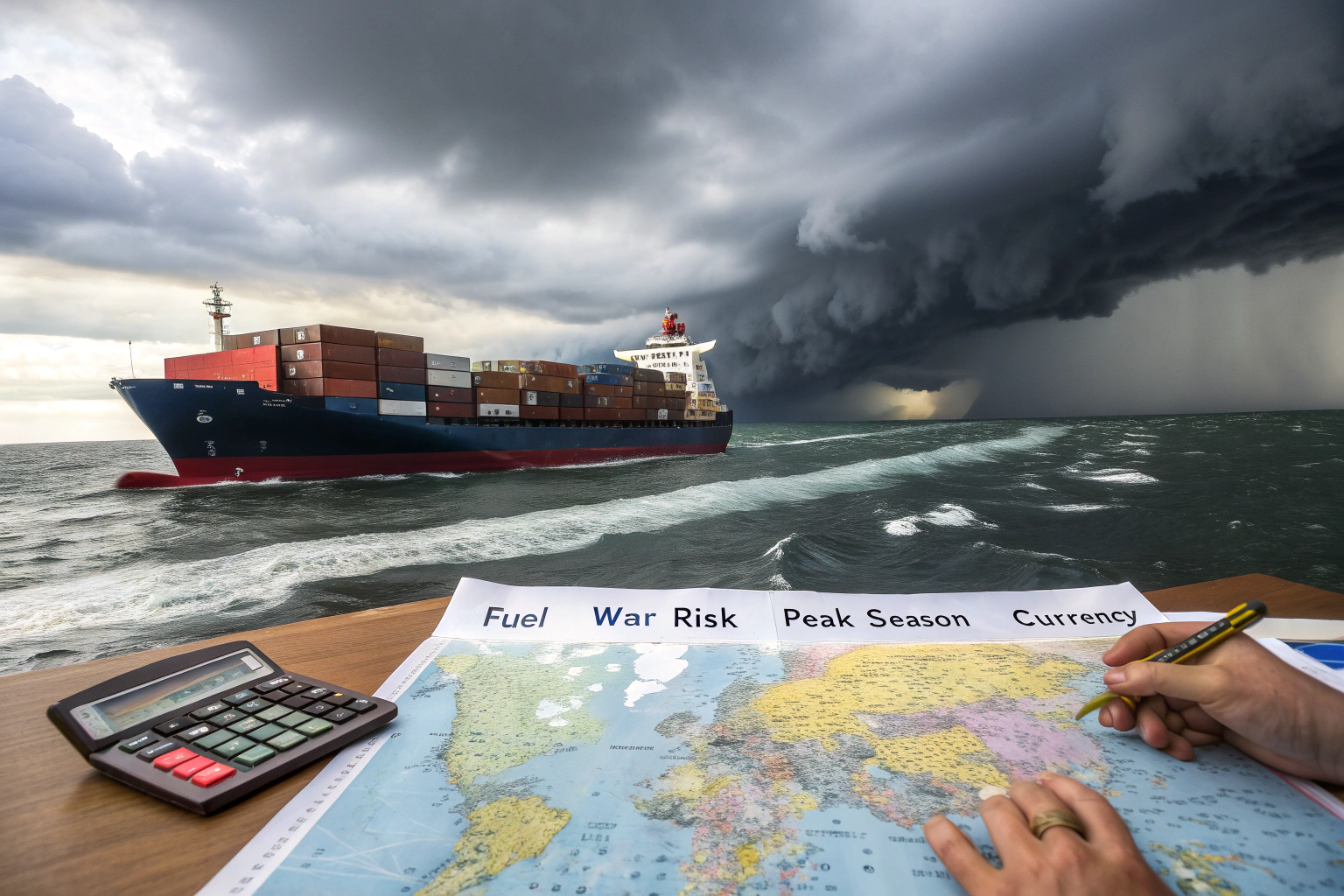
A missile fired in Yemen can make your yoga pants more expensive. It sounds insane, but in February 2024, I watched the spot rate for a 40-foot container from Shanghai to Los Angeles jump by 40% in two weeks because Houthi rebels were attacking ships in the Red Sea. Now, you might think, "The Red Sea is between Asia and Europe. I ship to the US West Coast. Why should I care?" Because shipping is a globally connected bathtub. When the Suez Canal route becomes dangerous, carriers divert ships around Africa. That trip takes an extra 14 days. That means those ships are not available to pick up cargo in China on schedule. A shortage of vessels in China pushes up the price for all routes, including trans-Pacific ones. It is the butterfly effect, but with steel behemoths and $10,000 freight bills.

What is the "War Risk Surcharge" and Why Is It on Your Invoice?
This is a line item that makes new importers furious. You will see it on your invoice as "WRS" or "Emergency Risk Surcharge." It is not a scam. It is the shipping line passing on the skyrocketing cost of their hull insurance. When a conflict zone is declared, Lloyd’s of London and other marine insurers immediately raise premiums for vessels transiting those areas. A container ship worth $150 million carrying 15,000 boxes of cargo suddenly costs a fortune to insure. The carrier splits that extra insurance bill across every container on board, regardless of whether your specific box is going through the danger zone. Because the global fleet is shuffled around to cover the disrupted routes, everyone pays.
In late 2023, during the peak of the Red Sea diversions, I saw WRS charges fluctuate between $40 and $450 per container on shipments that had nothing to do with the Middle East. The carriers call it a "Cost Recovery Initiative." I call it an unavoidable headache. But you can protect yourself. When you sign a freight contract, ask whether the "all-in" rate includes war risk and what the trigger point is for additional surcharges. Some forwarders will offer a "no-surprise" guarantee that caps these emergency surcharges at a certain percentage. If you are shipping during a period of active geopolitical tension, you might want to explore how to negotiate a freight contract with a war risk clause to avoid a blank check situation on your final bill.
How Does Vessel Bunching After a Canal Closure Create Artificial Scarcity?
Canal closures do not just delay ships; they create what logistics experts call a "phantom capacity crunch." Think of it like a highway accident. The crash gets cleared in an hour, but the traffic jam lasts for six hours. When the Ever Given blocked the Suez Canal in 2021, it was stuck for six days. But the bunching effect lasted for three months. Ships that were delayed arrived at European ports at the same time as ships that were on schedule. The ports could not handle the sudden spike. Vessels sat at anchor for 10 days waiting for a berth. Those delayed vessels could not make their scheduled return trip to China to pick up your next fabric order.
This bunching means that even though the actual number of ships in the world has not changed, the available capacity in Shanghai or Ningbo drops by 15-20% for a window of about six to eight weeks. Less capacity plus steady demand equals a price spike. When this happens, I immediately advise my clients to shift to "service contract" rates rather than relying on the spot market. If you are buying fabric regularly from Shanghai Fumao, we can link your production schedule to a fixed-volume service contract with a carrier, which shelters you from the worst of these temporary madness spikes.
Why Does the Panama Canal Drought Translate to Higher Textile Freight Bills?
This is a story about rain, or the lack of it. The Panama Canal operates on fresh water from Gatun Lake. Every time a ship passes through the locks, millions of gallons of fresh water are released into the ocean. When there is a drought, the canal authority reduces the number of daily transit slots and restricts the draft of ships. A restricted draft means a ship cannot sit as deep in the water, which means it cannot carry as much weight. For textiles, this is a body blow because fabric is heavy. A container of denim or heavy upholstery velvet hits weight limits fast. In 2023, some carriers were loading containers 40% below capacity to meet the draft restrictions, then charging 40% more per container to make up for the lost slots.

How Do Weight Restrictions Force "Dead Freight" Charges?
"Dead freight" is when you pay for air. If a carrier books a ship expecting to load 10,000 containers but the canal says the ship can only sit high enough to safely carry 7,000 containers, 3,000 slots are lost. The carrier still needs to make the voyage profitable. So they impose a "Peak Season Surcharge" or a "Weight Limitation Fee." Your fabric is heavy, so your container gets flagged as a "high-weight unit." The carrier might charge you an extra $300 to $600 per heavy container to justify putting it on a ship with limited capacity.
I have had to get creative with loading plans. Instead of putting 25,000 meters of a cotton-spandex twill into a single 40HQ container, I now sometimes split it into two lighter 20-foot containers if the per-kilo rate becomes cheaper after calculating the dead freight penalty. It sounds counterintuitive—two smaller boxes instead of one big one—but the math works when the weight penalty is high. The textile industry is particularly vulnerable to this because our product is dense. A cubic meter of printed chiffon is light and puffy; a cubic meter of coated canvas is a brick. This is why knowing the weight of your order, not just the volume, is critical for accurate logistics budgeting.
Is the "Panama Canal Transit Fee" Now a Permanent Surcharge?
Yes, and I believe it is never going away. The canal authority has added a "Fresh Water Surcharge" of up to 10% on top of the base toll, plus a variable fee based on the lake level. These are not temporary. They are restructuring their entire pricing model to deal with climate change. As the lake levels become more erratic year by year, the canal becomes more expensive to operate.
For US East Coast importers, this is a strategic problem. The alternative is the Suez Canal route, which has its own war risk issues, or the US West Coast route plus cross-country rail, which has its own congestion and labor issues. There is no easy escape. I have seen some savvy furniture and heavy fabric importers start using the "Land Bridge" strategy: ship to a West Coast port like Long Beach, then use a bonded rail service directly to a Midwest or East Coast warehouse. It can be faster and, during a Panama drought, surprisingly cost-competitive. It requires a forwarder who is a wizard at intermodal routing.
Why Do Labor Disputes at US Ports Create Sudden Demurrage Bills?
Your ship arrived on time. The customs entry was accepted. Everything is perfect. And then the port workers go on a "slowdown" or a full strike, and your container sits on the dock for two weeks. The terminal charges you "demurrage" for using their space after the free days expire. The shipping line charges you "detention" for holding their container beyond the allowed time. I had a client in 2022 who paid $3,200 in demurrage and detention on a single container during the West Coast labor negotiations, simply because the longshoremen were working at half speed. The fabric inside was only worth $12,000. The logistics failure consumed 26% of the product’s value. This is pure waste.

How to Negotiate "Free Time" for a Fabric Container Before It Lands?
Free time is the number of days you get to pick up the container from the terminal without paying extra. The standard is 4 to 7 working days. Do not accept the standard. Textile buyers need more because a roll of fabric is not a perishable avocado, but it also is not a high-priority item for a trucker compared to a hot-selling iPhone. Truckers will delay picking up fabric if they get a better offer for a food shipment.
I always push my forwarder to negotiate "14 calendar days free time" at the destination port. It costs the forwarder something, but the cost of an extra week of free time is a fraction of what you will pay in demurrage if there is a single hiccup. I also demand that this free time is written into the service contract before the container is loaded in China. If you wait until the container is already stuck, you have zero negotiating power. You will pay whatever the terminal asks. This is especially critical during known labor negotiation periods. The International Longshore and Warehouse Union (ILWU) contract cycles are public knowledge. You can plan around them. If you are shipping during a contract expiration year, extend your free time to 21 days. Pay the premium for the extra days upfront. Trust me, it is cheaper than the emergency demurrage invoices.
What Is the Difference Between "Demurrage" and "Detention" and Why Both Hurt?
These two terms are often confused, and the shipping lines love that confusion because they can double-charge you. Let me clarify:
- Demurrage: The fee you pay to the terminal when your full container sits on their ground beyond the free days. You are using their real estate.
- Detention (or Per Diem): The fee you pay to the shipping line when you keep their container outside the terminal for too long. You are using their equipment.
You can get hit with both on the same shipment. If the port is congested and you cannot pick up the box, you pay demurrage. Then, when you finally get it and truck it to your warehouse, you have to unload it fast and return the empty box. If your warehouse team is overwhelmed and takes a week to unpack that 20,000-meter fabric shipment, you pay detention for the extra days you held the container. I have seen fabric buyers focus entirely on the ocean freight rate and ignore the detention fine print, then get a shock when the empty return is rejected because the container has a dent, and the per-diem clock keeps ticking during the dispute.
How Can a Strategic Forwarder Turn Logistics Costs into Predictable Margins?
Most buyers treat freight as a variable expense. They get a quote, pay the bill, and complain. The smartest buyers treat freight as a fixed line item in their cost sheet, even if the real-world rate is variable. They do this by hiring a strategic forwarder who acts more like a financial consultant than a truck dispatcher. A good forwarder will offer you a "Blended Rate" or a "Fixed-Freight Contract" for a six-month period. They take on the volatility risk themselves, and you get a single, unchanging price per kilo for your fabric, regardless of whether the spot market spikes or the canal dries up. This is revolutionary for a fashion brand because it allows you to price your garments accurately for a full season.

What is a "Buffer Stock" Agreement and How Does It Lower Per-Unit Shipping?
Here is a logistics hack I use for Shanghai Fumao clients who order consistently throughout the year but in batches too small to fill a container efficiently. Instead of shipping 5 cubic meters every month via expensive Less-Than-Container-Load (LCL), we ship a full 40-foot container to a bonded warehouse in New Jersey under a "Buffer Stock" agreement. The container moves at the cheapest Full Container Load (FCL) rate. The goods are stored in the bonded warehouse, and the US client "pulls" inventory as needed, clearing customs in small chunks.
This converts a high-cost LCL supply chain into a low-cost FCL pipeline. The storage cost at a bonded warehouse is roughly $12 to $18 per pallet per month. For heavy fabric, the math is a no-brainer. You save hundreds of dollars per cubic meter by avoiding LCL charges and peak season surcharges, and you have instant access to stock for your cut-and-sew factories in the US. This turns a volatile logistics cost into a predictable warehousing cost, which is much easier to budget for.
How Can Multi-Year Contracts "Flip" the Power Dynamic with Carriers?
In 2020 and 2021, carriers made more money than they had in the previous fifty years combined. They treated small and medium shippers with a take-it-or-leave-it attitude. That power balance has shifted. As new vessels ordered during the boom come online, capacity is growing. Carriers now need volume commitments to fill their ships. This is your window of opportunity. If you can commit to a consistent shipping volume—say, two 40-foot containers per month—you can demand a multi-year contract with a fixed rate or a capped increase.
I am currently advising my US clients to negotiate a "two-year fixed with annual review" contract directly with a carrier, bypassing the forwarder if necessary for the ocean leg. This contract includes a guaranteed equipment clause (meaning they cannot roll your booking because they ran out of containers) and a fixed bunker fuel adjustment factor. The key is the volume commitment. If you waver on volume, the contract breaks. But if your production with Shanghai Fumao is stable, you can predict your shipping volume accurately. This flips logistics from a source of constant anxiety into a boring, predictable utility, which is exactly where you want it to be so you can focus on designing and selling your collection.
Conclusion
Unstable logistics costs feel personal, but they are not a sign that you are bad at sourcing. They are a structural feature of a global shipping network that is simultaneously fighting wars, draining lakes, negotiating labor contracts, and chasing profit margins. The Red Sea conflict tacks on a war risk surcharge. A Panama drought forces your heavy denim into a weight penalty. A labor slowdown in Long Beach burns your free time and leaves you with a demurrage invoice that stings. These are not random acts of God. They are predictable patterns with paper trails and insurance products designed to manage them.
I have spent twenty years watching these waves hit, and I have spent the last five years at Shanghai Fumao building a logistics buffer around our production so that your fabric cost does not double between the loom and your warehouse. We use fixed-volume contracts, bonded warehouse strategies, and a network of textile-specific brokers who understand the difference between a knit and a woven when it comes to customs valuation. If you are tired of losing sleep over the next surcharge or the next port strike, please reach out to our Business Director, Elaine. She can connect you with a logistics partner who sees your fabric business as more than just a container number, and she can build a shipping strategy that turns that volatile freight line into a flat, predictable number. Write to her at elaine@fumaoclothing.com. Let us lock down your logistics before the next storm hits.