You have stared at the "sold out" badge on your own product page, feeling that strange mix of pride and panic. You lost sales. The demand was there, but the fabric was not. Or worse, you ordered a mountain of what you thought was the trendiest jacquard, and it is now sitting in a clearance bin at 70% off, mocking your judgment. The North American market chews up trends and spits them out faster than any other fashion scene on earth. TikTok makes something viral on Monday, and by Friday, your customer is asking why you do not have it in stock. Sourcing fabric here is not just about finding good quality. It is about finding a speedometer that matches the market’s heartbeat.
The secret to sourcing fabric that sells out fast is to stop guessing and start connecting three dots: the visual data of social media, the tactile substance of the sample room, and the relentless efficiency of the supply chain. You do not need a crystal ball. You need a process that shortens the distance between a trend appearing on a screen and a bulk fabric roll hitting your cutting table. At Shanghai Fumao, we have retooled our entire R&D model around this "speed-to-market" logic. We do not just wait for you to send us a spec. We push trend-responsive stock programs and rapid strike-off capabilities so you can ride the wave while it is cresting, not paddle out when it is already breaking.
I am going to show you how to reverse-engineer a trend into a tangible textile, how to test market demand with micro-batches before committing to a full container, and how to build a fabric library that acts like your personal trend insurance policy.
What Trend Data Should You Track Before Ordering a Custom Textile?
Back in the summer of 2024, I had a client from Los Angeles who was absolutely convinced that neon lime green mesh was going to be the story of the season. She had a gut feeling. She sketched an entire collection around it. We at Shanghai Fumao had the yarn and the knitting machines ready, but I urged her to check the data before committing to the 3,000-meter dye lot. She pulled up Google Trends and TikTok hashtag analytics and discovered that "neon green" was actually in freefall, while "soft sage green" was spiking heavily among the eco-conscious influencer crowd. She pivoted the dye lot at the last second. That sage mesh sold out in four days on her Shopify store. The gut feeling would have bankrupted her inventory. The data saved her season.

How to Use Google Trends and TikTok Hashtags to Validate a Fabric?
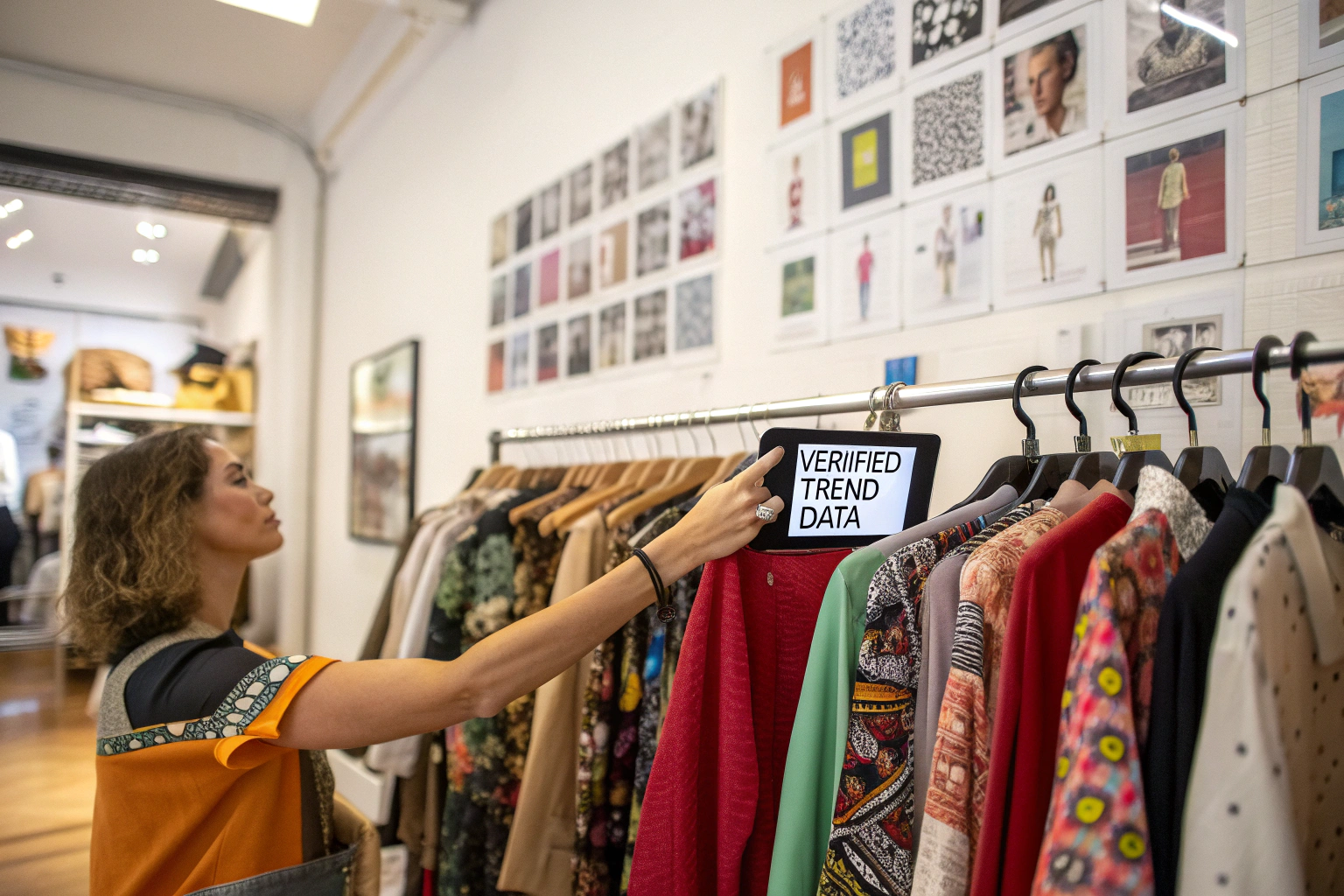
Do not just browse social media for inspiration like a consumer. Browse it like a detective. You need to validate whether a specific material is a fleeting flash or a rising tide. Start with Google Trends, but do not just type in "linen fabric." That is too broad and only shows general seasonal spikes when people buy summer clothes. Type in very specific, long-tail queries like "organic seersucker dress" or "recycled sherpa jacket." Look at the 5-year graph. If the search volume is hitting a new all-time high in September, that is a signal that demand is building for the upcoming winter season. It means your customers are actively searching for this specific texture.
Then, move to TikTok’s Creative Center. This is a goldmine that most small brands ignore. Type in the same keywords and look at the audience demographics. Is "quilted corduroy" trending with the 25-34 female demographic in the US Northeast specifically? If yes, you just found a regional trend with a clear target market. A fabric mill should be able to show you how to validate textile trends using free digital tools, and the good ones will even cross-reference this data with their own internal order frequency. I track which swatches are being requested by our Japanese and European buyers, and if a specific trend hits all three markets simultaneously, I know it is a global macro-trend worth stocking as a program fabric.
What is a "Trend Lifecycle Gap" and How Does It Kill Your Restock?
The trend lifecycle gap is the deadly delay between "I saw it sell out" and "My supplier delivered the restock." Let us be brutally realistic with a timeline table I show all my buyers before they plan a "chase" order for a hot-selling item:
| Phase | Description | Typical Duration | Your Risk |
|---|---|---|---|
| Spike Detection | You notice your initial 200-unit run sold out in 48 hours. | Day 1-3 | Excitement blinds you. |
| Fabric Order Lag | You email your supplier to order more greige for dyeing. | Day 3-7 | The yarn might be out of stock globally. |
| Production Gap | The mill weaves/dyes the new batch. | Week 2-5 | This is a fixed physical limit. |
| Shipping Gap | Air freight or sea freight. | 1-4 Weeks | Air freight kills margin; sea freight kills trends. |
| Restock Hits Shelf | You finally go live again. | Week 6-10 | The trend died 3 weeks ago. |
That 6-to-10-week lag is the graveyard of fast fashion. To beat this, you cannot wait for the "Spike Detection" to order fabric. You need to have the greige fabric sitting in a bonded warehouse, ready to be piece-dyed the moment the trend flickers. This is why I always advise clients to buy the base cloth in the "natural" or PFD (Prepared for Dyeing) state if they have even a 40% suspicion that a style might blow up. You cannot make a 10-week boat move faster, but you can eliminate the weaving lead time by having the raw fabric ready to color locally or via a rapid dye service.
How to Test Demand with Mini-Batches and Pre-Order Sampling?
Let me tell you a story about a disaster that turned into a triumph. A few years ago, a startup brand wanted to develop a heavy, padded satin for a niche "streetwear opera" concept. It was wild. Our minimum run was 2,000 meters for the specific embossing they wanted. They could not afford the risk. So we settled on a "Digital Print Mini-Batch" compromise. We took a stock satin from our shelf, digitally printed a trompe-l’oeil embossed effect, and made 100 meters. The brand launched it as a "limited exclusive drop." It sold out in 45 minutes. With that cash in hand and social proof in the screenshot, they confidently came back and ordered the 2,000 meters of the real embossed textile. That is the power of using a lower-fidelity proxy to validate a high-fidelity risk.

Can "Digital Sampling" Reduce Your Physical Inventory Risk?
Yes, and it is the most underused tool in fabric sourcing. Digital sampling means creating a hyper-realistic 3D render of your garment using software like CLO 3D or Browzwear, mapped with the exact drape and weight parameters of our fabric. You then push these renders to your Instagram or email list as a "Pre-Order." You collect the money, count the orders, and only then do you physically cut a single meter of fabric.
For one of our North American swimwear clients, I provided the full PBR (Physically Based Rendering) texture maps of our recycled nylon spandex. Their 3D designer draped a virtual bikini on a digital avatar and posted it on their site. They sold 300 units before we had finished knitting the greige. The key is that the digital sample must be built from the real technical specs. If you use a generic "silk" preset in your 3D software, the real fabric will look wrong, and you will have a returns nightmare. But if the mill gives you the exact bending resistance and shear values, the render looks photographic. This allows the marketing campaign to start concurrently with the bulk production, collapsing the timeline in a way that drives hype and funds the raw material cost.
How Do "Capsule Drops" Create Scarcity and Market Validation?
Scarcity is your best friend for a sell-out. I love working with brands that understand the "Capsule Drop" model. Instead of ordering one fabric for a full 12-piece collection, you order 5 very different, low-quantity fabrics. You release 5 distinct "drops" of 1-2 styles each over two months. The market tells you which fabric is the winner based on sell-through speed. You then double down on the winner.
This works commercially because you can negotiate a "Blanket Order" with a mill like Shanghai Fumao. You secure the total volume commitment upfront to get the bulk price, but you specify the dye lots and finishes in phases. The first phase is your 5 test drops. The second phase is a rapid dye-lot repeat of the one that sold fastest. If a particular cupro-silk blend gets a 95% sell-through in the first week, the second phase is triggered. This turns your entire collection launch into a live, customer-funded focus group. It is the opposite of the traditional "bet everything on one season" model, and it is perfectly suited for the Instagram-fueled, algorithm-driven customer.
Why Does Greige Fabric Inventory Hold the Secret to Fast Turnarounds?
Most fabric lead time is not about the dye. It is about the greige. The weaving process is the long pole in the tent. But if the greige fabric is already sitting on a shelf, the "production" time collapses from 6 weeks to 2 weeks. This is the difference between catching the trend and marking down the inventory. We at Shanghai Fumao have a "Greige Bank" program where we stock the most common high-demand base cloths in their raw state: 40s compact cotton single jersey, 75D recycled poly interlock, Tencel twill, and a few core linen-cotton canvases. These bases are the blank canvas for the North American market. They are the jeans, the tee shirts, the soft dresses.

How Can a "Pre-Dyed Stock Service" Beat the Supply Chain Bottleneck?
We realized that even two weeks for dyeing is too long for the ultra-fast segment. So we developed a "Rapid Response Color Library." We take our best-selling greige bases and pre-dye them in the 20 most commercially reliable colorways for the North American market—things like "Oat Milk Beige," "Washed Black," "Sage Green," and "Dusty Rose." These are not custom lab dips; these are ready-to-cut inventory.
When a brand comes to us and says, "I saw this bomber jacket blow up on TikTok, I need 500 meters of a soft sage peached twill by Friday," we do not start from scratch. We walk them into our digital inventory system, show them the live stock of the pre-dyed sage twill, and ship it immediately. The price per meter is slightly higher than a custom bulk dye lot because we held the inventory risk, but the brand makes that margin back tenfold by being the first to market. If you are building a long-term apparel business and want to understand the mechanics behind fast-turn textile stock services, this model is what separates the industry veterans from the novices.
What is the "Core Base" Strategy for North American Neighborhood Markets?
Not every brand is a hyper-fast fashion TikTok brand. Many of my successful North American clients are building a steady, loyal customer base in the boutique and "main street" market. For them, the "Core Base" strategy is more important than chasing viral trends. They identify three or four signature fabric bases that define their brand’s hand feel, and they build their entire seasonal collection on those bases, changing only the colors and the silhouettes.
For example, a sustainable womenswear brand in Portland might build everything on our GOTS-certified organic cotton voile and our Hemp-Organic Cotton canvas. They stock the greige of these two bases continuously. For Spring, they dye the voile in florals. For Fall, they dye it in jewel tones. They build a library of digital prints that fit the 150cm width of the canvas. They never touch a new fabric construction because their customer is not buying a weave; she is buying the brand’s specific drape. This strategy simplifies logistics, reduces the minimum order quantity pressure on niche colors, and creates a signature "fabric DNA" that a loyal customer can recognize by touch alone. If you want to build a brand that sells out season after season, consistency in your base cloths builds more value than constantly chasing novelty.
What Makes a Factory a True "Speed Partner" Instead of Just a Vendor?
A true speed partner is a factory that has an opinion on your trends, not just a capacity to print your orders. A vendor waits for your P.O. A partner alerts you when a specific yarn is about to sell out globally, or when a new eco-finish has just been validated for commercial production. Our most successful collaborations at Shanghai Fumao come from the WhatsApp messages we send at 10 PM our time, saying "Hey, did you see that this new bamboo-silk jersey is trending in Paris? We have a batch finishing tomorrow. Want us to hold 200 meters for your capsule?" That is not sales. That is supply chain intimacy.

How Does "Concurrent Engineering" Reduce Your Total Lead Time?
Traditional sourcing is linear. You design, then you source, then you sample, then you produce. Concurrent engineering smashes all of that together. As soon as you have a rough sketch and a target price point, our R&D team starts the lab dip process while you are still refining your tech pack. You are adjusting the sleeve length; we are already testing the colorfastness of the zipper tape. We run the "Sourcing and Sampling" phase simultaneously.
This works because of trust and constant digital communication. We use shared cloud folders where your design updates and our strike-off photos pass each other in real time. It is messy at first, but it shaves two to three weeks off the pre-production calendar. That saved time translates directly to your garment hanging on the rack while the competitor’s version is still a sketch on a napkin. Speed is not found in asking people to work harder. Speed is found in overlapping workflows that normally sit idle waiting for approval.
Why Does a Factory’s "Independent Auxiliary Network" Matter for Speed?
A fabric mill sitting alone in a field is slow. A fabric mill sitting 500 meters from a zipper factory, a print house, a chemical supplier, and an embroidery workshop is fast. We are based in Keqiao, the densest textile cluster on earth. This is not an accident. When you ask us to produce a fully embellished, printed, and coated performance jacket fabric, we do not need to put the greige on a truck for a 12-hour drive to the printer. The printer is 15 minutes away. The laser cutting facility is next door. The chemical plant that mixes the water-repellent finish is across the street. This geographic density means the transportation time between production stages shrinks from days to hours, and the communication between technicians happens face-to-face rather than via forwarded emails.
I once solved a massive quality crisis because of this proximity. A flocking finish on a velvet was curing unevenly. The chemical engineer from the auxiliary plant walked over to our coating line, looked at the viscosity cup, and identified that the humidity was off. He adjusted the cross-linking agent ratio right there on the factory floor. The total delay was 45 minutes. If that had been a remote supplier in a different state, that 45-minute fix would have been a five-day email chain and a scrapped batch.
Conclusion
Making fabric sell out fast in North America is not about predicting the future. It is about reducing the distance between an insight and a yard of finished fabric. You track the data like a quantitative analyst, validate the hunch with a 100-meter digital mini-drop, and then pull the trigger on a pre-positioned greige stock that cuts the standard lead time in half. The brands that win are not the ones with the loudest marketing. They are the ones who have a supply chain agile enough to land the right texture, in the right color, on the right day, while the TikTok algorithm is still pushing the hashtag.
I built Shanghai Fumao to be that agile engine. Our "Greige Bank" program, our rapid lab dip service, and our location in the Keqiao textile cluster are all designed to eliminate the dead time between your creative spark and your customer’s "Add to Cart" click. We do not just supply fabric; we supply market timing. If you want to discuss a "Core Base" strategy for your brand or need a speed partner who brings trend data to the conversation, not just a price list, please email our Business Director, Elaine. She can show you our live stock inventory and help you build a validation drop that tests the market without breaking your budget. Reach out to elaine@fumaoclothing.com. Let us make sure your next collection is the one with the "Sold Out" badge on it.