You have the sketches ready. The mood board is finalized. Your customers are already asking for pre-orders. You fire off an email to your fabric supplier: "How long?" They reply: "4 to 6 weeks." You feel a wave of relief—until week 5 arrives and they mention the fabric is still "in the greige state." Panic sets in. The launch date is now in serious danger. I have seen this cycle of hope and chaos play out thousands of times. The "standard lead time" you see on a quotation is frequently a fantasy, a best-case scenario that assumes no backorders on chemicals, no rain disrupting the drying line, and a full workforce with zero absenteeism.
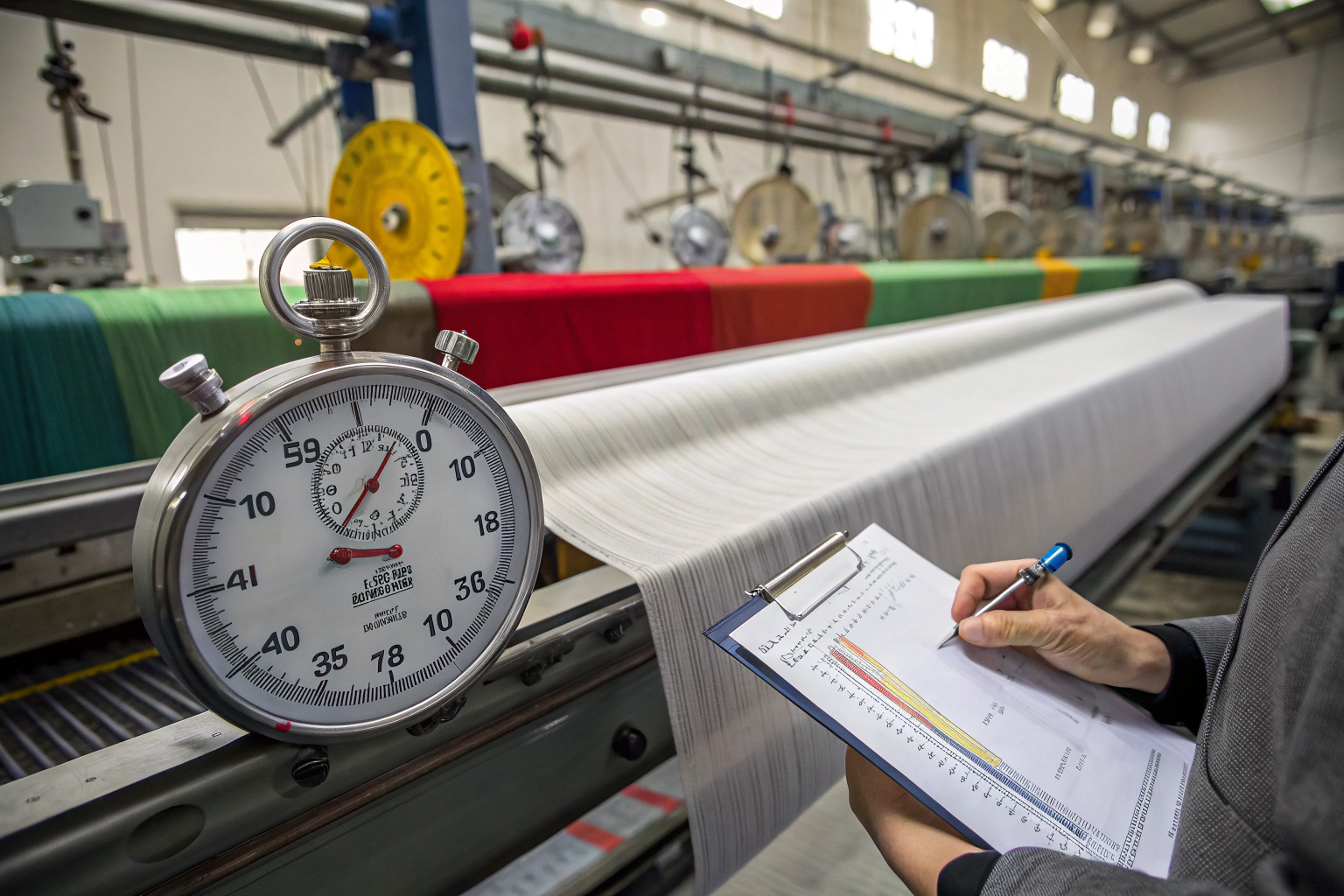
The actual, real-world timeline for custom fabric production in China falls between 5 and 8 weeks, but "actual" is a dangerously slippery word. It morphs based on the fiber you choose and the season you book the order. After running Shanghai Fumao in the chaotic, beautiful heart of Keqiao for over two decades, I can tell you that the calendar is not a straight line. It is a winding road with traffic jams called Chinese New Year, energy restrictions, and yarn shortages. Knowing the difference between a "quote time" and a "buffer time" is what separates a brand that flies off the shelves from one that liquidates stock.
I am going to walk you off the sales floor and onto the factory floor. I will break down the actual hours hidden behind a spec sheet, and show you how a smart production schedule can cheat the seasonal gridlock. I will not sugarcoat the bad news—some processes are physically slow, and no amount of yelling at a supplier can speed up polymerization. But I will also show you the back roads we use to shave weeks off the clock.
Why Does Fabric Weaving Setup Add Hidden Lead Time?
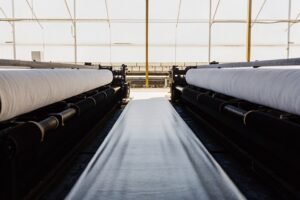
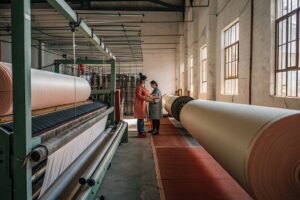
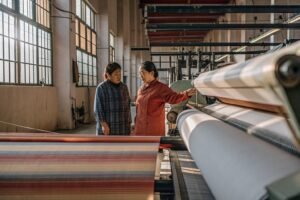
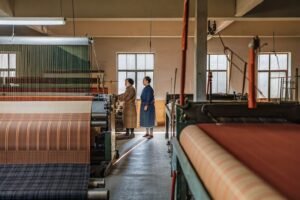
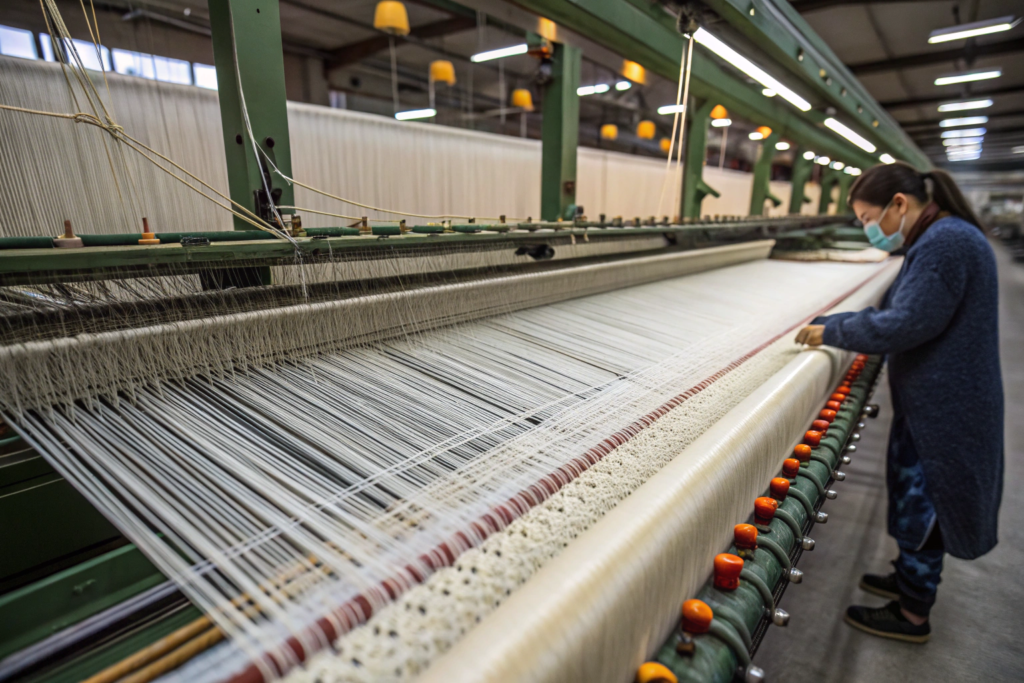
Think of weaving like baking a very complex wedding cake. The actual time in the oven is fixed, but the preparation—the measuring, the sifting, the piping bag assembly—can take twice as long. In fabric, the "baking" is the loom running. But before that shuttle flies, we spend days, sometimes a week, on the "warping" and "drawing-in" process. I recall a nasty shock a Canadian outerwear brand got in 2022. They ordered a complex 4-color dobby weave with recycled nylon. They thought the 3-week production time started the day they approved the sample. No. The clock started after the warping team manually threaded 12,000 yarn ends through the heddle wires. A single misplaced thread, and you get a streak right down the 2,000-meter roll. That preparation is silent, invisible, and often skipped in sales conversations.
How Many Days Are Lost to Warping and Loom Calibration?
You cannot just plug a USB drive into a loom and hit "print." For a high-density down-proof fabric, the setup is brutal. Let me break down the non-negotiable time sinks:
| Setup Phase | Standard Cotton Plain | Complex Jacquard/Dobby | What It Means for You |
|---|---|---|---|
| Warping (Beaming) | 4-6 hours | 8-12 hours | Aligning thousands of yarns in parallel onto a giant beam. One tangled thread adds 1 hour. |
| Drawing-In/Tying-In | 6-8 hours | 2-3 full days | The manual labor of threading each end through the loom’s harness. This physically cannot be automated for many retro-fits. |
| Loom Calibration | 2-3 hours | 6-8 hours | Adjusting the pick density (weft count per inch) and tension. We run 10 meters of scrap to test. |
| Total Setup Loss | ~1 Shift | ~3-4 Days | This time burns machine capacity, even if zero "saleable" fabric is produced. |
This setup time is why Minimum Order Quantities (MOQs) are sacred. If we spend 3 days calibrating a machine for a 200-meter run, we lost money the second you hit "send." The 200 meters run in a few hours; the 3 days of calibration cost more than the fabric itself. When a buyer asks how to reduce fabric minimum order quantity for a custom mill run, I usually tell them the MOQ is not about greed—it’s about amortizing these brutal setup hours over enough meters to make the math work.
Can Yarn Twist and Tension Issues Delay the Greige Stage?
Here is a "soft" delay that kills hard deadlines: yarn breakage. If you spec a high-twist crepe yarn or a brittle metallic filament, the weaving floor turns into a war zone. A standard 40s combed cotton might break once or twice per hour per loom. A stiff linen or a slubby novelty yarn can break 10 to 15 times an hour. Every break means the machine stops, a technician ties a weaver’s knot, and restarts the pick cycle. A 10% drop in loom efficiency sounds like a data stat. In reality, it means your 5-day weaving schedule just stretched to 7 days. We control this by doing a "sizing test" first. We coat the warp yarns in a starch-like protective film (sizing) to make them iron-tough to survive the loom’s friction. If the size formula is wrong—too sticky or too weak—we lose a day washing it off and re-sizing the entire beam. A new client ordering a ramie/cotton drapery blend learned this the hard way. The ramie was so brittle and hairy it snapped every five minutes. We had to stop, completely change the size mix to an acrylic binder, and restart. That was a four-day detour that no one predicted when the contract was signed.
The Dyeing and Finishing Bottleneck You Cannot Skip
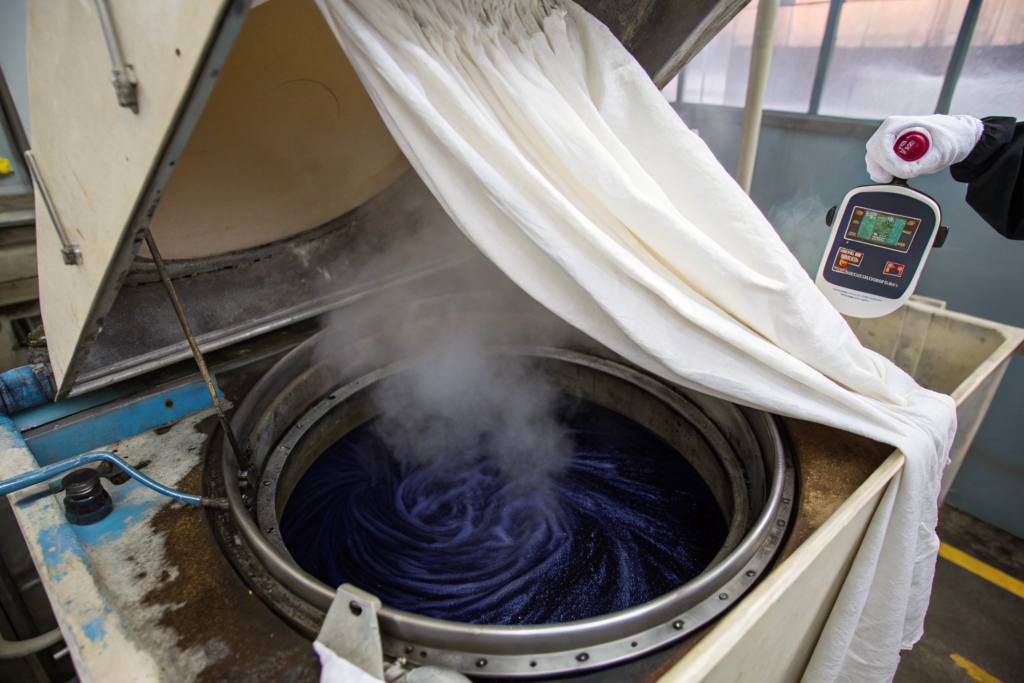
Dyeing is alchemy. It is the one part of the supply chain where physics, chemistry, and luck collide. You can have the most perfectly woven greige fabric in the world, but if the dyeing house is overloaded, your fabric sits on a pallet in a queue for ten days before it even gets wet. I call dyeing the "Great Bottleneck." It is the stage where delivery dates go to die, especially if you care about color accuracy. A sales rep might tell you dyeing takes "a day." Technically, a single dye cycle in a jet machine for polyester is about 3 to 5 hours. But the loading, the cooling, the unloading, the rinsing, the drying, the stentering—the whole process block is a physical monster.
Why Do Different Fiber Blends Require Radically Different Dye Cycles?
Dyeing cotton is not dyeing polyester. They hate each other’s chemicals. When you ask for a poly-cotton blend, you are asking for a double-processing nightmare. Let me visualize this for you using a two-bath process for a core-spun spandex poplin:
- Stage 1 (Polyester Dyeing): We load the fabric into a high-temperature jet machine. We blast it with disperse dyes at 130°C under pressure. This takes about 4 hours. If the shade is off, we "re-reduce" it. Add 3 hours.
- Stage 2 (Reductive Cleaning): We drain the machine and wash out the excess polyester dye. If we skip this properly, the cotton will get stained and look muddy. Add 1.5 hours.
- Stage 3 (Cotton Dyeing): Now we lower the temp to 60°C for reactive dyes. Completely different chemical bath. Add 4 hours.
- Stage 4 (Fixing & Soaping): To lock the reactive dye so it doesn’t bleed, we run multiple cold water rinses and soaping cycles. Add 2 hours.
A single-bath cotton poplin might leave the dye machine in 8 hours. A heavy poly-cotton fleece can take 14 to 16 hours inside the machine, not counting the drying on the stenter frame. If the lab is backed up because the head colorist is matching a difficult navy, the strike-off (lab dip) approval alone can eat five days before we even book the machine time.
How Does the Stenter Frame Speed Limit Your Output?
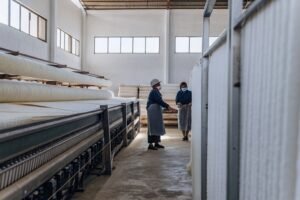
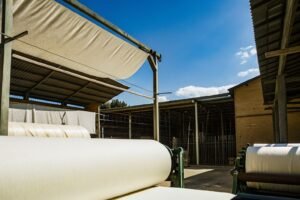
The stenter is the long oven-like machine that dries and sets the fabric’s width after dyeing. This is the true speed governor. A dye machine might process a 500kg batch. The stenter dries it continuously. You cannot change the laws of physics to make water evaporate faster without burning the fabric. The delicate dance is temperature versus residency time. For a lightweight silk charmeuse, we run the stenter very fast to avoid yellowing the white. For a heavy 400gsm organic cotton french terry, we might crawl at 15 meters per minute. If the terry is not 100% dry when it comes off the clip, it will develop mildew in the roll later. I always check the residual moisture rate; we target 6% to 8% internal moisture. Any wetter, the fabric rots in transit. Any drier, the fabric loses hand feel and elasticity. When we are running our Shanghai Fumao coating line on a waterproof fabric, the stenter has to dry the base fabric and cure the coating. That’s a single bottleneck that has forced us to tell a client their "urgent" order will take an extra four days, just waiting in line for the finishing range to open up.
How the Chinese Calendar Affects Fabric Lead Times
You can have the world’s fastest loom and the sharpest chemists, but the Chinese national calendar will still dictate your delivery schedule. I keep a printed calendar on my desk with the danger zones circled in red ink. Western brands that do not account for these periods end up with air freight bills that eat their entire margin. The Chinese textile industry operates on a rhythm that is thousands of years old, and that rhythm stops almost completely at certain points of the year. You cannot negotiate with the Chinese New Year. You can only plan around it. I have seen a single week of holiday cause a six-week delivery delay because of the logistical pile-up before and after.

What Is the "Blackout Window" of Chinese New Year and Golden Week?
Chinese New Year (CNY) is not a week off. It is a four-week plus disruption. Migrant workers leave two weeks early, and they come back two weeks late, if they come back at all. The dyeing houses drain their chemical tanks and shut off the boilers. If your fabric is in the queue and doesn’t get finished before the boiler cools, it sits there soaking in water for three weeks. Here is how I frame the "Danger Zone" to buyers looking for the real fabric lead time in Asia during the holiday season:
- Dec 15 – Jan 5: Order Rush. Suppliers try to finish everything. Quality risks are highest here because lines are overloaded.
- Jan 5 – Jan 25: Workforce Drain. Production capability drops to 30%. Only finishing and packing happen. Do not expect new weaving to start.
- Jan 25 – Feb 15: Total Shutdown. Zero movement. Ports are quiet or backlogged with last-minute containers.
- Feb 15 – Feb 28: Recovery. Workers trickle back. Dyeing houses need 3-5 days to re-heat boilers and stabilize chemical vats. Quality is extremely unstable during this "restart" period.
- March 1: Back to normal.
Golden Week in October is shorter but just as sharp. A 7-day national holiday stops the logistics chain. Truckers are on vacation. You cannot book a container. In 2023, a European client ignored my warnings and insisted on a shipment date of October 3rd. The fabric was woven and finished on the 1st, but the trucking company simply had no drivers. It sat in our warehouse for six days until the 7th. That week-long delay meant the vessel was missed, and the next available ship was two weeks later. Those are calendar weeks you just cannot steal back.
Why "Off-Peak Periods" Can Drastically Shorten Your Timeline?
There is a magic window, though. June, July, and November are usually the low seasons for domestic Chinese demand. The machines are hungry. If you come to Shanghai Fumao with a serious development project right before the summer lull, I can sometimes cut the standard lead time by 20-30%. This is because the dyeing houses are not running at full capacity. Your lab dips get prioritized. The stenter line doesn’t have a two-day queue. This is particularly true for specialized finishes like anti-static or anti-microbial treatments. We can push a 6-week program through in 4 weeks if you catch the relaxation of the industrial grid. It’s the industry’s best-kept secret. While everyone is at trade shows, the smart buyers are putting their PO’s in right before the lull to get the fast lane at the finishing plant.
Accelerating Your Order Without Sacrificing Quality Control
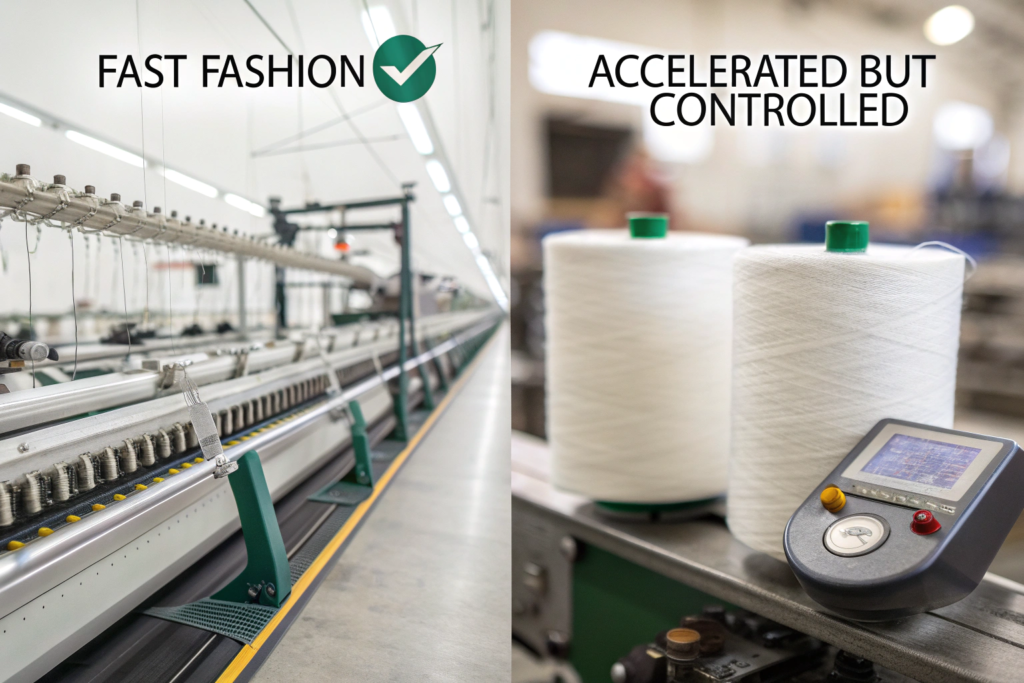
Speed kills quality—unless you cheat smart. When a buyer calls me in a panic, whispering the magic words "I need this tomorrow," I do not just turn the dial up to 11 and hope the machine doesn’t explode. We engineer micro-shortcuts. The trick to accelerating an order without ending up with 3,000 meters of slanted weft and bleeding colors is to overlap phases that are normally sequential. However, you can only do this if you have absolute confidence in your testing lab and your raw materials. You cannot cut corners; you just overlay them. It requires a factory that has seen every mistake before and knows exactly which chemical bonds can cure on a rolling conveyor belt instead of a static rack.
How Can a "Digital Twin" Sample Speed Up Approval Loops?
The biggest time-waster in custom fabric is the back-and-forth mailing of physical samples. DHL from China to New York takes 3 days. Back to China takes 3 days. If you do three rounds of strike-off adjustments, you just lost two weeks to courier time. So we developed a "Digital Twin First" policy. Before we ship that physical lab dip, we scan it with a calibrated spectrophotometer. We generate a QTX file (a digital color fingerprint). We email the file to you instantly. On your side, you open it in a color-matching cabinet software that simulates the fabric under D65 light. It is not 100% as good as touching the hand feel, but for color, it is 95% accurate. We get the green light on the shade digitally within hours, not days. By the time the physical swatch arrives for texture approval, the dyeing department is already mixing the bulk chemicals based on the approved digital data. I did this last month with a large sportswear brand. They approved a complex lavender digital file from their office in London at 10 AM UK time. By 10:30 AM China time, my dye master was hitting the "start" button on the 200-kilo vessel. We essentially stole a free week of production time by letting the bytes travel ahead of the atoms.
What Inline Inspection Tech Prevents "Rework" Delays?
Rework is the schedule killer. Finishing a roll, inspecting it, finding a barre defect (a dye streak), and then having to re-dye or discard it sets you back a full cycle. So we moved our QC from the end of the line to the middle of the line. On our tenter frame, we have installed a high-speed camera system. As the fabric flies past at 30 meters per minute, the camera scans the surface for oil spots, fly yarn contamination, and uneven dyeing. It uses an AI algorithm trained on ten thousand defect images. If it finds a problem, the line stops right there. We don’t wait until the whole 2,000-meter roll is packed. We cut the 10-meter defect out immediately and re-splice the fabric. This means we finish the production run with a 98% pass rate instead of discovering a 15% failure rate at final inspection. Without this inline system, a failed final inspection throws you back to the dye queue, which is a two-week penalty. By checking in real-time, we guarantee the fabric is right the first time, allowing us to confidently book the container truck for the same afternoon the last meter drops off the compressor machine.
Conclusion
The honest answer to "how long" is not a number. It is a negotiation between physics, labor calendars, and your own flexibility. You are not just buying a textile; you are renting time on a loom, reserving a slot in a pressure cooker, and praying your color matches before the boiler shuts down for a holiday. The warp ends take a silent week to hand-thread, the polyester stage needs 130-degree heat that cannot be rushed, and the calendar in January says "stop" regardless of your deadlines. But by knowing this, you have the power to plan properly. Choose off-peak months for lightning speed. Approve digital color fingerprints while the courier is mid-air. And build a timeline that respects the stenter’s drying speed.
Here at Shanghai Fumao, we have mapped out every second of this process. We know exactly how to sync your deposit with our yarn warehouse, and how to push your order through a sleepy June dyeing house so you get July delivery while competitors wait for September. If you are working on a timeline and need a fabric development partner who gives you the real data, not just the sales pitch, please reach out to our Business Director, Elaine. She can send you a live production calendar showing current machine availability. Email her at elaine@fumaoclothing.com. Give her your target in-hands date, and let us reverse-engineer the schedule to make it happen without cutting a single quality corner.