
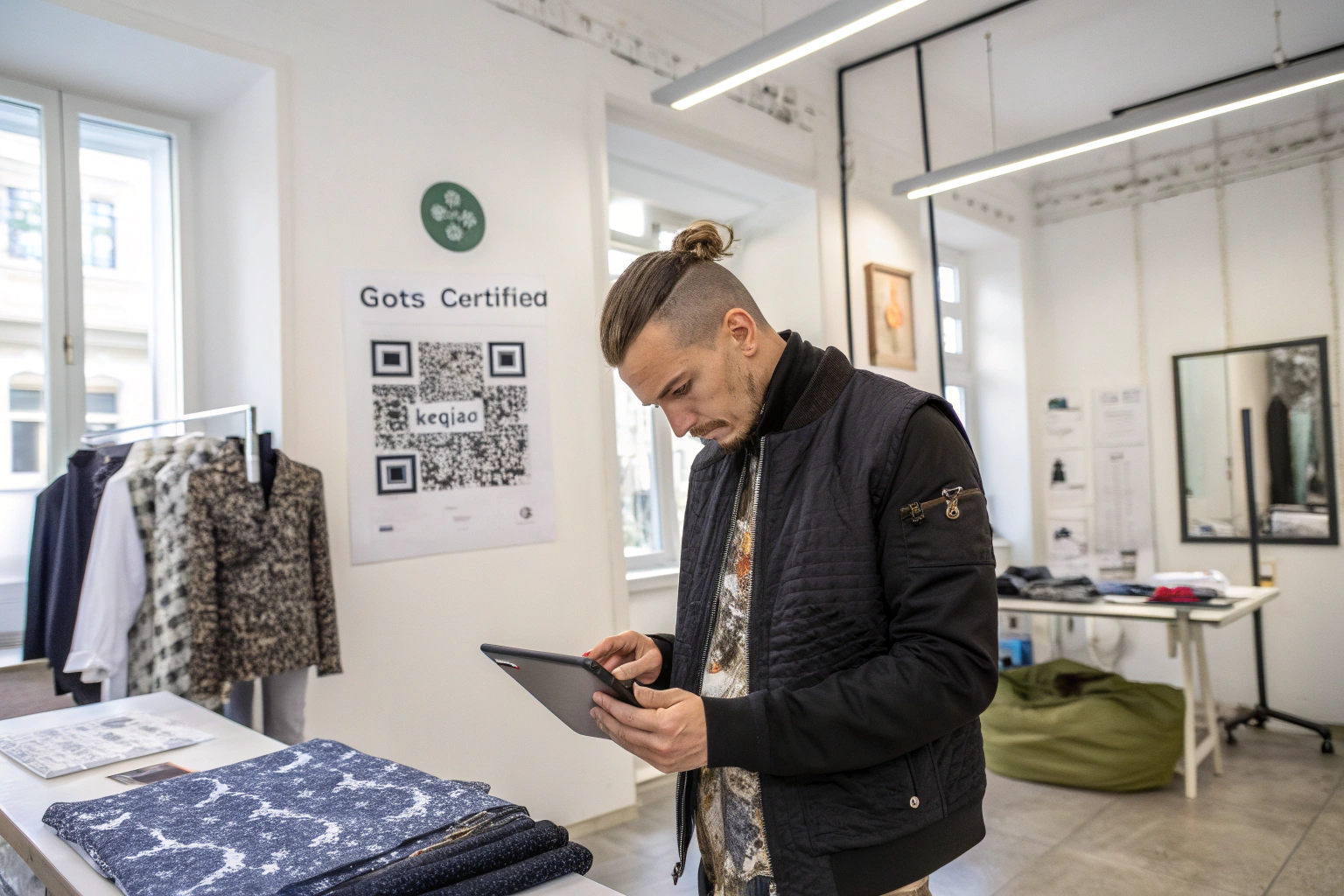
Two years ago, a German distributor told me something that stuck. We were sitting in our Keqiao showroom, and he was flipping through a book of our best-selling organic cotton jerseys. He rubbed a swatch between his fingers, nodded approvingly, and then said: "The fabric is beautiful, Mr. Ma. But beautiful is not enough anymore. My retailers in Berlin and Stockholm don’t want a certificate. They want a story they can verify with their own phones." He wasn’t talking about marketing. He was talking about survival. The EU regulatory machine has turned its gaze on textiles, and the era of the paper mill certificate is ending. The era of the scannable, immutable, digital supply chain has begun.
I’m the managing director of Shanghai Fumao, a vertically integrated textile mill in Keqiao, China. Over the past three years, I have watched blockchain traceability transform from a tech buzzword into a hard commercial requirement for European distribution. The distributors who once asked only about price and minimums now ask about data schema, hash verification, and Digital Product Passport readiness. They are not doing this because they love technology. They are doing it because EU regulation is making them legally responsible for the truth of what they sell. If they cannot prove, with data, that a fabric labeled "organic" actually came from an organic farm, they face fines, border rejections, and retailer delistings. The burden of proof has shifted, and blockchain is the tool that carries that burden.
At Shanghai Fumao, we didn’t wait for the regulation to force our hand. We built our traceability system—QR codes, blockchain-anchored production records, live CNAS lab data—because we saw that European buyers would soon need it to stay in business. This article explains why that need has become urgent, how the technology actually works on a factory floor, and what it means for your fabric sourcing in 2026 and beyond.
What EU Regulations Are Forcing the Shift to Blockchain Traceability in Textiles?
The demand for blockchain traceability did not originate in a marketing department. It originated in the Official Journal of the European Union. A wave of interconnected regulations has created a legal environment where selling textiles in Europe without verifiable origin data is becoming structurally impossible. The three most impactful regulations are the Ecodesign for Sustainable Products Regulation, the EU Strategy for Sustainable and Circular Textiles, and the proposed Directive on Green Claims. Together, they form a compliance triangle that no distributor can escape.
The Ecodesign regulation mandates a Digital Product Passport for textiles sold in the EU, containing data on durability, recyclability, and material provenance. The Green Claims directive requires that any environmental claim—like "organic" or "recycled" or "carbon-neutral"—be backed by independently verified evidence. And the broader Corporate Sustainability Due Diligence Directive holds companies legally accountable for human rights and environmental violations in their supply chain, including forced labor in cotton farming or chemical pollution in dyeing. A paper certificate from a supplier you’ve never visited is no longer a credible defense. The EU wants digital, auditable, real-time data. That’s what blockchain provides.

What Is the Digital Product Passport and Why Does It Require Blockchain-Grade Data?
The Digital Product Passport is not a PDF. It is a machine-readable, interoperable dataset that travels with a product through its entire lifecycle. For a fabric, this means the passport must contain the fiber origin, the spinning location, the weaving mill, the dyeing chemicals used, the finishing processes, and the social audit status of each facility. This data must be accessible via a data carrier—like a QR code—and it must be authentic, tamper-proof, and verifiable by customs authorities and consumers alike.
Why does this effectively require blockchain? Because a centralized database controlled by a single company can be edited. A PDF attachment to an email can be altered. The EU regulation specifically requires that the data be "authentic, reliable, and verifiable." A blockchain ledger, where each production event is cryptographically hashed and immutably recorded, provides mathematical assurance that the data has not been manipulated. When our weaving machine logs a production batch and our CNAS lab logs a test result, those events are written to the blockchain. The QR code on the fabric roll unlocks a digital passport that draws directly from that immutable record. No human can retrospectively alter it without breaking the cryptographic chain. This is what European distributors mean when they demand how to comply with EU Digital Product Passport requirements for textile supply chains using blockchain data verification. They are not asking for a website link. They are asking for a defensible legal position.
How Does the EU Green Claims Directive Make Paper Certificates Obsolete?
The Green Claims directive, which is being finalized for enforcement, tackles the problem of greenwashing directly. If a brand labels a jacket "made with organic cotton," they must be able to substantiate that claim with evidence that traces back to the certified organic farm. A generic GOTS certificate that covers a factory’s general capability, but not the specific batch of cotton in that specific jacket, will no longer suffice. The directive requires specificity—linking the claim to the physical product.
This is where the gap between a paper certificate and a blockchain record becomes a chasm. A paper GOTS scope certificate proves that a mill is authorized to process organic cotton. It does not prove that a particular 500-meter roll of jersey actually used organic yarn from a certified farm. A blockchain traceability system does. It records the transaction certificate number of the organic yarn lot, the date it entered the knitting machine, and the production batch number. That batch number is tied to the finished roll’s QR code. The claim "this jacket is organic" is substantiated by a chain of cryptographic evidence that ends at the farm. I had a Danish distributor audit our system in early 2026. He scanned a roll, traced it back to the organic cotton cooperative in Xinjiang, cross-referenced the GOTS transaction certificate, and closed his laptop. "This is the only kind of evidence that will survive a consumer authority challenge," he told me. He placed an order for 12,000 meters that afternoon. The how EU Green Claims Directive enforcement makes blockchain textile traceability essential for substantiating organic and recycled content marketing claims is not a future threat; it’s a present reality for distributors who are already seeing competitor claims challenged by national consumer protection agencies.
How Does Blockchain Traceability Actually Work on a Textile Factory Floor?
When European buyers hear "blockchain," they imagine something abstract—crypto, computers, complexity. In our factory, blockchain is a barcode scanner in the hands of a yarn warehouse operator. It’s a tablet mounted next to a stenter frame. It’s an automated data feed from our color spectrophotometer. We designed our traceability system to be invisible to the production team and indispensable to the compliance team. The workers do their jobs. The system captures the proof.
The process begins at goods-in. Every pallet of yarn that enters our facility carries a supplier barcode that encodes the lot number, the fiber origin, and any certifications like GOTS or GRS. Our operator scans that code. The system automatically queries the supplier’s database or the certification body’s transaction certificate portal, verifies the lot is certified and valid, and records the acceptance onto our private blockchain ledger. From that moment, the yarn’s digital identity is born. As it moves through knitting, dyeing, finishing, and inspection, production events are captured and hashed. The finished fabric roll carries a QR code that is the key to this complete, unalterable history. The blockchain is not a separate process. It is the digital shadow of the physical production line.

What Production Data Points Are Captured on the Blockchain for a Single Fabric Roll?
A single roll of our GOTS-certified organic cotton jersey carries a surprisingly dense data narrative. The blockchain record begins with the yarn transaction certificate—the unique TC number issued by the GOTS system that tracks organic fiber through the supply chain. It captures the farm cooperative name, the ginning mill, the spinning mill, and the date the yarn was shipped to us. This is the "upstream" traceability that paper systems often lose.
Then our internal data layers begin. The knitting event is recorded with the machine number, the gauge, the operator ID, the start and end timestamps, and the yarn consumption. The dyeing event captures the dye lot number, the recipe reference, the chemical batch numbers, the water consumption, and the wastewater pH at discharge. The finishing event records the softener type, the stenter temperature and speed, and the final fabric weight and width. The quality control event captures the CNAS lab report ID, the colorfastness rating, the shrinkage percentage, and the visual inspection grade. All of this data is linked by a unique batch ID, hashed at each stage, and anchored to a public blockchain via a Merkle tree structure. When you scan the QR code on the finished roll, you see a chronological, unbroken chain of custody from the cotton field to our export warehouse. This is how textile blockchain traceability system works from yarn lot scanning to finished fabric roll QR code on a factory floor operationalized. It’s not theory. It’s running on our production lines today.
Can a Blockchain Record Be Faked, and How Does Fumao Prevent That?
This is the most common objection I hear from skeptical buyers, and it’s a legitimate one. A blockchain record is only as honest as the data entered into it. If a factory scans a barcode from a fake organic yarn label, the blockchain will immutably record that fake data. This is the "garbage in, garbage out" problem. Blockchain guarantees the integrity of the record, but it does not guarantee the integrity of the physical product. That’s where our third-party verification layers come in.
Our traceability system integrates with the GOTS and GRS certification body databases directly. When our operator scans a yarn pallet, the system does not just trust the label. It pings the certification body’s API with the transaction certificate number and verifies, in real time, that the certificate is valid, unexpired, and matches the yarn lot. If the API returns a mismatch, the system locks and the yarn cannot be logged into inventory. This is an automated, external verification gate that prevents fraudulent inputs. Additionally, our CNAS lab tests every incoming yarn lot for fiber composition. If a yarn labeled "100% organic cotton" shows polyester content in the burn test or microscopic analysis, it is quarantined and returned, regardless of what its papers say. The combination of blockchain integrity, certification body API verification, and physical lab testing creates a defense-in-depth against fraud. One of our European clients, a children’s wear brand with strict compliance requirements, sent an independent auditor to stress-test our system in late 2025. The auditor attempted to introduce a falsified yarn lot. Our API gate rejected it instantly. The audit report concluded that our how to prevent false data entry in textile blockchain traceability using certification body API verification and in-house CNAS lab testing was the most robust the auditor had seen in an Asian mill. That report is now part of the brand’s EU compliance dossier.
How Are European Consumers Driving the Demand for Verifiable Fabric Stories?
European distributors are not demanding blockchain traceability in a vacuum. They are responding to a consumer who has become deeply skeptical of brand claims and startlingly adept at using technology to verify them. The European consumer of 2026 has lived through the greenwashing scandals of the early 2020s, the forced labor exposés in fashion supply chains, and the microplastic anxiety that has reshaped textile preferences. They don’t trust a hang tag that says "sustainable." They trust their phone, and they are increasingly using it to interrogate the products they buy.
This behavior shift is measurable. A 2025 survey by a major European consumer organization found that 68% of fashion buyers in Germany and the Netherlands have scanned a QR code on a garment to check its sustainability claims, and 41% have decided against a purchase because the available information was vague or unverifiable. Distributors know this. They know that a jacket with a scannable, blockchain-verified supply chain story outsells a jacket with a generic "eco-friendly" sticker. The transparency is not just a compliance shield. It is a sales tool. And the distributors who cannot provide it are losing shelf space to brands that can.

Can a QR Code on a Fabric Label Really Influence a Consumer’s Purchase Decision?
Yes, and I have seen it happen in real time. During a trade show in Paris last year, a French boutique owner visited our booth and scanned the QR code on our display fabric. She watched the supply chain map load on her phone, scrolled through the farm certification, the dyeing water recycling data, and the CNAS chemical safety report. She looked up and said, "My customers are asking for exactly this. They want to feel like detectives, not just shoppers."
The psychological mechanism at work is the "trust but verify" instinct. A brand that provides a QR code to a blockchain traceability platform is not just making a claim; it is inviting verification. That invitation signals confidence. It says, "We have nothing to hide." In a market saturated with vague marketing language, that signal cuts through the noise. I have spoken with multiple European distributors who have reported that garments carrying our traceable fabric sell at a 15-25% higher full-price sell-through rate than comparable garments without digital provenance. The consumer perceives higher value—not just in the fiber, but in the honesty. One distributor told me the QR code is now part of their merchandising display, with a small sign next to the garment that reads "Scan to see where your clothes come from." The how scannable blockchain QR codes on fabric labels influence consumer purchase decisions and brand trust in European sustainable fashion markets is no longer a pilot project for niche eco-brands. It’s a standard feature of competitive retail.
How Does Transparency About Dyeing Chemicals Affect European Market Access?
This is the sharpest edge of the traceability demand. European consumers—and the NGOs that influence them—are increasingly focused not just on where fibers come from, but on what chemicals were used to process them. The Zero Discharge of Hazardous Chemicals coalition and the Greenpeace Detox campaign have educated the market that a "natural" fiber can be dyed with toxic chemicals that poison rivers and harm factory workers. The fabric may feel soft, but the backstory may be ugly.
Our blockchain traceability system captures and exposes the chemical inputs of every dye lot. The dye recipe reference, the chemical batch numbers, and the wastewater test results are all recorded. A consumer who scans our fabric’s QR code can see that the reactive dyes used meet the ZDHC Manufacturing Restricted Substances List, that the wastewater was treated to EU Blue Angel standards, and that the dye house is audited by a third-party chemical management auditor. This level of disclosure is becoming a market access requirement. A Belgian organic fashion distributor I work with told me that two of his retail accounts now require "full chemical transparency" as a condition of listing. They will not stock a garment unless the brand provides a digital chemical inventory for the fabric, accessible by scanning the label. Paper MSDS sheets in a binder are not acceptable. The consumer wants to see it on their phone. Our blockchain system provides that access. The how chemical transparency in fabric dyeing and finishing processes accessed via blockchain QR codes satisfies European retailer and consumer demands for detox fashion is no longer a marketing differentiator. It is the new compliance baseline.
How Does Fumao’s Blockchain System Integrate With European Distributor Compliance Platforms?
A traceability system that cannot talk to the customer’s own compliance software is just an expensive silo. European distributors operate under their own enterprise resource planning and compliance platforms—SAP, Texbase, or specialized Product Lifecycle Management tools. They need our fabric data to flow into their systems automatically, without manual re-entry, and without formatting conflicts. This is the "last mile" of traceability integration, and it’s where many supplier systems fail.
At Shanghai Fumao, we built our blockchain platform with an API-first architecture. The data that is captured on our factory floor and anchored to the blockchain is also exposed through a REST API that any authorized distributor system can query. When a distributor receives a container of our fabric, they don’t have to scan each roll individually into their inventory system. Our pre-shipment ASN (Advanced Shipping Notice) includes the QR code IDs and the blockchain transaction hashes for every roll in the shipment. Their system ingests that data, verifies it against our blockchain node, and pre-populates their compliance dossier. The fabric enters their warehouse already digitally integrated into their regulatory documentation. This is the engineering work that separates a true traceability partner from a supplier who just prints QR codes.

Can Fumao’s Blockchain Data Export Directly Into a Brand’s PLM or Compliance Software?
Yes. We built a standardized data export format that maps directly to the data fields required by the EU Digital Product Passport schema. This schema includes fields for material composition, supplier information, certification numbers, chemical substance data, and environmental footprint metrics. Our API can push this data in JSON or XML format, ready for ingestion by PLM systems like Centric, PTC FlexPLM, or custom SAP modules.
A Swiss performance wear brand we supply integrated our API into their PLM system in January 2026. The integration took their IT team and our data team approximately three weeks. Now, when we ship a DDP container of fabric, the shipping notification automatically triggers an API call. Our system pushes the full blockchain traceability dossier for that shipment into their PLM. Their compliance officer sees a green "Data Received and Verified" status without any manual data entry. The fabric rolls arrive at their cutting facility already cleared for production from a compliance standpoint. This integration saves them an estimated 12 hours of compliance labor per shipment and eliminates the risk of transcription errors that could trigger a customs audit. If your distributor is asking about blockchain traceability, they are ultimately asking about this integration capability. Ask them: "Does your supplier how to integrate Chinese textile mill blockchain traceability data into European brand PLM and compliance software via API for automated Digital Product Passport generation?" If the answer involves emailing PDFs, their traceability is not enterprise-grade.
What Happens When a European Customs Authority Scans Our Fabric’s QR Code?
This is the ultimate test of the system, and we have passed it. When a customs officer at Rotterdam or Hamburg scans the QR code on one of our DDP fabric rolls, they access a dedicated customs-facing version of our traceability portal. This portal presents the compliance data in a format optimized for regulatory review: the HS code, the fiber composition with CNAS lab verification, the GOTS or OEKO-TEX certificate with live validity check, the country of origin documentation, and the importer of record bond information.
The data is not just displayed; it is cryptographically verified in real time. The portal checks the blockchain hash of the roll against the public ledger. A green badge confirms the data is authentic and unaltered. A red badge would indicate tampering—and we have never seen a red badge on a genuine roll. The officer can see the full chain of custody and the lab reports without opening a single carton. In February 2026, a container of our organic cotton poplin was selected for a documentary check at the Port of Hamburg. The customs officer scanned the QR code, reviewed the GOTS transaction certificate and the CNAS composition report, and released the container within 90 minutes. No physical sample was taken. No storage fees were incurred. This is the how EU customs authorities use blockchain QR code scans to verify textile product compliance and accelerate clearance for DDP shipments at Rotterdam and Hamburg ports advantage that makes our DDP shipments clear European ports faster than traditional paper-documented containers. The distributor’s logistics team doesn’t get a detention invoice. The retailer’s shelf doesn’t sit empty. The system works.
Conclusion
The European demand for blockchain traceability is not a passing trend or a marketing fad. It is a structural, regulatory, and consumer-driven transformation of the textile supply chain that is already underway. The EU Digital Product Passport is codifying the requirement for machine-readable, verifiable product data. The Green Claims Directive is raising the evidentiary standard for sustainability marketing. And European consumers, armed with smartphones and scarred by greenwashing, are voting with their wallets for brands that can prove their promises. The distributors who connect these three forces—regulation, compliance, and consumer trust—are the ones who will own the European fashion market in the second half of this decade.
At Shanghai Fumao, we made a strategic decision to be ahead of this curve. We built our blockchain traceability system not as a pilot project or a press release, but as an operational reality that captures data from every yarn pallet, every knitting machine, every dye lot, and every CNAS lab test. We integrated that data with the GOTS and GRS certification body APIs to prevent input fraud. We built an API that feeds directly into European PLM and compliance platforms. And we deliver it all through a simple QR code on a fabric selvedge that a customs officer in Hamburg, a compliance manager in Berlin, or a consumer in Stockholm can scan and trust. This is not the future of fabric sourcing. It is the present of fabric sourcing for any brand serious about the European market.
If you are a European distributor navigating the new regulatory landscape, or an American brand planning to expand into the EU, the traceability of your fabric is now as important as the fabric itself. I invite you to test our system directly. Our Business Director, Elaine, can arrange a live demonstration where you can scan a sample roll from our current production, trace it back through the blockchain to the organic farm, and see the complete compliance dossier that will accompany every meter of your order. You can also receive a sample data export formatted for your PLM system. Experience the transparency before you commit to the partnership.
Reach out to Elaine at elaine@fumaoclothing.com. Ask for a Blockchain Traceability Demo and a sample Digital Product Passport data file. Let’s make your supply chain not just sustainable, but provably so. Your European retailers are waiting.








