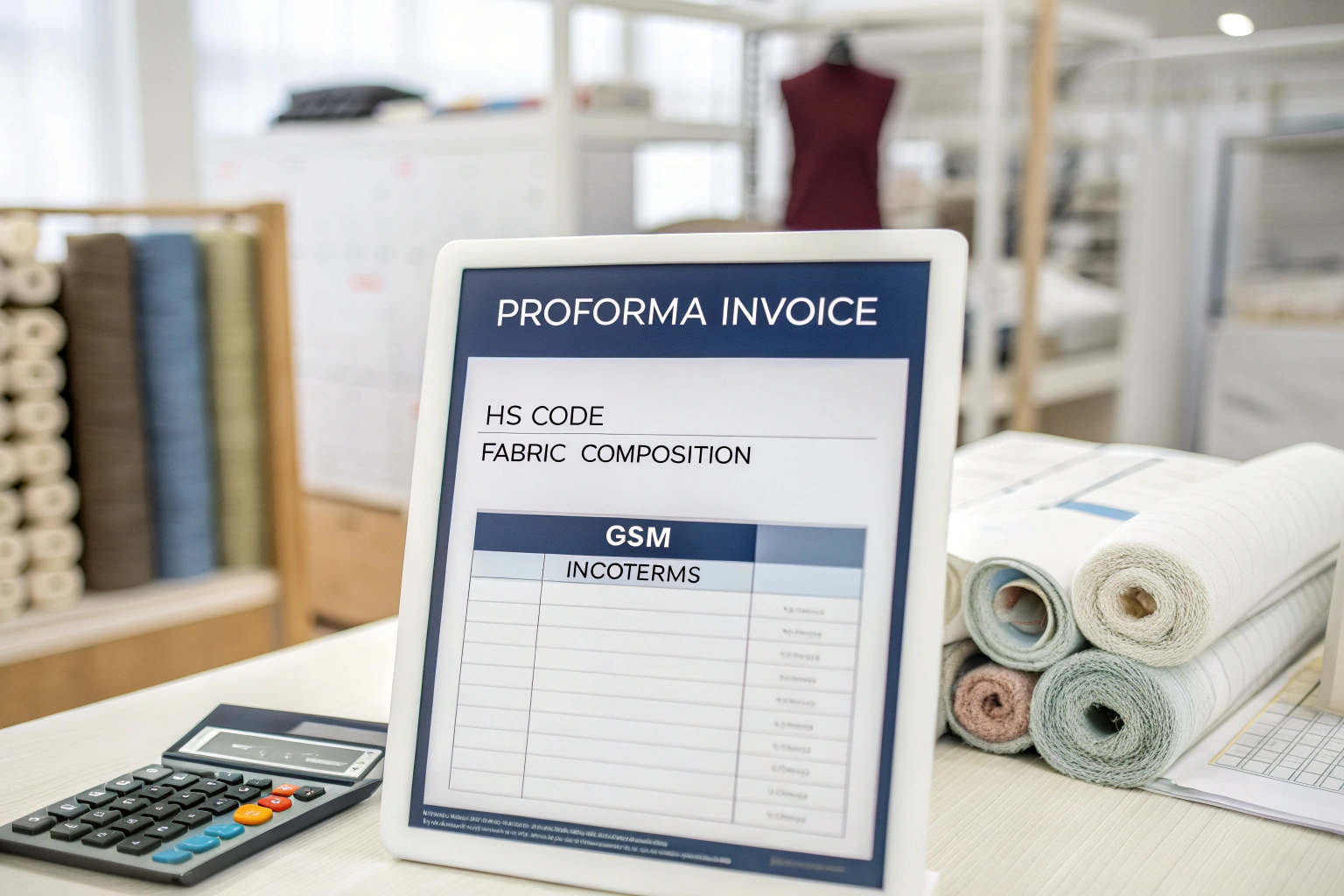
Three years ago, a buyer from Manchester called me in a rage. He’d just received his container of 100% linen tablecloth fabric from a supplier in Jiangsu, and Customs was holding it at the port of Felixstowe. The problem? The commercial invoice listed the fabric as "linen blend," but the proforma invoice he’d approved six weeks earlier—and used to open his letter of credit—said "100% linen." The supplier had changed the composition without updating the paperwork, and the fiber analysis didn’t match the declaration. The buyer had to post a bond of £4,200 just to get the container released, and then spent another month disputing with the supplier about who was responsible. "I thought a proforma invoice was just a preliminary quote," he told me. "I didn’t realize it was legally binding for my bank." He’s not alone in that mistake. I hear it all the time.
A standard proforma invoice for fabric must serve three functions simultaneously: it is the binding price quote that locks your cost per meter, it is the technical specification sheet that Customs will use to verify your shipment, and it is the document your bank requires to issue a letter of credit or release a wire transfer. At minimum, it must include the supplier’s full company details with tax ID, a line-item breakdown of each fabric with HS code, fiber composition by percentage, weight in GSM, weave type, finish, width, unit price, total quantity, Incoterms, port of loading, estimated sailing date, payment terms, and a validity period for the quote. Missing any of these elements doesn’t just cause confusion. It causes money to leave your account and never come back.
I’ve been on both sides of this document. I’ve written proforma invoices for thousands of shipments from Keqiao to 100+ countries, and I’ve also had to explain to angry buyers why their fabric didn’t match the paperwork. At Shanghai Fumao, we treat the proforma invoice as the single most important document in the pre-production phase. It’s not a quote. It’s a contract. And if you treat it like one, you avoid 90% of the disputes that plague textile imports. In this article, I’m going to walk you through every field that should appear on your PI, explain why each one matters for customs and quality assurance, and share the horror stories that taught me what happens when you leave something out.
What Are the Mandatory Technical Specifications for a Fabric Proforma Invoice?
I learned the hard way that "cotton fabric" on a proforma invoice is almost as useless as writing "food" on a restaurant menu. In 2018, a client from Melbourne ordered what they understood to be a midweight cotton canvas for tote bags. The PI said "100% cotton canvas, 150cm width, $3.20/m." That’s it. When the fabric arrived, it was a lightweight 180 GSM canvas—fine for lining, useless for structured bags. The supplier argued they never specified the weight, so the fabric met the description. The buyer argued that "canvas" implies a heavier weight. The dispute dragged on for weeks because the PI was technically accurate but woefully incomplete. Neither side was clearly right or clearly wrong. The PI simply failed to define the product.
A proper fabric PI must specify, at minimum, the following technical parameters for each line item: fiber composition with exact percentages (not "cotton-rich" but "97% Cotton, 3% Spandex"), yarn construction (ring-spun vs. open-end, single vs. plied, yarn count in Ne or Nm), weave or knit type (plain, twill, satin, jersey, rib, etc.), weight in grams per square meter with a tolerance of ±5%, width in centimeters with a tolerance, and any applied finishes (water repellent, flame retardant, antimicrobial, enzyme wash). If the fabric is printed, the PI should reference the approved strike-off or digital print file number. If it’s dyed, it should reference the lab dip approval code and the colorfastness grade you’ve agreed to—typically grade 4 or higher on the AATCC scale for washing fastness. At Shanghai Fumao, we go further and include the shrinkage test result standard (AATCC 135) and the acceptable tolerance (usually ±3% for wovens) directly on the PI. This way, the PI isn’t just a price document. It’s the technical standard against which the bulk production will be judged.

Why Does the HS Code on Your Proforma Invoice Determine Your Customs Liability?
The HS code is not a formality. It is the single most financially significant piece of data on your proforma invoice. When we put an HS code on a PI at Shanghai Fumao, we are making a representation to your government about what this fabric is, and that representation determines your duty rate. If we write 5209.42—denim, cotton, weighing more than 200 GSM—you pay one rate. If we write 5211.42—denim, cotton, blended with man-made fibers, weighing more than 200 GSM—you pay a different rate. The difference can be 5-10% of your total invoice value. If Customs disagrees with the code we put on the PI, they don’t hold us liable. They hold you liable. You are the importer of record.
I had a case in January 2022 with a U.S. buyer importing a cotton-polyester blend twill for work shirts. Our lab analysis showed 58% cotton and 42% polyester, making cotton the dominant fiber by weight. We classified it under Chapter 52 (cotton woven fabrics) with a base duty rate of 7.6%. The buyer’s customs broker, seeing "cotton-poly blend," reclassified it under Chapter 55 (man-made staple fiber fabrics) with a base rate of 14.9% plus the Section 301 tariff. Suddenly, the landed cost was 22% higher than the PI had projected. The broker argued the fabric was a "mixed woven" that defaulted to man-made classification. We had to send the actual fiber dissolution test results proving cotton dominance before the broker corrected the entry. The PI had the right HS code from the start, but nobody verified it against the lab data until there was a problem. The HS code on your PI must be backed by a fiber composition test report, not a guess based on what the fabric "feels like." If your supplier cannot give you the test report to support their HS code, demand it before you approve the PI. For an authoritative resource on this, I recommend reading this detailed tariff classification guide for cotton-rich woven fabrics which breaks down the exact subheadings and their duty implications.
How Specific Should the "Fabric Composition" Section Be to Avoid Disputes?
Extremely specific. Vague composition descriptions are one of the top three causes of textile import disputes I see. "Silk feel fabric" is not a composition. "Viscose" is not specific enough if the fabric is modal viscose, which has different duty treatment and mechanical properties. "Eco-friendly fabric" is marketing language that means nothing to a customs chemist. The composition section must list every fiber present in the final fabric, by percentage, in descending order of predominance, using the standardized generic fiber names recognized by the International Organization for Standardization (ISO) and the U.S. Textile Fiber Products Identification Act. For example, instead of "cotton-spandex stretch," write "97% Cotton, 3% Elastane." Instead of "bamboo silk," write "100% Bamboo-Derived Viscose (Rayon)." If the fabric contains recycled fibers, specify the percentage of recycled content and the certification standard, such as "100% Recycled Polyester (GRS Certified)."
I recall a shipment to France in November 2020 that nearly went sideways because of a composition ambiguity. The fabric was a heavy drapery cloth with a chenille effect. The PI said "80% Polyester, 20% Cotton." But the 20% was not uniformly distributed. It was a cotton slub yarn twisted with a polyester filament, creating an uneven texture. The French lab tested three different areas and got three different composition readings—one as low as 14% cotton, one as high as 24%. The customs inspector flagged it as misdeclared. We had to provide our internal QC data showing the average across 20 test points was indeed 20% with a ±3% tolerance. The container was held for 11 days while this was resolved, costing the buyer approximately €950 in storage fees. The fix was simple: the PI should have said "80% Polyester, 20% Cotton (±3% tolerance due to slub yarn variation)." That one sentence would have pre-empted the entire dispute. If you’re unsure about how to properly label a blend, this guide on how to properly label fiber blends in fabric composition testing offers practical protocols for writing composition descriptions that labs and customs will accept.
How Do Incoterms on a Proforma Invoice Affect Your Total Landed Cost?
The three letters after the price on your proforma invoice—FOB, CIF, EXW, DDP—are not just logistics jargon. They define exactly where the supplier’s responsibility ends and your responsibility begins. And that boundary determines who pays for the freight, who insures the cargo, and who bears the risk if a container falls off the ship in a storm. I’ve seen too many buyers focus entirely on the per-meter price and ignore the Incoterms, only to discover that their "cheap" EXW fabric from a mill in Jiangsu actually costs 40% more than the FOB quote from Shanghai Fumao once they pay for inland trucking, export clearance, port handling, and a forwarder who charges them penalty rates because they don’t have a regular account.
Let me break down the three most common Incoterms for fabric exports from China and what they actually mean for your wallet. EXW (Ex Works) means you pick up the fabric at the factory gate. You arrange the truck to the port, you handle export customs, you load the container. The price looks lowest on paper, but unless you have a logistics team in China, you will pay a premium for every step because you’re a one-time buyer, not a regular shipper. FOB (Free On Board) means the supplier delivers the goods to the named vessel at the named port, clears export customs, and hands you a clean bill of lading. This is the sweet spot for most fabric buyers. You control the ocean freight and insurance, so you can use your own forwarder and negotiate your own rates. CIF (Cost, Insurance, Freight) means the supplier pays for the ocean freight and insurance to the named destination port. The price is higher, and you’re trusting the supplier to choose the cheapest, slowest carrier to maximize their margin. DDP (Delivered Duty Paid) means the supplier handles everything door-to-door, including import customs and duties in your country. This is rare for fabric because few Chinese suppliers want to register as importers in foreign jurisdictions, but it gives you maximum certainty. You know exactly what you’ll pay, and there are zero hidden charges after the PI.

Should You Accept an EXW Proforma Invoice for Fabric from an Unfamiliar Supplier?
My short answer: no. Not unless you have a trusted logistics partner on the ground in China who can physically go to the factory, inspect the goods, and manage the trucking. An EXW quote from an unfamiliar supplier is full of hidden risks. The factory might be in a remote part of a province you’ve never heard of. The nearest container freight station might be 300 kilometers away. The local trucking company might refuse to load without a cash payment in RMB. And if the fabric is damaged during loading—say, a forklift punctures a roll—that’s your problem, not the supplier’s. Under EXW, the risk transfers to you the moment the goods are made available at the factory premises. You haven’t even seen the fabric yet, and you’re already legally responsible for it.
I had a client from Canada try this in 2021. They found a small denim mill in a town outside Changzhou that offered an EXW price 20% below our FOB quote for a similar quality. They accepted. Their forwarder sent a truck to pick up the 12,000 meters. The truck arrived at 8 a.m. The factory was gated and locked. Nobody answered the phone for two hours. When someone finally showed up, the fabric wasn’t packed for export—loose rolls, no export cartons, no pallets. The driver refused to load it. The buyer’s forwarder arranged emergency packing at a local warehouse, which cost $850 and delayed the shipment by three days, missing the vessel cutoff. The "20% cheaper" fabric ended up costing 8% more than our FOB quote after all the chaos, plus a week of delay. The buyer told me later, "I thought EXW was a discount. It was actually a trap." For a realistic breakdown of what EXW actually entails, this practical explanation of EXW shipping from China and hidden buyer responsibilities details all the costs that a factory won’t tell you about when they offer that low EXW price.
What Is the Difference Between a "FOB Shanghai" and a "CIF Los Angeles" Invoice?
The difference is control versus convenience. On a FOB Shanghai invoice, the unit price includes the cost of the fabric, the cost of transporting it from our factory in Keqiao to the port of Shanghai, and the cost of export customs clearance. The price on the PI stops at "alongside the vessel in Shanghai." Everything after that—the ocean freight, the marine insurance, the destination port charges, the import customs, the inland delivery to your warehouse—is arranged and paid by you directly. You choose the shipping line. You choose the insurance provider. You control the routing and the timing. For an experienced importer shipping a full container, FOB is almost always the better financial choice.
A CIF Los Angeles invoice rolls the ocean freight and a minimum insurance policy (usually 110% of the invoice value) into the supplier’s quoted price. It’s convenient. You pay one price, and the goods show up at the port of Los Angeles. But here’s what often happens. The supplier books the cheapest available carrier—maybe a line with a 35-day transit time instead of 18 days, or a line that transships through three ports, increasing the risk of delay and damage. The insurance is the bare minimum, covering only total loss of the container, not partial damage to your fabric. If the container leaks and damages the outer layers of your rolls, you’re fighting with the supplier’s insurance company in a language you might not speak. I compared two actual shipments for a client in 2023. Their CIF quote from a trading company was $2.80/m to Los Angeles. Our FOB quote was $2.10/m plus $0.45/m for their own forwarder’s ocean freight and $0.05/m for their own All-Risk insurance. Total FOB landed cost: $2.60/m. They saved $0.20 per meter—about $4,000 on a 20,000-meter order—and had door-to-door visibility through their own forwarder’s tracking system. The CIF "convenience" was costing them a 7.7% premium for less transparency and worse insurance. This shipping industry analysis of FOB versus CIF for textile imports from Asia breaks down the actual cost differentials with current freight rates.
What Payment Terms on a Fabric Proforma Invoice Protect Both Buyer and Seller?
Payment terms are the hardest negotiation point in any fabric PI, and I’ve seen more relationships collapse over payment structure than over quality disputes. The reality is that both sides have legitimate fears. The buyer is afraid of paying 100% upfront and receiving substandard fabric—or nothing at all. The mill is afraid of producing 10,000 meters of custom-dyed fabric and having the buyer cancel, leaving them with inventory they can’t sell because the color was matched to a specific brand palette. A fair PI balances these fears. The standard structure that I’ve seen work for decades is 30% deposit to initiate production, and 70% balance against the scanned copy of the bill of lading—often abbreviated as "30/70 T/T against BL copy." The deposit covers the mill’s raw material costs (greige fabric, dyes, chemicals) so if the buyer cancels, the mill isn’t out of pocket for materials. The balance is paid before the buyer receives the goods, but after they have proof that the goods have been loaded onto a vessel.
At Shanghai Fumao, we’ve evolved this standard to include a quality assurance step. Our PI typically states: "30% deposit with order confirmation, 70% balance after buyer’s inspection agent approves shipment and against presentation of shipping documents." This gives the buyer the right to send an inspector—or review our inspection video and photos—before releasing the final payment. It adds about 24-48 hours to the process, but it eliminates the fear that the fabric shipped is different from the fabric approved. For new relationships with smaller brands, we sometimes offer an escrow service through Alibaba Trade Assurance, which holds the payment until the buyer confirms receipt. The escrow fee is about 2-3% of the invoice value, which is cheap insurance for a first transaction.

How Can a "T/T Against Bill of Lading" Clause Prevent Fabric Shipment Scams?
T/T against Bill of Lading means the buyer pays the balance when the supplier presents a copy of the bill of lading proving the goods are on the ship. This is the industry standard for a reason: it aligns incentives. The supplier gets paid once they’ve fulfilled their obligation to manufacture and ship. The buyer pays once they have objective evidence—a document issued by an independent shipping line—that the goods exist and are in transit. But this clause only works if the bill of lading is genuine and the container actually contains your fabric. I’ve heard horror stories of suppliers shipping containers full of waste fabric or even empty rolls to generate a BL and trigger payment before the buyer discovers the fraud.
You can protect yourself by adding three words to the PI: "against copy of clean onboard bill of lading." "Clean" means the shipping line has inspected the container’s external condition and found no damage. "Onboard" means the container has been physically loaded onto the vessel, not just dropped at the port yard. And you should also add: "and submission of third-party inspection certificate." This means before you pay the 70% balance, the supplier must send you a BL copy, a packing list, and an inspection report from SGS, ITS, or a similar agency confirming that the fabric in the container matches the PI specifications. This costs about $300-500 per inspection, and it’s the best money you’ll ever spend in a new supplier relationship. I introduced this requirement for a first-time buyer from Texas in mid-2023. Their supplier—not Shanghai Fumao, a different mill—pushed back on the inspection clause. Eventually they agreed, and the inspection revealed that the fabric was a 180 GSM jersey when the PI specified 220 GSM. The buyer cancelled the order before making the balance payment and recovered their deposit through Alibaba Trade Assurance. Without the inspection clause, they would have paid the balance and received fabric they couldn’t use. For a comprehensive guide to these payment structures, this detailed explanation of T/T against BL copy in Chinese textile exports walks through the exact process and typical timelines.
What Is a "Price Validity Clause" and Why Should You Demand One?
A price validity clause is a simple statement on your PI that says: "This price is valid until [date], after which it is subject to revision based on raw material and exchange rate fluctuations." Without this clause, you have no lock on your cost. Textile raw material prices—cotton, polyester chips, viscose pulp—are commodities that swing with global markets. The RMB-USD exchange rate can move 3-5% in a quarter. If you negotiate a price in March for an order you plan to place in June, and the PI has no validity clause, the supplier can come back in June and say, "Cotton went up 12%, sorry, the price is now higher." And legally, they’re entitled to do that because the original PI was an invitation to treat, not a binding contract with a defined expiration.
A proper validity clause says something like: "This Proforma Invoice is valid for 30 calendar days from the date of issue. If deposit is received within this period, the unit prices are locked for the quantities specified herein, regardless of raw material price fluctuations." This gives you a defined window to make your decision and secure your pricing. At Shanghai Fumao, we honor our PI prices within the validity window even when market prices move against us. If a buyer sends the deposit on day 28, we absorb any raw material increases that happened during those 28 days. That’s the commitment the validity clause represents. If the validity period expires, we issue a revised PI with updated pricing, but we always explain exactly what changed—"cotton yarn increased from ¥28/kg to ¥31/kg, adding $0.18/m"—so the buyer can verify the adjustment against public commodity indices. This financial risk guide for textile importers on managing currency and raw material fluctuations explains how professional mills calculate price adjustments and what you should accept as reasonable.
How Should Fabric Quality Standards Be Documented Directly on the Proforma Invoice?
The PI is not just a financial document. It is your last chance to lock in the quality standards that will govern whether you accept or reject the shipment. If your PI says nothing about quality standards, and the fabric arrives with a color 10% off the approved lab dip, or a width 3 inches narrower than specified, or a weight 15 GSM lighter, you have a weak case for rejection. The supplier can argue that the fabric is "commercially acceptable" because no specific tolerance was documented. But if your PI states "Color must match approved Lab Dip #LD-2024-089, Delta E ≤ 1.0 under D65 light source" or "Width tolerance: 150cm +2/-0cm," then the standard is objective and measurable. You’re not arguing about opinion. You’re measuring against an agreed number.
At Shanghai Fumao, our PIs include a dedicated "Quality Standards" section that references specific testing methods and acceptable tolerances for each key parameter. We list colorfastness to washing (AATCC 61, Grade 4 minimum), colorfastness to light (AATCC 16, Grade 4 minimum for upholstery, Grade 3 for apparel), shrinkage (AATCC 135, ±3% for wovens, ±5% for knits), seam slippage (ASTM D434, 15 lbs minimum for lightweight fabrics), and tear strength (ASTM D1424, value varies by fabric weight). We also include the inspection standard: "Final inspection per ANSI/ASQC Z1.4, AQL 2.5 for major defects, AQL 4.0 for minor defects, using the 4-Point System." This paragraph on the PI has prevented more disputes than any other document we produce.

Why Should the Accepted "Tolerance" for Weight and Width Be Stated in Writing?
Fabric is not machined metal. It stretches during weaving, shrinks during dyeing, and relaxes during finishing. The weight and width of the final piece will always vary slightly from the target specification. The question is not whether there will be variation. The question is how much variation you’re willing to accept, and whether that acceptance is documented. If your PI says "Weight: 200 GSM" with no tolerance, the supplier could ship fabric at 190 GSM or 210 GSM, and neither you nor the supplier has a clear basis to argue. Ten GSM lighter might seem like a small number, but it means you’re getting 5% less fiber than you paid for. Over a 20,000-meter order, that’s 1,000 meters worth of missing material.
The industry standard tolerance for woven fabric weight is ±5%. For knitted fabric, which is more dimensionally unstable, it’s usually ±7%. Width tolerance is typically +2/-0 cm for wovens, meaning the fabric can be wider than specified but not narrower. If you need a specific minimum usable width—say, for a cutting marker that’s optimized for a 145cm width—you need to state "Minimum usable width 145cm" on the PI, not just "150cm ± tolerance." In September 2022, a British sportswear brand ordered 180 GSM single jersey from us with a stated tolerance of ±5%. A batch came out at 169 GSM—technically within the 5% lower tolerance of 171 GSM, but borderline. Our inspector flagged it, and we offered the buyer a 3% discount because the fabric was lighter than the nominal specification, even though it was technically within tolerance. The buyer appreciated the honesty and kept the fabric. If the tolerance hadn’t been on the PI, we would have had no contractual obligation to even flag it. For a detailed breakdown of how mills establish and justify these tolerances, this textile testing forum discussion on fabric weight and width tolerance disputes provides real-world examples of how these standards are negotiated between mills and buyers.
How Can You Reference an "Approved Sample" on the Proforma Invoice to Create a Legal Benchmark?
The approved sample—often called the "sealed sample," "counter sample," or "approval swatch"—is the physical reference that overrides every written description on the PI. If your PI describes "navy blue twill," but your approved sample is a specific shade of navy that both parties have signed and dated, the sample is the legal standard. If the bulk production matches the sample, you must accept it even if your written description was ambiguous. If the bulk production differs from the sample, you have grounds for rejection even if the written description could be interpreted to include the delivered fabric. This is why luxury brands and technical apparel companies obsess over sample approval.
To create this legal benchmark, the PI must reference the sample explicitly. A line item should read: "Fabric: 100% Organic Cotton Twill, color ‘Indigo Night,’ as per sealed counter sample ref. CS-2025-0147, dated 12 March 2025, signed by Buyer and Supplier." Both parties should have identical physical samples with signatures and dates on tamper-evident labels. At Shanghai Fumao, we produce three identical approval samples: one for the buyer, one for our production file, and one sealed in a tamper-proof bag and stored in our QC archive for the life of the product. If a dispute arises six months later, we open the sealed archive sample, and there’s zero argument about what was approved. I’ve seen this resolve disputes in hours that would otherwise have dragged on for weeks. A buyer from Berlin once claimed our bulk color was too warm compared to the approved standard. We opened the archive sample, placed it side by side with the bulk under a D65 lightbox, and the Delta E measured 0.8—well within the commercial tolerance of 1.0. The buyer’s memory of the color had drifted. The physical sample corrected it instantly. For a practical guide on setting up a proper sample approval system, I recommend this resource on how to create and manage sealed sample standards for textile quality control.
Conclusion
A Proforma Invoice for fabric is not a preliminary quote that you glance at and file away. It is the foundation of your entire transaction. Every field—the HS code, the fiber percentages, the weight tolerance, the Incoterms, the payment structure, the inspection standard, the sample reference—defines what you’re buying, what you’ll pay, and what recourse you have if things go wrong. When these fields are vague, the PI is a time bomb. When they’re specific, the PI is a shield. I’ve watched a £4,200 customs bond get triggered because a PI said "linen blend" instead of "100% linen." I’ve seen a buyer pay 22% in unexpected duties because the HS code on the PI didn’t match the fiber test. I’ve watched a container of perfectly good fabric sit at a port for 11 days because the composition tolerance wasn’t stated. These are not abstract risks. They are the predictable consequences of treating a PI as paperwork instead of a contract.
Here’s what I want you to do next time you receive a PI from any fabric supplier, including Shanghai Fumao. Read every field. Ask yourself: if this fabric doesn’t match my expectation, does this document give me the evidence I need to reject it or claim compensation? If the answer is no, send the PI back and ask for the missing detail. A professional supplier will add the specifications without complaint because they want clarity as much as you do. An unprofessional supplier will resist, and that resistance tells you everything you need to know about how that relationship will go.
If you’re ready to work with a fabric partner who treats the Proforma Invoice as a precision instrument, not a rough estimate, reach out to Elaine, our Business Director, at elaine@fumaoclothing.com. Tell her what fabric you’re developing, and she’ll send you a sample PI so you can see exactly how we document every specification, every tolerance, and every standard. You’ll see the detail before you spend a dollar. That’s how we build trust—not with promises, but with paperwork that protects you.