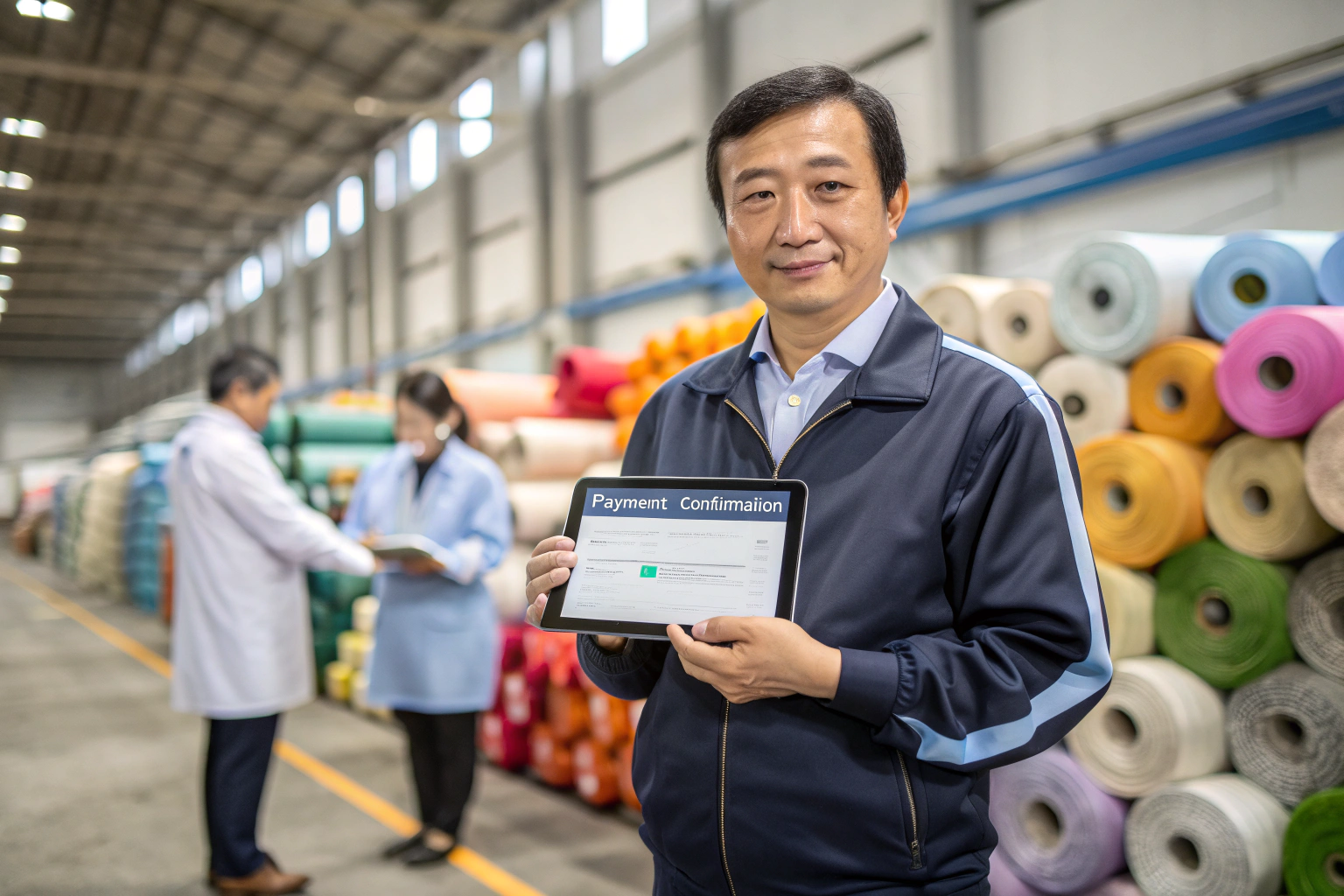
When you run a fashion brand or a sewing business, nothing kills momentum faster than a fabric order stuck because of payment problems. I have seen it happen again and again. A buyer from Milan finds the perfect recycled polyester, we agree on the price, and then… silence. Why? Because their usual bank transfer takes ten days, or their credit card gets declined for international use, or they simply don’t trust sending a wire to China.
I run Shanghai Fumao. We ship over 500 tons of fabric every month to buyers in the US, Europe, and Southeast Asia. And trust me, the payment method is often the make-or-break detail.
The short answer is: Shanghai Fumao accepts T/T (Telegraphic Transfer), Letter of Credit (L/C) at sight, Western Union, PayPal for samples and small orders under $2,000, and Alibaba Trade Assurance for orders placed through our Alibaba store. For long-term partners, we also offer 30% deposit and 70% balance against copy of Bill of Lading.
But here is the thing: each method changes your final cost, your risk, and your delivery speed. Let me walk you through how we actually handle payments with real buyers from New York to Berlin. This is not theory. This is how we get fabric on your cutting table without the usual headaches.
How to choose the safest payment method for bulk fabric orders?
Let me start with a real example. In February 2024, a British sportswear brand wanted 15,000 meters of our moisture-wicking recycled polyester. Their first request? “Can we pay 100% after delivery?” I said no. Not because I don’t trust them, but because fabric production ties up real money. We buy yarn, book dyeing slots, and run looms. A $120,000 order means $80,000 in raw materials before we even start.
So we agreed on 30% T/T deposit and 70% against the Bill of Lading. That is our sweet spot for most bulk orders.

What is the real difference between T/T and L/C for fabric imports?
T/T (Telegraphic Transfer) is like sending a wire. It is fast and cheap. You pay a fee of about $30–$50, and the money arrives in 2–4 business days. But here is the risk: once you send the deposit, you rely on my honesty. That is why you only do T/T with suppliers you trust. We have been in business since 2003, and our CNAS-certified lab tests every batch. So our clients know we deliver what we promise.
L/C (Letter of Credit) is safer for you but more expensive. Banks charge 0.5% to 1.5% of the order value. And if your documents have a tiny error—like the shipping date off by one day—the bank might reject payment. In 2022, a Canadian buyer lost $18,000 because their L/C had the wrong HS code. (Here is a tip: always ask your bank to pre-approve the draft.)
Real example: A German home textile company ordered 40,000 meters of organic cotton muslin in March 2023. They used a 60-day L/C. That meant we shipped the fabric, and they paid two months later. It worked fine because we had worked together for three years. For new clients, I usually ask for a 30% deposit.
Can I use a credit card for a $50,000 fabric order?
Technically yes, but practically no. Credit cards charge 2.9% to 3.5% fees. On $50,000, that is $1,450 to $1,750. Most fabric suppliers, including us, do not accept cards for large orders because of those fees.
Instead, use cards for:
- Sample orders (under $500)
- Small batch runs (under $2,000)
- Urgent re-orders when you cannot wait for a wire
For example, a Los Angeles-based designer needed 500 meters of bamboo silk (BAMSILK) in June 2024. She paid via PayPal. The fabric arrived in 12 days. Easy.
But for large orders, stick to T/T or L/C. You will save 3% right away.
What payment methods work best for small fabric samples and prototyping?
Small orders are a different game. We love them because many big brands started with a 50-meter sample order. But we also know that paying $45 for a wire transfer on a $200 sample feels ridiculous.

Why does PayPal work well for fabric samples under $2,000?
PayPal is fast and familiar. For buyers in the US or UK, it takes two clicks. The fee is 2.9% + $0.30 per transaction. On a $300 sample, that is about $9. Worth it for the speed.
Real example: A Swedish startup needed 200 meters of Tencel™ lyocell denim in January 2024. They paid via PayPal on a Tuesday. We shipped on Wednesday. They received the fabric in Stockholm the next Tuesday. That speed helped them meet a trade show deadline.
But PayPal has a limit. For amounts over $2,000, they might hold the funds for 21 days if you are a new buyer. That frustrates everyone. So for samples between $500 and $2,000, we often suggest Western Union.
Here is a detailed comparison of PayPal vs Western Union for fabric purchases. Read it before you decide.
How to pay for fabric prototyping without paying high bank fees?
Western Union is underrated. The fee is usually $10–$20, and the money arrives instantly. The downside? You need to go to a physical location or use their app. And the exchange rate is about 3% worse than the market rate.
Still, for a $400 prototype order, Western Union beats a $45 wire transfer.
We also accept Alibaba Trade Assurance for orders placed through our Alibaba store. This is great for new buyers. Alibaba holds your payment until you confirm receipt. The fee is about 1% to 2% of the order value. In 2023, a Brazilian swimwear brand used this for their first $8,000 order. After that, they switched to T/T because they trusted us.
Here is a step-by-step guide to using Trade Assurance for fabric orders. It saved one of our Australian clients from a $6,000 mistake when their first supplier shipped the wrong color.
How do seasonal production cycles affect your payment schedule?
This is where I see even experienced buyers make mistakes. They think payment is just about moving money. But in fabric, payment timing is linked to production timing.

Why should you pay your deposit 6 weeks before Chinese New Year?
Chinese New Year (CNY) shuts down most factories for 3 to 4 weeks. But the real problem is the two weeks before. Workers leave early. Dyeing houses stop taking new batches. Logistics grind to a halt.
Real example: In January 2023, a US activewear brand ignored my warning. They paid their 30% deposit on January 10th. CNY started on January 22nd. We could not start production until February 15th. Their fabric arrived in March, six weeks late. They lost a major retail window.
Now we tell all clients: Complete your pre-production and pay your deposit 6 weeks before CNY. That means:
- For CNY 2025 (January 29th), pay by December 15th, 2024.
- We finish weaving before the holiday.
- When we reopen, we go straight to dyeing and finishing.
This is not just our rule. Most reliable fabric suppliers in Keqiao follow the same schedule. Plan around it.
What are the timeline advantages of paying during slower months (June-July)?
From June to July, business slows down. European buyers take holidays. American brands prepare for fall. We have open capacity. That means faster delivery and sometimes better payment terms.
In June 2023, a Polish children’s wear brand ordered 25,000 meters of organic cotton jersey. They paid a 20% deposit (instead of our usual 30%) because we wanted to fill our dyeing machines. We delivered in 25 days, not the usual 35.
The same happens from November to December. After the November 11th (Singles’ Day) rush, factories have open slots. If you pay your deposit in early November, you can often get your fabric before Christmas.
Here is a forum discussion about timing fabric orders from China to avoid delays. One buyer shares how they saved 15% by shipping in July.
Can I negotiate payment terms with a Chinese fabric supplier?
Yes, you can negotiate. But you need to understand our costs first. Fabric suppliers like Shanghai Fumao have thin margins—typically 10% to 20% on woven fabrics and 15% to 25% on knits. So asking for 90-day terms on a first order is unrealistic.

What payment terms can you realistically ask for as a new buyer?
For a first order under $10,000, most suppliers will ask for 100% T/T in advance. That is standard. But you can push for 50% deposit and 50% against the Bill of Lading.
For orders over $50,000, 30% deposit and 70% against shipping documents is very common. We offer this to most new clients after a quick video call.
Real example: A Russian denim brand placed a $95,000 order in April 2024. They asked for 20% deposit and 80% 30 days after delivery. I said no. We settled on 30% deposit and 70% against the Bill of Lading. That protected both sides.
If you have been buying from us for over a year with perfect payment history, we can offer 30% deposit and 70% 30 days after delivery. But only after we check your Dun & Bradstreet rating.
Here is a template for negotiating fabric payment terms with Chinese suppliers. Use it as a starting point.
How to use escrow services for high-value fabric orders?
Escrow is rare in fabric, but it exists. Services like Escrow.com charge 1% to 3% of the order value. They hold your money and release it when you confirm the fabric meets specifications.
We have used escrow twice. Once for a $200,000 order from a Nigerian government uniform project. The buyer wanted extra security because it was their first time importing from China. It worked smoothly, but the 2.5% fee hurt.
For most buyers, a simple T/T with a reputable supplier is cheaper and faster. Check our factory audit report from SGS if you want proof of our reliability.
Conclusion
Let me wrap this up clearly. Choosing the right payment method for fabric orders from China is about balancing cost, risk, and speed.
For bulk orders over $10,000, use 30% T/T deposit and 70% against Bill of Lading. It is what we use with 90% of our clients. For samples and small orders under $2,000, use PayPal or Western Union to avoid high wire fees. For first-time large orders, consider Alibaba Trade Assurance or an L/C at sight, but know that each adds 1–3% to your cost.
Timing matters just as much as the method. Pay your deposit 6 weeks before Chinese New Year to avoid a 4-week shutdown. And if you can schedule your orders during June-July or November-December, you will get faster delivery and sometimes better terms.
We have been shipping fabric to over 100 countries from our base in Keqiao, China. Our payment terms are fair because we want long-term partners, not one-off sales.
Ready to start your fabric order? Contact our Business Director, Elaine, directly at elaine@fumaoclothing.com. Tell her your order quantity, fabric type, and target delivery date. She will send you a proforma invoice with the best payment method for your specific situation. Whether you need 50 meters of organic bamboo silk for a prototype or 50,000 meters of recycled polyester for a sportswear collection, we make the payment process simple.
Let’s get your fabric on the water.