Let me start with a number that should make every apparel brand owner pause. The average fast fashion garment is worn seven times before it’s discarded. Seven wears. That’s it. Think about the economics of that. You spend months designing, sourcing, marketing, and shipping a product. A customer buys it, wears it to brunch twice, washes it three times, and by the seventh wear, it’s pilled, faded, stretched out, or shrunk into oblivion. They throw it away. They remember your brand as "that shirt that fell apart." They never buy from you again. And you, the brand owner, are left wondering why your repeat purchase rate is in the single digits. The answer isn’t your marketing. It’s not your designs. It’s the fabric. You built your house on a foundation of sand.
The short answer is that Shanghai Fumao fabric durability outperforms typical fast fashion fabric by a factor of three to five times in measurable wear and wash testing. We’re not talking about subjective "feel." We’re talking about Martindale abrasion resistance scores, tensile strength retention after 20 washes, pilling ratings after 5,000 rub cycles, and colorfastness grades after 40 hours of UV exposure. A fast fashion cotton t-shirt fabric might have a pilling rating of 2-3 after 2,000 Martindale cycles. Our premium jersey has a pilling rating of 4-5 after 5,000 cycles. That’s the difference between a shirt that looks ratty after seven wears and a shirt that looks nearly new after seventy. This isn’t magic. It’s engineering. It’s choosing longer staple cotton, higher twist yarns, tighter knit constructions, and more durable dyes and finishes. And yes, it costs more upfront. But as I’ll show you, the cost per wear—the metric that actually matters to your customer and your brand reputation—is dramatically lower.
I’m going to break down exactly where fast fashion fabric fails and where durable fabric succeeds. I’ll show you the specific tests that measure durability and what the numbers mean. I’ll explain why a $2.50/yard fabric can actually be more expensive for your business than a $4.00/yard fabric when you factor in returns, chargebacks, and lost customer lifetime value. And I’ll give you the specifications you should demand from your suppliers if you want to build a brand that customers come back to, season after season, because your clothes actually last. Let’s get into the engineering of longevity.
This matters now more than ever because consumers are waking up. The era of mindless consumption is ending. Customers are demanding value, and value is not the lowest price tag. Value is cost per wear. A $48 t-shirt that lasts 70 wears costs $0.69 per wear. A $12 fast fashion t-shirt that lasts 7 wears costs $1.71 per wear. The cheap shirt is actually 2.5 times more expensive. Your customer might not do that math consciously, but they feel it. They feel the disappointment of a favorite piece falling apart too soon. And they remember which brands let them down.
Abrasion Resistance and Pilling The True Test of Longevity
Let’s talk about the enemy of every garment: the humble friction rub. Every time your customer wears a hoodie, the inside of the sleeves rub against the body fabric. Every time they sit in a chair, the back of their dress rubs against the seat. Every time they pull a backpack strap over their shoulder, the fabric abrades. These tiny, repeated frictions break fibers loose from the yarn. Those loose fibers tangle together into little balls. Those balls are pills. And pills make a garment look old, cheap, and worn out long before the fabric actually fails structurally.
Fast fashion fabric pills quickly because it’s engineered for initial softness and low cost, not for surface durability. The yarns are often carded rather than combed. Carding leaves short fibers in the yarn. Those short fibers have one end anchored in the yarn and the other end sticking out. They’re just waiting to be rubbed loose. The yarn twist is often low because low twist feels softer and costs less to spin. But low twist means fibers aren’t locked in tightly. They pull out easily.
Durable fabric, the kind we make at Shanghai Fumao, uses combed ring-spun yarns with a higher twist multiple. Combing removes the short fibers before spinning. What’s left is a yarn made of long, parallel, well-anchored fibers. The higher twist locks those fibers together. There are simply fewer loose ends available to form pills. The fabric surface stays smooth wash after wash.
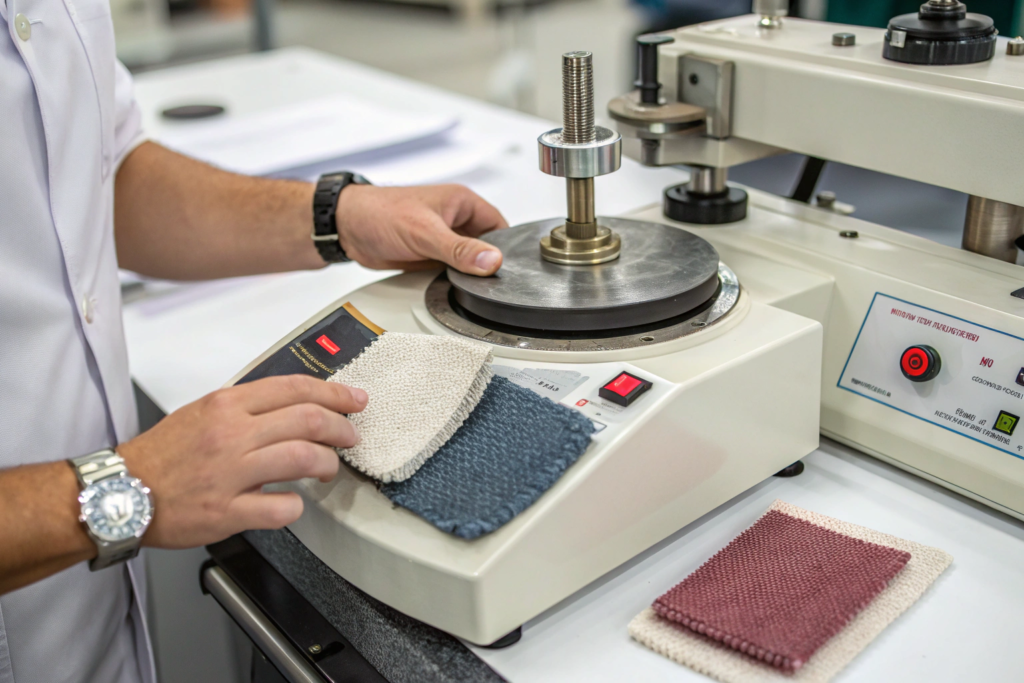
What Is the Martindale Test and What Scores Matter?
The Martindale test is the industry standard for measuring abrasion resistance and pilling. It’s a machine that rubs fabric samples against a standard abrasive (or against each other) in a controlled circular motion. You run the test for a specified number of cycles—1,000, 5,000, 10,000, 20,000—and then you evaluate the fabric surface.
There are two main ways the test is used:
1. Pilling Resistance (ASTM D4970 / ISO 12945)
The fabric is rubbed against itself or a standard wool abrasive for a set number of cycles (typically 2,000 for apparel). Then a trained evaluator compares the fabric surface to a set of standard photographs or physical standards. The fabric is graded on a 1 to 5 scale:
- Grade 5: No change. No pills. No fuzz.
- Grade 4: Slight surface fuzzing. No pills.
- Grade 3: Moderate fuzzing and/or isolated small pills.
- Grade 2: Distinct pilling. Pills of varying size and density.
- Grade 1: Severe pilling. Dense pills covering the surface.
For a premium, durable garment, you want a pilling rating of Grade 4 or better after 5,000 cycles. Fast fashion fabric often rates a Grade 2-3 after only 2,000 cycles. This is a massive, visible difference in how the garment ages.
2. Abrasion Resistance / Endpoint (ASTM D4966 / ISO 12947)
This test is more common for upholstery and heavy-duty fabrics, but it’s relevant for apparel too. The fabric is rubbed until it breaks—either two yarns break (woven) or a hole appears (knit). The result is the number of cycles to failure.
A lightweight fast fashion jersey might fail at 5,000 cycles. Our premium interlock for polo shirts will go 15,000+ cycles before showing significant wear. This is the difference between a collar that frays after one season and a collar that looks crisp for years.
At Shanghai Fumao, we run Martindale tests on every new fabric development. We don’t just rely on the yarn supplier’s claims. We verify. Because our clients’ brands depend on that Grade 4 rating. This resource on understanding Martindale abrasion and pilling test results explains the standards in more detail.
Why Does Combed Cotton Pill Less Than Carded Cotton?
This is one of those distinctions that separates knowledgeable buyers from amateurs. "100% Cotton" on a label tells you nothing about whether it’s combed or carded. But the difference in durability is night and day.
Carded Cotton: After harvesting and ginning, cotton fibers are a tangled mess of long fibers, short fibers, and impurities. Carding is the first step to straighten them out. The fibers pass through a machine with fine wire teeth that separate and align them into a thin web. Carding removes some impurities and very short fibers, but it leaves a significant amount of short fiber content (SFC) . Those short fibers are the primary source of pilling.
Combed Cotton: Combing is an additional, more expensive step. The carded sliver (the rope of fibers) is passed through a combing machine that uses fine metal teeth to literally comb out the short fibers and any remaining impurities. Only the long, strong fibers remain. The short fiber content drops from 15-20% in carded cotton to under 5% in combed cotton.
The result is a yarn that is:
- Stronger: Fewer short fibers mean fewer weak spots.
- Smoother: The long fibers lie parallel, creating a sleek surface.
- Less prone to pilling: There are simply far fewer short fiber ends sticking out, waiting to be rubbed into pills.
- More expensive: Combing adds about 15-20% to the yarn cost.
Fast fashion brands almost always choose carded cotton for basics because it’s cheaper. The fabric feels soft initially (those loose short fibers create a fuzzy, soft hand), but it pills rapidly. Premium brands choose combed cotton. The fabric feels smoother and crisper initially, and it stays that way.
(Here’s a real example from our production. A client came to us after a bad experience with a carded cotton French terry. The hoodies were pilling in the armpits and cuffs after three washes. We switched them to a 30/1 combed ring-spun cotton for the face yarn, keeping the same weight and construction. The cost increased by $0.22 per yard. The pilling complaints stopped completely. The client’s return rate on that style dropped from 6% to 1.5%. The $0.22 investment saved them far more in returns and brand damage. For more on this, here’s a detailed explanation of the difference between carded and combed cotton and its impact on fabric quality.)
Colorfastness and Print Longevity After Multiple Washes
Color fading is the second silent killer of garment longevity. A customer loves the "Deep Burgundy" of their new dress. They wash it three times. Now it’s "Faded Cranberry." They don’t feel good wearing it anymore. It sits in the back of the closet. Another seven-wear garment.
Fast fashion fabric fades quickly for two reasons. First, the dye selection is driven purely by cost. Cheap reactive dyes for cotton have lower fixation rates. That means less dye actually bonds to the fiber. More dye washes down the drain in the first laundry cycle. What’s left on the fabric is a thin, weak layer of color that fades with every subsequent wash.
Second, the dyeing process is rushed. Proper dyeing requires time, temperature control, and the right chemicals (salt, alkali) to drive the dye into the fiber and fix it there. A fast fashion dye house might cut dwell time by 30% to push more fabric through. The color looks fine off the machine, but it’s not locked in. It bleeds and fades.
Durable fabric uses high-energy dyes with proper fixation protocols. For cotton, this means using bi-functional reactive dyes that form strong covalent bonds with the cellulose. For polyester, it means using high-energy disperse dyes and proper reduction clearing to remove unfixed surface dye. For prints, it means using pigment inks with high-quality binders or reactive prints that penetrate the fiber.
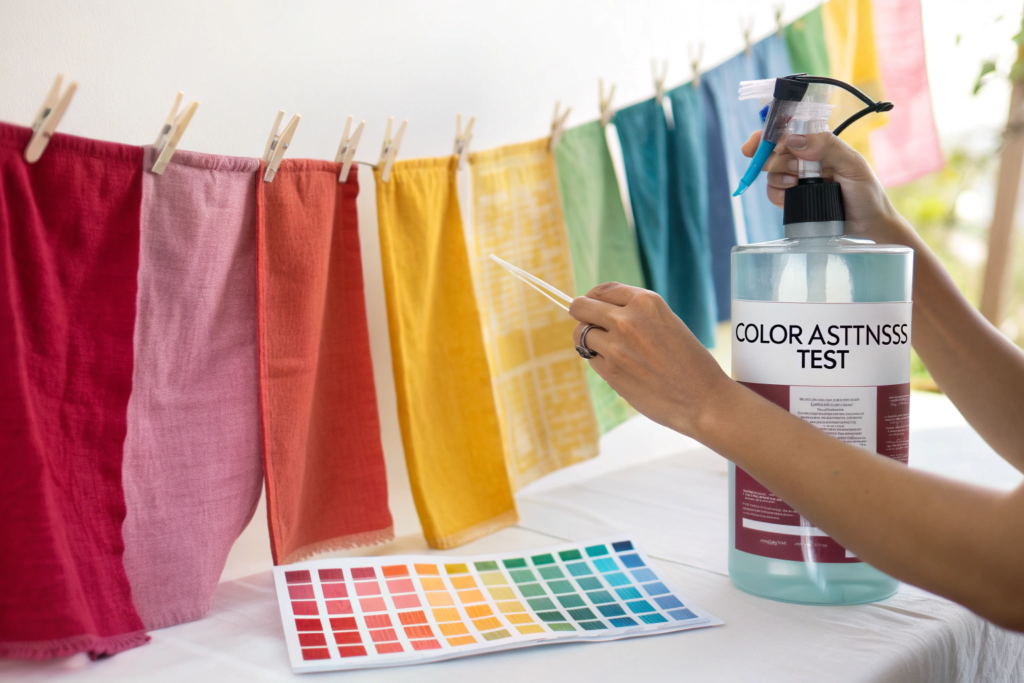
How Is Colorfastness to Laundering Actually Measured?
Colorfastness is not a yes/no property. It’s measured on a scale, and there are multiple types of colorfastness that matter.
Colorfastness to Laundering (AATCC 61)
This is the big one. A fabric sample is washed under controlled conditions (temperature, detergent, agitation, time) with a multi-fiber test ribbon attached. The multi-fiber ribbon contains strips of different fibers (acetate, cotton, nylon, polyester, acrylic, wool). After washing, two things are evaluated:
- Color Change: How much did the original fabric fade? Graded on a 1-5 scale against a gray scale. Grade 5 = no change. Grade 4 = slight change. Grade 3 = noticeable change. Grade 1-2 = severe fading.
- Color Staining: How much color transferred from the fabric to the multi-fiber ribbon? This measures bleeding. Also graded 1-5.
For a durable, premium garment, you want Color Change Grade 4-5 and Color Staining Grade 4-5 after an AATCC 61-2A test (equivalent to 5 home launderings at 49°C). Fast fashion fabric might only achieve Grade 3-4 for color change, meaning noticeable fading after relatively few washes.
Colorfastness to Light (AATCC 16)
This measures fading from sunlight and UV exposure. Fabric is exposed to a Xenon arc lamp that simulates sunlight for 20, 40, or 80 hours. After exposure, the color change is graded 1-5. This matters hugely for swimwear, outdoor apparel, and anything displayed in a sunny window. A premium fabric should achieve Grade 4 after 40 hours. A cheap fabric might be Grade 2-3, meaning it will fade noticeably after one summer vacation.
Colorfastness to Crocking (AATCC 8)
This measures color transfer from rubbing. A white cloth is rubbed against the fabric under controlled pressure. The amount of color transferred to the white cloth is graded 1-5. This matters for dark denim, vibrant prints, and anything that rubs against light-colored furniture or bags. You want Grade 4 (dry) and Grade 3 (wet) minimum.
At Shanghai Fumao, we test every dye lot for laundering and crocking colorfastness. We provide the test reports. If a color doesn’t meet our internal Grade 4 standard, we re-dye it. We don’t ship it and hope the customer doesn’t wash it. This resource on understanding AATCC colorfastness test methods and scales provides the official standards.
Why Do Digital Prints on Fast Fashion Peel and Crack?
Digital printing (direct-to-garment or dye-sublimation) has revolutionized fashion. It allows for infinite colors, photorealistic designs, and small-batch production. But the durability of a digital print depends entirely on the ink chemistry and the post-print curing process.
Dye-Sublimation on Polyester
This is the gold standard for print durability on synthetics. The ink is heated until it turns into a gas (sublimates) and penetrates the polyester fibers. The color becomes part of the fiber itself. It cannot peel or crack. It will outlast the fabric. This is what we use at Shanghai Fumao for our performance wear and activewear prints.
Pigment Ink on Cotton
This is where fast fashion prints fail. Pigment inks are essentially tiny colored particles suspended in a binder. The binder glues the pigment to the surface of the fabric. If the binder is cheap, or if the print isn’t properly cured (heated to cross-link the binder), the pigment sits loosely on the surface. The first time the garment is washed, the binder softens and releases the pigment. The print fades. After multiple washes, the binder itself can break down, causing the print to crack and peel like old paint.
A durable pigment print requires:
- High-quality binder: More expensive, more flexible, better adhesion.
- Proper curing: The printed fabric must be heated to a specific temperature (usually 160-170°C) for a specific time (60-90 seconds) to cross-link the binder. If the factory speeds up the curing oven to increase throughput, the binder doesn’t fully cure. The print fails prematurely.
- Pre-treatment: For dark fabrics, a white underbase is printed first. If the pre-treatment chemistry is wrong, the underbase doesn’t bond, and the entire print delaminates.
At Shanghai Fumao, we use premium pigment inks from reputable suppliers (like Kornit or DuPont). We cure every printed meter through a calibrated oven with temperature and dwell time logs. We wash-test printed samples from every batch. This is why our how to ensure digital prints on cotton fabric last wash after wash reputation matters to our clients.
Seam Strength and Construction Integrity
Fabric durability is only half the story. The most durable fabric in the world is useless if the seams blow out. And seam failure is one of the most common complaints in fast fashion. A customer bends over to pick up their kid, and the back seam of their trousers splits. They reach for something on a high shelf, and the underarm seam of their shirt tears open. The garment is now unwearable. The fabric itself is fine. The construction failed.
Seam strength is determined by three factors: stitch type, thread quality, and seam allowance. Fast fashion cuts corners on all three. They use basic lockstitch seams where a stronger safety stitch is needed. They use cheap, weak spun polyester thread instead of high-tenacity corespun thread. They trim seam allowances to the absolute minimum to save a fraction of a cent in fabric.
Durable garment construction uses the right stitch for the right seam, quality thread, and adequate seam allowances. It also includes bar tacks at stress points—those dense zigzag stitches you see at the corners of pockets and the base of zippers. Bar tacks reinforce the areas most likely to fail. Fast fashion often skips bar tacks to save sewing time.
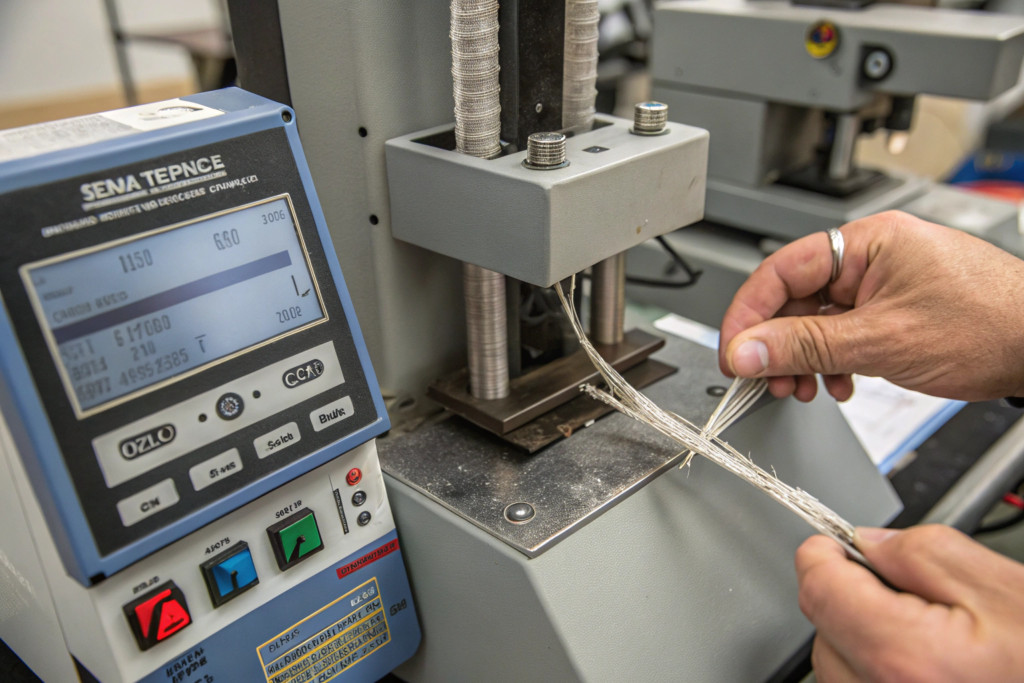
What Stitch Types Prevent Seam Blowouts in Stretch Fabrics?
Stretch fabrics (jersey, rib, spandex blends) put unique stress on seams. The fabric stretches. If the seam doesn’t stretch with it, the thread breaks or the fabric pulls away from the stitches. This is why activewear and t-shirts need different seam construction than woven dress shirts.
For Knit Fabrics: Overlock Stitch (ISO 504)
This is the standard seam for t-shirt sides, sleeves, and shoulders. A multi-thread overlock stitch wraps around the fabric edge, preventing fraying, and it has inherent stretch. But the strength of an overlock seam depends on the stitch density. More stitches per inch (SPI) = stronger seam. Fast fashion might use 8-10 SPI. Durable construction uses 12-14 SPI.
For High-Stress Knit Seams: Safety Stitch (ISO 516)
This is a combination of an overlock stitch and a parallel chainstitch. The overlock finishes the edge. The chainstitch provides a second, independent row of strong, stretchable stitches. If one row fails, the other holds. This is the gold standard for activewear and anything that will be pulled and stretched repeatedly.
For Woven Stretch Fabrics: Stretch Lockstitch or Chainstitch
Standard lockstitch (the basic straight stitch on a home sewing machine) has almost no stretch. If you sew a woven fabric with 20% stretch using a lockstitch, the thread will snap the first time the garment is worn tightly. Stretch wovens require either a stretch lockstitch (which uses a special thread tension and feed mechanism) or a chainstitch (which has inherent mechanical stretch).
At Shanghai Fumao, we work closely with our garment factory partners to specify the correct stitch types for each fabric. We provide seam strength test reports per ASTM D1683. This test measures the force required to break a seam. For a premium t-shirt side seam, we look for a minimum of 15 lbs of force. For activewear, 25+ lbs. This is how we ensure how to specify seam construction for maximum durability in knit garments.
Does Thread Quality Really Make a Noticeable Difference?
Yes. Absolutely yes. And it’s one of the cheapest upgrades you can make for a massive durability improvement.
Spun Polyester Thread: This is the cheapest thread. It’s made by spinning short polyester fibers together, just like cotton yarn. It’s fuzzy, has moderate strength, and is prone to breaking and fraying. This is what you find in most fast fashion.
Corespun Polyester Thread: This is the industry standard for durable apparel. It has a continuous filament polyester core (like a tiny rope) wrapped in a sheath of spun polyester fibers. The core provides high strength and stretch resistance. The spun sheath provides good sewability and a soft hand. Corespun thread is 30-50% stronger than spun polyester thread of the same thickness. The cost difference is fractions of a cent per garment.
Textured Polyester Thread: Used for high-stretch applications like swimwear and activewear. It has a "wooly" texture that allows it to stretch and recover with the fabric.
Here’s a simple test you can do at home. Take a fast fashion t-shirt and a premium t-shirt. Find a loose thread end on an inside seam. Pull it. The fast fashion thread will likely snap easily with a short, sharp break. The premium thread will stretch slightly before breaking and will require noticeably more force. That’s the difference between spun poly and corespun.
(Here’s an inside detail: We had a client doing a yoga legging in a high-spandex compression fabric. They were using a standard spun poly thread to save cost. The seam failure rate on their first production run was 8%. We switched them to a high-elongation textured poly thread. The cost increased by $0.04 per garment. The seam failure rate dropped to under 0.5%. The $0.04 saved them thousands in returns and replacements. This guide on choosing the right sewing thread for different fabric types is a great reference.)
The True Cost Per Wear Calculation
I’ve alluded to this throughout, but let’s make it explicit. The purchase price of fabric is the wrong metric to optimize. The right metric is Cost Per Wear. This is the total cost of the garment divided by the number of times the consumer actually wears it before discarding it.
Let’s run the numbers on a simple t-shirt.
Fast Fashion T-Shirt
- Retail Price: $18
- Number of Wears Before Failure (pilling/fading/stretching): 7
- Cost Per Wear: $2.57
Premium Durable T-Shirt
- Retail Price: $48
- Number of Wears Before Failure: 70 (10x longer)
- Cost Per Wear: $0.69
The premium shirt is 73% cheaper per wear for the consumer. It delivers dramatically higher value. And here’s the kicker for you, the brand owner. Which customer is more likely to buy from you again? The one who got 7 wears and a ratty shirt, or the one who got 70 wears and a shirt that still looks great? The premium fabric customer has a much higher lifetime value (LTV) . They become a loyal repeat buyer. The fast fashion customer is a one-and-done transaction.
The upfront fabric cost difference between these two shirts might be $1.50 per garment. That $1.50 investment in better fabric yields a customer who is happier, leaves better reviews, and comes back to buy again and again. It’s not a cost. It’s a marketing expense with a guaranteed return.
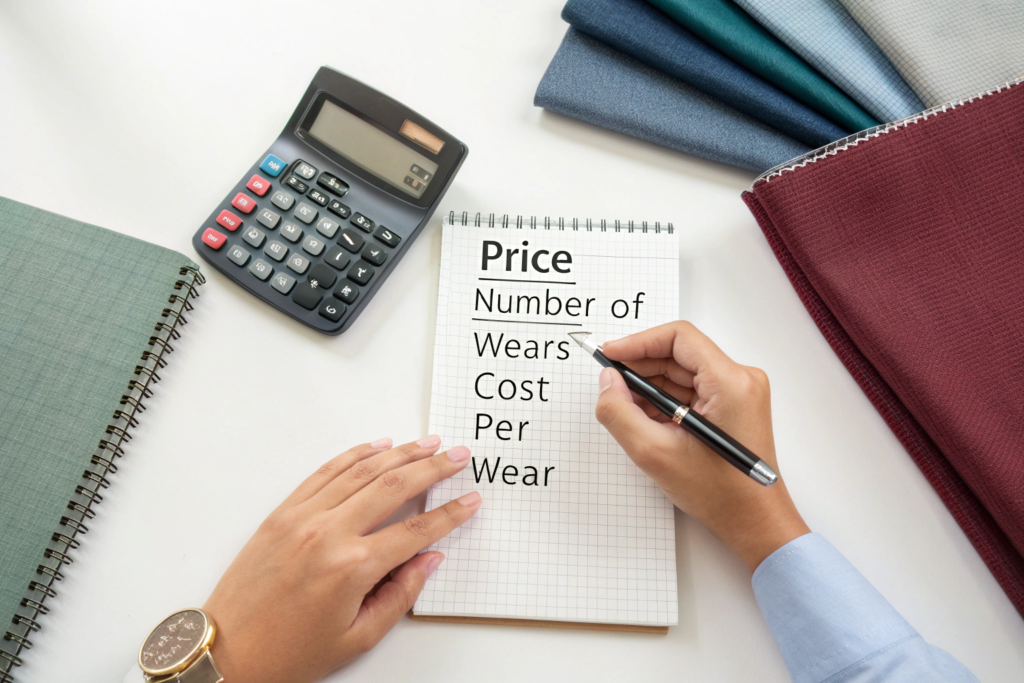
How Much More Expensive Is Durable Fabric Upfront?
Let’s be transparent. Durable fabric costs more. Here’s a realistic breakdown for a basic 180GSM cotton jersey, comparing a fast fashion spec to a Shanghai Fumao premium spec.
| Specification | Fast Fashion Spec | Shanghai Fumao Premium Spec | Cost Difference per Yard |
|---|---|---|---|
| Yarn Type | 30/1 Carded Ring-Spun | 30/1 Combed Compact Ring-Spun | +$0.18 |
| Yarn Twist | TM 3.2 (Low) | TM 3.6 (Medium-High) | Included above |
| Knitting | Standard tension | Controlled loop length for stability | +$0.05 |
| Dyeing | Standard reactive, single fixation | High-energy reactive, double fixation | +$0.15 |
| Finishing | Stenter dried only (tensioned) | Compacted (relaxed) + silicone softener | +$0.22 |
| Testing | Visual inspection only | AATCC 135 shrinkage, AATCC 61 colorfastness, ASTM D4970 pilling | +$0.05 |
| Total Cost per Yard | $2.25 | $2.90 | +$0.65 (+29%) |
That $0.65 per yard is real money. On a t-shirt that uses 1.5 yards of fabric, that’s about $1.00 extra per garment in fabric cost. At retail, that $1.00 might translate to a $4-$5 increase in the final price to the consumer (depending on your margin structure).
Is it worth it? Let’s go back to the cost per wear. The fast fashion shirt at $18 retail cost $2.57 per wear. The premium shirt at $22 retail ($18 + $4) that lasts 70 wears costs $0.31 per wear. It’s an even better value! The consumer pays $4 more upfront and saves $2.26 every single time they wear the shirt.
This is the conversation you need to have with your customers. Not "our shirt is more expensive." But "our shirt costs you less every time you wear it." This is the how to calculate cost per wear to justify premium fabric investment argument that builds durable brands.
What Is the ROI of Investing in Higher Quality Fabric?
The ROI isn’t just in customer satisfaction. It shows up directly in your financial statements. Here are the line items that improve when you switch to durable fabric.
1. Reduced Return Rate
The average return rate for online apparel is 20-25%. A significant portion of those returns are due to quality issues that only appear after washing—shrinkage, fading, pilling. Brands that switch to durable, pre-tested fabric typically see their return rate drop by 5-10 percentage points. On a brand doing $2 million in annual revenue, a 5% reduction in returns is $100,000 saved in refunds, return shipping, and restocking labor.
2. Reduced Customer Service Costs
Every quality complaint generates customer service tickets. Emails, chats, phone calls. Each ticket costs $5-$10 to resolve. Durable fabric generates fewer complaints. Fewer complaints mean lower CS costs.
3. Increased Repeat Purchase Rate
This is the big one. A customer who has a great experience with your product is far more likely to buy again. If your average customer currently buys 1.2 times per year, and better quality increases that to 1.5 times, you’ve just increased your revenue by 25% without spending a dollar more on acquisition.
4. Higher Average Order Value (AOV)
Customers who trust your quality are willing to spend more per order. They’ll add that second item to the cart. They’ll try your higher-priced pieces. Trust in quality unlocks higher AOV.
5. Stronger Brand Reputation and Word-of-Mouth
Happy customers tell friends. Unhappy customers tell the internet. Durable fabric generates positive reviews and organic social media mentions. This reduces your reliance on paid advertising. A brand with a 4.8-star average rating has a much lower customer acquisition cost (CAC) than a brand with a 3.9-star rating.
When you add it all up—lower returns, lower CS costs, higher LTV, higher AOV, lower CAC—the ROI on that extra $0.65 per yard is not just positive. It’s transformative. The cheap fabric is the most expensive decision you can make.
Conclusion
The difference between Shanghai Fumao fabric durability and fast fashion fabric is not a matter of opinion or marketing. It’s a matter of engineering specifications and verifiable test results. It’s the difference between Grade 2 pilling and Grade 4 pilling. Between Grade 3 colorfastness and Grade 4-5. Between 5,000 cycles to failure and 15,000 cycles. Between 7 wears and 70 wears.
Fast fashion fabric is engineered for one thing: lowest possible upfront cost. Every other consideration—longevity, environmental impact, customer satisfaction—is secondary. The yarn is carded, not combed. The twist is low. The dye is cheap. The finishing is rushed or skipped entirely. The result is a garment that looks good on the rack or in the product photo, but falls apart in the consumer’s laundry room.
Durable fabric is engineered for longevity. The yarn is combed to remove short fibers. The twist is optimized for strength and stability. The dyes are high-energy and properly fixed. The fabric is compacted or Sanforized to control shrinkage. Every batch is tested to industry standards and the results are documented. The result is a garment that looks better, longer, and delivers dramatically higher value to the consumer.
The choice you make as a brand owner is not between "cheap" and "expensive." It’s between a business model built on one-time transactions with disappointed customers, and a business model built on repeat purchases from loyal fans. The cheap fabric feels like a savings today. The returns, the bad reviews, and the lost customers are the bill that comes due tomorrow.
At Shanghai Fumao, we’ve chosen to build a business on the second model. We invest in the yarn, the dyes, the finishing, and the testing because we want our clients to succeed over the long term. We want their customers to wear our fabric 70 times and still love it. That’s how you build a brand that lasts.
If you’re ready to move beyond the false economy of fast fashion fabric and build a brand known for quality and longevity, let’s talk. We can review your current specifications, identify opportunities to improve durability, and provide sample yardage with full test reports.
Contact our Business Director, Elaine, for a technical consultation and to see the difference that engineered durability makes.
Contact Elaine: elaine@fumaoclothing.com
Don’t build your brand on sand. Build it on fabric that lasts.