
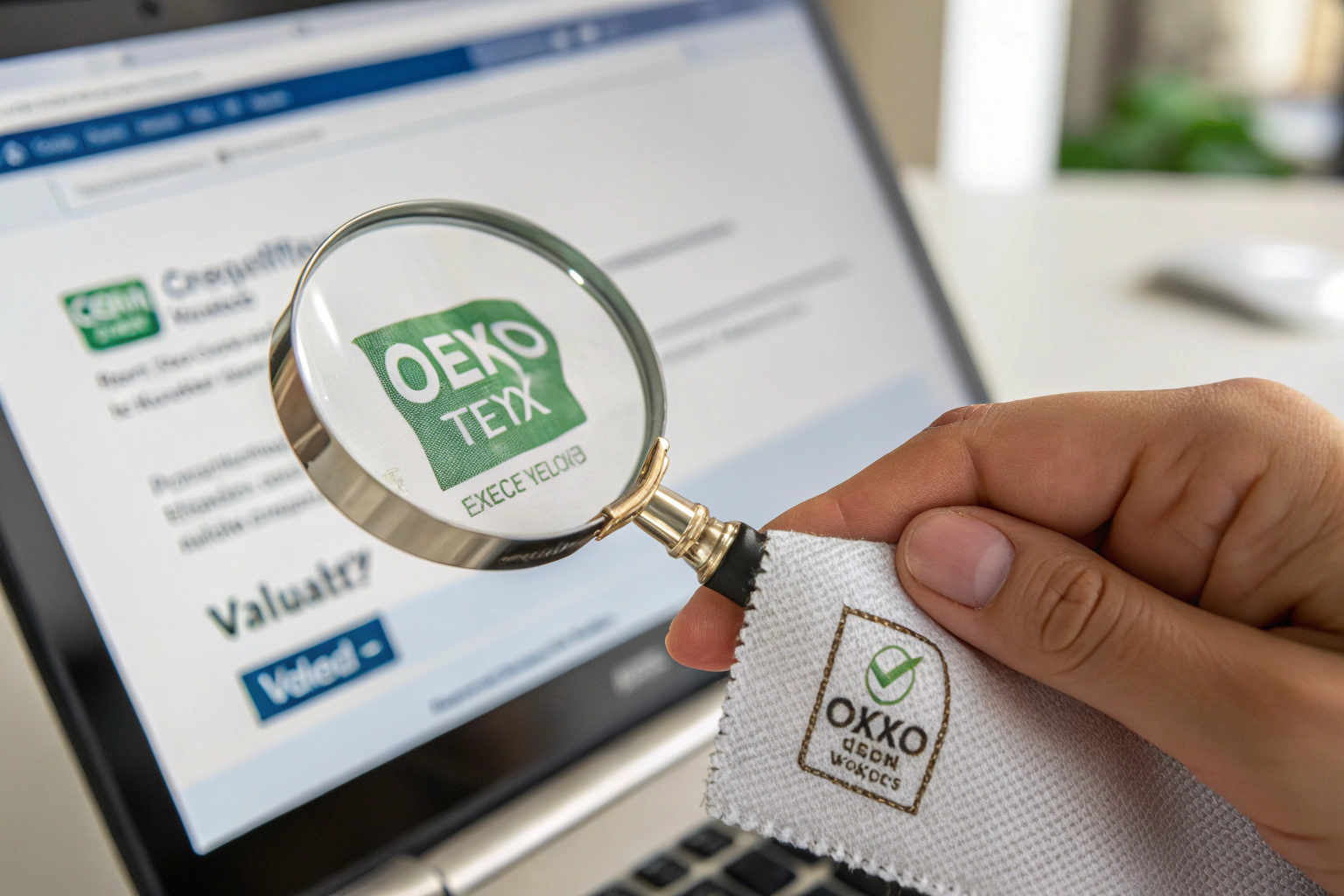
Let me start with a scene I’ve witnessed more times than I care to count. A buyer walks into our showroom in Keqiao, pulls out a fabric swatch from a competitor, and says, "Look, they have GOTS certification and their price is 30% lower. Why should I pay more for yours?" I take the swatch. I look at the certification label. And then I pull out my phone, go to the GOTS public database, and type in the certificate number printed right there on the label. Invalid. Expired. Or worse—valid, but belonging to a completely different company in a different province. The buyer’s face falls. They placed a $40,000 order based on that piece of paper. The fabric arrives, and it’s not organic. Their customers find out. Their brand reputation takes a hit they can’t quantify. That sinking feeling—the realization that a logo on a hangtag meant absolutely nothing—that’s what keeps honest mill owners like me awake at night. Not because we’re worried about our own certifications. Because the fraud out there makes the whole industry look bad.
The short answer is yes, you can trust fabric certifications from overseas. But only if you verify them yourself. A certification is not a magic spell. It’s a claim. And like any claim in business, it’s only as good as the evidence behind it. The problem in 2026 is that the barriers to faking a certification have dropped to nearly zero. Anyone with basic Photoshop skills can create a GOTS certificate that looks real. Anyone can print an OEKO-TEX hangtag. And the enforcement mechanisms—the actual audits and verifications—are stretched thin, especially in countries where the certification infrastructure is newer and less rigorous. At Shanghai Fumao, we maintain GOTS, GRS, OEKO-TEX, and CNAS accreditations. It costs us real money. Annual audits. Lab equipment calibration. Dedicated compliance staff. We do it because our European and American clients demand it, and because we believe in transparency. But we’re competing against factories that fake it. And the buyers who can’t tell the difference are the ones who get hurt.
I’m going to walk you through exactly how to separate real certifications from paper fakes. I’ll show you the specific databases where you can verify any certificate number in 60 seconds. I’ll explain the difference between a certificate that covers the product versus one that covers the factory. I’ll tell you which certifications actually require on-site audits and which are basically mail-order diplomas. And I’ll share the red flags that scream "this certificate is borrowed, expired, or photoshopped." Because in 2026, trusting a certification without verifying it is like trusting a stranger who says they’re a doctor because they’re wearing a white coat. The coat means nothing. The medical license on the wall that you can look up in the state database? That means something. Let’s learn how to check the license.
This matters more than ever because the premium you pay for certified fabric—whether it’s organic cotton, recycled polyester, or toxin-free dyes—only makes sense if the certification is real. If you’re paying a 20% premium for GOTS organic cotton that’s actually conventional cotton with a fake label, you’re not just losing money. You’re committing fraud against your own customers, even if unknowingly. The Federal Trade Commission doesn’t care that you were "tricked." They care that you made a false claim. So let’s get into the nuts and bolts of certification verification.
The Difference Between Real and Fake Certification Labels
Here’s the first thing you need to understand: there are two completely different types of certifications in the textile world, and confusing them is how buyers get burned.
Product Certification means a specific batch of fabric has been tested and meets a standard. OEKO-TEX Standard 100 is a product certification. It says "This fabric does not contain harmful levels of restricted substances." But it says nothing about how the fabric was made. It doesn’t mean the factory is clean. It doesn’t mean the workers are treated fairly. It doesn’t even mean the next batch of fabric from that same factory will pass. The certificate is tied to the specific article (fabric style) and is valid for one year.
Process Certification means the factory’s entire production system has been audited and meets a standard. GOTS and GRS are process certifications. They say "This factory has systems in place to track organic or recycled materials from input to finished product, and its environmental and social practices meet our criteria." The certificate is tied to the facility, not just the product.
The fraud happens when a factory has a process certification (like GOTS) for one production line, but uses the logo on products made on a different, uncertified line. Or when a factory has a product certification (like OEKO-TEX) for one fabric, but slaps the label on every fabric they sell. Or worst of all, when a trading company buys a small amount of certified fabric, uses the certificate to get approved by a buyer, and then ships uncertified bulk fabric with fake labels.

How Can You Verify a GOTS Certificate Number in 60 Seconds?
This is the single most useful skill I can teach you. It takes one minute and it will save you thousands of dollars.
Step 1: Get the certificate number. Not the "license number" or "registration number." The actual GOTS Scope Certificate number. It usually looks like this: GOTS-2024-0001234 or CU 123456. It must be on the certificate itself. If the supplier "can’t find it right now" or gives you a number that doesn’t match that format, red flag.
Step 2: Go to the GOTS public database. The URL is https://global-standard.org/find-suppliers. Bookmark it. Use it.
Step 3: Enter the certificate number or the company name. Hit search.
Step 4: Verify the details. The database will show you:
- Company Name: Does it exactly match the name on the supplier’s invoice and website? If it’s off by even one word ("Zhejiang Fumao Textile Co." vs "Fumao Textiles International"), be suspicious. Certificates are issued to specific legal entities.
- Scope: This is critical. It will list what the factory is certified to do. For example: "Weaving, Dyeing, Finishing of Organic Cotton Woven Fabrics." If you’re buying knitted fabric, and the scope only covers woven, the certification does NOT apply to your order.
- Validity Dates: Is the certificate current? GOTS certificates are valid for one year and must be renewed. An expired certificate is useless.
- Address: Does the facility address match where the supplier claims production is happening?
Step 5: Ask for the Transaction Certificate (TC). This is the advanced move. A Scope Certificate (SC) says the factory can make GOTS fabric. A Transaction Certificate (TC) proves that a specific batch of fabric is GOTS certified. The TC traces the organic material from the gin to the spinner to the knitter to the dyer. It’s a chain-of-custody document. If you’re ordering 5,000 yards of "GOTS organic cotton," demand the TC number before you pay the balance. If they can’t produce it, they’re either not making your fabric in the certified facility, or they’re not using certified organic yarn. Both are deal-breakers.
I’ve seen buyers accept a Scope Certificate as proof and later discover their fabric was made in an uncertified subcontractor’s facility. The TC is your insurance policy. For a step-by-step visual guide, here’s a resource on how to verify GOTS certification and avoid fake organic claims.
Is OEKO-TEX Standard 100 Enough to Guarantee Safety?
OEKO-TEX Standard 100 is the most widely recognized textile safety certification in the world. And it’s valuable. It tests for over 100 harmful substances—azo dyes, formaldehyde, heavy metals, pesticides, phthalates. It’s a robust standard.
But here’s what OEKO-TEX does not tell you:
- It does not mean the fabric is organic. OEKO-TEX tests for chemical residues. It doesn’t care if the cotton was grown with pesticides, as long as those pesticides don’t remain on the finished fabric in detectable amounts. A fabric can be OEKO-TEX certified and still be conventional, pesticide-intensive cotton.
- It does not mean the factory has good labor practices. OEKO-TEX is a product test, not a social audit. A factory with child labor can still produce OEKO-TEX certified fabric.
- It does not mean the dyeing process is environmentally friendly. It tests the finished product, not the wastewater. A factory can dump toxic dye effluent into a river and still produce OEKO-TEX certified fabric, as long as the final fabric is clean.
So, is OEKO-TEX "enough"? It depends on your claims. If you’re marketing your product as "free from harmful chemicals" or "safe for sensitive skin," OEKO-TEX is excellent supporting evidence. If you’re marketing it as "organic" or "eco-friendly" or "ethically made," OEKO-TEX is insufficient. You need GOTS or GRS or Fair Trade certifications to back those broader claims.
Also, verify the OEKO-TEX certificate the same way you verify GOTS. Go to the OEKO-TEX Label Check website (https://www.oeko-tex.com/en/label-check) and enter the certificate number. Check that the certificate covers the specific product category (Product Class I for baby items, Class II for direct skin contact, etc.). And check the validity date. An OEKO-TEX certificate is only valid for 12 months. I’ve seen factories using certificates that expired three years ago. Buyers don’t check. They see the logo and assume it’s current. This resource on understanding the limitations of OEKO-TEX Standard 100 certification explains the nuances well.
Why Factory Audits Matter More Than Paper Certificates
Here’s a truth that certification bodies don’t like to admit. An audit is a snapshot, not a movie. The auditor visits for one or two days. The factory knows they’re coming weeks in advance. They clean up. They hide the worst practices. They put their best workers on the floor. For 48 hours, the factory looks like a model of compliance. The auditor leaves. The certificate is issued. And six months later, the factory is back to its old ways.
This doesn’t mean audits are worthless. They’re essential. But they’re a starting point for verification, not the final word. The real value of an audit is in the audit report, not just the certificate. A certificate is a yes/no document. An audit report contains findings, observations, and—crucially—non-conformities. A factory with zero non-conformities in an audit is either perfect (impossible) or the auditor was asleep (likely). A factory with minor non-conformities that were addressed with a corrective action plan is demonstrating a functioning quality system.
When I audit my own suppliers—the yarn spinners and chemical companies I buy from—I don’t just ask for their GOTS certificate. I ask to see their last audit report. I want to see what the auditor found. Did they have issues with record-keeping? With chemical storage? With wastewater testing? And I want to see the corrective action plan and evidence that it was implemented. That’s the difference between checking a box and actually managing quality.

What Happens During an Unannounced GOTS or GRS Audit?
Most audits are announced. The certifier sends a letter: "We will be visiting your facility on March 15-16." The factory prepares.
But both GOTS and GRS include provisions for unannounced audits. The certifier can show up any time during the certificate validity period, walk in the front gate, and demand to inspect the facility. No warning. No preparation time.
What happens during an unannounced audit is where the truth comes out. The auditor will:
- Check the receiving area: Are there bales of conventional cotton sitting next to organic cotton? If so, is there a clear separation and identification system? Or is it a mixed mess?
- Check the production floor: Is the organic production line clearly identified? Are there procedures to prevent mixing of organic and conventional fibers?
- Check the chemical storage: Are GOTS-approved chemicals stored separately from prohibited chemicals? Are the Safety Data Sheets (SDS) available and current?
- Check the records: This is the big one. The auditor will trace a specific batch of finished fabric back through the system. "Show me the Transaction Certificate for the organic yarn used in this roll. Show me the production records for the knitting of this roll. Show me the dyeing log with the approved chemical list." If the paper trail breaks, it’s a major non-conformity.
- Interview workers: The auditor will pull workers aside, privately, and ask about their hours, their pay, their training on organic procedures. This is where labor violations often surface.
A factory that survives an unannounced GOTS audit with only minor findings is the real deal. They’re not just documenting a system. They’re living it every day. When you’re evaluating a supplier, ask: "When was your last unannounced audit, and can I see a summary of the findings?" A transparent supplier will share this. An evasive one won’t. For more on this process, here’s a detailed look at what to expect during a textile certification audit from the factory perspective.
How Can You Conduct a Remote Video Audit That’s Actually Effective?
You can’t fly to China or Vietnam or India for every order. I get it. But you can do a surprisingly effective remote audit with a smartphone and a list of specific requests. The key is to be directive. Don’t let the supplier show you what they want to show you. Tell them what you want to see.
Here’s my remote video audit checklist. Ask the supplier to get on a video call (WeChat, WhatsApp, Zoom) and walk you through these specific areas. Tell them you want the video to be live and unscripted. If they hesitate or say "that area is not accessible," red flag.
1. The Dye Kitchen (Crucial)
"Walk me into the dye kitchen. Show me the scales where you weigh dyes and chemicals. Are they clean? Show me the computer where you store dye recipes. Show me the shelf where you keep approved GOTS chemicals. Pick up a container and show me the label." This reveals whether the "organic" dyeing is actually happening in a controlled environment or in a dirty, chaotic room.
2. The Quarantine Area
"Show me your quarantine area for non-conforming fabric. What’s in there right now? Show me the tag on one of those rolls that explains why it’s quarantined." A real quarantine area with current inventory proves they actually catch and isolate defects. An empty quarantine area is either a sign of perfection (unlikely) or a sign that defects are being shipped.
3. The Wastewater Treatment (If Applicable)
"Walk me outside to your wastewater treatment system. Is it running? Show me the effluent discharge pipe. Is the water coming out clear or colored?" This is a quick and dirty check on environmental claims. If they’re claiming eco-friendly dyeing but the river behind the factory is bright blue, you have your answer.
4. The Yarn Warehouse
"Show me the bales of yarn you’re using for my order. Show me the labels. Do they say ‘GOTS Certified Organic’? Show me the Transaction Certificate number on the bale label." This verifies that the incoming raw material matches the certification claim.
5. The Testing Lab
"Show me your in-house testing lab. Show me the spectrophotometer. Turn it on. Show me the calibration certificate sticker on the machine." This verifies that they actually have the equipment they claim to have.
At Shanghai Fumao, we welcome these video audits. We’ve done them for clients in Australia, Canada, and the UK who couldn’t travel. We walk them through every step of their order. It builds trust and transparency. A supplier who refuses or makes excuses is hiding something. Here’s a guide on conducting effective remote supplier audits in the textile industry.
The Rise of Recycled Content Fraud in Polyester Fabrics
This is the dirty secret of the sustainable textile boom. Recycled polyester (rPET) is in massive demand. Brands have made public commitments to use 50%, 80%, 100% recycled polyester by 2030. The demand far outstrips the supply of genuine post-consumer PET bottle feedstock. And where there’s a supply-demand gap and a price premium, fraud follows.
Here’s how the fraud works. Recycled polyester chips (the raw material) cost about 10-15% more than virgin polyester chips. A mill that wants to win orders on price, or that can’t secure enough genuine rPET feedstock, will blend virgin polyester into their "100% recycled" yarn. Maybe it’s 80% recycled, 20% virgin. Maybe it’s 50/50. The fabric looks identical. It feels identical. It performs identically. And unless you do a specific isotopic test, you cannot tell the difference.
This fraud is rampant. I’ve heard estimates from industry insiders that 20-30% of "recycled polyester" on the market is adulterated with virgin content. The brands don’t know. The buyers don’t know. The consumers certainly don’t know. And the mills doing the right thing—like Shanghai Fumao, which buys certified GRS rPET chips at a premium—are competing against cheaters.

Can Lab Tests Prove Fabric Is Actually Recycled Polyester?
Yes, but not the standard tests. Standard fiber identification tests (like the burn test or solubility test) only tell you the fabric is polyester. They can’t distinguish virgin from recycled.
The test that can is called ASTM D6866 – Standard Test Methods for Determining the Biobased Content of Solid, Liquid, and Gaseous Samples Using Radiocarbon Analysis. This test measures the amount of Carbon-14 in the material. Virgin polyester is made from petroleum, which is millions of years old and contains zero Carbon-14 (it’s all decayed away). Recycled polyester made from PET bottles contains modern carbon from the plants that were used to make the original bottles, so it has a measurable Carbon-14 signature.
By measuring the Carbon-14 level, the lab can calculate the percentage of "modern" (biobased or recycled) carbon versus "fossil" (virgin petroleum) carbon. A result of 100% modern carbon confirms the polyester is fully from recycled or biobased sources. A result of 80% modern carbon suggests 20% virgin polyester adulteration.
This test is not cheap—around $400-600 per sample. It’s not something you do on every order. But if you’re making a major commitment to a supplier for a "recycled" program, it’s worth spot-checking. Send a random sample from bulk production to a lab like Beta Analytic or SGS for ASTM D6866 testing. If the supplier is clean, great. If the test comes back showing 15% fossil carbon, you’ve caught a fraud and saved your brand’s reputation.
Another emerging technology is tracer-based verification. Companies like Applied DNA Sciences offer a system where a unique molecular tag is added to certified rPET chips at the source. The tag can be detected in the finished fabric with a simple field test. This provides physical, forensic proof of the recycled content claim. As the fraud problem grows, I expect tracer technology to become standard for premium recycled programs. For more on this, here’s a deep dive on how ASTM D6866 testing verifies recycled content claims in textiles.
What Does the GRS Certification Actually Require for Recycled Claims?
The Global Recycled Standard (GRS) is the primary certification for recycled content claims. It’s a process certification, like GOTS. It requires:
1. Chain of Custody Tracking
The facility must have documented procedures to track recycled material from receipt to finished product. This includes:
- Maintaining records of purchased recycled material with supplier GRS certificates.
- Physically segregating recycled and virgin materials (or using a mass balance calculation if segregation isn’t feasible).
- Calculating the exact recycled content percentage of each production batch.
- Issuing Transaction Certificates (TCs) for each sale of GRS-certified product.
2. Environmental Requirements
Certified facilities must meet standards for:
- Wastewater treatment and testing.
- Energy and water use monitoring.
- Proper chemical management (using GRS-approved chemicals).
3. Social Requirements
GRS includes social criteria based on the International Labour Organization (ILO) conventions:
- No forced or child labor.
- Freedom of association and collective bargaining.
- Safe and hygienic working conditions.
- No discrimination or harassment.
- Reasonable working hours and wages.
4. Chemical Restrictions
GRS-certified products must also meet the chemical restrictions of the ZDHC Manufacturing Restricted Substances List (MRSL) , which is more comprehensive than OEKO-TEX.
The strength of GRS is its comprehensiveness. It covers the entire supply chain, from the recycler to the final product. The weakness is that it relies on documentation and audits. A determined fraudster can still game the system with fake documents. That’s why combining GRS certification with occasional third-party isotopic testing is the gold standard for verifying recycled content claims.
When you’re sourcing "GRS certified recycled polyester," demand the Transaction Certificate (TC) for your specific order. The TC will state the exact percentage of recycled content (e.g., "100% Post-Consumer Recycled Polyester"). If the supplier can’t produce a TC, they’re not selling you GRS-certified fabric, regardless of what their website says. For more details, here’s the official Textile Exchange guide to GRS certification requirements and scope.
How to Build a Verification System for Your Supply Chain
Relying on a one-time check of a certificate is not a system. It’s a hope. A real verification system is an ongoing process that catches problems before they become shipments.
I’ve built this system for my own supply chain at Shanghai Fumao. I buy yarn from multiple spinners. I buy dyes from chemical companies. I buy packaging from carton suppliers. Every one of them provides certifications. And every one of those certifications gets verified, tracked, and re-verified on a schedule.
You need the same discipline for your fabric suppliers. The system doesn’t have to be complex. It just has to be consistent. A simple spreadsheet that you actually use is better than expensive software that sits empty.

What Should Be in a Supplier Certification Tracking Spreadsheet?
Create a spreadsheet (Google Sheets or Excel) with one tab per supplier. Track these columns for every certification they provide:
| Column | Example Data | Why It Matters |
|---|---|---|
| Certification Type | GOTS Scope Certificate | Identifies the standard |
| Certificate Number | CU 876543 | Unique identifier for verification |
| Issuing Body | Control Union | Different certifiers have different credibility |
| Issue Date | 2026-01-15 | When the certificate was issued |
| Expiry Date | 2027-01-14 | Certificates expire after 12 months |
| Scope / Product Category | Knitting, Dyeing of Organic Cotton | Must match what you’re buying |
| Facility Address | No. 88 Keqiao Textile Rd, Shaoxing | Must match actual production location |
| Verification Date | 2026-03-10 | The date YOU checked it online |
| Verification Result | Valid | Valid / Expired / Not Found / Scope Mismatch |
| TC Number for Last Order | TC-2026-089 | Transaction Certificate for your specific order |
| Next Verification Due | 2026-09-10 | Set a calendar reminder |
Set a recurring calendar reminder to re-verify every certificate 30 days before its expiry date. Certificates lapse. A supplier who lets their GOTS certification expire and keeps shipping "organic" fabric is committing fraud. Your tracking system catches this.
For suppliers with high-volume or high-risk claims (like 100% recycled content), schedule a random ASTM D6866 test once per year. Budget $500 for it. It’s insurance. If the test comes back clean, you have peace of mind. If it comes back adulterated, you just saved your brand from a potential class-action lawsuit.
This level of diligence separates professional sourcing from amateur buying. It’s what the big brands do. It’s what you need to do if you’re making public claims about sustainability or safety. Here’s a resource on building a supplier compliance and certification management program.
How Often Should You Re-Verify Supplier Certifications?
At minimum, every six months. Certifications expire annually, but things change faster than that. A factory might pass its annual audit in January, but by June, they’ve changed yarn suppliers, or their head dyer quit, or they’ve taken on so much new business that their segregation systems are overwhelmed.
My recommendation:
- GOTS / GRS Scope Certificates: Check the public database every 6 months. Set calendar reminders.
- OEKO-TEX Certificates: Check the Label Check website every 6 months.
- Transaction Certificates (TCs) : Demand a copy for every single order of certified fabric. No exceptions. Review the TC to ensure the certified content matches your order quantity. If you ordered 5,000 yards of GOTS fabric, the TC should cover at least 5,000 yards.
- Third-Party Lab Tests: For recycled content claims, do random ASTM D6866 testing on 1-2 orders per year per supplier. For chemical safety claims, do random Azo dye / heavy metal testing on 1-2 orders per year.
This sounds like work. It is. But it’s less work than dealing with a consumer lawsuit, a chargeback from a retailer, or a damaged brand reputation. The cost of verification is a fraction of the cost of failure.
At Shanghai Fumao, we make this easy for our clients. We provide a Certification Packet with every first order and annually thereafter. It includes:
- Current GOTS Scope Certificate (with public database link for self-verification)
- Current GRS Scope Certificate
- Current OEKO-TEX Standard 100 Certificate (Appendix 6 level)
- CNAS Lab Accreditation Certificate
- Sample Transaction Certificate (for reference)
- Summary of last audit findings and corrective actions
We want our clients to verify us. A client who trusts but verifies is a client who will stay with us for years. A client who trusts blindly is a client who will eventually get burned by someone else and become cynical about the whole industry. We’d rather build relationships on transparency and evidence.
Conclusion
So, can you really trust fabric certifications from overseas? Yes, but "trust" in this context doesn’t mean blind faith. It means verified confidence. It means you’ve checked the certificate number in the public database. You’ve confirmed the scope covers your specific product. You’ve seen the Transaction Certificate for your specific order. You’ve done a video audit of the dye kitchen and the quarantine area. You’ve got a tracking spreadsheet with expiry dates and calendar reminders.
Certifications are not worthless. They are valuable signals. GOTS, GRS, and OEKO-TEX represent real standards backed by real audits. The factories that invest in maintaining these certifications—like Shanghai Fumao—are demonstrating a commitment to transparency and process discipline that correlates strongly with overall quality. The problem is the counterfeiters and corner-cutters who exploit the credibility of these logos without doing the work.
Your job as a buyer is to make the fraud unprofitable. When you verify, you protect yourself. But you also protect the honest mills. Every time a buyer catches a fake certificate and walks away, that fraudulent supplier loses business. Every time a buyer demands a Transaction Certificate and isotopic test results, the honest mills that can provide them gain a competitive advantage. Your verification diligence makes the whole ecosystem healthier.
Don’t be the buyer who trusts the hangtag. Be the buyer who checks the database. The 60 seconds it takes to type in a certificate number is the difference between a supply chain you can stake your brand on and a supply chain that’s one Instagram exposé away from disaster.
If you’re looking for a fabric partner who welcomes verification and provides complete certification transparency, let’s talk. We’ll share our certification packet. We’ll walk you through our facility on video. We’ll show you the Transaction Certificates for your order. We believe that the best way to build trust is to invite scrutiny.
For inquiries about certified organic, recycled, or safety-tested fabrics, and to request our current certification documentation, contact our Business Director, Elaine.
Contact Elaine: elaine@fumaoclothing.com
Trust, but verify. It’s the only way to source with confidence in 2026.








