
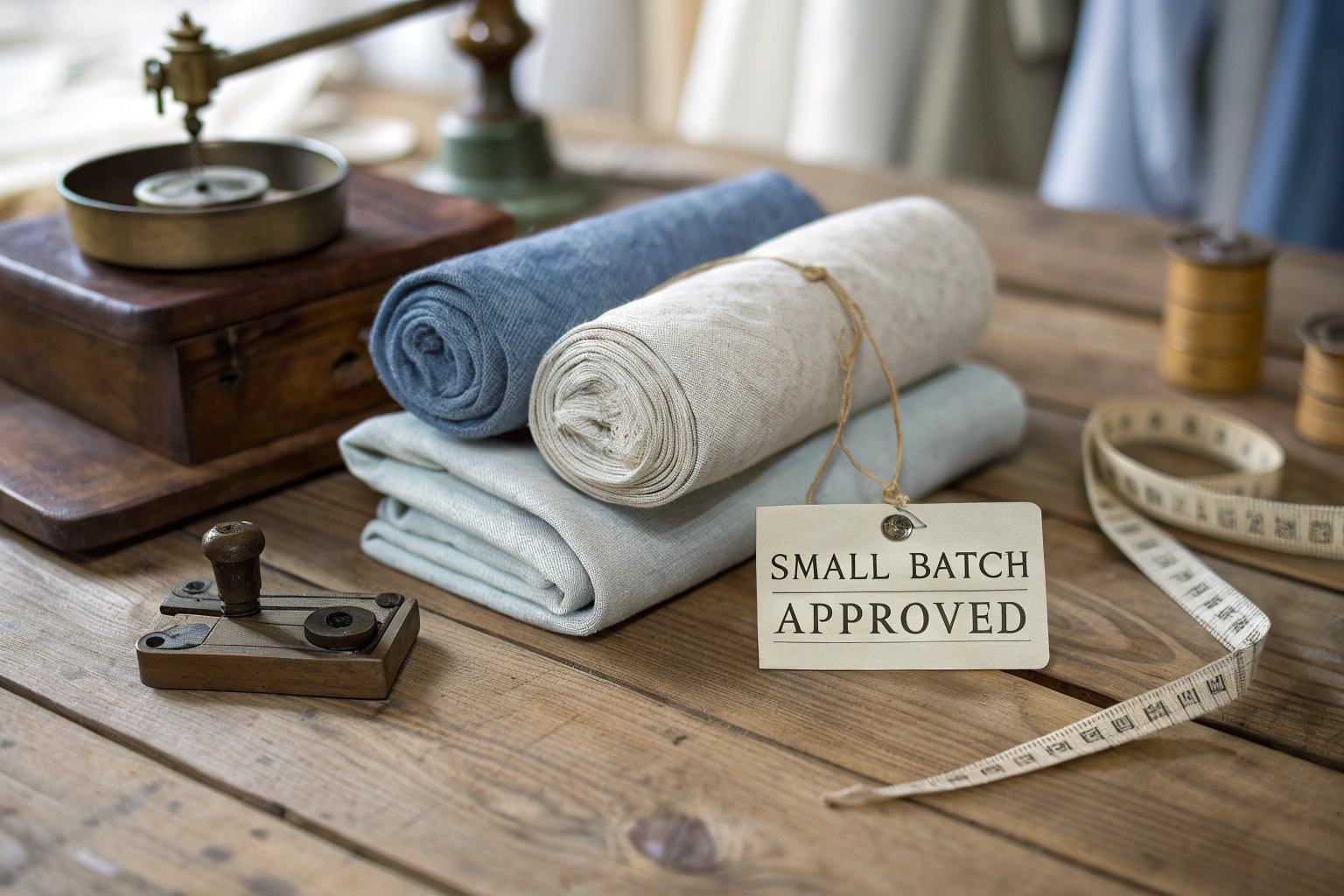
Let me kill the biggest lie in wholesale fabric right now: "We have no minimum." I hear this all the time on Alibaba and at trade shows, usually from a trading company that has never owned a loom. They say "no MOQ" and then send you a dusty deadstock roll from 2022, or they quote you a price per meter that is five times the market rate. The real frustration for a small brand or a start-up designer isn’t finding a supplier; it’s finding a real manufacturer who will weave specifically for you without forcing you to buy a container load that you’ll spend two years trying to liquidate. You need 150 meters of a specific custom texture, not 5,000 meters of a generic plain weave.
At Shanghai Fumao, our Minimum Order Quantity (MOQ) for "good" cotton and linen is not a single fixed number; it is a sliding scale based on whether the fabric is stock (open-line) or custom-developed. For our existing in-stock cotton-linen blends—the fabrics we already have sitting in our greige warehouse ready to dye—the MOQ is 300 meters per color. This is low because the base greige has already been woven in bulk, and we only need to configure our small jig dyeing machines for your specific shade. For a fully custom development, where we spin a specific trial yarn, build a sample warp, and tune the finishing chemistry just for you, our technical MOQ is 200 meters. We can hit this because we built a dedicated "mini-mill" line inside our factory, using a sectional warping machine designed specifically for short runs. It’s not a marketing gimmick; it’s a hardware investment.
But let me be straight with you: the MOQ isn’t arbitrary. It’s dictated by the physics of wet processing and the mechanics of the loom. If you understand the "why" behind the number, you can engineer your project to fit perfectly within it. Let me walk you through the exact math of the dye vat and the warp beam, and show you how even a micro-brand can access the same premium fibers as the big houses.
How Does MOQ Differ Between Stock Fabrics and Custom Developments?
This is the fundamental fork in the road for any buyer. Stock fabrics are off-the-shelf. The risk and the setup cost have already been absorbed by us. We hold a "greige bank" of our top-selling cotton-linen constructions, like our 185 GSM twill and our 150 GSM plain weave. When you order from stock, you’re essentially paying for the dyeing, finishing, and inspection of a pre-woven roll. The MOQ drops because we don’t need to interrupt our mass production looms. Custom developments are the opposite. You are asking us to stop a loom, change the warp beam, dial in a new weft density, and possibly spin a new yarn batch. That setup time is the same whether we produce 5 meters or 5,000 meters. Therefore, the custom MOQ exists to cover the cost of that machine downtime and the technical man-hours. We don’t make margin on a custom 50-meter run; we actually lose money on the weaving setup. But we value the innovation partnership, so we subsidize the custom R&D for promising long-term collaborations.

What Are the Price Breaks for Stock Cotton-Linen Blends?
Volume dictates the dyeing cost allocation. For a standard stock quality like our 55% Linen / 45% Organic Cotton canvas (210 GSM), the base greige price is fixed, but the processing cost per meter drops sharply as the dye lot size increases. Here is a realistic tier breakdown for a piece-dyed solid color:
- Tier 1 (Sample/Strike-off): 10 meters. This is a "lab dip length." It’s expensive per meter (often a flat sampling fee of $50-$80 plus courier) because the dye machine has to be run at a minimum bath ratio just to drown the small fabric roll, wasting most of the water and chemical energy.
- Tier 2 (Small Batch – 300 meters): This is our standard MOQ for stock. The dye lot fits perfectly into our 100-kg capacity mini-jigger. The per-meter price is competitive for boutique production. You aren’t covering any fixed loom costs, just the dye stuff and labor.
- Tier 3 (Bulk Run – 1,500 meters+): At this volume, we move the dyeing to our large-scale continuous dyeing range, which cuts the dye stuff and energy cost by roughly 18-22% compared to the mini-jigger. The price per meter drops noticeably. If your brand can forecast a core color for the season, hitting this tier is the sweet spot for margin maximization.
What Is the Technical Reason Behind the 200-Meter Custom Limit?
The bottleneck is the warp beam. A weaving loom needs a warp—the vertical threads that run the length of the cloth. To make a warp, you need to wind thousands of individual yarn ends onto a beam, perfectly parallel, under uniform tension. On our high-speed production looms, the standard warp length is 1,200 meters. That’s too long for a custom trial. So, for custom projects, we use a "Benninger sectional warping machine." This machine divides the warp into small vertical sections ("cheeses"), allowing us to build a very short warp of just 200 meters. However, even this has a waste factor. The "loom waste" (the yarn left on the beam that can’t be woven because the shed geometry collapses) is about 3-5 meters, regardless of the warp length. On a 1,200-meter warp, 5 meters of waste is negligible. On a 200-meter warp, 5 meters is 2.5% of your total order wasted. If the warp were any shorter, the waste percentage would make the fabric economically unsustainable. Two hundred meters is the mathematical balance point where the waste ratio is still commercially acceptable for a premium product. It’s the hardware, not the sales policy, that sets the floor.
How Can Small Designers Negotiate Lower Trial Run Quantities?
Money talks, but "partnership continuity" talks louder. If you are a small designer and 200 meters still feels heavy, you don’t negotiate the meter length; you negotiate the "sampling pathway." We structure a "Stepped Development Agreement." This means you don’t jump straight to a bulk MOQ. You commit to a three-stage roadmap: (1) a paid lab dip and 5-meter strike-off today, (2) a 50-meter pre-production "sealing sample" run in 4 weeks, and (3) a 200-meter bulk order in 8 weeks. We waive the initial bulk MOQ pressure because you’ve signed a commitment letter for the bulk phase, and you’ve paid for the lab work. This gives you time to sell the fabric to your own wholesale buyers (pre-order model) before you have to pay for the 200 meters. It bridges the cash flow gap. We also offer "piggybacking." If we are running a specific yarn for another brand, we can tack on your 50 meters of a unique color to the end of their warp, provided the base weave structure is identical.

Can You "Piggyback" on an Existing Bulk Order?
Yes, with a hard technical constraint: the weave must be identical, and the finish must be roughly similar. If we are warping up a 10,000-meter beam of our standard 45/55 cotton-linen plain weave for a large European chain, we can technically extend the weft run. We can run your specific custom color (say, a very specific terracotta) using their warp. You get the structural integrity and the yarn quality of the mass production run, but you only pay for the weft yarn consumed and the specific dye vat for your 100-meter cut. This drops the price closer to "stock" levels for a "custom" color. However, this only works if the base fabric is a standard construction. If your fabric needs a specific slubby high-twist weft that the main bulk order doesn’t use, you can’t piggyback; you have to wait for the loom to be re-threaded. The weaving shed manager controls the "creel matrix"—the wall of yarn cones feeding the loom. Mixing weft yarns within the same warp beam takes 15 minutes of changeover time, which is feasible. Mixing warp yarns takes 8 hours of re-drawing the loom, which is not feasible for a small run. Piggybacking on the weft side is fast; piggybacking on the warp side requires a full custom order. This is standard knowledge when exploring how small brands can utilize excess warp capacity in weaving mills to lower custom fabric minimums.
What Is the "Wash-and-Wear" Sample Program for New Clients?
Before you risk any bulk order, you should test the fabric’s long-term behavior. We offer a "Wash-and-Wear Kit" specifically for first-time clients who are nervous. For a nominal fee of $30 (shipping included), we send you a 30cm x 30cm swatch of our top three cotton-linen bases. But we don’t just send them pristine and flat. We send them "pre-tortured." The kit contains the "Factory Fresh" swatch, plus an identical swatch that we have machine-washed and tumble-dried five times in our lab following AATCC standards. You see the fabric not just as it leaves the mill, but as it will look after a month of actual wear. You see the "bloom" of the linen fibers, the slight softening of the hand, and the zero-pilling surface. Seeing the "aged" swatch removes the fear. It proves we aren’t hiding a cheap finish that will wash out. It’s a tactile guarantee.
What Are the Shipping and Logistics Considerations for Small Orders?
A 200-meter roll of cotton-linen (58 inches wide) is heavy, roughly 35-45 kilos depending on the GSM. For a small order, shipping a single roll via sea freight (LCL – Less than Container Load) is often a false economy. The port handling charges, the documentation fees, and the customs brokerage are fixed costs that apply whether you ship 1 roll or 100 rolls. For a single roll, these fixed costs can add $2.00 per meter to your landed cost, killing your margin. For orders under 100 kilos, we strongly recommend "express air consolidation" using our FedEx or DHL trade accounts. We use a specific "half-width fold" (the fabric roll folded once lengthwise) to shrink the volumetric weight, which is the real killer on air freight. It sounds counterintuitive to pay air freight on a cheap commodity, but it’s often cheaper than the hidden fees of LCL for a tiny shipment. Plus, it arrives in 5 days instead of 35.

How Does "Half-Width Rolling" Cut Air Freight Costs by 30%?
Air freight isn’t charged on actual weight; it’s charged on "chargeable weight," which is the higher of the actual kilos and the volumetric kilos (calculated as Length x Width x Height in cm divided by 5000). A standard full-width roll of fabric is a long cylinder: 150cm long, 20cm diameter. Its volume is roughly 0.047 cubic meters, giving a volumetric weight of 9.4 kg. But the actual weight is only 8 kg. You pay for 9.4 kg. If we split that fabric in half and fold it lengthwise before rolling, the package dimensions change to a shorter, fatter cylinder: 75cm long, 28cm diameter. The volume drops to 0.046 cubic meters, but the smaller length often allows it to fit into a smaller "oversize" bracket on the conveyor belt, avoiding a manual handling surcharge. Additionally, "half-width rolling" prevents the roll from snapping in half during the rough air freight sorting process. A long, skinny tube acts like a lever; a short, wide cylinder is structurally rigid. This technique saves an average of 25-35% on the final freight bill, which is pure margin saved for a start-up.
Why Is "LCL Sea Freight" a Hidden Cost Trap for Small Brands?
The $100 ocean freight quote you see online is the base rate. It doesn’t include the "destination terminal handling charges" (THC), the "documentation fee" ($45-$65), the "customs clearance fee" ($55-$85), the "single entry bond" ($50 minimum), and the "trucking" from port to your doorstep. For a single roll, these fees can easily total $400-$600, while the ocean freight itself is $100. We provide a "Landed Cost Simulator" spreadsheet before you ship. It breaks down every single fee line by line based on your local ZIP code and the current carrier tariffs. I’ve seen a start-up from Brooklyn try to save $50 by switching from our recommended air express to LCL sea freight. The ocean leg was $75 cheaper, but the destination fees at the New Jersey port were $350 more, and the roll got stolen by a pilferer at the container freight station because it was a loose carton. The cheap freight turned into a total loss. We advise small brands on freight strategy based on total landed cost, not just the ocean invoice. The complexity is similar to understanding the true total landed cost calculation for Less than Container Load shipments of textiles.
How Does Fumao Support Sampling and Prototyping Before Bulk Orders?
Sampling is the dress rehearsal for the fabric. We separate the "aesthetic sample" from the "bulk sealing sample." An aesthetic sample is a 5-meter cut we send for you to drape, photograph, and show your buyers. It doesn’t need to be from the exact bulk dye lot. But a "bulk sealing sample" is a 20-meter cut that we pull specifically from the actual production lot. We run this mini-batch first, you sign off on it, and we physically bolt that signed swatch to the master production file. No change is allowed after that. This two-tier system prevents the tragedy of a designer approving a lab dip that looks perfect, but rejecting the 1,000-meter bulk because the hand feel changed by 2%. By pulling a 20-meter pre-production run on the exact bulk machine (not the lab machine), we surface the scale-up errors while the batch is still small enough to correct.

What Is the Difference Between a "Lab Dip" and a "Strike-Off"?
These terms are the Rosetta Stone of fabric development. A "lab dip" is a small tuft of raw cotton (like a cotton ball) dyed in a beaker to match your Pantone color. It proves the chemistry works. But a dyed cotton ball looks completely different from a woven fabric surface, because a woven fabric has shadows from the interlacing yarns. A "strike-off" is the next step: we take a piece of actual greige fabric (about 2-3 meters) and run it through the pad-steam range to hit your exact color. The strike-off shows you the final optical effect. The color in a lab dip often looks 20% darker than the color on a woven strike-off because of light scattering. Designers who sign off on lab dips alone inevitably face a "color too dark" shock on the bulk fabric. We mandate a strike-off approval before we will accept a bulk color PO. The cost is usually $50-$80, credited back against the bulk order.
How Can a "Virtual Showroom" Help Visualize the Fabric Hand Feel?
You can’t touch a screen, yet. But you can see the physics of the drape if we film it correctly. When we ship a physical swatch, we simultaneously upload a "Hand Feel Video" to your private portal. It’s a 30-second clip with no music, no slow motion, just a hand squeezing the fabric rapidly (to show wrinkle recovery) and draping it over a convex curve. We film it in 4K 60fps so you can see the micro-movements of the surface fibers. We also post a "scratch test audio file"—yes, sound—where we rub the fabric near a sensitive microphone. Linen has a distinct "whispery, sandy" scratch sound; cheap blends with too much softener sound "sticky" and silent. This multimodal approach closes the sensory gap. You can’t smell the flax, but you can see the spring-back and hear the texture. It’s the closest thing to being in the Keqiao showroom while sitting in your studio in Austin.
Conclusion
The MOQ for premium cotton-linen at Shanghai Fumao isn’t a wall; it’s a gate. And we’ve installed a smaller gate right next to it for the smart, the agile, and the start-ups. At 300 meters for stock colors and 200 meters for custom warp developments, we’ve set the bar at the precise point where the dye vat efficiency meets the sectional warper’s physics. We bridge the gap from a 5-meter aesthetic strike-off to a 50-meter pre-production seal with piggybacking, stepped commitments, and a Wash-and-Wear sample program that lets you age the fabric before you buy the bolt.
Small brands aren’t a nuisance to us; they are the R&D lab for the next big trend. We’ve sunk capital into the mini-jig dye vats and the half-width rolling machines specifically to serve the designer who needs 350 meters of a dusty rose cotton-linen for a limited drop, not 3,500 meters of generic black. That’s the future of fashion: faster, smaller, smarter. We just made it economically possible.
Ready to test your concept without the bulk stress? Send your spec requirements and target FOB to our Business Director, Elaine, at elaine@fumaoclothing.com. She’ll send you the exact MOQ tier for your project, the current stock greige availability list, and a physical "Wash-and-Wear Kit" so you can feel the 5-wash patina before you commit a single dollar to production.








