
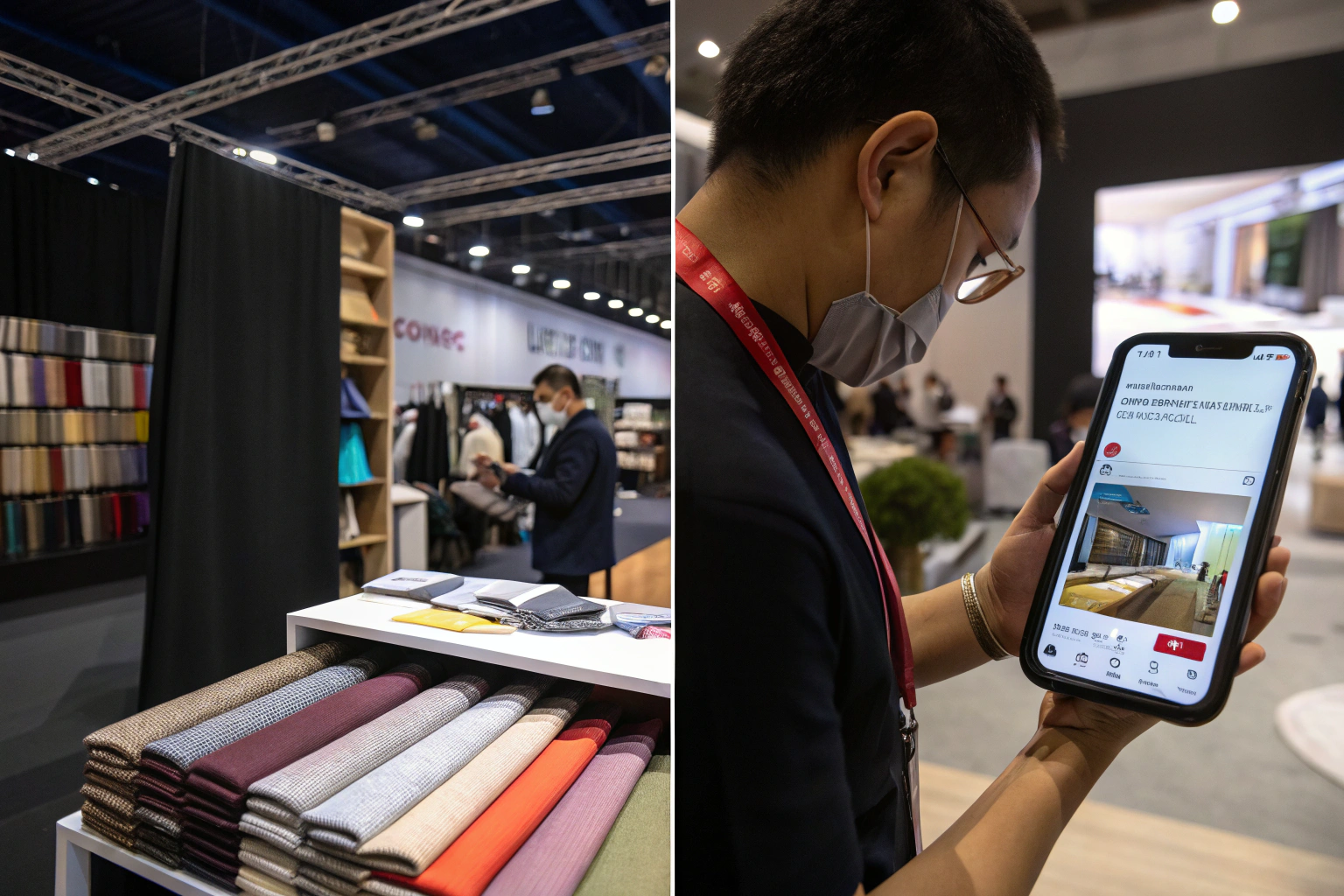
A buyer for a Los Angeles streetwear brand scrolls TikTok at midnight. They’re not looking for dance challenges. They’re watching a live stream from inside a dye house in Keqiao. A technician holds a lab dip up to a D65 light box, compares it to a Pantone chip, and answers questions from viewers in real time. The buyer types: "Can you do that exact color on a 320gsm French terry?" The host reads the question aloud, walks to the fabric shelf, pulls a roll of greige terry, and shows the weight label to the camera. Three days later, a sample is in FedEx. No Alibaba RFQ. No trade show badge. No sourcing agent. Just a TikTok live stream, a direct message, and a sample shipment. This is not the future. This is happening right now, and it’s fundamentally rewriting how professional fabric buyers discover, vet, and engage with overseas mills.
The trade show floor and the B2B platform search bar are losing their monopoly on supplier discovery. TikTok and Instagram have built the infrastructure for live, visual, personality-driven industrial content that bypasses the polished corporate brochure and goes straight to the production floor. The algorithm doesn’t care whether you’re watching a makeup tutorial or a fabric finishing process—it cares about watch time, engagement, and relevance. For a textile mill, that means a 60-second video of a jacquard loom in operation, shot on a smartphone with factory-floor audio, can reach more qualified buyers in a week than a $15,000 trade show booth reaches in three days. In this article, I’ll break down exactly how this shift is happening, why it advantages certain types of mills and disadvantages others, and how Shanghai Fumao is building a B2B social presence that prioritizes technical transparency over polished marketing. The sourcing game is changing. Let’s look at the new rules.
Why Are Textile Mills Using TikTok Live to Attract Wholesale Buyers?
A TikTok live stream from a factory floor does something that a product listing page can never do: it proves physical existence. When a mill goes live from their weaving shed at 3:00 PM Keqiao time, and you watch rapier looms running in real time with the characteristic rhythm of weft insertion, you are witnessing a fact that no photoshopped Alibaba storefront can fabricate. The machines are real. The production is active. The person holding the phone knows their way around the floor. The transparency is the marketing.
This matters enormously in an industry plagued by trading companies pretending to be factories. A live stream eliminates the "virtual tour" PDF and replaces it with an unscripted, real-time walkthrough that a viewer can interact with. Buyers can ask: "Show me the dyeing workshop." "Zoom in on that yarn cone label." "What’s the humidity reading on that wall monitor?" The host either complies immediately—proving they’re in the facility—or deflects, which tells the buyer everything they need to know. Our mill started live-streaming on TikTok in late 2024, initially as an experiment by our marketing team. The first stream was a 45-minute walkthrough of our finishing department showing the compacting machine in operation. We expected maybe 20 viewers. Over 800 unique accounts tuned in. A dozen took the conversation to DM. Two converted to trial orders within the month. The TikTok live commerce growth statistics for B2B industrial categories and manufacturing content shows that industrial live streams are the fastest-growing content category on the platform that most textile executives don’t even know exists.

How Does Factory-Floor Content Outperform Traditional B2B Marketing?
Traditional B2B textile marketing is a polished brochure showing a fabric swatch flat-laid under perfect lighting with a brief specification list. It’s static, impersonal, and indistinguishable from every other mill’s brochure. The buyer cannot tell whether the fabric was produced in a world-class facility with statistical process control or a makeshift workshop with zero quality infrastructure. The marketing materials from both look the same. Factory-floor content breaks this visual parity. A video showing a Martindale pilling tester running in a CNAS-accredited lab, with the technician explaining the ISO 12945-2 standard in English while the machine operates, communicates technical competence in a way that a static certificate PDF cannot.
The key performance advantage of factory-floor content is that it’s verifiable. A mill can claim they have "advanced quality control." A video showing the spectrophotometer reading a lab dip, displaying the Delta E CMC value on the screen, with the operator explaining what a 0.8 Delta E means for batch consistency—that’s not a claim. That’s evidence. A mill can claim they use "high-twist yarns for anti-pilling." A macro video showing the yarn twist tester counting turns per meter, with the actual TPM number visible, is verifiable proof. The buyer doesn’t need to trust the marketing copy; they can see the instrumentation. We’ve found that our TikTok videos showing specific test procedures—crocking tests, Martindale rubs, light fastness chamber pulls—generate far more qualified inbound inquiries than our polished product photography ever did on Alibaba. Buyers who reach out after watching a lab video ask technical questions: "Can you guarantee Grade 4 at 2000 rubs on that modal?" Buyers who reach out from a static listing ask price questions: "What’s your best price for modal fabric?" The technical buyer is more likely to convert to a long-term partnership. The B2B industrial content engagement comparison between static product listings and live process demonstration video on social platforms confirms that process-transparency content filters for higher-intent, more knowledgeable buyers.
What Types of Textile Processes Attract the Most Buyer Engagement?
Not all factory content is equal. A static shot of a sewing machine hemming a curtain generates little interest. But certain textile processes are inherently high-engagement because they’re visually dramatic, technically interesting, and difficult to fake. The processes that attract the most viewer retention and the most conversion to DM inquiries in our experience are, in order: yarn dyeing and color matching (watching a lab technician formulate a dye recipe and pull a lab dip from a beaker dyeing machine is mesmerizing and proves color competence), fabric strength testing (a universal testing machine stretching a fabric strip until it breaks, with the Newton force curve displayed on the monitor, communicates durability better than any spec sheet), water repellency spray tests (water beading and rolling off a finished fabric surface is visually satisfying and directly demonstrates a functional finish), and high-speed weaving or knitting (rapier looms operating at 700 RPM or circular knitting machines producing fabric at visible speed convey production capacity instantly).
These processes share a common characteristic: the viewer can see the quality outcome in real time. They don’t need to read a test report; they watched the test happen. The water beaded and rolled. The fabric stretched and didn’t tear. The lab dip matched the standard under D65. The visual evidence bypasses the buyer’s skepticism because it wasn’t edited, staged, or filtered—it was a live process with a measurable outcome. A high-engagement industrial process video content analysis for manufacturing brands on short-form video platforms identifies live testing demonstrations as the single highest-converting content type for B2B manufacturing accounts.
Can Instagram Reels Replace the Traditional Fabric Trade Show?
The trade show circuit—Première Vision, Texworld, Intertextile—still has value. A buyer can touch a thousand fabrics in a day. That sensory density is impossible to replicate digitally. But the cost of attending a trade show, both for the exhibitor and the buyer, has become extraordinarily high relative to the qualified leads it generates. A mid-size mill might spend $20,000 to $40,000 on booth space, travel, sample production, and shipping for a single three-day show. They’ll collect 150 business cards, of which perhaps 15 are genuinely qualified leads, of which perhaps 3 convert to orders within the year. The cost per qualified lead is staggering.
Instagram Reels, combined with a well-managed DM response system, can generate a comparable volume of qualified leads at a fraction of the cost. A Reel showing a 30-second macro video of a new fabric—the hand feel compression, the drape over a curved form, the recovery snap after stretching—with a caption that includes the fiber content, weight, MOQ, and a "DM for sample" call to action, can reach 10,000 targeted viewers in a week through hashtag optimization and algorithmic distribution. The viewers who DM are pre-qualified: they saw the fabric in motion, they read the specs, they made the effort to inquire. The conversion rate from DM to sample request is significantly higher than the conversion rate from trade-show-brochure-collector to email-respondent because the social media inquiry is active and specific, while the trade show inquiry is often passive and generic. Our mill’s Instagram account now generates more qualified sample requests per month than our last two trade show appearances combined, at roughly 3% of the cost. The trade show lead generation cost per qualified lead comparison with social media video content for textile and apparel B2B marketing suggests the traditional show model is shifting from primary discovery channel to relationship-maintenance channel.

How Do Buyers Use Instagram to Vet a Factory Before Sending a Deposit?
A buyer receives a DM response from a mill. The price is good, the sample is en route. Before they wire a deposit, they open the mill’s Instagram profile and scroll through the grid and the Reels. They’re looking for consistency, not just aesthetics. Does the factory show up regularly, or are there three posts from last year and nothing since? An active, frequently updated account with real-time story content is a signal of an operational, engaged business. A dormant account with a few polished brochure shots is a signal that the mill doesn’t take its digital presence seriously—or that it’s a trading company with no factory floor to film.
The buyer looks for specific verification content. They swipe through Reels looking for footage of the production floor, the quality lab, the warehouse, the packing area. They check if the same people appear across multiple videos—a consistent team with recognizable faces builds trust. They check if the videos show the same factory layout and equipment across different days and angles, which would be difficult to fake across dozens of posts. They check the comments: do other buyers ask technical questions, and does the mill respond knowledgeably? A comment thread where a buyer asks "What’s the shrinkage on this after 3 washes?" and the mill replies "Tested at 2.1% warp, 1.8% weft per AATCC 135, DM for the full report" is a powerful trust signal visible to every prospective buyer scrolling the profile. The social media profile analysis techniques for verifying manufacturing supplier legitimacy in B2B sourcing documents this emerging buyer behavior pattern in detail.
What Content Formats on Instagram Drive the Most Sample Requests?
Short-form video under 60 seconds consistently outperforms static images and carousel posts for sample request conversion, but the content type within that video format matters more than the length. Based on our internal Instagram analytics, the top-performing content formats for generating DM sample requests are: the "macro hand-feel" video (15 to 30 seconds of fabric being scrunched, stretched, draped, and recovery-tested by hand, with a gloved hand and neutral background, showing the fabric’s physical behavior), the "lab test live" video (a 45 to 60-second cut of a specific test being performed—crocking, pilling, tear strength—with the result shown on the instrument display), the "production walkthrough" video (a 30-second continuous shot walking through a production department, no cuts, no edits, showing the scale and organization of the facility), and the "dye lot check" video (a lab technician checking a bulk dye lot against the approved lab dip standard under a D65 light box, showing the match to the camera).
These formats share a common DNA: they are low-production-value, high-information-density, technically specific, and unpolished. They communicate what a polished brochure hides—the actual physical and procedural reality of the fabric. A buyer watching a macro video of a fabric being twisted and released can assess hand feel, recovery, and drape almost as if they were in the showroom. A buyer watching a crocking test live can verify the color fastness claim before they request the report. The format strips away the marketing layer and delivers the technical substance directly. The B2B Instagram content format performance data for industrial product sample generation and lead quality shows that "behind-the-scenes" and "process" content generates higher engagement rates than polished product photography across manufacturing categories.
How Is the "Live Inspection" Trend Changing Sample Approval Times?
The traditional sample approval process is a physical logistics chain. The mill produces a lab dip or a strike-off. The sample is couriered to the buyer—three to five days internationally. The buyer reviews it, emails comments, and the process repeats. Two to three rounds of physical sampling can consume four to six weeks before bulk production even begins. For a brand operating on a fast-fashion calendar, that timeline is unworkable. The "live inspection" trend collapses that physical logistics chain into a real-time video call. The buyer and the mill’s QC technician agree on a time. The technician sets up a D65 light box, positions the lab dip and the buyer’s original standard side by side, and initiates a WhatsApp or WeChat video call. The buyer views the shade comparison on their screen in real time, asks the technician to rotate the samples, check under different angles, and take a spectrophotometer reading. The buyer approves or rejects the shade on the spot. The physical sample still ships for record-keeping, but the approval happens in minutes, not days.
We’ve adopted this process as a standard offering for our direct-partnership clients. The time saving is dramatic—a color approval process that previously took two weeks per round now takes one day. The communication quality is higher because the buyer and the technician can discuss the shade in real time, pointing to specific areas of the sample that need adjustment, rather than sending annotated photos with uncalibrated color rendering across different screens. The live video inspection adoption rates for remote quality control and sample approval in textile manufacturing supply chains indicates that live approval processes are expanding from color assessment to defect inspection, hand feel evaluation, and even packing verification before container loading.

What Equipment Does a Factory Need for Credible Live Inspection?
The credibility of a live inspection depends entirely on the quality of the visual data the buyer receives. A blurry, poorly lit video call where the sample is held under a warm office ceiling light is worse than no call at all—it creates false confidence based on bad data. The minimum equipment standard for a credible live inspection setup, and the standard we’ve invested in at Shanghai Fumao, includes: a D65 daylight simulation light booth (the same standard used for visual color assessment in ISO 3668, ensuring the light spectrum is standardized and repeatable), a calibrated spectrophotometer positioned adjacent to the light booth (so the technician can take a Delta E reading and show the numerical value on camera during the call), a high-resolution camera or smartphone with manual white balance lock (to prevent the camera from auto-adjusting color temperature and distorting the buyer’s perception of the shade), and a stable tripod or overhead mount (to eliminate hand-shake and keep the sample in consistent framing throughout the call).
Without these four elements, the live inspection is a conversation, not a quality control event. The buyer cannot make an objective approval decision based on uncalibrated visual data. We provide a pre-call checklist to clients that specifies the equipment setup and requests that the client also view the call on a color-calibrated screen if possible. The realism about screen calibration limitations is important—a buyer’s uncalibrated phone screen will not render color perfectly. But the combination of D65 lighting, spectrophotometer data, and real-time discussion still produces a far more reliable approval decision than a five-day courier delay and a photo email chain. The D65 standard lighting and spectrophotometer calibration requirements for remote textile color approval video inspection covers the technical infrastructure requirements that separate credible remote inspection from guesswork.
How Does Live Approval Change the Legal and Payment Risk?
When a buyer approves a shade via live video call, the approval is a verbal instruction followed by a written confirmation—typically an email or WhatsApp message sent immediately after the call stating "Color approved per live inspection on [date/time]. Please proceed with bulk dyeing." This written confirmation carries the same contractual weight as a physically signed lab dip submission form. The legal risk for the buyer is that the shade, as perceived on their screen, might differ slightly from the physical fabric when it arrives. The legal risk is mitigated by the spectrophotometer data displayed during the call. If the Delta E CMC reading is below 1.0 and the buyer approves, the approval is defensible even if the physical shade looks marginally different under the buyer’s specific showroom lighting. The numerical data anchors the visual decision.
The payment risk is actually reduced by live approval. In the traditional process, a sample is shipped, the buyer sits on it for a week before opening it, the response is delayed, and the production schedule slips. The delay creates a crunch at the end of the production calendar, and rushed production creates quality risk. The live approval compresses the timeline, which allows the dyeing to start earlier, which allows more time for finishing and QC, which reduces the probability of defects. The faster approval doesn’t just save time—it improves quality by removing the scheduling pressure at the back end of the process. Buyers who are concerned about the legal validity of a live approval can include a clause in their purchase contract explicitly recognizing "live video inspection and approval via mutually agreed communication platform" as a valid approval method. The legal validity of remote visual inspection and digital approval in textile supply chain contracts provides model language for this contractual recognition.
Will Social Media Sourcing Replace the Sourcing Agent Role?
The traditional sourcing agent performs three functions: discovery (finding factories that can make a specific fabric), verification (confirming those factories are legitimate and capable), and translation (bridging the language and cultural gap between buyer and factory). Social media platforms are now performing the first two functions algorithmically, and AI translation tools are rapidly handling the third. When a buyer can search TikTok for "cotton twill dyeing factory Keqiao" and watch a dozen real-time factory walkthroughs, the agent’s discovery function is largely replaced. When the buyer can scroll through a factory’s Instagram history and see two years of consistent production-floor content, customer comments, and lab test videos, the agent’s verification function is partially replaced by the factory’s own transparent documentation.
This doesn’t mean the sourcing agent role disappears. It means the agent’s value proposition shifts from information asymmetry (I know factories you don’t) to process management (I manage the production timeline, quality control, and logistics so you don’t have to). The agent who survives the social media transformation is the one who adds operational value beyond introduction. The agent who simply provides a list of supplier contacts and takes a commission is competing with a TikTok search bar—and the search bar is free, faster, and gives the buyer direct contact with the factory. We see this in our inbound inquiries: buyers who found us through social media almost never have a sourcing agent intermediating the relationship. They contact us directly, negotiate directly, and manage the production directly because the platform already provided the verification that an agent would traditionally offer. The disintermediation trends in textile sourcing and the impact of direct social media factory discovery on traditional sourcing agent business models explores how the agent role is evolving from gatekeeper to value-added service provider.

How Do AI Translation Tools Remove the Language Barrier in Direct Sourcing?
A buyer from Turkey messages our TikTok account in Turkish. We read the message in Chinese via WeChat’s built-in translation. We reply in Chinese, and the buyer reads it in Turkish. The conversation continues across three languages, instantly, with functional accuracy that enables commercial negotiation. The technology is not flawless—nuance about hand feel descriptors or dye shade terminology can get garbled—but it’s good enough for a buyer and a factory sales rep to exchange specifications, negotiate MOQs, and confirm pricing without a human translator.
The availability of real-time translation inside the messaging platforms where buyer-factory communication already happens—WeChat, WhatsApp, Instagram DMs, TikTok DMs—removes the language barrier that previously made a bilingual sourcing agent essential for cross-border textile trade. The translation layer is automatic and invisible. A factory’s sales team that speaks only Mandarin can communicate with buyers in English, Spanish, Turkish, and Portuguese simultaneously, through the same DM interface. Our sales team handles inquiries in seven languages daily without a single human translator, using the translation tools embedded in our communication platforms. The real-time AI translation tool adoption in B2B cross-border trade communication and its effect on reducing intermediary dependency documents how this technology is reshaping direct trade.
What Value Does a Sourcing Agent Still Provide in a Social-Media-Driven Market?
The agent who remains relevant is the one who provides physical presence, technical inspection, and production management. A TikTok video can prove a factory exists and produces fabric. It cannot ensure that your specific order, your lot number, your 2,000 meters of navy twill, is running on time and meeting your quality standards. That requires a person physically present at the factory, checking your production, inspecting your fabric, and reporting back to you. Some agents have repositioned themselves as "production managers for hire"—they handle the on-the-ground supervision for brands that source direct but don’t have their own China-based QC staff.
The agent also provides consolidation logistics for small brands. If a brand sources fabric from three different mills—woven from Mill A, knit from Mill B, trims from Mill C—an agent can consolidate those shipments into one container at their warehouse, manage the export documentation, and ship a single consolidated load. A direct factory relationship doesn’t solve the multi-supplier logistics problem. The agent who combines factory-direct discovery (the brand finds the mills themselves on social media) with value-added logistics and QC (the agent manages the consolidation and inspection) is the evolution of the role, not the extinction. The evolving textile sourcing agent value proposition and service model adaptation in response to direct factory digital discovery describes this transition from commission-based introduction to fee-based production management services.
Conclusion
The future of B2B fabric sourcing is not a single platform, a single technology, or a single trend. It’s a structural shift from opaque, intermediated, document-based trust to transparent, direct, visual trust. TikTok live streams and Instagram Reels are not replacing the technical requirements of fabric sourcing—you still need to verify certifications, inspect quality, and negotiate contracts. But they are replacing the discovery and initial vetting stages that previously required trade shows, agent networks, or blind Alibaba searches. A buyer can now watch a mill’s daily operations for weeks before making contact. They can assess the equipment, the quality culture, the team stability, and the technical competence through a body of content that the mill builds over time. The decision to engage is informed by months of observational data, not a single sales meeting.
This shift rewards mills that invest in transparency and punishes mills that hide behind polished marketing and opaque intermediation. At Shanghai Fumao, we’ve chosen to show our production floor, our testing lab, our dyeing processes, and our QC procedures publicly and frequently. We do live streams from the factory. We post lab test videos. We answer technical questions in comments. We do this not because it’s trendy, but because it works. The buyers who reach out after watching our content are more informed, more technical, and more likely to become long-term partners than any other inquiry channel we’ve ever used.
If you’re a brand, a designer, or a sourcing manager who’s curious about what direct factory transparency actually looks like in practice, I invite you to follow our social channels and see for yourself. Watch the content. Ask questions in the comments. Request a live video walkthrough of the production floor. If you like what you see and you’re ready to move from observation to procurement, reach out to our Business Director, Elaine, at elaine@fumaofabric.com. She can set up a live inspection call, arrange sample dispatch, and begin a sourcing relationship that’s built on visual evidence, not just promises. The future of fabric sourcing is direct, visual, and verifiable. We’re already there. Come see for yourself.








