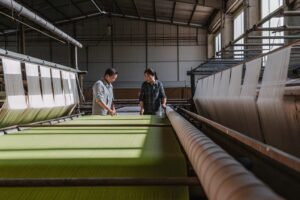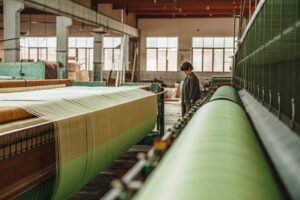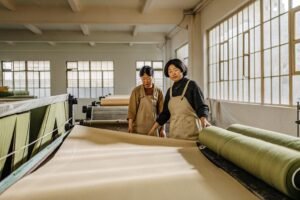
When you’re sourcing fabric for a new collection, few things kill a brand’s reputation faster than a garment that fades like a cheap souvenir t-shirt after just three washes. You spend months perfecting the fit, you nail the marketing, and then the returns start rolling in because the color bled or the surface looks washed out. It’s frustrating. It’s expensive. And nine times out of ten, it boils down to a fundamental misunderstanding at the sourcing stage: You picked piece-dyed fabric when the design absolutely demanded yarn-dyed construction. At Shanghai Fumao , we see this mix-up cost buyers thousands in lost inventory every season. Understanding this one distinction isn’t just textile trivia; it’s the difference between a premium garment that ages with character and a discount-bin item that falls apart.
The core difference is simple: Yarn-dyed fabrics have the color locked inside the threads before weaving or knitting, while piece-dyed fabrics get their color after the fabric roll has been constructed. Think of it like a salad versus a soup. In a salad, you see distinct green lettuce, red tomatoes, and orange carrots—they maintain their individual identity (Yarn-Dyed). In a soup, you throw everything in a pot and it all turns the same color (Piece-Dyed). Yarn-dyed means colorfastness and pattern clarity. Piece-dyed means flexibility and lower upfront cost. If you need a pair of jeans that reveals a white core when you sand it down, you cannot achieve that look with piece-dyed goods. You need yarn-dyed denim.
That’s the textbook answer. But if you’re here, you probably already know the basic definition. What you really need to know is when to pay the premium for yarn-dyed, how to spot a factory cutting corners with cheap piece-dye substitutes, and why that plaid shirt on Alibaba looks great in the photo but arrives looking like it was printed on paper. Stick with me. I’m going to walk you through the supply chain realities, the cost implications, and some insider tricks we use at our Keqiao facility to help global brands avoid these expensive mistakes. Let’s dive into the weave room.
How to Identify Yarn-Dyed Fabric vs. Piece-Dyed Fabric
I can’t count the number of times a client has sent me a photo of a "plaid" that turned out to be a print. They swear up and down it looked woven in the picture. Look, I get it. Lighting on e-commerce sites can be deceptive. But if you’re ordering from an overseas factory and you don’t know how to verify the construction, you’re gambling with your money. Here’s the dead giveaway: Look at the back of the fabric.

Does Fabric Reverse Side Reveal True Dye Method?
If you’re holding a swatch right now, turn it over. Flip that seam allowance inside out. This is the single most reliable test you can do without a lab. With a yarn-dyed fabric, the pattern penetrates the entire structure. If it’s a blue and white stripe, you’ll see a mirror image on the back. The back might look a little "fuzzy" compared to the finished face, but the color arrangement is identical. Why? Because the threads themselves are colored. A blue thread is blue all the way through. A white thread is white all the way through.
Now, look at a piece-dyed fabric. The back is usually a uniform, single color. If the fabric has a floral print or a plaid design on the face, and the back is just a pale, off-white or solid blue blob, you’ve got a printed piece-dyed fabric. There’s a third trick too, common in cheap fast fashion: Cross-Dyeing. This happens when you weave a fabric using two different types of fibers (like polyester warp and rayon weft) and then throw it in a dye bath that only sticks to one of the fibers. The face might have a heathered, two-tone look, but it’s not true yarn-dyed. It lacks the crisp definition.
(Here’s an insider tip: If you want to learn more about how to verify fabric composition and dye method with a simple burn test, check out this detailed guide from a textile hobbyist forum. It’s not a replacement for lab equipment, but it’s saved a few of my startup clients from getting scammed by "fake linen.")
Why Does Denim Fade Differently Than Chinos?
This is where the rubber meets the road, or rather, where the indigo meets the cotton. If you’ve ever wondered why a pair of raw selvedge denim jeans costs $300 and develops those beautiful "whiskers" at the hip, while a pair of khaki chinos just… doesn’t, the answer is the dye method.
Denim is the gold standard of yarn-dyed fabric. (Well, technically it’s yarn-dyed in the warp only, but that’s a lesson for another day). The warp yarns are rope-dyed in indigo. That indigo doesn’t penetrate the core of the cotton fiber; it sits on the outside like a shell. As you wear the jeans, that outer shell rubs off, revealing the white cotton core underneath. That’s fading.
Chinos, on the other hand, are almost always piece-dyed. You take a greige fabric roll, sew it into a pant, and cook it in a giant pressure vessel full of beige or navy dye. The color goes through the entire fabric. When you wash chinos, they might get lighter overall, but you won’t get those high-contrast wear marks. In fact, in our Shanghai Fumao lab, we test for this specifically. For a yarn-dyed denim client from Italy last spring, we had to guarantee a specific "wash-down rating" using a Martindale abrasion tester. We ran the test for 5,000 cycles to ensure the indigo would slough off predictably. For a piece-dyed chino order for a UK workwear brand, we were testing for resistance to that same abrasion—they wanted the color to stay put for 10,000 cycles.
Yarn-Dyed vs. Piece-Dyed Fabric Cost and Lead Time Analysis
Money talks, right? Especially in this economy. You might be reading this thinking, "Okay, yarn-dyed is better. Got it. I’ll just make everything yarn-dyed." Whoa, slow down. If you did that, your cost per meter would skyrocket and your timeline would stretch into next season. We need to be smart about this. The decision often comes down to Minimum Order Quantities (MOQs) and cash flow. At Shanghai Fumao , we have to balance these two methods daily to keep our European fast-fashion clients happy and our Japanese workwear clients satisfied.

What Is Minimum Order Quantity for Custom Yarn-Dyed Fabric?
This is the big one. The question I get on LinkedIn almost daily. Let me break down the real numbers from our mill in Keqiao.
Piece-Dyed MOQ: With piece dyeing, we can take a generic "greige" fabric off the shelf and dye it any color you want from the Pantone book. Because the greige is universal, we can stockpile thousands of meters. MOQ for piece dyeing is often as low as 300 to 500 meters per color. We can even do smaller batches (100m) if you’re willing to pay a significant surcharge for the machine setup time.
Yarn-Dyed MOQ: This is a whole different beast. Before we even turn on a loom, we have to spin the yarn, wind it onto cones, and then dye those cones in a specific color. That’s the warping and beaming process. It takes time and energy. You can’t just do a few kilos of yarn; the dye machine has a minimum fill level. For a custom stripe or plaid, our realistic MOQ for woven yarn-dyed fabric is between 1,500 and 3,000 meters. For knits, it’s slightly lower, maybe 800kg to 1,000kg.
Here’s a table to visualize the cost structure comparison:
| Factor | Yarn-Dyed Process | Piece-Dyed Process |
|---|---|---|
| Initial Setup Cost | High (Dyeing yarn lots + Warping) | Low (Standard greige stock) |
| Color Matching Fee | $150 – $300 per shade (lab dip) | $50 – $100 per shade |
| Waste Factor | Higher (loom waste is colored yarn) | Lower (greige waste is cheap) |
| Typical Price Premium | +25% to +60% over piece-dyed | Baseline Price |
You also have to think about yarn dyeing troubleshooting at the cone stage. If the yarn doesn’t penetrate evenly, you get "grin through" where the white core shows when the fabric stretches. We see this a lot with cheap recycled polyester yarns.
How Chinese Factory Holidays Impact Dyeing Lead Times?
Remember that intro about planning around Chinese New Year? This is where it hits the hardest. If you don’t understand how the dyeing calendar works, you will miss your launch window. I guarantee it.
Piece-Dyed Timelines: Piece dyeing is fast. Once the greige is woven, we can dye and finish 5,000 meters of solid polyester in about 10-14 days. That’s because the dyeing process is high-pressure and automated. We can cram a lot of work in before the holiday shutdown.
Yarn-Dyed Timelines: This is a slow, mechanical process. You have to account for yarn spinning (if it’s a custom blend), yarn dyeing, warping, weaving, and then finishing. A complex yarn-dyed jacquard can take 45-60 days easily.
Now, overlay the Chinese calendar. If you approve a yarn-dyed sample in mid-December, thinking you’ll get bulk fabric in January for a Spring launch… you’re in trouble. The yarn dye houses close for Chinese New Year and take a week to ramp back up. That 45-day timeline suddenly becomes a 90-day timeline.
I remember a specific nightmare scenario from February 2022 (right after CNY). A new designer client from California had an order for yarn-dyed linen stripes for a summer resort line. She finalized the lab dips in late January. She thought, "Okay, 45 days puts me at mid-March." Wrong. The yarn mills didn’t start spinning again until February 20th. The dye house had a backlog of 20,000kg of yarn to process. We had to pay a 30% rush fee and fly the yarn to a different province just to get her fabric delivered by May 1st. She made her season, but her margin was destroyed. That’s why we now have a hard rule: Yarn-dyed orders must be finalized 8 weeks before the CNY shutdown. For a deep dive into strategies for timing textile orders with Chinese manufacturing holidays, this resource from a supply chain consultant is a lifesaver. They break down the internal factory schedules by region.
Which Fabric Dyeing Method Offers Better Color Durability?
Let’s talk about the wash. Or rather, the 50th wash. You might love that deep, rich black we just shipped you. But if it turns into a sad, gray dishrag after a summer of wear, I’m going to get an angry email. And honestly, I hate getting those emails. Durability isn’t just about the fiber content (though that matters). The method of dye application fundamentally changes how the color behaves under stress—stress from light, from sweat, and from your washing machine’s agitator.

Does Yarn-Dyed Fabric Bleed Less in Cold Water Wash?
Generally, yes. But let me explain why so you don’t just take that as a blanket rule. It’s about penetration and binding. When we dye yarn, especially in a package dye machine, we’re forcing dye liquor through tightly wound spools of thread under extreme pressure. The dye molecules have a better chance to settle deep into the amorphous regions of the fiber before any weaving lubricants or size coatings are applied.
With piece-dyed fabric, the dye has to navigate the complex geometry of a woven intersection. There are "dead zones" at the crossover points of warp and weft. That’s why when you cut a piece-dyed twill, you sometimes see a slightly lighter core at the cut edge. The dye didn’t quite make it into the center of the yarn bundle.
That said, yarn-dyed cotton can still bleed if the dyer didn’t do a proper "soaping off" process. Unfixed dye molecules just sit on the surface of the yarn, waiting to stain your white shirt in the laundry.
Here’s a practical breakdown of how we test for this at our facility, which you can use as a benchmark when talking to other suppliers:
| Test Standard | Yarn-Dyed Typical Result | Piece-Dyed Typical Result | What It Means For You |
|---|---|---|---|
| AATCC 61 (Colorfastness to Laundering) | Grade 4.0 – 4.5 (Slight change) | Grade 3.5 – 4.0 (Noticeable fade) | Yarn-dyed holds true color longer. |
| AATCC 8 (Crocking – Rubbing) | Dry: 4.0 / Wet: 3.0 | Dry: 3.5 / Wet: 2.5 | Yarn-dyed is less likely to rub off on furniture. |
| AATCC 16 (Lightfastness) | Grade 4.0 (40 hours) | Grade 4.0 (40 hours) | This is where they are equal if using same dye class. |
Crucial Note: You cannot cheat lightfastness with dye method. If you use cheap reactive dyes on yarn-dyed linen, it will still fade in the sun just as fast as piece-dyed linen. The type of dyestuff (Reactive vs. Vat vs. Disperse) is the ultimate king of durability.
If you’re deep into the technical side of textile chemistry, I highly recommend reading up on how reactive dyes form covalent bonds with cellulose fibers for superior wash fastness. It’s heavy science, but it explains why we spend extra on high-quality dyestuffs from Huntsman or Dystar instead of the cheap local stuff.
Is Piece-Dyed Polyester More Colorfast Than Yarn-Dyed Cotton?
This is a classic "apples to oranges" question, but it comes up so often in product development meetings that we need to address it. You’re comparing Fiber Chemistry vs. Dye Method.
Piece-Dyed Polyester: Polyester is a hydrophobic (water-hating) plastic. We dye it with Disperse Dyes at 130 degrees Celsius. These dyes essentially sublimate into a gas and get trapped inside the fiber as it cools. Once they’re locked in that polymer matrix, they are incredibly hard to get out. Unless you boil the garment or use harsh solvents, piece-dyed polyester is exceptionally colorfast to washing. It’s why athletic wear stays bright even with weekly chlorine exposure.
Yarn-Dyed Cotton: Cotton is a hydrophilic (water-loving) cellulose. We dye it with Reactive or Vat Dyes. While Vat Dyes (like Indigo) are very wash-fast, Reactive Dyes on cotton can be susceptible to hydrolysis—meaning the bond between dye and fiber can break down over time with repeated washing in hard water or with aggressive detergents.
So, who wins in the wash?
Winner for Washing: Piece-Dyed Polyester (by a mile). It just doesn’t fade in the machine.
Winner for Abrasion (Rubbing): Yarn-Dyed Cotton (usually). The dye is inside the thread, so you can’t rub the surface color off like you can on a printed polyester satin.
Last year (October 2023), we worked with a Russian sportswear brand on a new rugby jersey. They wanted a classic thick cotton stripe. We advised them against it because the players would be sweating and the red stripes would bleed onto the white stripes. We switched them to a 100% Recycled Polyester Yarn-Dyed Stripe. Because the yarn was dyed before knitting, it had the crisp definition they wanted (yarn-dyed aesthetic), but because the fiber was Polyester, it had the wash-fastness and sweat-resistance they needed for athletic performance. That’s the kind of cross-functional thinking you need when picking fabrics.
When to Choose Yarn-Dyed Fabric vs. Piece-Dyed for Apparel
Alright, we’ve covered the science and the supply chain. Let’s get practical. You’re staring at a tech pack. You have a specific garment in mind. How do you decide? I’m going to give you my decision tree. This isn’t just based on "what looks pretty." This is based on cutting table yield, sewing needle wear, and consumer return rates. Let’s walk through the three biggest apparel categories we see here at the Shanghai Fumao showroom.

Why Choose Yarn-Dyed Fabrics for Men’s Formal Shirts?
You choose yarn-dyed because the seam is the tell. Let me explain. A man’s dress shirt lives and dies by the crispness of its pattern matching at the shoulder seam and the sleeve placket. If you use a printed (piece-dyed) fabric to make a gingham check shirt, you have a 99% chance of failure.
Why? Because during the cutting and sewing process, fabric stretches. Even a millimeter of stretch means the printed squares on the left sleeve no longer line up with the printed squares on the right body. It looks crooked. It looks cheap. It is cheap.
With a yarn-dyed gingham, the pattern is an architectural feature of the weave. Even if the fabric shifts slightly, the grid is locked into the structure. A skilled tailor can use the woven threads themselves as a guide to keep the pattern plumb. Plus, the drape is different. Yarn-dyed fabrics, especially those with different colored wefts, often have a softer, more "seasoned" hand feel right off the loom because the sizing used in weaving washes out differently.
Here’s a specific case: In March 2023, a UK-based formalwear startup came to us with a design for a "Tuxedo Shirt" featuring a very subtle, tone-on-tone micro-stripe. They wanted it to look like white from a distance, but with a texture up close. They originally spec’d a piece-dyed dobby weave. We showed them the sample: the texture was there, but it looked flat under flash photography. We counter-sourced a yarn-dyed 80s cotton using optical white yarn and a "snow" white yarn. The difference in light reflection between the two yarns gave the shirt a three-dimensional depth that photographed beautifully. It cost 20% more, but their return rate on that shirt was under 2% —industry standard is closer to 8-10%. Check out this detailed guide to understanding shirt fabric construction and pattern matching for more visual examples of why this matters.
When Does Piece-Dyed Fabric Make Sense for Activewear?
You want to know the secret to a $90 pair of yoga pants that don’t pill, don’t fade, and make the wearer’s butt look fantastic? It’s not yarn-dyed. It’s piece-dyed performance polyester with a good brushing finish.
Activewear is the kingdom of solid colors and heathers (which are often achieved by blending white and black undyed yarn and then piece-dyeing the whole thing). Here’s why piece-dyeing wins in the gym:
- Elasticity and Recovery: Activewear needs Spandex (Elastane). Spandex is very sensitive to heat and dye chemistry. Dyeing spandex at the yarn stage often degrades the stretch recovery. It’s much safer to knit the fabric with "greige" (undyed) spandex and nylon, and then piece-dye the roll at a lower temperature with acid dyes. This preserves the "snap" of the fabric.
- Cost Efficiency for Color Range: If you want to offer those leggings in 12 different neon colors, yarn-dyeing is a logistical nightmare. You’d have to hold inventory of 12 different colored yarns. With piece-dyeing, you hold one giant roll of greige fabric and dye to order. You can react to TikTok trends in two weeks.
- Surface Finish: Most activewear relies on a finishing process (wicking agents, softeners, anti-static treatments) applied after dyeing. These treatments adhere better to a freshly dyed, clean piece-dyed surface than to a yarn-dyed surface that might have residual waxes.
We produce about 50,000 meters of piece-dyed activewear knit per month for various US and Australian brands. Our lab uses a specific test: the AATCC 124 Smoothness Appearance Test. We wash the fabric 5 times and measure how wrinkled it looks. For a piece-dyed nylon/spandex blend, we consistently hit a Grade SA-3.5 (very smooth). For a cotton yarn-dyed interlock? It’s a Grade SA-2 (crumpled mess). Know your end-use.
Conclusion
So there you have it. Yarn-dyed is your structural, high-character workhorse. It’s the fabric you choose for crisp patterns, premium denim, and heirloom-quality garments where the inside is almost as important as the outside. Piece-dyed is your versatile, agile sprinter. It’s the go-to for solid colors, activewear, and projects where you need to pivot on color trends without remortgaging your warehouse.
Remember the two-second test: Flip it over. If the back tells the same story as the front, you’re looking at yarn-dyed quality. If the back is a blurry ghost of the front, you’re dealing with a piece-dyed or printed surface. Knowing this difference gives you the power to negotiate with factories from a position of strength. It stops you from overpaying for a "premium" fabric that’s actually just cheap greige with expensive ink, and it stops you from under-spec’ing a design that demands the durability of colored thread.
The global textile game is complex, but it’s not rocket science. It’s just attention to detail. And that’s what we do best here at Shanghai Fumao . We don’t just ship containers; we solve fabric headaches.
If you’re working on a new collection and you’re stuck on whether to spec yarn-dyed or piece-dyed for a particular style, don’t flip a coin. Reach out. We can walk you through the cost implications, the lead time reality, and the performance testing data specific to your target market.
For a direct consultation on your next order, you can reach out to our Business Director, Elaine. She knows the mill schedule inside and out and can give you a straight answer on whether that custom plaid is actually feasible this season.
Contact Elaine at: elaine@fumaoclothing.com
Let’s make something that lasts.