
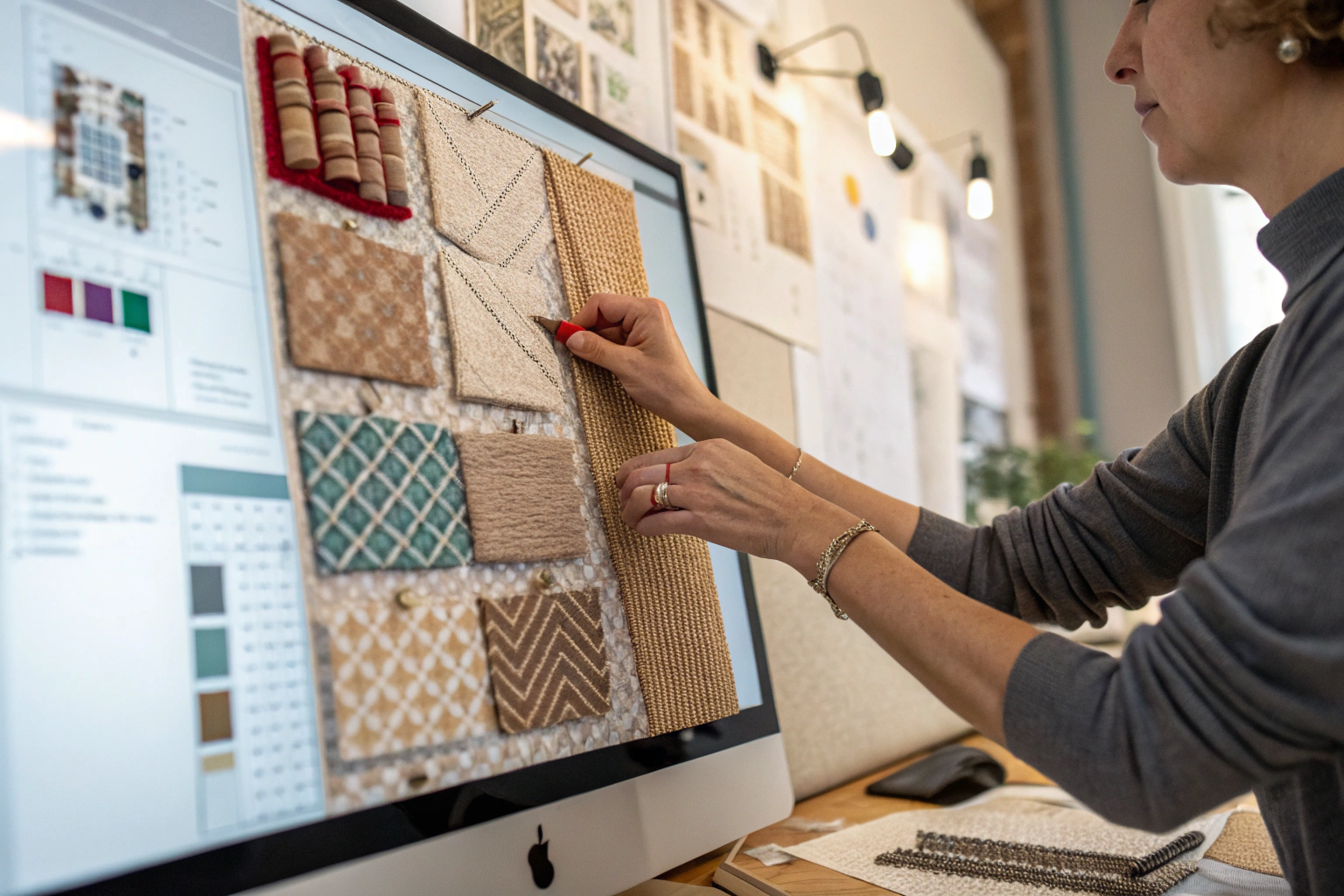
Look, I get it. You’ve found a fantastic fabric online, but the exact weave pattern you dream of simply doesn’t exist on a shelf. Or maybe you tried explaining a complex dobby weave to a sales rep over email, and the lab dip came back looking absolutely nothing like the heritage jacquard you had in mind. It feels like you’re shouting into the void, wasting precious weeks in your development calendar. The real headache isn’t just the cost; it’s the fear of committing to a bulk order only to receive fabric that shimmers wrong or doesn’t drape as expected. In this business, a miscommunication on a custom weave structure can turn a promising collection into a warehouse full of deadstock.
You don’t need just any supplier. You need a technical partner who actually speaks the language of the loom. The absolute best way to request a custom weave pattern from a mill is to combine a physical reference sample with a clear technical sheet—what we call a Tech Pack—and submit it during the slow season to lock in faster lead times. At Shanghai Fumao, we process over 500 custom weave requests a year, and I’ve learned that replacing vague descriptions with a 5×5 cm original swatch immediately cuts the sampling time by about 40%. If you can tell us the warp and weft density and hand us a thread you pulled from a vintage garment, we can reverse-engineer almost anything.
I’ve spent twenty years standing on the concrete floors of weaving rooms in Keqiao, covered in cotton fly, yelling over the deafening rattle of rapier looms. I’ve seen the industry shift from purely manual punch cards to modern digital yarn simulation software. If you stick with me for the next few minutes, I’ll walk you through exactly how to avoid the "it’s just a little off" trap. I’m going to reveal why sending a potato-quality photo of a dress on your phone is a recipe for disaster, and why knowing the difference between a plain weave and a satin weave in your initial inquiry can save you two thousand dollars in sampling fees. Trust me, your supply chain will thank you.
Why Physical Reference Samples Beat Digital Photos
If I had a dollar for every blurry Amazon screenshot a buyer sent me, I’d own a second coating factory by now. You’re excited about a texture, so you grab a still image from a runway video and fire it off to ten mills. Three weeks later, you get a stack of handloom swatches that feel completely different from each other. The stress piles up because you’re running against a hard launch date, and now you have to choose between cutting corners or missing the market window. It’s a nightmare that starts with a lack of tactile data.
A digital photo can’t show you the hand feel or the recovery of the yarn. It flattens the depth of a three-dimensional structure. When you mail us a physical reference sample, even if it’s just a 2-inch snip, we can instantly put it under a thread counter and determine the exact picks per inch. This allows us to calculate the exact grammage per square meter before we even spin a single thread. It’s the difference between a 95% accuracy rate on the first strike-off and a costly guessing game.

Why Visual Color Matching Often Fails Without a Physical Loom State
This is where the science gets real. You have to understand that your phone screen is an RGB light source, but dyed yarn is a CMYK reflective surface. The blue light emitted by your monitor tricks your eye into seeing vibrancy that physical thread simply cannot replicate. In our CNAS-certified lab, we don’t judge color by eye alone. The moment a reference arrives, we scan it with a spectrophotometer.
The critical mistake I see European buyers make is sending a paper printout of a Pantone chip. Paper absorbs light, fabric reflects it. Here is a quick breakdown of why we need the actual yarn or a "loom state" cutting:
| Matching Factor | Digital Photo Result | Physical Reference Result |
|---|---|---|
| Luster/Shine | Screens add artificial glare; satin weaves look wet. | We see true light refraction based on fiber content. |
| Crimp & Texture | Crepe textures look flat; we miss the twist level. | We measure the amplitude of the crimp under a lens. |
| Drape Feel | Impossible to assess stiffness. | We do a "ring test" to check bending rigidity instantly. |
(I should jump in here—our tech team actually uses a digital microscope connected to a central database. If you’ve given us a spec before, we can pull up your historical texture preferences instantly.)
We always ask: do you want a "clean cut" or a "soft feel"? A photo cannot answer that. The physical swatch tells us if the original fabric was scoured for softness or left stiff for garment construction. Without it, we are just guessing.
What Is a "Fabric Fingerprint" and Why Your Mill Needs One?
A "Fabric Fingerprint" is our internal term for a deconstructed technical analysis. Don’t just send a swatch; send the data of that swatch. To get that perfect custom weave pattern, you need to ask how to perform a burn test for fabric fiber identification on blended materials. This simple test, involving a lighter and a careful sniff of the smoke, instantly tells us if there is polyester hidden in what you thought was pure cotton. It grounds our development in chemical reality.
Furthermore, you must know how to specify a weave repeat notation when communicating with your mill. If you can tell us the repeat is a "24-end sateen" rather than just "shiny," we can skip the loom programming lead time. I recall a project in late 2023 when a Parisian couture buyer needed a stiff, paper-touch taffeta for an experimental ball gown. She sent us a swatch that looked shiny on video. We burned the edge and found it was 100% silk, but the weave was a tight basket weave, not plain taffeta. By identifying the fingerprint, we replicated the exact acoustic rustle and the specific bending stiffness of the original fabric, delivering 500 meters within 18 days. That’s how you avoid disappointment.
How to Write Technical Specs for a Custom Weave
Technical specs sound scary, but they are just the grammar of the fabric language. Without them, you and your supplier are essentially trying to build a house without a blueprint. The pitfall here is ambiguity; you write "strong fabric," but the mill interprets that as a tight weave, while you actually meant high tensile strength in the yarn. This disconnect blows out development times and fills your inbox with completely wrong lab dips that miss the mark entirely.
A proper spec sheet cuts the chit-chat. It translates your creative feelings into mechanical parameters. When you tell us you want a "flowy dress fabric," we need to know if you mean "limp and liquid" like a viscose crepe or "bouncy and airy" like a polyester chiffon. The spec solves this by defining the weight. We look for g/m². If you specify 80gsm, we immediately rule out the heavy worsted wool equipment and move to the high-speed rapier section. It gates the process efficiently.

What Are the Essential GSM and Yarn Count Formulas for Bespoke Textiles?
Let’s break down the math, but I’ll keep it simple. You don’t need to be an engineer, but you need to understand the scale. Yarn count measures the thickness of the thread. There are two systems, and mixing them up is a classic error. We use Metric Count (Nm) for cotton and Denier for filament silk and polyester. A 50 Denier thread is basically invisible to the naked eye, while a 2/20s Ne cotton yarn is chunky and great for denim.
Here is a sanity check table I use with my junior merchandisers to check weave feasibility:
| Fabric Type (Hand Feel Goal) | Recommended Yarn Count | Target Weight (GSM) |
|---|---|---|
| Lightweight Blouse (Soft) | 20D/22D Silk or 60s Cotton | 40 – 70 gsm |
| Shirting (Crisp) | 40s – 50s Cotton | 90 – 130 gsm |
| Heavy Suiting (Structured) | 30s Wool or 150D Poly | 200 – 280 gsm |
| Bottoms/Denim (Durable) | 10s – 16s Cotton | 300 – 400+ gsm |
To avoid a stiff, cardboard-like result, research how to calculate the optimum warp and weft density for a balanced custom weave. If the density is too high for the yarn count, the fabric becomes a stiff board that can’t breathe. If it’s too low, you get a sleazy, unstable mesh that grows in the wash. I always tell my weaving engineers to keep the cover factor between 0.6 and 0.8 for shirting; that’s the sweet spot where drape meets durability.
Why Specifying a Weave Repeat Before the Loom Setup Saves Two Weeks?
Do you know why lead times balloon during the August-October peak? Because mills are frantically changing loom harnesses. A dobby loom has limited frames, usually 16 or 24. If you wait until the loom is available to start the design, you’ve wasted a week. If you provide a weave repeat diagram—a grid of black and white squares—we can pre-load it into the CAD system. This is the language of the warp lifting.
In 2024, a London streetwear startup approached us with just a mood picture of a "diamond grid" for a puffer jacket. They didn’t know the repeat size. We assumed a small 2cm repeat, but they rejected it because they wanted a massive 8cm "climbing scale" look. We had to recut the pattern completely. After that delay, we sat down and taught their designer how to draw a weave repeat using free online pixel art tools. It’s easier than you think. If you sketch a 16×16 grid, you essentially dictate the exact lifting plan of the loom. That rigid visual instruction removes the guesswork. (Here is a secret: if you just take a screenshot of your pixel grid and drop it in your email, that’s faster than a formal Adobe file.)
Peak Season Planning for Custom Fabric Development
The textile supply chain isn’t flat; it has massive seismic shifts. You can’t just toss a custom weave request over the wall in March and expect a relaxed, methodical development. That’s peak madness season for us, and honestly, your project will get stuck in a queue behind a hundred other buyers screaming for the same loom time. The anxiety comes from watching your shipping window close while the mill goes dark for three weeks, and no amount of frantic WhatsApp messages can spin yarn faster.
The way to beat the system isn’t to rush harder; it’s to surf the calendar. You need to treat the Chinese production cycle like the tides. Our smartest partners reverse-engineer their launch dates by working backward from the major holidays. If you want cotton poplin delivered in May, you don’t start sourcing in April. You start in January. This isn’t procrastination; it’s strategic timing that guarantees your project gets senior-level attention rather than a rushed overnight shift by exhausted technicians.

Why Is Pre-Production Before the Chinese New Year Shutdown Critical for Weavers?
Chinese New Year isn’t just a long weekend. It’s a 3 to 4 week total operational freeze, followed by a chaotic restart where workers might migrate to different cities and never return to the same factory. It is the biggest supply chain risk in the textile calendar. If you leave a project dangling before the holiday, the operators forget the nuances of your tension settings over the break, and the prototype yarns go missing in the dust.
Here is the hard data on why you need to push pre-production early:
- Loom Allocation: Mills finalize their long-term loom schedules two weeks before the shutdown. If your tech pack isn’t approved by then, your warp beam can’t be prepared. You’ll be pushed to the back of the line for the new year.
- Yarn Security: Dyeing houses stop taking "small batch" custom colors 10 days before shutdown. If you miss this deadline, you can’t get the specific dyed yarns to even begin sampling until late March.
- Return Uncertainty: We usually forecast a 15% worker return delay. That means even if the factory opens on day one, it’s running at 40% capacity for the first week.
I advise our American partners to look at "how to conduct a Chinese factory audit during the transition peak before Golden Week". This due diligence isn’t just about checking the fire exits. It’s about verifying that the specific Jacquard technician who handles your account will be back on the floor. We offer video walk-throughs of our empty mill before the new year, showing your allocated beam racks with your name on them. That visual verification cuts the restart anxiety by half.
How to Leverage the November-December "Slow Window" for Faster Sampling R&D?
While everyone is panicking about holiday sales, the smart players are in the lab. November and December are my favorite months for development. Why? The noise is gone. The big commercial orders from the mega-brands have wrapped up their spring collections, so the weaving floor is quieter and cleaner. You get our undivided attention.
In this window, we can offer what we call "Rapid Reverse Engineering." You want to lower the cost of custom jacquard production for small-batch fashion brands, and this is the time to do it. Because machine time is less constrained, I can let my best weaver spend two days experimenting with different tension springs to fix a tricky selvedge curl, without being penalized for slowing down a bulk order. The advantage is qualitative, not just quantitative. This is the period where we innovate. In November 2023, a Canadian outerwear brand sent us a heavy, brittle architectural mesh to copy. We couldn’t get the stiffness right in the spring rush. During the December slow-down, we had the time to experiment with a post-weave coating that mimicked a resin finish without making the fabric snap. We nailed the hand feel in 15 days—a timeline absolutely impossible during the March peak. You can view our latest developments at Shanghai Fumao to see how we maintain this standard.
Quality Control: Verifying a Custom Weave Before Shipment
So, you approved a tiny lab dip in a dark office in Manhattan, but now 5,000 meters of fabric is sitting in our dispatch center in Keqiao. How do you know the bulk matches the swatch? This is the classic "trust gap" in custom manufacturing. You’re staring at a shipping deadline, worrying that the roll lengths are short, the selvedge is wavy, or the black color looks dusty under natural light. The stress of inspecting goods an ocean away is enough to make anyone lose sleep.
We don’t just fold the fabric and ship it. We close the trust gap with digital data and standardized physical procedures. We operate on the "Four-Point System" for major flaws and a stringent roll-by-roll continuity check. Before that cargo hits the container, you should have a report in your hand that feels like you were standing right there with a lightbox. At Shanghai Fumao, we hook up a webcam to our inspection table for live-streamed audits. No surprises, no hidden patches, just objective quality.

How Do the AATCC and ASTM Standards Apply to a Custom Woven Lot?
You might think global standards only apply to chemical safety, but they dictate weave quality, too. When we talk about "shrinkage," we aren’t guessing. We use AATCC Test Method 135 for dimensional stability. We cut the fabric, wash it five times, and measure the warp distortion. For a custom weave pattern, you need to know the global standard for visually assessing colorfastness in crocking for textile exports. Crocking is when dry or wet friction rubs the dye off onto another surface—a disaster for a dark indigo denim couch.
Here is a practical standard comparison for visual color grading using a lightbox:
| Quality Standard | Light Source | Primary Use |
|---|---|---|
| AATCC EP9 | Cool White Fluorescent (Daylight D65) | U.S. market visual color pass/fail. |
| ASTM D1729 | Tri-stimulus filters | Judging shade matching & metamerism. |
| ISO 3668 | Standard Illuminant D65 | European and global color assessment. |
We always inform buyers that you cannot grade a custom black fabric under a warm yellow office bulb. You need D65 daylight. I tell my clients to buy a $50 portable light tent online before signing off on a bulk shade band. It brings the lab conditions to your desk. This reduces the "it looks different here" call by 90%.
Can You Perform a Remote "Hand Feel" Assessment Using Standardized Methods?
Touch is the hardest sense to digitize. You can’t email a hug. But we can communicate "compression" and "drape" using objective tests that bypass personal preference. I hate seeing an email that says "this feels cheap." That’s not a spec, that’s an emotion. We replace it with the Cantilever method for bending length.
We drape the custom weave pattern over a specific edge and measure the overhang. A polyester satin might have a bending length of 2.5cm, while a stiff cotton canvas has a bending length of 7cm. You can replicate this at home. Just hang your approved swatch and the bulk sample over a table edge and measure the droop angle. We also use a compression tester to define "fullness." If you want a dense, thick hand, we aim for a high compression resilience value. By referencing the international guide for tensile strength testing of woven fabrics, you can ensure the fabric doesn’t just feel good but also holds up under stress. For a 2024 project with an Australian workwear brand, the remote spec was "rigid but not brittle." We quantified "rigid" as a bending length > 5cm and "not brittle" as a tensile strength > 400N. We then validated this via a video call using a standardized lab setup, and it passed on the first submission. That’s how you turn a subjective feeling into binary data. Don’t hesitate to contact us for a detailed discussion with our technical team at Shanghai Fumao.
Conclusion
We’ve covered the whole dance, haven’t we? You’ve seen that asking for a custom weave isn’t a wild goose chase if you treat it like a technical partnership. We moved from smudged phone screens to the sharp, microscopic reality of a "fabric fingerprint." You learned that a simple pixel grid of your weave repeat can knock two weeks off a production schedule that gets jammed by seasonal peaks. And you realized that subjective words like "soft" or "strong" are useless; the only language a loom understands is GSM, yarn count, and bending length numbers. The core secret is that the magic happens not in the weaving, but in the detailed specification before the yarn even hits the beam.
Remember the core principles. Always send a physical sample, even if it’s just a tiny snip with a burned edge to verify the fiber. Always plan your development timetable against the massive tide of the Chinese holiday calendar, using the November-December lull as your secret innovation lab. And never, ever approve a shipment based on a warm yellow office light; demand the cold, hard truth of a D65 lightbox or a live-streamed inspection video. If you apply these rules, you stop being a distant buyer and become a master of the supply chain.
If you are planning a new collection and need to move beyond the standard fabric catalogues, I want you to stop guessing and start communicating. At Shanghai Fumao, we don’t just rent out machine time; we lend you two decades of textile brainpower. We are ready to walk you through the warp and weft of your toughest design concepts. Let’s turn your sketch into a physical reality that handles exactly how you dreamed it would. Please reach out to our Business Director, Elaine, directly via her email at elaine@fumaoclothing.com. Let’s weave something exceptional together.








