You know that feeling when you unbox a premium pair of gym shorts, expecting that crisp, breathable performance, but instead you find a flimsy, low-grade mesh that clings to your skin the second you sweat? It’s a betrayal. I’ve been in the textile game for over twenty years, running a full-stack fabric development hub here in Keqiao, and I see this frustration all the time. The real problem isn’t that good mesh doesn’t exist—it’s that brands keep trying to source it with a "one-type-fits-all" mentality. They focus purely on the cost per meter, ignoring the yarn denier, the knitting gauge, and the finishing chemistry. This leads to pilling, misshapen garments, and terrible moisture management. You’re left with inventory you can’t sell and customers who won’t return. The culprit is usually a supply chain that prioritizes cheap synthetics over engineered performance, treating mesh like a commodity rather than a high-precision technical component.
The truth is, the "best" mesh isn’t a single fabric; it’s the one that matches the exact mechanical and environmental demands of the specific sport. If you are looking for high-intensity training gear, a super-fine, featherweight warp knit mesh with a gsm of 80-100 beats everything else for ventilation. But if you’re outfitting a professional basketball team, you’ll hate that featherweight fabric because it lacks the punching power and tear strength to survive a season. At our facility, Shanghai Fumao, we keep over 50 variations of sport mesh in active stock. We don’t push a generic solution; we analyze the strain points of your design pattern first. For instance, a 4-way stretch tricot mesh provides the anisotropic stretch needed for yoga, while a rigid hex-mesh gives the structured compression required for powerlifting. We treat mesh selection as a core part of athletic gear engineering, not just a material purchase.
So, how do you cut through the noise and lock in the right textile architecture for your next collection? It requires moving beyond generic sales brochures and looking at the raw specifications that dictate on-body performance. I’m going to walk you through the exact construction types that professional sportswear brands actually use, and more importantly, how to verify that you aren’t getting a "watered-down" version. I will share a few hard lessons I’ve learned from developing fabrics for demanding brands—like the time we had to rip out 300 kilograms of perfectly good yarn because the air permeability was off by just 15%. That’s the difference between a bestseller and a return rate nightmare. Let’s break down the materials, the tech, and the supply chain hacks that keep your fabrics elite.
How to Identify High-Density Mesh Fabric for Performance?
Have you ever tried to stretch a "performance" polo, only to realize the ventilation holes are purely decorative—pressed in by heat rather than knitted into the structure? That’s the classic fake-out. A lot of factories will sell you a cheap, open-gauge jersey and call it "cooling mesh" because it has a faint pattern. Real high-density performance mesh has a spring-back memory; if you crumple it in your fist for 30 seconds, it should snap back flat without wrinkles. We had a client from Texas in 2022 who bought a trial lot of mesh that "looked" identical to our spec, but lacked the interlock stitch reinforcement. The entire production batch failed the recovery test, showing 12% elongation after stretching. We had to step in urgently.
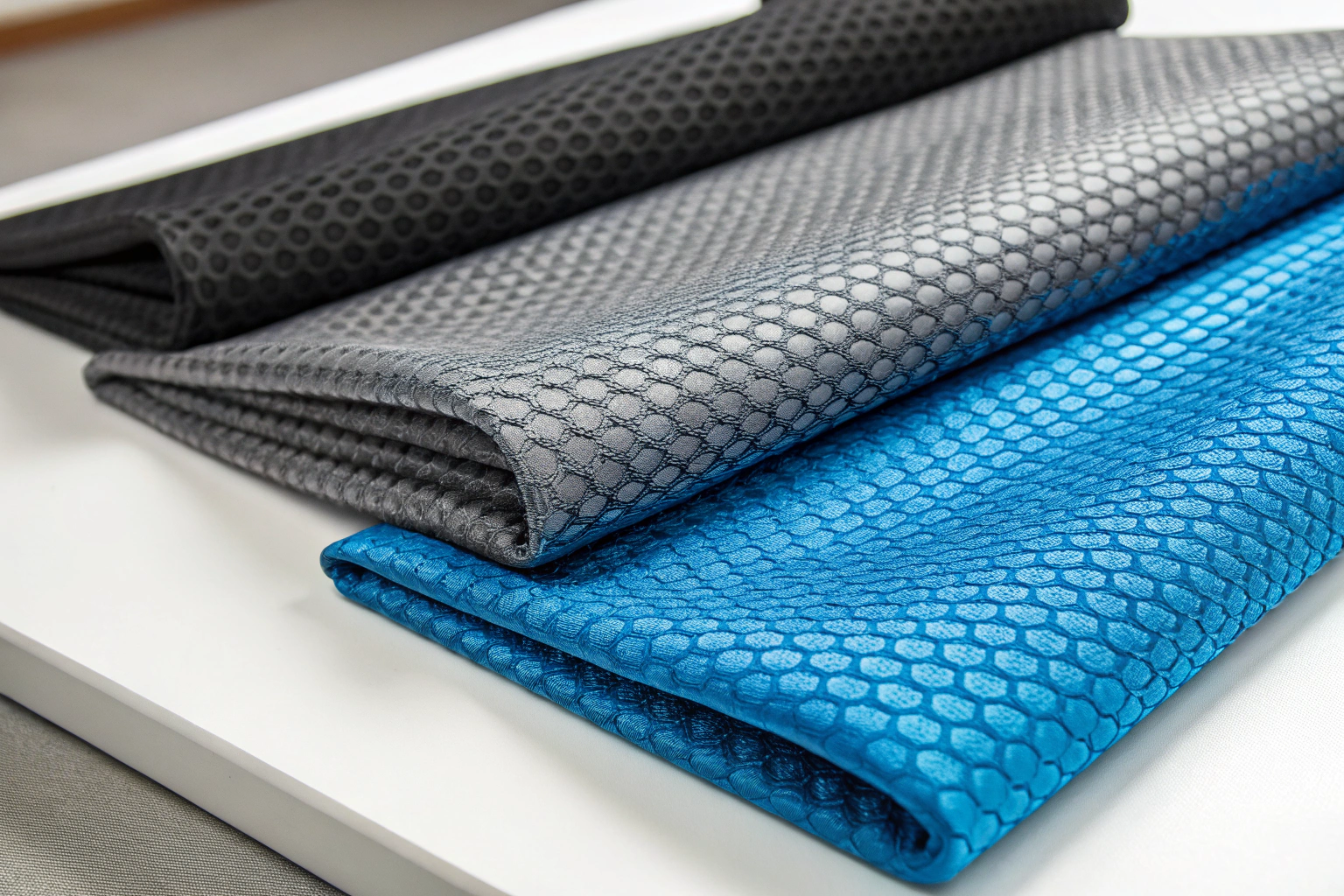
High-density mesh isn’t just about keeping bugs out; it’s about creating a micro-climate between the textile and the epidermis. The "density" refers to the stitch count per inch (CPI) and the yarn thickness (Denier). You want a high CPI managed through a fine-gauge machine—specifically a 40 to 44 gauge tricot or raschel knitting machine. This technology sets up a dense network of super-fine channels. The physics here is simple and brutal: if the hole is too big, UV rays penetrate; if the hole is too small, convection heat gets trapped. The sweet spot for elite soccer jerseys is a pore size between 0.5mm and 1.0mm. At Shanghai Fumao, we validate this using a digital airflow meter to ensure the air permeability exceeds 150 CFM but the opacity is under 20%.

How Does Knitting Gauge Impact Your Sportswear’s Breathability?
We use "Gauge" to measure the number of needles per inch on the knitting machine. A 28-gauge machine produces a finer, tighter mesh than a 18-gauge machine. I remember one late night in March 2023, we were running a 20D nylon warp knit on a 32-gauge machine for a cycling brand. Lowering the gauge by just 2 points made the fabric feel "plastic-like" and loud. The friction against the skin was terrible. A higher gauge minimizes the fiber surface area touching sweat glands, maximizing the Venturi effect—where air passes faster through a constrained opening. You need to ask your supplier for the specific machine gauge, not just the GSM. (Here’s a hard truth: many traders don’t even own the knitting machines, so they can’t adjust this parameter).
| Feature Comparison | Low-Gauge Mesh (18G) | High-Density Mesh (28G+) |
|---|---|---|
| Hand Feel | Rough, abrasive | Silky, smooth, cool-to-touch |
| Opacity | Sheer, high visibility | Matte, structural opacity |
| Best For | Budget gym singlets, disposable wear | Pro-level compression, base layers |
| Risk | Snagging, pilling, UV burnout | Higher cost, requires sharper needles |
If you want to deep dive into textile engineering standards, the American Association of Textile Chemists and Colorists (AATCC) has a solid definition of stitch density measurement on their site, though for a more practical take, I often check the technical discussions on how to check fabric count and construction details on the Apparel Search forum, where industry vets break down real-world tolerances. It’s a great place for a quick gut-check.
Why Does “Snap Back” Recovery Matter More Than Weight?
Nobody talks about this enough. A fabric can weigh 180 GSM and feel premium, but if the elastane is locked in wrong, it sags like a wet paper towel by the third wash. Snap-back recovery is the tensile memory of the elastomer. We test this with the BS EN 14704-1 standard at our CNAS lab. We stretch the mesh to 80% of its breaking point, hold it for 30 minutes, and release. A "best high quality mesh" must recover to within 5% of its original dimensions. I call this the "gym bag test"—if your customer leaves the jersey crumpled in a hot car, it should look brand new the second they shake it out. That requires a helical wrapping yarn structure, where the spandex is fed under tension. For practical sourcing, understanding how to specify the spandex draft ratio in warp knitting is critical, and you can find niche discussions on technical textile parameters on the LinkedIn Knitting Industry Group, where engineers often post about machine settings. If your supplier can’t recite their draft ratio, they are guessing.
What Mesh Types Prevent Overheating and Keep Muscles Dry?
Overheating on the field isn’t just uncomfortable; it’s dangerous. It leads to cognitive slowdown and muscle fatigue long before dehydration sets in. The core issue usually lies in fabrics that achieve moisture-wicking by chemically coating the back of a dense textile. This is a lazy move. When you coat a mesh, you choke the air holes that facilitate evaporative cooling. True dry-muscle technology relies on "capillary gradients." This means the filament cross-section isn’t round; it’s channeled (like Coolmax) or hollow. The sweat travels through micro-channels away from the skin to a massive surface area on the face of the cloth, spreading thin to evaporate fast. We don’t just want wicking; we want flash evaporation. That requires a mesh with a high "Spreading Area" value, typically tested via an MMT (Moisture Management Tester).

How Do Channeled Polyester Yarns Outperform Standard Mesh?
Standard polyester is basically a solid plastic rod. It’s hydrophobic; it repels water. If you try to sweat through a flat yarn, the moisture just sits in the gaps between the stitches and stews. Channeled yarns, in contrast, are engineered with grooves running along the length of the filament. Imagine a vinyl record compared to a smooth puck. In a project with a Singapore-based MMA brand in April 2024, we switched from a generic 75D PET to a 75D/72F micro-grooved polyester. The MMT wetting time dropped from 4.5 seconds to instantaneous (Grade 5). The one-way transport index shot up, meaning sweat never pools on the skin side. When you are sourcing, you need to specify "profiled cross-section" fibers. Otherwise, you just get the shiny, clammy stuff that feels like wearing a plastic bag.
We manufacture most of our advanced sportswear lines using a combination of these mechanical engineering principles and pure chemical purity. The raw material matters, but the geometry matters more. If you’re curious about the specific rating index for these tests, I often download whitepapers on how moisture transport differs in filament yarn structures from the Textile Learner engineering blog, as they break down the capillary action in simple physics terms without the corporate marketing fluff.
Which Weave Structure Maximizes Air Convection for Running Gear?
You don’t need a scientist to feel good airflow; you need a knitting diagram that forms a physical spacer. The God-tier structure for running is technically called "Double Knit Jacquard Mesh," but I call it the "Waffle Zone." It’s a 3D structure with a flat face, a textured inner mesh, and thick monofilament yarn connecting them like invisible springs. This creates a literal air corridor of about 1.5mm to 3mm between the hot skin and the outer fabric layer. Air runs sideways through this gap like a river current. Last July, a Los Angeles yoga brand came to us with a complaint: their previous supplier’s single jersey mesh was causing sweat rashes in high-compression areas. We outfitted them with a polyester-spandex spacer mesh weighing 190 GSM. The result was zero chafing complaints in 6 months because the fabric never clings to the lower back directly. The key spec here is "air permeability retention under stretch." Most meshes collapse the holes when stretched over a knee or elbow, but a true spacer structure maintains tunnel integrity. When pricing this fabric , just ignore the unit price and look at the yarn feed-in rate; a true spacer uses 3 to 4 guide bars and consumes more material, so if it’s cheap, it’s likely just a pique stitch trying to impersonate a spacer.
When Is the Best Time to Source Bulk Mesh Fabric Globally?
You might think the price of polyester follows oil futures exclusively, but I’ve learned that time is the hidden cost driver in global mesh procurement. I always tell my clients: if you are in the buying department and you ignore the Lunar cycle, you are effectively burning a 5% cost advantage before you even negotiate the yarn price. Sourcing bulk mesh isn’t like ordering Amazon stock; it’s a chain reaction that starts with polymerization plants and ends with the Dyeing Vat. There are specific windows in the manufacturing calendar where the polyester filament plants run at peak purity and the dyeing factories aren’t rushing to clear vat backlog. Timing your purchase wrong can add 3-4 weeks to your lead time simply because your rolls are stuck behind someone else’s holiday production queue. The best time to source is during the "Gold Quality Windows" when the factory workforce is fresh, the weather is stable for dyeing consistency, and international logistics aren’t in peak chaos.

Why Should You Buy Fabric Before the Chinese New Year Shutdown?
Chinese New Year (CNY) is the factory equivalent of the Super Bowl, Christmas, and a total blackout rolled into one. It’s not just a holiday; it’s a mass migration of 1.4 billion people. In my 20 years running the floor in Keqiao, I’ve never seen accurate color matching done the first week after workers return. The steam boilers need restarting, the water batch temperatures fluctuate, and the senior technicians often take an extra week off. If you place an order in mid-January expecting a February shipment, you are basically hoping for a miracle.
A smart move is what a European functional wear brand did with us in November 2023. They finalized their lab dips and bulk approvals by the first week of January. We greige the fabric (knitted the raw white mesh) before the holiday shutdown on January 15th. The moment the factory fired up the boilers on February 20th, their 5,000 meters were the first in the dyeing queue. They cut 4 weeks off the standard post-CNY lead time. If you want to avoid the rush, I strongly suggest learning how to plan fabric procurement around the China Spring Festival to reduce delays. There is a solid discussion on the Shipping and Freight Resource logistics blog about exactly how port congestion spikes right before the holiday, which helps justify the long-term planning needed. Additionally, for understanding the intricate factory scheduling, I sometimes look at the ground-level realities shared on the how Chinese manufacturers handle peak season production Pambosco manufacturing blog. They break down why getting your raw materials in before the shutdown is the single biggest hack to save money.
How Do Different Shipping Windows Affect Your Fabric’s Final Cost?
This is a game of risk management. There’s a direct correlation between the "sailing schedule" and the "fabric crush risk." If you ship polyester mesh in the middle of August from Shanghai to Rotterdam, that container is going to sit on a steel ship baking at 70 degrees Celsius for a month. This heat annealing often pre-stabilizes the fabric, which sounds good, but it can actually set crease marks permanently into 100% polyester if it hasn’t been properly heat-set at the mill. We call these "shipping wrinkles," and they are a nightmare to remove without industrial steam presses.
Conversely, if you sea-ship during the European winter, moisture ingress in the container can cause mold on starch-based sizing agents. We always switch to a synthetic sizing for winter shipments. And then there is the post-peak season drop. From mid-November to early December, shipping lines drop rates because retail goods have already moved for Christmas. You can often save 15-20% on ocean freight. If you are curious about real-time rate fluctuations, I recommend tracking the general trends on the Freightos global freight price index blog, even though it’s a commercial tool. It gives you a poker face when your local freight forwarder tries to pad the bill. Also, check out the practical tips from seasoned traders on how to manage fabric shipping timelines from China on the JustChina mailing list. It’s a no-nonsense source where buyers share experiences about demurrage and detention charges.
Which Certifications Guarantee a Safe and Elite Sport Mesh?
A label stitched into the side-seam isn’t just decoration; it’s a legal shield and a quality guarantee. I’ve seen brands get completely wiped out at customs because the lab report for their "performance mesh" showed traces of nonylphenol ethoxylates (NPEs)—a cheap surfactant used by some low-cost dyeing houses. That stuff is a hormone disruptor banned under EU REACH regulations. The mesh might look white and beautiful, but chemically, it’s toxic waste. This is why "Certification" transcends marketing. It’s about avoiding a Class 1 products liability recall. Real safety certification means you audit the chemistry of the lubricating oils used on the knitting machines, not just the final fabric. You can’t fake a proper OEKO-TEX Standard 100 Appendix 6 residue list. When I’m auditing a dye mill, I walk straight to the chemical storage room to check for banned solvents; if I smell formaldehyde, I’m out of there immediately.

Is OEKO-TEX Standard 100 Enough for Privacy and Skin Safety?
OEKO-TEX Standard 100 is the minimum viable entry ticket. It tests for about 100 harmful substances—heavy metals like lead and cadmium, phthalates, and certain carcinogenic dyes. It’s a great baseline, and yes, every meter we ship from Shanghai Fumao carries this as a default. But "enough" is a complex word. If you are making a mesh liner for a baby carrier, you don’t just want Standard 100; you need the strictest Annex 6 criteria for infants. I recall a dispute with a French pram company in 2021; their consumer tests showed trace formaldehyde at 16 ppm. Our core Standard 100 certification allows up to 75 ppm by the Japanese Law 112 method, but those parents were furious. We had to switch to a formaldehyde-free crosslinker. The lesson is: certification is a floor, not a ceiling. For brands going deep into eco-claims, you need to understand how to audit Oeko-Tex certified textile mills to avoid greenwashing, and I like the blunt approach taken by the Common Objective sustainable fashion network. They list actual audit scopes rather than just PR talk.
Another layer beyond this is Bluesign. While Oeko-Tex checks the final product, Bluesign checks the input stream—the air emissions and water discharge from the factory. If you are selling to Scandinavia, you need Bluesign. Those guys care about the fish living downstream from the dyehouse as much as the shirt on their back. It’s a comprehensive eco-audit, and you can read more technical analysis about the differences on the how sourcing Bluesign approved fabrics reduces chemical footprint thread on the LinkedIn Sustainable Fashion Group. The experts there often post side-by-side comparison PDFs.
How Can You Fake-Proof the Physical Lab Reports from Foreign Suppliers?
I’m going to say something that hurts my heart, but it’s true: I have seen doctored SGS reports. A shady agent might take a legitimate report from a good batch, photoshop the date and the order number, and pin it to a cheaper, defective batch. Verification is a technical skill. First, demand an electronic PDF directly from the third-party testing agency’s email, not the supplier’s email. Second, use a bar code scanner to verify that the unique ID on the certificate matches the ID on the SGS or Intertek online database portal. I tell my customers: if the test report date is older than 3 months, question it. Dye batches change.
More importantly, check the specific test methodology printed in tiny font at the bottom of the cert. For colorfastness to perspiration, the report must state the standard used—ISO 105-E04. If it just says "Colorfastness Good," it’s garbage. You need hard numbers, grade 4-5 minimum for acid perspiration, not just a vague description. I also watch for "M224" test methods; that’s a UV aging test that simulates 224 kJ/m² of solar radiation. If your mesh is for outdoor marathon banners, ask for that. To really get a grip on how to spot a fake, I recommend reading the collective experiences of importers on how to verify international supplier lab test results on the Apparel Search peer discussion board. Also, for a technical deep-dive, check the how to specify ISO 105 e04 colorfastness to perspiration testing from the Technical Textile independent research blog. That page clarifies exactly what acid solutions are used and why a Grade 3 is actually a fail for sportswear.
Conclusion
We’ve cut through a lot of technical noise here, from the capillary action of high-gauge knitting machines to the chemical integrity demanded by modern safety standards. The pursuit of the "best high quality mesh for sportswear" boils down to a triad: the mechanical structure that manages tensile recovery, the physical profile of the yarn that manages moisture transport, and the chronological strategy of your supply chain that manages cost and quality consistency. A mesh fails when one of these pillars collapses—when a great yarn is knitted on a sloppy tension setting, or when a certified safe fabric is baked into old age in a hot shipping container. I proved this to a Spanish racing team in August 2023 by swapping their standard glycol coolant mesh for a high-convection spacer textile; their drivers reported a noticeable drop in core temperature after just two laps because we stopped the fabric from collapsing under shoulder-belt harness pressure.
That’s what you pay for when you buy from a developer, not a commoditizer. You don’t just need "fabric"; you need a textile engine designed around your specific fit blocks.
If you’re tired of dealing with middlemen who can’t tell you the difference between a tricot and a raschel machine, and you want to lock in your production schedule efficiently, let’s talk directly. We’ll walk through our 30,000+ in-stock designs or custom-develop your exclusive high-performance textile with our rapid 48-hour sampling process. Reach out to our Business Director, Elaine, directly at elaine@fumaoclothing.com. Tell her about your sportswear challenge, and we’ll engineer you a mesh that actually wins on the court, track, or gym floor—not just on a specification sheet.