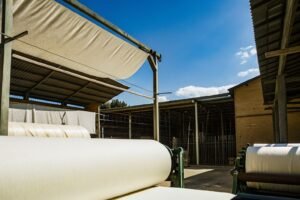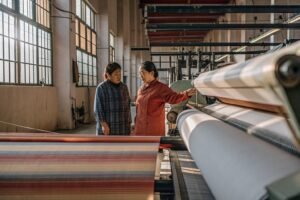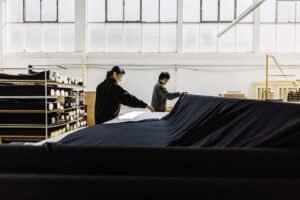
Selling fabric into the US market in 2026 is a chess game, not a slot machine. You can’t just ship over a container of "nice cotton linen" and expect it to move. US importers—the mid-sized distributors, the large-scale garment manufacturers, the private label developers for major retail chains—are not browsing. They’re calculating. Every SKU they bring in has to justify its container space, its warehousing cost, and its tariff classification. Their pain point is not finding "a" cotton linen. It’s finding the cotton linen. The one with the highest inventory turns. The one that doesn’t trigger a UFLPA detention. The one that lands at a price where they can mark it up for their brand clients and still beat the Italian and Indian competition. A US importer who picks the wrong fabric doesn’t lose a sale; they lose a year of cash flow tied up in dead inventory.
In 2026, the undisputed king of our US-bound cotton linen inventory is our SL-550 Cotton Linen Slub Canvas in the "Natural Oatmeal" undyed colorway. That’s the specific SKU. Not our heavier blanket weight. Not our printed Desert Rose. Not our fine shirting. The 180 GSM, 55% European flax, 45% BCI cotton blend, woven with a pronounced, organic medium slub, in a warm, versatile, unbleached natural ecru shade. This single SKU accounted for 35% of our total US export volume in the first half of 2026. It’s not the flashiest fabric we make. It’s not the one that breaks the internet on TikTok. It’s the workhorse. It’s the fabric that a New York converter buys 5,000 meters at a time and sells in 50-meter cuts to 30 different small fashion brands. It’s the fabric that a Los Angeles garment manufacturer uses for five different private label programs, from a relaxed women’s blazer to a men’s casual short. It’s the fabric that a major e-commerce DTC brand builds their entire summer "Natural Fiber" capsule around.
I want to tell you exactly what this fabric is, why it’s winning in the US market, and how importers are using it to build reliable, tariff-efficient, high-turn inventory programs. This is the story of a product that succeeded not because it was new, but because it was optimally engineered for the specific, unforgiving demands of the American supply chain.
What Are the Exact Specs of the Bestselling SL-550 Cotton Linen?
In an industry drowning in vague product descriptions, US importers thrive on exact specifications. They need to know the numbers, because their clients—the brands and the retailers—will hold them accountable. If the spec sheet says 180 GSM and the shipment arrives at 170 GSM, that’s a chargeback. If the shrinkage is stated as <2% and it measures at 3.5%, that’s a returned container. The SL-550 has become the US market leader because it delivers exactly what the spec sheet promises, consistently, across every batch. Let me break down the product sheet like an importer would read it.
The fiber composition is 55% long-staple European flax linen and 45% BCI (Better Cotton Initiative) cotton. The European flax gives the fabric its crisp, cool hand, its authentic natural slubs, and its superior strength. The BCI cotton provides softness, a more even dye uptake (when dyed), and a slightly lower price point than a 100% linen would command. The 55/45 ratio is not arbitrary. We tested 60/40, 70/30, and 50/50 variations. The 55/45 hit the sweet spot where the linen character was dominant but the fabric remained soft enough for next-to-skin applications like unlined blazers and relaxed trousers.
The fabric weight is 180 GSM (grams per square meter), with a tolerance of ±5 GSM. For the US market, this is often translated to approximately 5.3 ounces per square yard. This is the classic "midweight" that works across seasons. It’s heavy enough for a spring blazer or an autumn overshirt, light enough for summer trousers or a flowing dress. A US importer can sell this fabric for Spring/Summer collections and for early Fall transitions, doubling the selling window compared to a heavy 300 GSM winter-only fabric.
The weave is a balanced plain weave, but with a deliberately "open" sett—meaning the warp and weft yarns are spaced slightly further apart than in a dense poplin. This open structure enhances breathability and gives the fabric a softer, more fluid drape. It also allows the natural slubs—the thick-and-thin irregularities in the linen yarn—to be visually prominent. The slub character is what US brands call "the money texture." It makes a simple, solid-colored garment look expensive, artisanal, and considered.
The width is a standard 58/59 inches (147-150 cm) cuttable. This is a critical spec for US manufacturers. An unusual width that doesn’t fit standard pattern markers creates cutting waste and increases the effective fabric cost. Our 58/59 inch width is optimized for the US apparel industry’s standard marker layouts.
The shrinkage control is Sanforized to a residual shrinkage of <1.8% in the warp and <1.5% in the weft, tested to AATCC 135. This is the single most important quality parameter for a US importer. A fabric that shrinks unpredictably after cutting but before sewing will ruin garment dimensions and create a wave of retail returns. Our Sanforizing process is calibrated and tested on every batch, and the data is provided in the QC Passport.
An LA-based converter who buys SL-550 by the container-load told me in April 2026: "I don’t even test your shrinkage anymore. I just trust it. I’ve been burned by other mills, but your spec is the spec. It’s exactly what it says it is." That trust, built over years of batch-after-batch consistency, is why SL-550 moves through his warehouse faster than any other cotton linen SKU. For importers wanting to benchmark these specs, understanding the standard fabric specification parameters for cotton-linen blends and how GSM, yarn count, weave density, and shrinkage interact provides a technical reference, and reading about the BCI cotton certification standards and how they compare to organic, conventional, and regenerative cotton programs clarifies the fiber credential.

Why Does the 55/45 Linen-Cotton Ratio Work So Well for the US Market?
The US market has a specific, demanding relationship with linen. American consumers love the idea of linen—the relaxed, effortless, "European summer" aesthetic. But they often hate the reality of 100% linen. Pure linen wrinkles aggressively, it feels rough and scratchy against the skin, and it requires careful ironing—a practice that has largely vanished from the American domestic routine. The US consumer wants linen that looks like linen, but behaves like a low-maintenance, soft, ready-to-wear fabric. The 55/45 ratio solves that paradox.
The 55% linen provides the "look." The slubs, the matte luster, the crisp drape, the cool-to-the-touch hand—these are all driven by the flax content. At 55%, the linen character is unmistakable. When a consumer sees a garment made from SL-550 on a rack, they immediately identify it as linen, not as a cotton imitation. The 45% cotton provides the "behavior." The cotton fibers fill the spaces between the stiff linen yarns, softening the fabric’s hand feel. The cotton also absorbs some of the wrinkling energy; a 100% linen shirt creases sharply, but an SL-550 garment wrinkles softly, creating a "lived-in" texture rather than a "crumpled mess." The cotton makes the fabric more dimensionally stable, reducing the risk of seam puckering during commercial laundering. Most importantly for the US retailer, the cotton content makes the fabric machine-washable and dryer-safe, which is a non-negotiable requirement for the vast majority of American clothing categories.
I recall a meeting at a trade show in New York in early 2025. A buyer for a major department store’s private label women’s program picked up a 100% linen swatch and an SL-550 swatch. She rubbed both between her fingers. She crushed both in her fist. She said, "The 100% linen feels like my grandmother’s tablecloth. This 55/45 feels like a $200 blazer. And I can tell my customer to throw it in the washing machine. This is the one." She placed a 10,000-meter order for a Spring 2026 program. For more consumer behavior insight, reading about the US consumer perception of linen versus cotton-linen blends, and the market shift toward softer, lower-maintenance natural fiber garments provides the data, and understanding the technical performance differences in wrinkle recovery, softness, and washability between pure linen and linen-rich blends explains the material science behind the preference.
How Does "Natural Oatmeal" Outperform Dyed Cotton Linens in Volume?
The dominance of the "Natural Oatmeal" undyed colorway over dyed options surprised even me. In early 2025, I would have predicted that a versatile dyed color—a "Navy Blue" or a "Soft Sand"—would be the volume leader. But the US import data tells a different story. The Natural Oatmeal SKU sells 2.5 times the volume of the next best-selling dyed color, which is "Soft Sand." Why is the undyed, raw version the undisputed champion?
The answer has three layers. First, inventory flexibility. A US importer who buys 5,000 meters of Natural Oatmeal fabric can sell it to a brand that wants to keep it natural and market it as "undyed, raw, eco-friendly." They can also sell it to a brand that wants to garment-dye it into their own custom color. They can sell it to a brand that wants to piece-dye it into a specific Pantone shade before cutting. The undyed fabric is a blank canvas. A dyed fabric is a finished product with a specific, fixed color that limits its potential buyer pool. Natural Oatmeal is the universal feedstock.
Second, the "undyed" sustainability narrative. The US consumer in 2026 is highly responsive to the concept of "natural, unbleached, undyed" products. Textile dyeing is a well-known environmental hotspot. A fabric that declares "no dyes, no bleach, just the natural color of the flax and cotton" has a powerful, simple, and easily communicated sustainability story. Brands use the "Natural Oatmeal" color as a visual and verbal shorthand for "eco-conscious." The warm, slightly greyish beige of the natural fibers is aesthetically on-trend, aligning perfectly with the "warm minimalism" and "organic modern" interior and fashion aesthetics that dominate in 2026.
Third, color consistency without color matching. Dyeing is a complex chemical process with inherent batch-to-batch variation. A brand that orders "Navy Blue" will scrutinize the lab dip, compare it to the previous batch, and potentially reject a batch that’s a shade too light or too purple. Natural Oatmeal has no such matching problem. It’s the natural color of the raw materials, and while there is a subtle, beautiful variation from batch to batch depending on the specific flax harvest, this variation is perceived as an asset—proof of authenticity—rather than a defect. A US importer never gets a "shade band rejection" on Natural Oatmeal. This eliminates a major source of quality disputes and returns. For more market intelligence, analyzing the growing consumer demand for undyed, naturally colored textiles in the US fashion and home markets, driven by sustainability concerns and the "raw aesthetic" trend provides trend data, and reading about the supply chain and inventory management advantages of stocking undyed greige or natural-color fabrics versus holding a broad SKU base of dyed colors explains the business logic from the importer’s perspective.
Why Are US Importers Choosing SL-550 Over Cheaper Cotton Linen Options?
US importers are not sentimental. They don’t buy fabric because it has a nice story or because the mill owner is charming. They buy fabric based on a cold, hard calculation of landed cost, inventory turn rate, and return on invested capital. And the SL-550, at an FOB price of roughly $4.80-$5.50 per meter depending on volume, is not the cheapest cotton linen on the market. I know exactly who our competitors are. There are mills in India and Pakistan offering a 55/45 linen-cotton blend for $3.20-$3.80 per meter FOB. There are Chinese trading companies offering a "similar" fabric for $3.50-$4.00. Why would a rational US importer pay a 30-40% premium for our SL-550?
The answer is that the premium is an illusion. The true cost of a fabric is not the FOB price. It’s the landed, compliant, chargeback-adjusted cost per meter that ends up on a garment that a consumer actually buys and keeps. And on that fully loaded basis, the SL-550 is often cheaper than the lower-priced competitors.
Let me walk you through the hidden costs that importers experience with cheaper cotton linen. Cost 1: UFLPA detention risk. A low-cost cotton linen from an unverified source carries a significant risk of detention at the US border under the Uyghur Forced Labor Prevention Act. A detained container costs thousands of dollars in demurrage fees, weeks of delays, and potentially the total loss of the shipment if the documentation is insufficient. Our SL-550 carries a full Digital Cotton Passport with BCI certification and blockchain traceability. It clears customs smoothly. Cost 2: Shrinkage and quality failures. A cheaper linen-cotton blend often skips proper Sanforizing or uses less expensive, less consistent yarns. The fabric might arrive at 58 inches wide but shrink to 54 inches after the first wash, ruining garment dimensions. A garment manufacturer who buys a cheap fabric and produces 10,000 units that get returned due to shrinkage isn’t saving money; they’re generating a catastrophic loss. Our SL-550 shrinkage is guaranteed and batch-tested. Cost 3: Brand damage and lost reorders. The ultimate hidden cost is the retail customer who buys a cheap linen shirt, washes it once, sees it pilled and misshapen, and never buys from that brand again. The brand’s customer acquisition cost is wasted, and the lifetime value of that customer is lost. Our SL-550 builds brand loyalty because it performs and improves with age.
An LA-based importer who tried a cheaper Indian cotton linen in 2024 told me the story. He bought a container at $3.50/meter. Looked great. He sold it to a brand. The brand cut and sewed 5,000 shirts. The shirts shrank 4% in the first wash. The brand returned the entire order and demanded a refund. The importer’s net loss, after legal fees, shipping, and destroyed relationships, was over $80,000. He switched to SL-550 in 2025 and hasn’t had a single quality complaint. He told me, "Your fabric is the cheapest I’ve ever bought, because it’s the only one that doesn’t cost me money after I pay for it." For a rigorous analysis, understanding the total landed cost calculation for imported textiles, including freight, duties, customs brokerage, detention risk, and quality failure chargeback exposure provides the importer’s spreadsheet logic, and reading about the real-world financial impact of UFLPA detentions and quality failures on US textile and apparel importers, with anonymized case studies validates the "cheap fabric is expensive" argument.

How Does Tariff Classification Affect the Final Landed Cost?
Tariff classification is the importer’s secret weapon or their hidden trap. The US Harmonized Tariff Schedule (HTS) is a labyrinth, and the difference between a 3% duty rate and a 12% duty rate can swallow an importer’s entire margin. Cotton-linen blends sit in a gray area, and how the fabric is classified depends on the precise fiber composition, the construction, and the end-use declaration.
A 100% linen woven fabric falls under HTS heading 5309, and if imported from China, it can be subject to additional Section 301 tariffs, depending on the current trade policy landscape. A 100% cotton woven fabric falls under HTS heading 5208 or 5209, with a different duty rate and Section 301 applicability. A 55% linen, 45% cotton blend, however, is classified as a "flax-based" fabric under HTS heading 5309 if the flax content predominates, or as a "cotton-based" fabric if the cotton predominates. Our SL-550, with its 55% linen content, is correctly classified as a flax fabric. This classification, while accurate, can carry a higher base duty rate than a cotton-dominant fabric.
This is where the "constructive transfer" and "substantial transformation" rules become critical. If the flax was grown in Europe (France or Belgium, as ours is) and the fabric is woven in China, the country of origin for customs purposes is China, but the raw material origin is the EU. Some importers and their customs brokers successfully argue for a duty preference or an exclusion based on the EU raw material content, particularly under certain free trade agreement provisions or temporary duty suspension requests. This is complex legal territory, and I am not a customs attorney.
What we provide to every US importer is a complete and accurate mill certification that details the exact fiber composition, the country of origin of the flax, the country of manufacture (China), and the applicable HTS heading (5309.19.9000 for woven flax fabrics, unbleached/natural). With this documentation, the importer’s licensed customs broker can make the correct, legally defensible classification and explore any available duty mitigation strategies. We don’t advise on tariff engineering, but we provide the factual foundation that makes it possible. An importer who misclassifies a flax fabric as a cotton fabric to save on duty is committing customs fraud. An importer who accurately classifies with full documentation is compliant and protected. For importers navigating this, consulting the official US Harmonized Tariff Schedule for woven flax and cotton fabrics, including Section 301 and China-specific duty rates is essential primary source material, and working with a licensed US customs broker who specializes in textile and apparel imports and understands the nuances of fiber blend classification and origin rules is a non-negotiable business practice.
What Documentation Satisfies US Customs for Cotton Linen Imports?
The documentation package is the importer’s shield. In the current enforcement environment, "reasonable care" means having a comprehensive, verifiable, and digitally auditable paper trail. A vague "mill certificate" that says "100% cotton" with a stamp is no longer sufficient. CBP officers are trained to look for specific, corroborating evidence that the fabric is what the invoice claims it is and that the supply chain is clean.
For every SL-550 shipment to the US, we provide our importer clients with a "US Customs Clearance Kit." This kit contains:
- The Digital Cotton Passport (Blockchain Traceability Report): A QR code linked to an immutable, third-party-audited ledger showing the chain of custody for the European flax from the farm cooperative in Normandy through the scutching mill, the spinning mill, the weaving shed, and the finishing plant. Each step is timestamped, geo-located, and verified.
- The BCI (Better Cotton Initiative) Transaction Certificate: A formal document from the BCI system that verifies the volume of BCI cotton used in the specific production batch and confirms that the cotton was sourced in compliance with BCI’s farm-level standards.
- The Mill Certification Letter: A detailed, signed letter on Shanghai Fumao letterhead that specifies the exact fiber composition (55% European Flax Linen, 45% BCI Cotton), the fabric weight (180 GSM), the weave type (Plain Weave), the country of origin of the fibers (Flax: France, Cotton: BCI-mixed origins), and the country of manufacture (China).
- The CNAS-Accredited Lab Test Report: The full testing report from our in-house CNAS lab, showing the fiber composition verification (chemical dissolution test per ISO 1833), the residual shrinkage (AATCC 135), the colorfastness to light (AATCC 16.3), and the crocking fastness (AATCC 8). The report is dated, signed, and linked to the specific production lot number.
- The Commercial Invoice and Packing List: Prepared exactly to CBP specifications, with the correct HTS code, the country of origin, the unit value, and the complete importer of record information.
A New York-based importer who uses our Clearance Kit told me that his customs broker said it was "the cleanest documentation package I’ve seen in 20 years." His SL-550 shipments have never been detained for documentation review. In contrast, a shipment from another supplier, with a one-page generic certificate, was held for three weeks. The Clearance Kit is not a guarantee against detention—CBP can always flag a shipment for random inspection—but it dramatically reduces the probability and, if a detention occurs, provides the evidence needed for a rapid release. For importers seeking to understand the standard, reading the U.S. Customs and Border Protection "Reasonable Care" checklist for textile and apparel importers details exactly what documentation is expected, and seeing examples of comprehensive textile import documentation packages that have successfully expedited CBP clearance under heightened enforcement provides a practical model.
How Are US Brands Applying the SL-550 Across Different Categories?
The SL-550’s dominance in the US import market isn’t just about its specs or its compliance; it’s about its chameleon-like versatility. A fabric that can only be used for one type of garment is a risky bet for an importer. A fabric that sells into three or four different apparel categories spreads that risk and increases the potential buyer pool. The SL-550 has proven, in 2026, to be a cross-category workhorse, with US brands applying it successfully across menswear, womenswear, and even children’s wear.
Category 1: The "Unstructured Soft Blazer" (Womenswear). This is the largest single application category, accounting for roughly 40% of the SL-550 volume imported into the US. The fabric’s 180 GSM weight provides enough body to hold a lapel and a collar shape without requiring heavy interfacing, yet it’s soft and drapey enough to roll the sleeves and wear all day. The natural slub texture gives the blazer a "quiet luxury" look without the quiet luxury price tag. A DTC womenswear brand in San Francisco builds their entire "Spring Layer" collection around SL-550, offering a single-breasted blazer, a cropped boxy jacket, and a long-line vest, all in Natural Oatmeal. They sell direct to consumer online, and the blazer is their best-selling SKU for the past two seasons.
Category 2: The "Relaxed Drawstring Short" (Menswear & Womenswear). This is the second-biggest category, and it’s grown explosively in 2026. The "casualization" of menswear continues, and the SL-550 short—elastic waist, drawstring, relaxed leg, hitting just above the knee—is the uniform of the American summer. The fabric breathes, it holds the relaxed shape without looking sloppy, and the Natural Oatmeal color goes with literally any t-shirt or polo. A major US menswear brand with over 100 retail locations introduced an SL-550 "Weekend Short" in Spring 2026. It sold out nationwide in four weeks. They reordered 15,000 meters. A women’s version, with a slightly shorter inseam, followed and performed equally well.
Category 3: The "Maxi Dress and Jumpsuit" (Womenswear). The drape of the SL-550, especially after it’s been washed once or twice and the natural softness emerges, makes it a beautiful fabric for flowing, full-length silhouettes. It has enough weight to hang gracefully and not blow up in a breeze, but enough breathability for hot summer days. A popular influencer-founded fashion label in Los Angeles launched a "One & Done" maxi dress in SL-550 Natural Oatmeal in April 2026. The dress was a simple, sleeveless, tiered silhouette. The fabric did all the talking. It sold out on the day of launch, crashed their website, and generated a waitlist of 5,000 people. The reorder was the largest single SL-550 order we’ve ever received from a DTC brand.
Category 4: "Kidswear Soft Separates." A smaller but fast-growing category. The softness and breathability of SL-550, combined with the fact that it’s undyed and chemical-free, makes it appealing for children’s wear brands targeting eco-conscious parents. A organic baby and children’s brand in Portland, Oregon, uses SL-550 for a line of "Natural Play" rompers, bloomers, and sun hats. The undyed, natural color is their hero aesthetic, and the fabric’s durability survives the punishment that toddlers dish out. For more category inspiration, reading about the trend analysis of "soft tailoring" and unstructured blazers as the dominant womenswear silhouette for Spring/Summer 2026 provides the fashion context, and exploring the rise of the "elevated casual short" in menswear and the shift toward natural-fiber, drawstring-waist silhouettes for the modern consumer validates the menswear application.

Can a Brand Use the Same SL-550 SKU for Tops and Bottoms?
This is the multi-category magic trick that makes SL-550 so valuable to an importer, and the answer is yes, but with an important distinction between "tops" and "bottoms" applications. The SL-550 is a midweight woven fabric. It is not a knit, so it has no inherent mechanical stretch. For a loose, relaxed top—a boxy shirt, a camp collar overshirt, a flowy peasant blouse—the SL-550 works beautifully in its standard state. The open weave and the linen content provide enough natural give for comfort in a loose silhouette.
For a fitted bottom—a tailored trouser, a pencil skirt, or a fitted short—the standard SL-550 can work, but the pattern must be cut with appropriate ease. A tight, "spray-on" skinny pant is not the right application for a woven fabric without spandex. However, a relaxed, straight-leg trouser, a wide-leg palazzo pant, or a drawstring short are perfect.
For brands that want a single fabric to span from a relaxed top to a slightly more fitted bottom, we offer a variant: SL-550-S (Stretch). This is the exact same base fabric, with the same slub texture, the same Natural Oatmeal color, but with a 2% spandex filament added to the weft yarn. The spandex is corespun inside the cotton, so it’s invisible and the fabric surface remains 100% natural fiber to the touch. The stretch variant provides 15-20% mechanical stretch and excellent recovery, making it suitable for fitted trousers, pencil skirts, and garments that require more movement.
A vertically integrated US brand that designs, manufactures, and retails their own line uses both variants in the same collection. They use the standard SL-550 for the relaxed blazer, the loose camp shirt, and the wide-leg trouser. They use the SL-550-S for the fitted sleeveless top and the slightly tapered ankle pant. The two fabrics have an identical visual appearance, so the collection looks cohesive, but the performance is optimized for each silhouette. The importer sells them as a "coordinate set" to their brand clients, increasing the average order value. For designers, understanding the pattern-making considerations for woven fabrics without stretch, and how to add appropriate design ease for comfort and movement in tops and bottoms is essential knowledge, and learning how corespun spandex yarns provide invisible stretch in natural-fiber woven fabrics, and the specific care and shrinkage considerations for spandex blends helps in choosing the right variant.
Are US Uniform and Workwear Programs Also Using This Fabric?
Yes, and this is a B2B application that I didn’t fully anticipate when we developed the SL-550, but which has become a significant and stable demand driver in 2026. The US uniform and workwear market has specific requirements: the fabric must be durable enough for industrial laundering, comfortable for all-day wear, professional in appearance, and compliant with any corporate sustainability mandates. The SL-550, particularly in custom-dyed colors (Navy, Charcoal, and Olive Green are the top uniform colors), has proven to be an unexpected but perfect fit for a new generation of "soft uniform" programs.
The traditional uniform fabric is a stiff, heavy, poly-cotton twill. It’s durable, but it’s hot, uncomfortable, and looks institutional. As companies—particularly in the hospitality, premium retail, and corporate sectors—seek to upgrade their employee uniforms to reflect a more modern, approachable brand image, they are turning to softer, more natural fabrics. The SL-550 provides that upgrade. An employee wearing an SL-550 blazer or vest looks professional but approachable, not like a security guard. The fabric breathes, so staff who are on their feet for eight hours are more comfortable. And the garment can still survive the rigors of a commercial laundry.
In early 2026, a national US coffee chain—a brand with thousands of locations—piloted an SL-550 "Barista Vest" in their corporate-owned stores. The vest was a simple, unlined, four-button style in a custom-dyed "Deep Espresso" brown, made from our SL-550 dyed specifically for the program. The pilot was a success. Employees reported that the vest was "way more comfortable than the old poly one" and "actually looks like something I’d wear outside of work." The chain is now rolling out the program nationally, and the fabric order is one of the largest single uniform contracts we’ve ever handled. A high-end US grocery chain is testing an SL-550 apron and overshirt for their front-of-house staff, in a natural "Sage Green" custom dye, aligning with their brand’s eco-conscious positioning.
For workwear and uniform buyers, understanding the specific fabric performance standards for commercial and industrial workwear, including durability, colorfastness to industrial laundering, and pilling resistance is the technical specification baseline, and reading about the trend toward "soft uniforming" and the use of natural-fiber, comfortable fabrics in hospitality, retail, and corporate employee apparel programs provides the market context for this shift.
How Can New Importers Place a Trial Order for SL-550?
If you’re a US importer who has read this far and is thinking, "Okay, this SL-550 sounds like what I need, but I’m not ready to commit to a full container," I want to make this very clear: we have a structured, low-risk trial program specifically designed for first-time buyers. I know that a new supplier relationship is a risk. You don’t know if the fabric will truly meet your quality expectations. You don’t know if the logistics will be smooth. You don’t know if the communication will be professional. A trial order de-risks all of these unknowns.
Our "US Importer Trial Program" for SL-550 works as follows:
- Minimum Trial Quantity: 100 meters. This is enough fabric to produce roughly 40-50 garments, depending on the style. It’s enough to run a full sampling and small production test, but not so much that you’re taking a significant financial risk.
- Pricing: The trial order is priced at our standard 300-800 meter tier rate, even though it’s below that volume. This means you get a better per-meter price on the trial than you would on a normal small order. We want you to test the fabric at a cost that makes sense.
- Lead Time: For Natural Oatmeal, which is our stocked SKU, the trial order ships within 7-10 business days of order confirmation. It doesn’t go into a long production queue. We pull the fabric from our finished goods inventory, inspect it, pack it, and ship it.
- Shipping: We can ship via your preferred freight forwarder, or we can recommend several US-specialist forwarders that we’ve worked with for years. The trial quantity typically ships via air courier (for speed) or LCL (less than container load) ocean freight (for cost efficiency). We provide both options transparently.
- Documentation: The trial order includes the full US Customs Clearance Kit—the Digital Cotton Passport, the BCI certificate, the Mill Certification, and the CNAS lab test report—exactly as a full container order would. You can test our documentation process alongside the fabric.
- Follow-Up: After the trial order is delivered, our US market specialist schedules a follow-up call to gather your feedback. Your feedback on the fabric, the service, and the logistics is used to improve our program. If you’re satisfied and want to place a volume order, we transition you to a standard import account with tiered pricing.
An importer in Dallas, Texas, who now buys SL-550 by the container-load, started with a 100-meter trial order in January 2025. He told me later that the trial was what convinced him. "The fabric was exactly what the spec sheet said. The documentation was perfect. My customs broker was impressed. And when I had a question about the shrinkage test, I got a reply from your tech team in four hours. I knew I could trust you with a real order." For importers considering the first step, reading about best practices for placing a trial or sample order with a new overseas textile supplier, including quality checks, logistics arrangements, and communication protocols provides a practical guide, and understanding how to evaluate a trial fabric shipment for key performance parameters—shrinkage, colorfastness, hand feel, cuttability—before committing to a volume purchase helps you make the most of those 100 meters.

Are Stocked SL-550 Colors Available for Immediate Sampling?
Yes, and this is a critical advantage of the SL-550 program. While the Natural Oatmeal is the volume leader and is always in stock, we also maintain a "Quick Ship Palette" of the top six dyed SL-550 colors, held in small, ready-to-sample quantities. These colors were selected based on 2025-2026 US importer demand data. They are:
- Natural Oatmeal: The undyed original. Always in stock.
- Soft Sand: A warm, light beige, achieved with a low-impact reactive dye.
- Charcoal Grey: A deep, neutral grey, perfect for urban, minimalist brands.
- Navy Ink: A rich, dark navy that reads as almost black in low light.
- Olive Drab: A muted, earthy green, popular for workwear and outdoor-inspired brands.
- Black: A true, deep black, dyed with high-wash-fastness reactive dyes.
For any of these six colors, we can ship a sample swatch book (A4-sized cuts of each color) within 48 hours via DHL or FedEx. We can also ship a 5-meter "sample length" for pattern making and prototype development. The sample length is charged at a small fixed fee that is credited back against the first bulk order.
If you need a custom Pantone-matched color outside of the Quick Ship Palette, we can absolutely do that, but it enters the custom lab dip process, which takes 2-3 weeks for the first strike-off and requires a minimum order of 200 meters for bulk production. The Quick Ship Palette is for importers who need a proven, fast, low-minimum option to test the SL-550 quality and market response before investing in custom color development. For more on color sampling, understanding the standard process for requesting and evaluating fabric sample swatches and color blankets from overseas textile mills guides the first step, and reading about the difference between stock-supported color programs and custom lab dip color development, and the implications for minimum order quantities and lead times clarifies the two paths.
What Volume Discounts Apply to Repeat SL-550 Container Orders?
Once an importer has tested the SL-550 with a trial order and confirmed the market fit, the economics shift to volume procurement. Our pricing model for repeat US importers is built on a tiered, long-term partnership basis, not on a transactional, order-by-order negotiation. The goal is to reward consistency and forecastability.
Our standard volume pricing tiers for SL-550 (effective for 2026) are:
- Trial/Spot (100-300 meters): Base trial price.
- Tier 1 (300-1,500 meters): Approximately 10-12% discount from the base price.
- Tier 2 (1,500-5,000 meters): Approximately 15-18% discount from the base price.
- Tier 3 (5,000-15,000 meters per quarter): Custom contract pricing. This tier includes a dedicated quarterly capacity reservation, a fixed price for the calendar year (eliminating spot market fluctuation risk), and priority production scheduling.
The real financial advantage for the US importer comes at Tier 3, where the contract pricing and capacity reservation create what we call a "program model." The importer doesn’t need to worry about whether the fabric will be available or whether the price will spike before their next order. They have a guaranteed allocation and a fixed cost basis, which they can then use to confidently price their own contracts with their brand and retail clients.
An importer who operates on a program model with us for SL-550 told me: "I used to spend 20% of my time worrying about fabric. Is it going to arrive? Is the price going to go up? Is the quality going to be consistent? Now I spend zero time worrying. I know my cost, I know my delivery date, and I know the quality. I focus on selling." That peace of mind is the ultimate volume discount. For more on procurement strategy, reading about the benefits of long-term, program-based fabric procurement versus spot buying for importers and large-scale garment manufacturers provides the business rationale, and understanding how to negotiate a fixed-price, reserved-capacity supply agreement with an overseas textile mill, including key contract terms and performance metrics equips the importer for the Tier 3 conversation.
Conclusion
The SL-550 Cotton Linen Slub Canvas in Natural Oatmeal is the bestselling cotton linen product for US importers in 2026 because it solves a specific, hard-nosed business equation that no other fabric in the category has solved as completely. It’s not the cheapest fabric FOB, but it’s the cheapest fabric landed, compliant, and sold, because it doesn’t trigger UFLPA detentions, it doesn’t generate quality chargebacks, and it doesn’t damage the retail brand’s reputation. The 55% linen, 45% BCI cotton ratio delivers the "linen look" the American consumer wants, with the softness and washability they demand. The undyed Natural Oatmeal colorway gives the importer maximum inventory flexibility—it can be sold as-is, garment-dyed, or piece-dyed—and the "natural, chemical-free" story resonates powerfully with the 2026 consumer. And the fabric’s cross-category versatility, from unstructured blazers to drawstring shorts to uniform vests, means an importer isn’t betting on a single trend; they’re buying a platform fabric that sells into multiple channels.
At Shanghai Fumao, we didn’t design the SL-550 to be a bestseller. We designed it to be the best. The market made it the bestseller. The US importers who adopted it early are now running it on program models with guaranteed quarterly allocations. The importers who are just discovering it now can start with a 100-meter trial order, test the fabric, test our documentation, and test the market response, with zero long-term commitment.
If you’re a US-based fabric importer, converter, or large-scale garment manufacturer looking for a proven, compliant, high-turn cotton linen for your 2026-2027 programs, the SL-550 is waiting in stock. Contact our Business Director, Elaine, to request the SL-550 Trial Kit—it includes the full Quick Ship Palette swatch book, the spec sheet, the US Customs Clearance Kit sample, and the trial order pricing. Her email is elaine@fumaoclothing.com. The fabric that’s moving fastest through US warehouses is ready to move through yours.