The spreadsheet says Vietnam is cheaper. The labor cost per hour is roughly half of China’s. The minimum wage in Ho Chi Minh City is around $200 per month. The factory gate price for a basic cotton poplin shirt—cut, sewn, and finished—can undercut a comparable Chinese quote by 15 to 25%. The spreadsheet math is seductive. It promises higher margins, a lower retail price, and a competitive edge. So you, the brand owner, the sourcing manager, the entrepreneur with a spreadsheet and a dream, start pivoting your supply chain toward Vietnam. You send inquiries to Vietnamese fabric mills. You fly to Hanoi for a sourcing trip. And then you hit the wall. The custom fabric you need—the 55% European flax, 45% BCI cotton, 180 GSM slub canvas in a specific "Dusty Cedar" shade, with a mechanical soft-finish and OEKO-TEX certification—is not available. The Vietnamese mill can offer you a basic 100% cotton poplin, or a standard poly-cotton twill, in black, white, or navy, with a 5,000-meter minimum and a 60-day lead time. Your custom development hits a dead end. The "cheaper" Vietnamese supply chain is a mirage, because the cost of the fabric is irrelevant if the fabric doesn’t exist.
The question "Is Vietnam cheaper than China for custom fabric?" is a trick question. The correct, honest answer is: Vietnam can be cheaper for high-volume, basic, repeat-order commodity fabrics. For custom-developed, high-specification, short-to-medium-run fabrics, China—and specifically the integrated textile cluster of Keqiao—remains the global center of capability, speed, and, when you account for the total cost of quality and development, true cost-effectiveness. At Shanghai Fumao, we don’t see Vietnam as a threat. We see it as a complementary manufacturing center. Many of our largest clients cut and sew in Vietnam, but they develop and source their custom fabric from us in China. The Vietnamese sewing factory is the body. The Chinese fabric mill is the heart and the brain. I’m going to break down exactly where the cost advantages are real and where they are illusory, based on the actual 2026 cost structures for a custom cotton-linen program. We’ll look at labor, raw material access, the "hidden tax" of logistics friction, and the capability gap that the spreadsheet never captures.
Where Does Vietnam Actually Hold a Cost Advantage in 2026?
Let’s give Vietnam its due. The country has earned its place as a major global apparel exporter through genuine, structural cost advantages, disciplined investment, and favorable trade policies. Pretending these advantages don’t exist would be analytically dishonest. The question is not whether Vietnam has advantages. The question is what those advantages apply to.
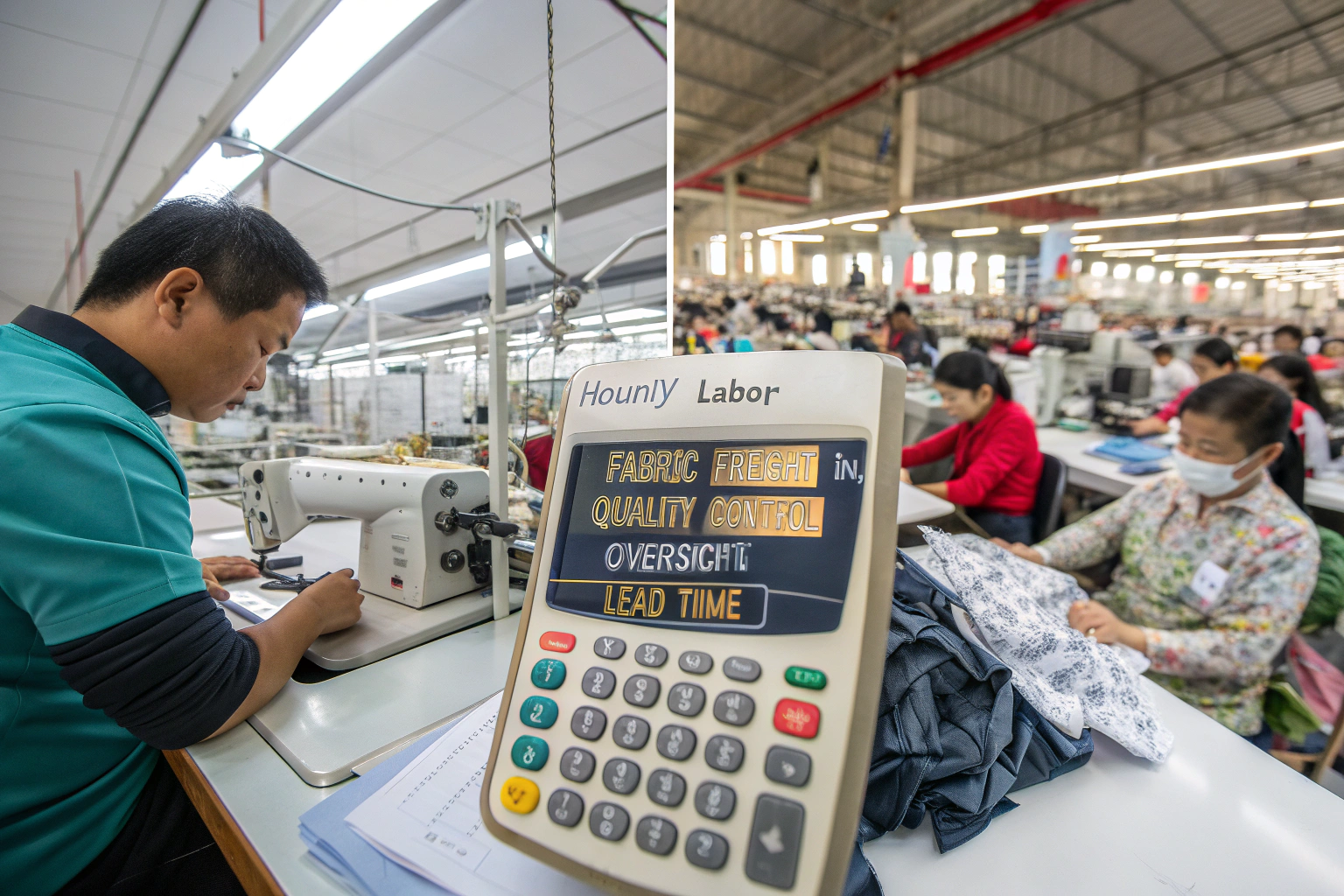
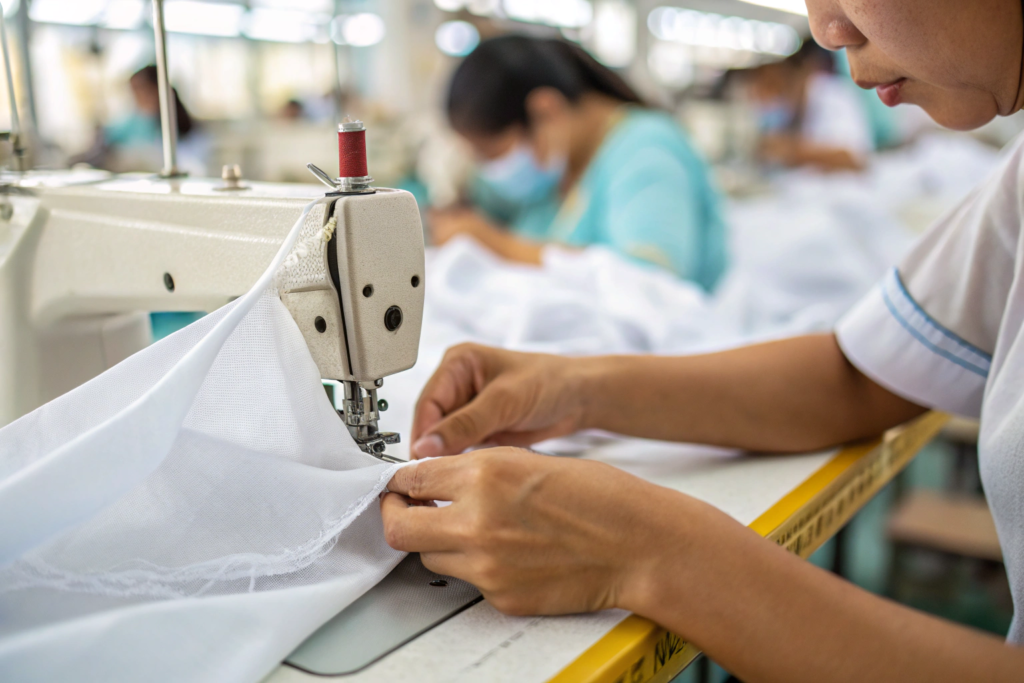
The primary, undeniable advantage is labor cost for cut-and-sew operations. As of 2026, the average monthly minimum wage for a garment worker in Vietnam ranges from approximately $180 in rural areas to $240 in the Ho Chi Minh City and Hanoi metropolitan regions. In the major Chinese textile centers like Keqiao and Guangzhou, a skilled textile worker earns $600 to $900 per month. The Vietnamese labor cost for manual, repetitive, labor-intensive sewing work is genuinely 50-60% lower than China’s. This is a real, structural advantage that directly reduces the cost of garment assembly.
The second advantage is duty-free access to key markets via free trade agreements. Vietnam is a signatory to the Comprehensive and Progressive Agreement for Trans-Pacific Partnership (CPTPP) and the EU-Vietnam Free Trade Agreement (EVFTA). These agreements eliminate or reduce import duties on Vietnamese-made garments entering Canada, Japan, Australia, and the European Union, provided the fabric meets the agreement’s rules of origin (often yarn-forward, meaning the fabric itself must be woven in a CPTPP or EVFTA member country to qualify). For a US-bound garment, Vietnam’s "Most Favored Nation" duty rate is the same as China’s for most textile categories, but Vietnam is not subject to the Section 301 additional tariffs that apply to Chinese-origin goods. This is a significant tariff advantage for the US market.
The third advantage is a young, growing, and increasingly skilled workforce. Vietnam’s demographic profile is favorable. The workforce is expanding, not contracting. The government has invested heavily in vocational training for the textile and garment sector. The quality of Vietnamese garment sewing, for basic to medium-complexity garments, is now on par with China’s.
These advantages are real. They make Vietnam an excellent location for the cut-and-sew assembly of garments, particularly basic to medium-complexity styles in high volume, where the labor cost dominates the total cost. For a brand producing 50,000 units of a basic five-pocket cotton twill pant, Vietnam is almost certainly cheaper than China for the sewing, and the duty savings amplify the advantage. But the operative word is "basic." The moment the product requires a custom-developed, high-specification fabric, the Vietnamese cost equation shifts dramatically. For data-driven comparison, reading a comprehensive 2026 report on comparative garment manufacturing costs in Asia, with a breakdown of labor, energy, logistics, and tariff costs by country and product type provides the macro analysis, and understanding the specific rules of origin and duty preference utilization rates under the CPTPP and EVFTA for Vietnamese garment exports gives you the detailed trade policy landscape.
What Are the Real Labor Cost Differences in Vietnam vs. China?
The headline labor rate—$240 per month in Vietnam versus $700 per month in China—is not the full story. The true cost of labor is the cost per unit of output, which is a function of the wage rate, the productivity (units per hour), and the skill level (defect rate, rework cost). On all three of these adjusted metrics, the gap between Vietnam and China narrows significantly.
Vietnamese garment worker productivity, while improving rapidly, remains lower than Chinese productivity for complex operations. A 2025 study by the International Labour Organization (ILO) benchmarked sewing productivity across Asian countries. For a standard men’s dress shirt, a Chinese sewing line produced an average of 1.8 shirts per operator per hour. A Vietnamese line produced 1.4 shirts. The 50% labor cost savings were partially offset by a 22% lower productivity rate. The effective labor cost per shirt was lower in Vietnam, but not by 50%; it was closer to 28%.
For custom fabric production—spinning, weaving, dyeing, and finishing—the productivity gap is often wider. Skilled weaving technicians and dye masters with 10-20 years of experience are still concentrated in China. A Chinese dye master can adjust a bulk dye formula to correct a shade deviation in a single iteration. A less experienced technician might require two or three iterations, consuming time, chemicals, and fabric. The lower hourly wage is consumed by the additional iterations. The labor cost advantage for high-skill, custom textile manufacturing is significantly smaller than the headline wage comparison suggests, and for some specialty processes, it may be negligible or even negative when rework and failure rates are accounted for. For a nuanced view, reading the ILO comparative study on labor productivity in the Asian garment and textile manufacturing sector, including wage-adjusted output per worker benchmarks for China and Vietnam provides the official data, and understanding the specific skills gap in technical textile manufacturing—dyeing, finishing, complex weaving—between the established Chinese workforce and the developing Vietnamese workforce gives context to the numbers.
Why Is Vietnam’s Fabric Raw Material Supply Still Dependent on China?
This is the structural dependency that the "move to Vietnam" narrative often glosses over. Vietnam is a garment assembly powerhouse. It is not, in 2026, a major textile raw material producer. The country’s textile industry is heavily skewed toward the "cut, make, trim" (CMT) stage of the value chain. The upstream stages—fiber production, yarn spinning, fabric weaving, and especially advanced dyeing and finishing—are significantly underdeveloped relative to the scale of the garment assembly sector.
The numbers tell the story. Vietnam imports approximately 60-70% of its woven fabric requirements. The largest single source of these fabric imports is China. A Vietnamese garment factory making a cotton-linen shirt for a US or European brand is very likely cutting and sewing fabric that was woven and finished in China, shipped on a short-sea container vessel from Ningbo or Shanghai to Hai Phong or Ho Chi Minh City. The Vietnamese CMT factory adds value through labor. The Chinese fabric mill adds value through material science, chemistry, and engineering.
This dependency has two cost implications. First, the fabric itself carries a "China cost," plus the additional freight, insurance, and handling to move it from China to Vietnam. This logistics friction adds roughly 3-7% to the fabric cost, depending on the volume and the shipping mode. Second, the development lead time is extended. A custom fabric development that takes 4 weeks in China now takes 4 weeks in China plus 1-2 weeks for shipping and customs clearance into Vietnam. The supply chain is longer, more complex, and more vulnerable to disruption. The Vietnamese sewing labor is cheaper, but the fabric that feeds those sewing lines is more expensive and slower to arrive than it would be if the brand sourced fabric and cut-and-sew in the same industrial cluster in China. Understanding the structure of the Vietnamese textile and garment industry, including the upstream-downstream imbalance and the heavy reliance on imported fabrics, primarily from China provides the official industry perspective, and reading about the cost and lead time implications of the China-to-Vietnam fabric supply chain for international apparel brands calculates the hidden tax.
Where Does China’s Keqiao Cluster Outperform Vietnam for Custom Fabric?
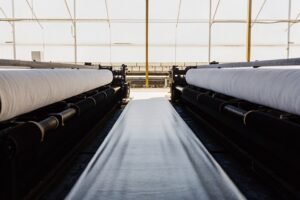
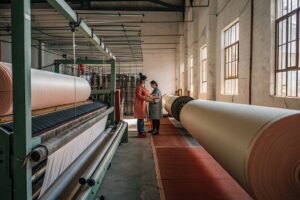
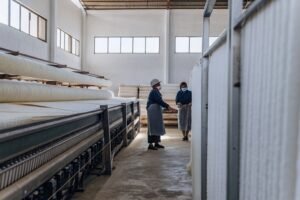
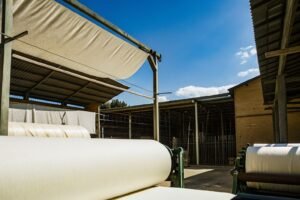
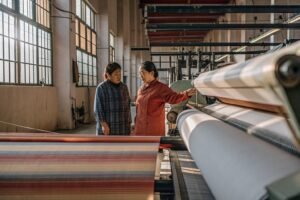
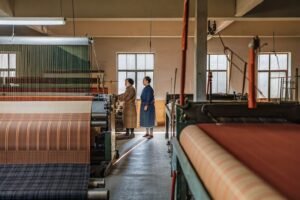
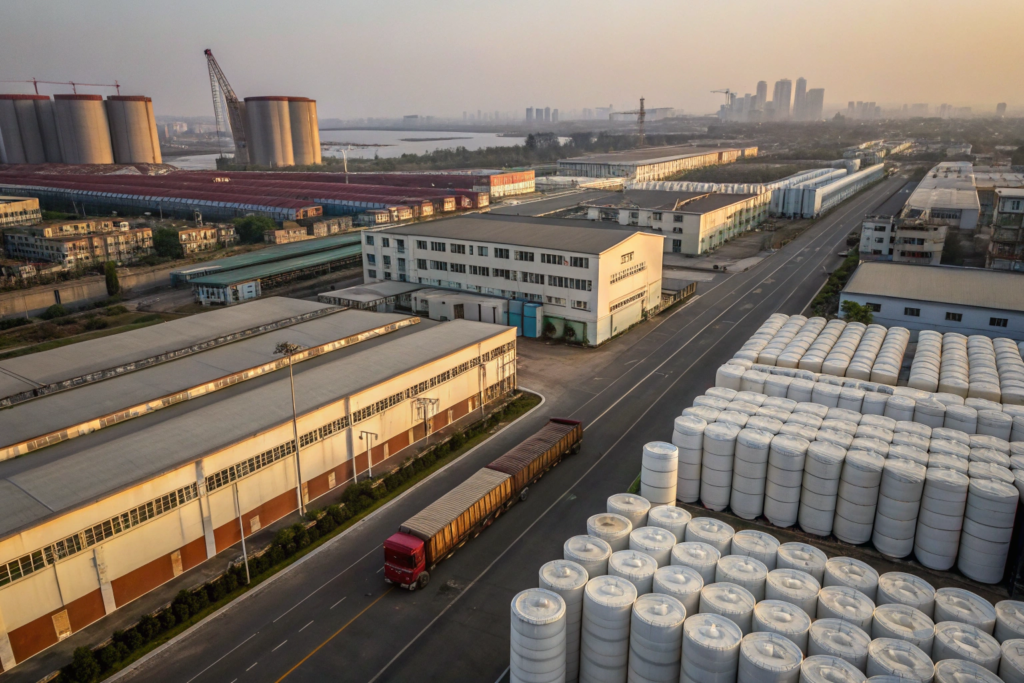
Vietnam has competitive sewing lines. China’s Keqiao district has something fundamentally different: an industrial ecosystem that has been evolving for 30 years and now constitutes the densest, most vertically integrated textile manufacturing cluster on the planet. Keqiao is not a factory. It’s a self-contained textile universe. Within a 50-kilometer radius, you can source raw cotton from a Xinjiang bale, spin it into yarn, weave it into greige fabric, dye it to a specific Pantone shade, print it with a custom design, finish it with a mechanical softener, inspect it on a 4-point system, pack it, and load it into a container bound for any major global port. Every step is performed by a specialist facility, connected by short, efficient trucking routes, and coordinated through decades-old business relationships.
This ecosystem density creates four specific, powerful advantages for custom fabric development that Vietnam cannot currently match.
Advantage 1: Speed of Sampling and Development. In Keqiao, a new yarn blend can be spun in a sample quantity within 3-5 days. The yarn can be woven into a sample greige on a handloom within 24 hours. The greige can be dyed to a lab dip within another 3 days. The entire physical sample development cycle—from concept to a hand-feel swatch—can be completed in 7-10 days. In Vietnam, where the spinning, weaving, and dyeing facilities are fewer, more spread out, and often fully committed to large-scale production runs, a sample development cycle can take 3-4 weeks or longer.
Advantage 2: Depth of Technical Specialization. Need a specific mechanical "peach skin" finish? There are five finishing plants in Keqiao that specialize in exactly that, each with different machine configurations and decades of process knowledge. Need a complex yarn-dyed jacquard pattern? There are weavers in Keqiao who have been setting up jacquard looms for three generations. This depth of specialized craft knowledge is not yet replicated in Vietnam. The Vietnamese textile industry is excellent at executing standard, large-volume orders. It is not yet structured for the rapid, high-spec, custom R&D that fashion brands demand.
Advantage 3: Raw Material Proximity. Keqiao sits within the Yangtze River Delta, which is the primary gateway for imported premium textile fibers—Australian and US cotton, European flax, New Zealand wool. The yarn spinners and fabric weavers in Keqiao have direct, efficient access to the full global palette of raw materials. A Vietnamese mill that wants to source European flax for a high-end linen blend must import that flax from Europe to Vietnam, a longer, more expensive, and less frequent supply line than shipping it to Shanghai.
Advantage 4: The "One-Stop" Integration. As I described at the beginning of this article, Shanghai Fumao and other Keqiao-based mills can offer a genuinely integrated service: from yarn sourcing, to weaving, to dyeing, to printing, to coating, to inspection, to DDP shipping. The buyer has one point of contact, one contract, one quality responsibility. In Vietnam, these processes are often distributed across multiple, independent companies, requiring the buyer to manage multiple supplier relationships and coordinate the logistics between them. The integration saves management cost, reduces coordination risk, and accelerates the timeline. For a complete understanding, reading about the structure and competitive advantages of the Zhejiang Keqiao textile industrial cluster, the world’s largest and most integrated textile manufacturing ecosystem provides the official description, and understanding the comparative advantage of industrial clusters in enabling rapid innovation and flexible production in the textile industry, relative to a dispersed, less integrated supplier base provides the economic geography reasoning.
Can a Single Factory in Vietnam Really Do "Everything" Like We Do?
The short answer is no. There are individual, vertically integrated textile companies in Vietnam—large, impressive operations, often funded by foreign direct investment from Korea, Taiwan, or China. These factories can spin, weave, dye, and finish. But the range and depth of what they can do in a single facility is significantly narrower than what a Keqiao-based integrated supplier can offer by combining its owned facilities with a tight network of specialized cooperative partners.
A typical large Vietnamese integrated mill is optimized for high-volume, standard-product production. It has a spinning line for a specific range of cotton counts. It has a weaving shed with a specific type of loom. It has a dyeing and finishing line set up for a specific range of colors and finishes. It can produce excellent basic cotton poplin, twill, and canvas, in a limited but sufficient color palette, with high efficiency and competitive cost. It can do "everything" within that narrow lane.
What it typically cannot do is seamlessly switch from a 100% cotton poplin to a 55/45 European linen-cotton slub fabric, to a Tencel-cotton blend, to a recycled polyester performance twill, all within the same management structure and with the same speed and expertise. The yarn spinning equipment for linen is different from that for cotton. The weaving setup for a slub fabric is different from that for a smooth poplin. The dyeing chemistry for a cellulosic blend is different from that for a synthetic blend. A Keqiao-based supplier like Shanghai Fumao can access all of these capabilities by leveraging the specialized cooperative network within the cluster, while presenting a single, coordinated interface to the buyer.
I’m not claiming this to disparage Vietnamese mills. They are excellent at what they do. But "what they do" is a subset of "what a custom fabric buyer needs." If your needs fall within that subset, Vietnam may work well. If your needs require flexibility, variety, and rapid custom development, the Keqiao ecosystem is unmatched. For a balanced view, reading a profile of a leading vertically integrated textile manufacturer in Vietnam, detailing its capabilities, its product range, and its target market segments shows the reality of what’s available, and comparing this to the capability profile of a Keqiao-based integrated fabric solutions provider, illustrating the broader product range and faster custom development enabled by the cluster ecosystem highlights the difference.
Is Vietnamese Quality Control Now on Par with Chinese Quality Control?
For garment sewing quality, yes. Vietnamese garment factories, particularly those managed by Korean, Taiwanese, or Hong Kong investment groups, have achieved quality levels that are fully competitive with the best Chinese factories. Their stitch quality, seam finishing, and attention to detail are excellent. For basic textile quality—standard greige weaving, basic dyeing of commodity fabrics—Vietnamese mills are also competitive.
For custom, high-specification fabric QC, the gap is still material. The depth of experienced QC technicians, the availability of advanced in-house testing laboratories (like our CNAS-accredited lab), and the discipline of batch-to-batch color continuity over many years of production runs are areas where the established Chinese textile industry retains an advantage. It’s not that Vietnamese mills cannot perform a 4-point inspection or an AATCC 135 shrinkage test. It’s that the systematic, deeply embedded quality culture that comes from decades of serving demanding global brands, and the investment in advanced testing equipment that supports it, is more widespread in the Chinese textile sector.
I’ve seen this difference firsthand when auditing potential cooperative partners. A Chinese QC manager with 15 years of experience can look at a shade band and instantly identify a 0.5 Delta E drift that a less experienced inspector might miss. The technology—the spectrophotometer—is available in both countries. The trained, experienced human eye that knows what to look for is still more abundant in China. This experience gap is closing every year, but in 2026, it remains a factor for brands that require absolute color precision and zero-defect fabric quality. For a detailed comparison, reading about the evolution of quality management systems in the Vietnamese textile and garment industry, from basic inspection to systematic QC, and the remaining gaps relative to China provides an independent industry analysis, and understanding the specific quality assurance challenges in custom fabric dyeing and finishing, and why human expertise and advanced lab equipment are both essential gives context to the experience gap argument.
What Are the "Hidden Costs" of Sourcing Custom Fabric from Vietnam?
The spreadsheet comparison between a Chinese custom fabric quote and a Vietnamese quote often omits several line items that the buyer will pay, just not to the Vietnamese mill. These are the "hidden costs" of sourcing custom fabric from a less developed textile ecosystem. They don’t appear on the mill’s proforma invoice, but they drain your budget and your timeline just the same.
Hidden Cost 1: The Development Travel and Communication Tax. Developing a custom fabric requires intense, iterative communication. A Chinese mill’s sales engineer is likely fluent in textile-technical English, works on WeChat for instant communication, and can conduct a live video walkthrough of the factory floor on 24 hours’ notice. A Vietnamese mill’s English capability is less consistent, the communication tools may be less integrated, and the time zone overlap with the US or Europe is the same as China’s, but the cultural and linguistic bridge is often newer and less tested. Misunderstandings happen. A misunderstood specification that results in a wrong sample costs you two weeks and the courier fees for a new sample. If you need to travel for a face-to-face meeting, the flight to Ho Chi Minh City or Hanoi from a Western capital is often longer, more expensive, and less frequent than the flight to Shanghai, which is a major global aviation hub.
Hidden Cost 2: The Longer and More Fragile Development Timeline. The Vietnamese custom fabric development pipeline is simply slower and more prone to delay. The yarn may need to be imported. The specialty dye chemical may not be in stock. The one technician who understands the specific finishing process may be on leave. A development that takes 4-6 weeks in Keqiao can take 8-12 weeks in Vietnam. For a fashion brand working on a seasonal calendar, an extra 4 weeks of development time is a significant cost. It compresses the selling window, increases the risk of markdowns, and consumes management attention.
Hidden Cost 3: The Minimum Order Quantity (MOQ) Penalty. Vietnamese mills, optimized for large-scale production, often have higher MOQs for custom fabric development than their Chinese counterparts. A Chinese supplier in the Keqiao cluster can often do a custom dye run of 200-300 meters. A Vietnamese mill may require 1,500-3,000 meters for a custom development. For a small-to-mid-sized brand, that higher MOQ means a larger upfront cash commitment, higher inventory risk, and a potentially longer sell-through period for the fabric. The per-meter price might be lower, but the total cash at risk is higher.
Hidden Cost 4: The Risk of Supply Chain Disruption. The Vietnam-China fabric supply chain is a cross-border supply chain. It involves international shipping, customs clearance in two countries, and the associated documentation. A political disruption, a port congestion event, or a customs regulation change can delay the fabric’s arrival into Vietnam, idling the CMT sewing line. An integrated China-China supply chain, where fabric is produced in Keqiao and sewn in nearby Shaoxing or Guangzhou, eliminates this cross-border risk. The risk cost is probabilistic, but it’s real, and professional supply chain managers assign a dollar value to it. For a full accounting, reading a guide to the total cost of ownership for custom textile sourcing, comparing China, Vietnam, and other Asian origins, including the often-overlooked costs of development, communication, logistics, and risk provides a holistic cost model, and understanding the specific logistical and administrative challenges of importing fabric into Vietnam for CMT processing and re-exporting the finished garment details the cross-border friction.
How Do Lead Time Delays in Vietnam Affect Your Bottom Line?
A delayed fabric delivery doesn’t just push back your production schedule. It triggers a cascade of financial consequences that multiply the cost of the delay far beyond the air freight bill you might pay to catch up. Understanding this cascade is essential to calculating the true cost of a sourcing decision.
Consequence 1: The Air Freight Penalty. If the fabric arrives late and the garment production window is fixed, you have two choices: delay the brand’s launch (damaging sales and brand reputation) or air-freight the finished garments to the market. Air-freighting a container of cotton-linen shirts from Vietnam to the US costs 5-8 times more than ocean freight. A $3,000 ocean freight bill becomes a $15,000-$24,000 air freight bill. This cost wipes out the entire labor savings from manufacturing in Vietnam.
Consequence 2: The Lost Sales and Markdown Cost. If the launch is delayed by two weeks, those two weeks of full-price selling are lost forever. The product goes on sale earlier, and the total full-price sell-through percentage drops. A brand that normally sells 70% of a collection at full price might sell 55% if the launch is delayed. The lost margin on those units is a direct cost of the fabric delay. This cost is often orders of magnitude larger than the fabric price difference between China and Vietnam.
Consequence 3: The Inventory Holding Cost. If the fabric arrives early—which sounds like a good thing, but has its own cost—it must be stored, insured, and financed. The longer the pipeline, the higher the in-transit and in-warehouse inventory, and the higher the working capital cost. A fabric shipment from China to a Chinese CMT factory might be in transit for 2-3 days. A shipment from China to a Vietnamese CMT factory might be in transit for 10-14 days, plus customs clearance. That extra 10 days of in-transit inventory represents additional working capital tied up, which has a real financial cost.
A US mid-sized apparel brand calculated that a two-week delay on a single seasonal collection, caused by a Vietnamese fabric supplier’s late delivery, cost them $112,000 in lost margin, air freight, and markdowns. The initial fabric cost saving from sourcing in Vietnam was $8,500. The hidden cost of the delay was 13 times the visible saving. The spreadsheet lied. For a methodological approach, reading about supply chain lead time variability and its impact on fashion brand profitability, including a model for calculating the cost of a delivery delay provides the financial framework, and understanding the specific lead time benchmarks for fabric development and delivery from China and Vietnam, and how to build these into a realistic sourcing calendar gives you the planning data.
Are Vietnamese Customs and Logistics as Efficient as China’s?
No. This is not a criticism of Vietnam; it’s a reflection of infrastructure maturity. China has spent three decades and trillions of dollars building the world’s most efficient port, rail, and logistics infrastructure, specifically designed to support its export manufacturing economy. Vietnam is investing heavily and improving rapidly, but the gap remains substantial.
The Port of Shanghai is the world’s busiest container port, with world-class productivity, deep-water berths, and highly digitized customs procedures. The Port of Ho Chi Minh City (Cat Lai) is a major port, but it experiences congestion, has shallower draft restrictions that limit the size of vessels that can call, and has less digitized customs processes. An export container can clear Chinese customs and be loaded onto a vessel in 24-48 hours. In Vietnam, the same process can take 3-5 days, and delays due to documentation queries or port congestion are more frequent.
For domestic logistics, China’s highway and rail network is world-class. A truck can leave Keqiao and deliver fabric to a Guangzhou CMT factory in 12 hours. The equivalent domestic journey in Vietnam, from a mill near Ho Chi Minh City to a cutting factory in Hanoi, is a 30-hour truck drive on a less developed highway system. The logistics are slower, less predictable, and more susceptible to weather disruption.
This logistics efficiency gap adds days to the pipeline and introduces variability into the delivery schedule. For a brand operating on a tight seasonal calendar, those extra days of variability are a cost and a risk. A stable, fast, predictable pipeline is a competitive asset that China’s mature infrastructure provides, and that Vietnam’s still-developing infrastructure does not yet fully match. For objective data, reading a World Bank Logistics Performance Index report, comparing the logistics infrastructure, customs efficiency, and timeliness of China and Vietnam for international trade provides the benchmark, and understanding the specific operational challenges and congestion issues at major Vietnamese container ports and their impact on textile and apparel export lead times gives the on-the-ground reality.
Conclusion
Is Vietnam cheaper than China for custom fabric in 2026? For high-volume, basic, repeat-order commodity fabrics, yes, Vietnam can offer a lower FOB price, and its free trade agreement advantages for certain markets can amplify that benefit. For custom-developed, high-specification, short-to-medium-run fabrics, no, Vietnam is not cheaper when you account for the total cost of development, quality, logistics, and risk. The lower labor cost is real but is largely consumed by lower productivity in high-skill operations, higher raw material import costs, longer development timelines, higher MOQs, and the inefficiency of a cross-border fabric supply chain.
The winning sourcing strategy for most brands in 2026 is not an either-or choice between China and Vietnam. It’s a hybrid strategy that leverages the unique strengths of each. Source your custom fabric from the Keqiao ecosystem, where the technical capability, speed, and integration are unmatched. Then, if your garment is a high-volume, labor-intensive style that benefits from lower sewing costs and duty advantages, ship that Chinese fabric to a trusted Vietnamese CMT factory for cut-and-sew assembly. Use the Chinese heart and the Vietnamese hands. That’s the supply chain architecture that optimizes for both cost and capability.
At Shanghai Fumao, this hybrid model is our daily business. We develop and produce custom cotton, linen, and blended fabrics in Keqiao, and we ship them, on DDP terms, to our clients’ cut-and-sew partners in Vietnam, Cambodia, Bangladesh, and beyond. We manage the cross-border logistics, the customs clearance, and the quality assurance, so the brand gets a single, integrated fabric supply chain feeding a lower-cost assembly operation.
If you’re evaluating your sourcing strategy for a custom fabric program and weighing the China vs. Vietnam equation, let’s have a data-driven conversation. Contact our Business Director, Elaine. She can provide a detailed total cost of ownership comparison for your specific fabric specification, including China FOB, DDP to Vietnam, and the lead time and logistics implications. Her email is elaine@fumaoclothing.com. The spreadsheet tells a simple story. The supply chain tells the truth. Let’s find the truth together.