You are designing a pair of tailored trousers for a brand that markets to office professionals. Your customer wants a sharp, crease-front silhouette that looks boardroom-appropriate, but they also want to sit cross-legged on a beanbag chair during their lunch break without splitting the seat seam. You have tried standard two-way stretch fabrics that stretch horizontally but not vertically. The trousers pull at the knee when the wearer bends their leg. The back rise bags out after two hours of sitting. You need a fabric that moves with the body in every direction and still snaps back to a crisp, pressed shape.
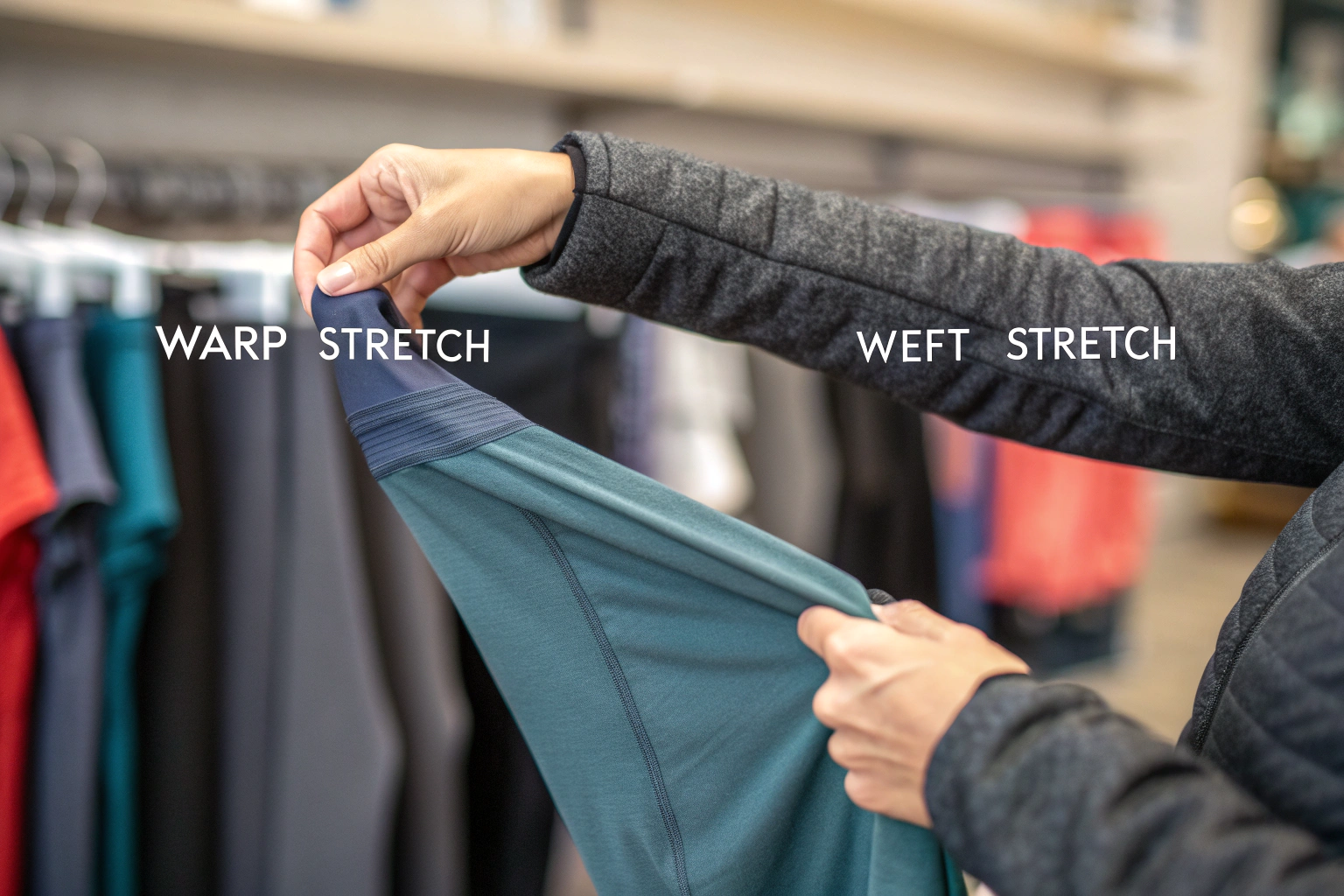
Bi-stretch fabric—also called four-way stretch or two-directional stretch—stretches and recovers in both the warp and weft directions. It is not a single fiber or a single construction. It is a performance specification achieved by combining elastic fibers like spandex or elastane with rigid fibers, engineered into a knit or woven structure that allows extension in both axes. Bi-stretch is trending because the pandemic-era casualization of workwear did not recede; it solidified into a permanent expectation that clothing must perform like activewear while looking like tailored apparel. At Shanghai Fumao, bi-stretch fabrics now account for a growing share of our development pipeline, from cotton-spandex woven shirting to recycled polyester-spandex suiting. I am going to explain what makes a fabric truly bi-stretch, how the stretch is engineered differently in knits and wovens, and how to specify a bi-stretch fabric that delivers the performance your customer now expects as baseline.
How Does Bi-Stretch Differ Mechanically from Two-Way Stretch?
The stretch direction of a fabric is determined by where the elastic yarn is placed during knitting or weaving. Two-way stretch—also called one-directional stretch—places the elastic yarn in either the warp or the weft, but not both. The fabric stretches in one axis and is rigid in the other. This is the standard construction for most stretch denim, stretch chinos, and stretch shirting. The wearer gets horizontal give for bending and sitting, but the vertical length is fixed. Bi-stretch places elastic yarn in both the warp and the weft, allowing the fabric to extend and recover in both directions simultaneously.

Why Does "Elastic Placement" Determine the Stretch Axis?
In a woven fabric, the warp yarns run the length of the fabric roll, and the weft yarns run across the width. If spandex is added only to the weft yarns—typically by core-spinning a spandex filament inside a cotton or polyester sheath—the fabric stretches only in the weft direction, which becomes the horizontal direction on a garment cut on the straight grain. If spandex is added to both the warp and the weft yarns, the fabric stretches in both directions.
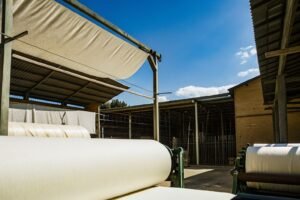
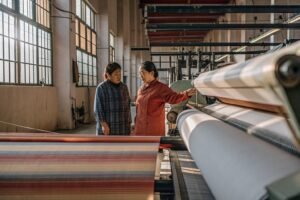
Warp spandex is more technically challenging than weft spandex. The warp yarns are under high tension during weaving, and spandex is sensitive to heat and tension. If the warp spandex is stretched beyond its elastic limit during the weaving process, it loses recovery power and the fabric will bag out rather than snap back. Warp spandex also requires careful control of the weaving loom’s let-off and take-up mechanisms to maintain consistent tension. This technical difficulty is why bi-stretch wovens are more expensive and less common than two-way stretch wovens. The mill must have the equipment and the expertise to handle warp-elastic yarns.
What Is the "Stretch Percentage" Test for Both Directions?
Stretch percentage is measured by cutting a fabric specimen, marking a known gauge length on it, applying a specified load, and measuring the extended length. The formula is: ((Extended Length minus Original Length) divided by Original Length) multiplied by 100. The test is performed separately on the warp and the weft specimens.
A true bi-stretch fabric should achieve a minimum of 15% to 20% stretch in both directions. For activewear and high-mobility garments, 30% to 50% stretch is common. The recovery percentage—how much of the stretch returns when the load is removed—is equally important. A fabric that stretches 30% but only recovers 80% of that extension will bag out after wear. A high-quality bi-stretch fabric should recover at least 90% of its extension in both directions after repeated stretching. At Shanghai Fumao, I test stretch and recovery on both axes for every bi-stretch development lot.
Why Are Bi-Stretch Wovens More Complex Than Bi-Stretch Knits?
Knits are inherently stretchy. The looped structure allows the fabric to extend in both directions even without spandex, simply by deforming the loops. Adding spandex to a knit makes the stretch more controlled and improves recovery, but the base structure already provides multi-directional give. A bi-stretch knit is relatively straightforward to engineer.
Wovens are inherently rigid. The perpendicular interlacing of warp and weft yarns creates a stable, low-stretch structure. Making a woven fabric stretch in both directions requires adding elastic yarns to both axes and engineering the weave to allow those elastic yarns to extend without compromising the fabric’s stability. This is a significantly more complex engineering challenge.

How Does "Crimp" Allow Woven Cotton to Stretch Without Spandex?
Mechanical stretch—stretch achieved without spandex—uses the natural crimp in the yarns. In a tightly woven rigid fabric, the warp and weft yarns are nearly straight. When the fabric is pulled, the yarns themselves must stretch, and they do not stretch much. In a mechanically stretchy woven, the yarns are woven in with a high degree of crimp—they curve up and down significantly as they pass over and under each other. When the fabric is pulled, the crimped yarns straighten out before the fibers themselves are stretched. This straightening of the crimp provides the stretch, and the yarn’s natural elasticity provides the recovery.
A bi-stretch mechanical woven requires crimp in both the warp and weft directions. The yarn selection, the weave structure, and the finishing processes all influence how much crimp is built in and how much of it recovers. Mechanical bi-stretch is less powerful than spandex-based bi-stretch—typically 8% to 15% stretch versus 20% to 50%—but it is more durable, more resistant to heat and chlorine, and often preferred for premium tailored garments where a subtle, natural stretch is more desirable than a technical, legging-like stretch.
Why Does "Warp Spandex" Require Specialized Looms?
Weft spandex is inserted by the weft insertion mechanism—a rapier, a projectile, or an air jet. The spandex yarn is under relatively low tension and is not subjected to the abrasive forces of the warp shedding motion. Standard looms can handle weft spandex with minor modifications. Warp spandex is fundamentally different. The warp yarns are held under high tension for the entire duration of the weaving process. They pass through the heddles, which move up and down thousands of times per hour, creating constant abrasion. A spandex core-spun warp yarn can lose its elasticity if the tension is too high, or it can create uneven fabric if the tension varies across the width of the warp beam.
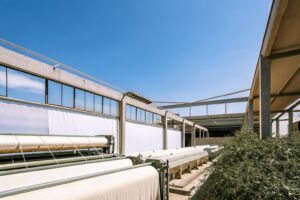
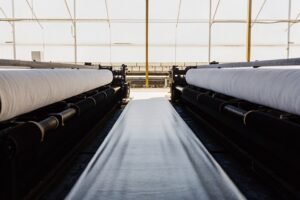
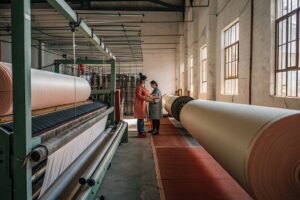
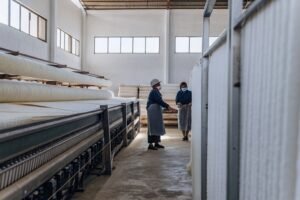
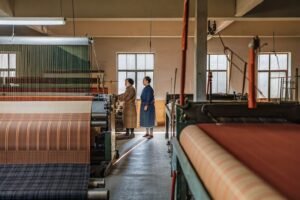
Specialized let-off mechanisms that maintain constant, low tension on the warp beam are required. The loom must be equipped with individual warp tension control or at least finely adjustable sectional beams. The weaving shed must be set to minimize abrasion on the elastic warp yarns. These requirements are not met by every weaving mill. A mill that produces excellent two-way stretch wovens may not have the equipment to produce bi-stretch wovens. At Shanghai Fumao, I invested in warp-elastic capable looms specifically to meet the growing demand for bi-stretch woven fabrics.
What Apparel Categories Are Driving Bi-Stretch Demand in 2026?
Bi-stretch is not a single market trend. It is a convergence of three separate apparel categories that are all demanding multi-directional stretch: tailored commuter wear, sculptural womenswear, and technical outdoor apparel. The common thread across all three is the consumer’s refusal to accept the trade-off between appearance and comfort that previous generations accepted as normal.

Why Is "Commuter Tailoring" the Biggest Growth Driver?
The return to office is real, but the office dress code has permanently shifted. Workers who spent two years in sweatpants during the pandemic are not willing to return to rigid, restrictive suiting. They demand trousers, blazers, and shirting that look tailored but feel like activewear. Bi-stretch woven fabrics are the material solution to this demand.
A bi-stretch cotton-nylon-spandex chino fabric allows a pant to hold a sharp crease, drape cleanly from the hip, and simultaneously accommodate a deep squat, a bike commute, or a cross-legged meditation session. The fabric stretches in the warp to release knee tension when sitting, and in the weft to release seat tension when bending. The recovery in both directions pulls the fabric back to its original shape when standing. This is the "commuter pant" category that has exploded in menswear and is now expanding rapidly in womenswear. I develop bi-stretch fabrics for multiple commuter-focused brands at Shanghai Fumao, and the demand growth year-over-year has been in double digits.
How Does Bi-Stretch Enable "Second-Skin" Silhouettes Without Compression?
Compression garments use high-power spandex to squeeze the body. Bi-stretch fabrics with moderate stretch power and high recovery enable a different aesthetic: the "second-skin" silhouette. The fabric follows the body’s contours closely without squeezing. It accommodates movement without riding up, pinching, or creating restriction lines.
This is the fabric category behind the sculptural bodycon dresses, the fitted knit blazers, and the sleek yoga-to-brunch tops that dominate contemporary womenswear. The bi-stretch property allows the garment to map to the body in three dimensions as the body moves, rather than stretching in only one axis and pulling uncomfortably in the other. The recovery ensures the garment returns to its intended shape rather than bagging out at the elbows, knees, and seat over the course of a day’s wear. The consumer experience is a garment that feels like a second skin, not a restrictive shell.
How to Test and Specify Bi-Stretch Recovery in Your Purchase Order?
A bi-stretch fabric that stretches but does not recover is worse than a rigid fabric. It bags, sags, and distorts, and the consumer cannot fix it by washing or ironing. Specifying bi-stretch performance in your purchase order means specifying not just the stretch percentage, but the recovery percentage, the test method, and the minimum acceptable values for both directions.

What Is "Growth" and Why Is It the Hidden Killer of Bi-Stretch Fabrics?
Growth is the permanent elongation that remains after a fabric has been stretched and allowed to recover. It is measured as a percentage: if a 10cm specimen is stretched to 13cm, and after recovery it measures 10.5cm, the growth is 5%. Growth is the difference between stretch and recovery. A fabric can have impressive stretch numbers and terrible growth numbers.
Growth occurs when the elastic yarn is over-stretched during processing or when the rigid yarn in the blend has been permanently deformed. In a bi-stretch fabric, growth can occur in either direction independently. A bi-stretch pant with high weft growth will bag at the seat. A bi-stretch pant with high warp growth will lose its crease and develop knee bags. I test growth after a standard stretch-and-recover cycle, typically 30 minutes of extension at a specified percentage followed by 30 minutes of relaxation. A growth value below 5% is acceptable for most applications. Below 3% is premium.
How to Write a Bi-Stretch Specification That Prevents Recovery Failures?
Write this line in your purchase order: "Bi-Stretch Performance: Warp stretch minimum 20%, weft stretch minimum 25%, per ASTM D3107. Warp growth maximum 4%, weft growth maximum 4%, measured after 30 minutes extension at 80% of maximum stretch, 30 minutes recovery. Both directions to be tested and reported."
This specification is specific, measurable, and enforceable by a third-party lab. The ASTM D3107 test method defines the stretch and growth measurement procedure. The 80% extension level simulates real wear—the fabric is not stretched to its absolute limit—and the 30-minute recovery time simulates the rest period between wears. A fabric that passes this specification will perform reliably in a garment. I include this specification in every bi-stretch development agreement at Shanghai Fumao, and I provide the corresponding lab report from our CNAS-accredited testing center for every bulk lot.
Conclusion
Bi-stretch fabric stretches and recovers in both the warp and weft directions, providing freedom of movement that two-way stretch cannot match. The stretch direction is determined by where the elastic yarn is placed during construction, and true bi-stretch requires elastic in both axes. Bi-stretch wovens are technically more complex than bi-stretch knits because warp spandex requires specialized loom tension control and abrasion management. The trend is driven by the permanent shift in consumer expectations—the commuter who wants tailoring with activewear comfort, the fashion customer who wants sculptural silhouettes without restriction, and the outdoor enthusiast who wants technical performance without a technical aesthetic. Specifying bi-stretch means specifying not just stretch percentage, but growth and recovery, using a defined test method and enforceable minimum values.
At Shanghai Fumao, I develop bi-stretch woven and knit fabrics across the casual, tailored, and performance categories, with stretch percentages from 15% to 50% and recovery rates above 95%. If you are developing a product that requires true multi-directional stretch and you want a fabric supplier who understands the difference between stretch and recovery, please contact our Business Director, Elaine. She can send you a bi-stretch swatch pack with test data for both directions so you can evaluate the performance yourself. Email her at strong>elaine@fumaoclothing.com. Let us build a fabric that moves with your customer, in every direction.