A customer buys a sharply tailored blazer from your new collection. They wear it to a business meeting, reach across the table to shake hands, and feel a subtle but alarming give at the back shoulder. By the end of the day, the sleeve seam at the armhole has opened slightly. The threads didn’t break. The fabric didn’t tear. The yarns in the woven fabric simply slid apart along the stitch line, opening a small but visible gap. The seam didn’t fail catastrophically, but the garment has lost its structural integrity. The customer returns it. Your tailor examines it and says, "The fabric has poor seam slippage resistance. Nothing we can do. It’s the material."
Seam slippage is the most underappreciated quality parameter in woven outerwear. It’s not about the sewing thread strength. It’s not about the fabric tensile strength. It’s about whether the warp and weft yarns in the fabric grip each other tightly enough to resist being pushed apart when a seam is placed under tension. A fabric can be strong, beautiful, and expensive, and still fail seam slippage. When it does, the garment looks old, worn, and cheap long before it should. At Shanghai Fumao, we test every woven fabric destined for tailored jackets, coats, and structured outerwear for seam slippage before it’s released for production. In this article, I’ll explain exactly what seam slippage is, how it’s tested, what numbers matter for different jacket types, and how to specify it in your purchase orders so you never ship a blazer that gapes at the seams.
What Exactly Is Seam Slippage and How Is It Different from Seam Strength?
Seam strength and seam slippage measure completely different failure modes, and confusing them leads to wrong fabric specifications. Seam strength measures the force required to break the sewing thread or tear the fabric at the stitch line. It answers the question: "How hard can you pull on this seam before something breaks?" Seam slippage measures the force required to make the fabric yarns slide apart sideways at the stitch line, opening a visible gap, even though nothing has broken. It answers the question: "How hard can you pull on this seam before the weave opens up and the garment looks damaged?"
The distinction matters because a fabric can have excellent seam strength but terrible seam slippage resistance. A tightly woven fabric with strong yarns will resist breaking under tension—high seam strength. But if those yarns are smooth and the weave has long floats with few interlacement points, the yarns will slide past each other easily—poor seam slippage resistance. This combination is common in filament polyester suitings and tightly twisted cotton sateens. The yarns are individually strong, but they don’t grip each other. The seam holds, but the fabric opens around it. For a jacket, where seams at the shoulder, armhole, and back are subjected to repeated stress from normal arm movement, seam slippage is often the more critical parameter. A broken seam can be re-sewn. A slipped seam has permanently distorted the fabric structure, and the garment is ruined. The seam slippage versus seam strength definitions, failure mode distinctions, and testing methodology differences for woven apparel fabrics provides the detailed technical explanation.

How Does Weave Structure Affect Seam Slippage Resistance?
The weave structure determines how much friction exists between warp and weft yarns to resist sliding. A plain weave, where every warp yarn goes over one weft and under the next in a constant up-down pattern, has the maximum number of interlacement points per inch. Each yarn changes direction at every intersection, creating high crimp and high friction. Yarns in a plain weave fabric resist sliding because they’re locked in by frequent directional changes. A twill weave, where the warp goes over two or three wefts before going under one, has fewer interlacement points and longer floats. The yarns have more freedom to slide along those floats before encountering an interlacement point that resists movement.
A 2/1 twill has moderate slippage resistance. A 3/1 twill, with longer floats, has lower slippage resistance. A 4/1 satin, with very long floats, has the lowest slippage resistance of all. This is why satin linings in jackets are frequent sites of seam slippage failure—the satin weave provides a beautiful smooth surface and lustrous drape, but its long floats offer minimal resistance to yarn sliding. A jacket lining sewn in a satin weave can develop gaping seams at the armhole and back after relatively few wearings if the fabric wasn’t specifically engineered for slippage resistance. At Shanghai Fumao, when we develop a satin-weave lining fabric, we increase the weft density—more picks per inch—to compensate for the low-interlacement weave structure. The tighter packing creates additional friction between yarns, offsetting the slippage-prone geometry of the satin weave. The effect of weave structure and fabric density on seam slippage resistance in woven apparel and outerwear textiles provides the comparative data across weave types.
Why Are Tailored Jackets Especially Vulnerable to Seam Slippage?
Tailored jackets concentrate stress at specific seams in ways that casual garments do not. The shoulder seam and armhole seam bear the weight of the entire sleeve, plus the stress of every arm movement—reaching forward, lifting, extending. These are not one-time high-force events; they’re repeated, moderate-force events that accumulate over time. Each reach stresses the seam slightly. Over hundreds of cycles, the yarns at the stitch line gradually work loose and begin to slide. The consumer doesn’t notice a single event; they notice that their jacket "looks tired" after a season of wear.
The tailored jacket’s construction amplifies the problem. The multiple layers at the shoulder—shell fabric, interfacing, lining, possibly shoulder pad and chest canvas—create thickness that concentrates stress at the seam. When the wearer moves, the outer shell fabric takes the highest strain because it’s the outermost layer with the largest circumference around the body curve. The lining and inner layers can shift slightly; the outer shell cannot. The structured nature of tailoring also means the seam is expected to lie flat and smooth. A 2mm seam opening that would be invisible in a relaxed, unstructured garment is glaringly obvious in a crisp tailored jacket where every seam line is supposed to be sharp and clean. The aesthetic demand of tailoring—sharp lines, flat seams, structured silhouette—leaves no tolerance for the visible signs of seam slippage. The stress distribution in tailored jacket seams and the mechanical factors contributing to seam slippage failure in structured woven outerwear provides the biomechanical analysis of seam loading.
What Does a Standard Seam Slippage Test Actually Measure?
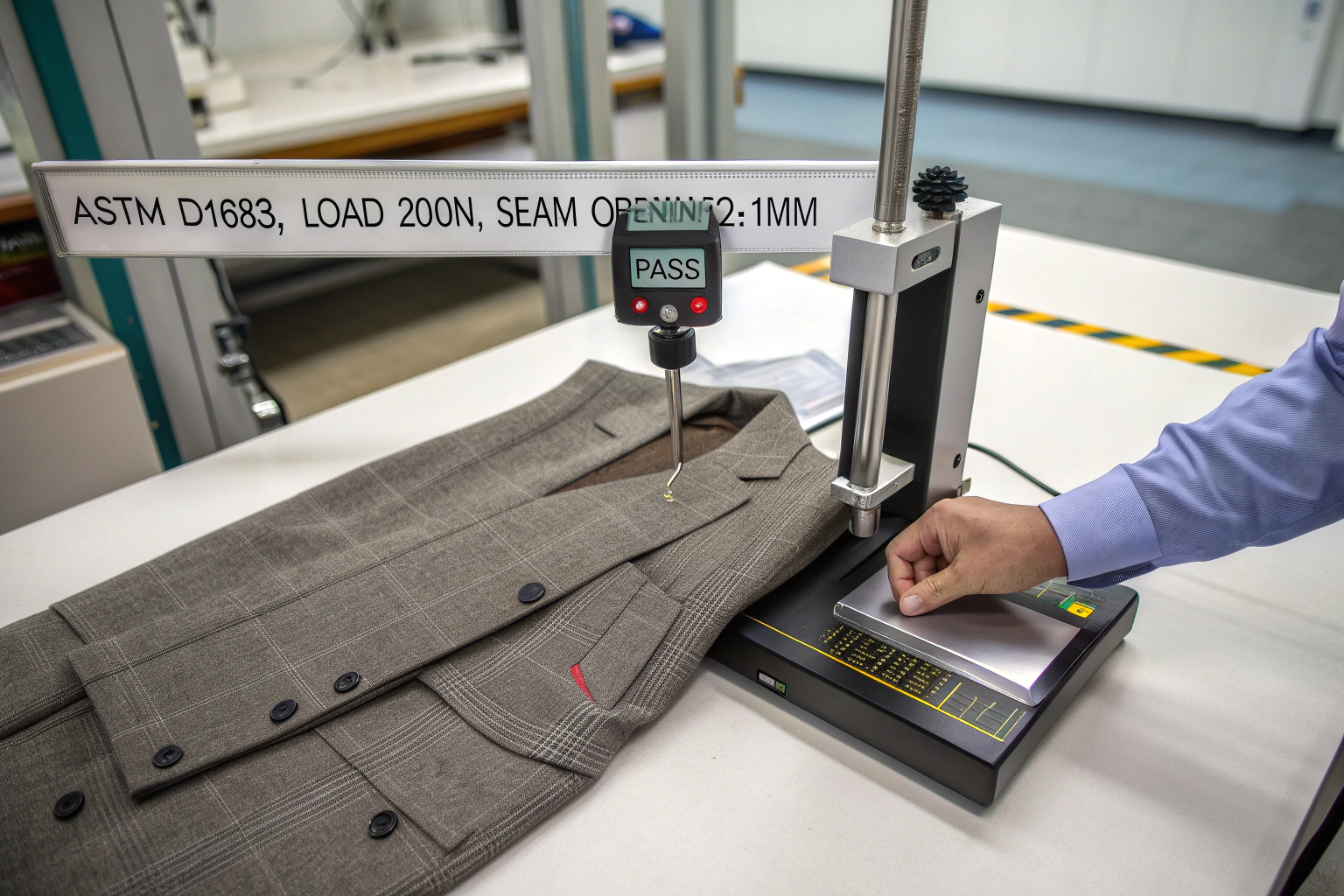
The standard seam slippage test, defined in ASTM D1683 for woven fabrics, is mechanically simple but precise in its interpretation. A fabric specimen is cut, folded, and sewn with a standardized seam—specified stitch type, thread type, and stitch density—across its width. The sewn specimen is clamped in a tensile testing machine with the seam running horizontally between the jaws. The machine pulls the specimen apart, applying force perpendicular to the seam, and measures the resulting opening between the two fabric edges at the seam. The test records either the force required to achieve a specified seam opening—typically 6mm—or the seam opening at a specified force, depending on which standard procedure is followed.
The most common procedure for apparel fabrics, ASTM D1683 Procedure D, applies a fixed force—typically 100N, 150N, or 200N depending on the fabric weight and end-use—and measures the resulting seam opening in millimeters. The fabric passes or fails based on whether the opening exceeds a specified limit at that force. For tailored jackets, the typical specification is a maximum seam opening of 2.5mm at a 150N or 200N load. A result below 2.5mm indicates the fabric structure resists yarn sliding well enough for tailored garment use. A result above 2.5mm indicates the seam will visibly gape during normal wear, and the fabric is unsuitable for structured jackets without modifications to the weave density, yarn type, or seam construction. The ASTM D1683 standard test method for failure in sewn seams of woven fabrics including seam slippage measurement procedure D provides the full specimen preparation, testing parameters, and measurement protocol.

What Is the Difference Between the Fixed-Load and Fixed-Opening Methods?
ASTM D1683 offers two approaches to measuring seam slippage. The fixed-load method applies a predetermined force and measures how far the seam opens. The result is a distance in millimeters at a specific force—for example, "2.1mm at 200N." This is the most common method for apparel quality specifications because it directly answers the question: "If this jacket experiences X force at the shoulder, how big will the seam gap be?" The fixed-opening method works in reverse. It measures how much force is required to open the seam to a predetermined distance, typically 6mm. The result is a force in Newtons at a specific opening—for example, "285N at 6mm opening."
The fixed-load method is generally preferred for apparel because it simulates real-world loading conditions. The garment experiences a certain force at the seams during wear, and the test tells you whether the resulting seam opening will be visible. The fixed-opening method is more common for technical textiles and industrial fabrics where a specific gap size defines functional failure. For jacket specification, I recommend the fixed-load method because it aligns with how the garment is actually stressed. A specification of "Maximum 2.5mm seam opening at 200N load per ASTM D1683 Procedure D" is clear, enforceable, and directly relevant to the jacket’s performance in use. The fixed-load versus fixed-opening seam slippage measurement methodologies and their applicability to different apparel end-use categories provides the comparative analysis and application guidance.
Why Does Stitch Density Affect Seam Slippage Test Results?
The seam slippage test result is sensitive to how the seam was sewn, not just the fabric’s inherent properties. A seam sewn with 3 stitches per centimeter concentrates the applied load onto fewer stitch points than a seam sewn with 5 stitches per centimeter. Each stitch point is a stress concentrator that pushes against the fabric yarns. Fewer stitch points means higher force per point, which means more yarn sliding. The stitch density must be standardized in the test to produce results that reflect the fabric’s slippage resistance, not the sewing variability.
ASTM D1683 specifies a standard stitch density of 5 stitches per 25mm, or 2 stitches per centimeter, for the test seam. But this is a testing standard, not a production sewing standard. Most tailored jackets are sewn with a higher stitch density—typically 3 to 4 stitches per centimeter for outer seams and 4 to 5 stitches per centimeter for high-stress seams. The higher production stitch density actually improves seam slippage resistance because the load is distributed across more contact points, each one pushing less forcefully against the fabric yarns. The seam slippage test at the standard 2 stitches per centimeter is therefore conservative—it tests the fabric under a worst-case sewing scenario. If the fabric passes at 2 stitches per centimeter, it will perform even better at the higher production stitch density. However, if the production sewing spec uses a lower stitch density than the test standard—which occasionally happens in budget production—the real-world seam slippage will be worse than the test predicts. The effect of stitch density on seam slippage test results and the relationship between testing standard stitch specifications and production sewing parameters provides the experimental data.
What Seam Slippage Values Are Acceptable for Different Jacket Types?
The acceptable seam slippage value is not a single number for all jackets. It scales with the fabric weight, the garment’s structural demands, and the consumer’s expectations for longevity and appearance. A lightweight unconstructed linen blazer worn casually over a t-shirt experiences lower seam stress and has a more relaxed aesthetic. A 3mm seam opening at the shoulder might be unnoticeable in a slouchy linen piece. A structured wool suit jacket worn in a professional environment with sharp tailoring expectations cannot tolerate that same 3mm gap. The same measurement means different things in different products.
For lightweight unstructured jackets—linen, cotton, lightweight blends under 200gsm, garments without heavy interfacing or shoulder pads—a maximum seam opening of 3.0mm at 150N is a reasonable specification. The garment isn’t expected to withstand heavy structural loads, and a slight relaxation at the seams is consistent with the casual aesthetic. For standard tailored jackets—wool suitings, cotton twill blazers, structured polyester-viscose blends between 200 and 300gsm—a maximum seam opening of 2.5mm at 200N is the industry standard. This is the most common jacket category, and 2.5mm at 200N provides a good balance between fabric drape requirements and structural integrity. For heavy-duty jackets—waxed cotton field jackets, heavy wool overcoats, technical outerwear shells over 300gsm—a maximum seam opening of 2.0mm at 200N or 2.5mm at 250N is appropriate. These garments are expected to endure hard wear, heavy loading at pockets and closures, and a long service life. The seam slippage specification should reflect those demands. At Shanghai Fumao, we categorize every woven fabric into one of these three tiers based on the intended jacket end-use, and we test and report seam slippage values against the tier-appropriate standard. The seam slippage acceptance criteria by garment category, fabric weight, and consumer performance expectations for woven outerwear and tailored clothing provides the detailed specification framework.

How Does Lining Fabric Seam Slippage Differ from Shell Fabric?
Jacket linings present a special seam slippage problem. The lining is usually a lightweight, smooth fabric—viscose, acetate, polyester, or a blend—with a satin or plain weave construction. It’s sewn into the jacket interior with seams that mirror the shell seams but carry different loads. When the wearer puts on the jacket, the lining takes stress at the armhole and back as it slides over the clothing underneath. The lining seams are less visible than the shell seams—they’re inside the garment—but a failed lining seam is just as damaging to the consumer experience. A lining that gapes at the armhole catches on the wearer’s shirt sleeve. A lining that slips at the center back pulls tight and restricts movement.
Lining seam slippage specifications are typically more lenient than shell specifications because the lining is hidden and the aesthetic demand is lower. A maximum seam opening of 4.0mm at 100N is a common specification for jacket linings. However, the test load is lower because the lining fabric is lighter—applying a 200N load to a 75gsm lining would simply tear it, not measure its slippage resistance. The load must be appropriate to the fabric weight. The key specification for linings is not just the opening at a load, but the load at which slippage begins. A lining that starts to slip at very low loads—below 50N—will develop visible gaping after minimal wear, even if the opening at 100N is technically within specification. The seam slippage testing and specification for lightweight woven lining fabrics used in tailored jackets and structured outerwear provides the adjusted load levels and acceptance criteria.
What Happens If My Fabric Fails the Seam Slippage Test?
A failed seam slippage test on a fabric destined for jackets is not necessarily the end of that fabric. It’s a signal that the fabric, as currently constructed, is not suitable for the intended end-use. There are corrective actions, but they must be evaluated honestly. The most direct fix is to increase the fabric density—more warp ends per inch, more weft picks per inch. This increases the inter-yarn friction by packing the yarns closer together. A 5% to 10% increase in thread count can improve seam slippage resistance by 20% to 30% in many weaves. However, increasing density changes the fabric weight, hand feel, drape, and cost. The fabric the buyer approved may not be the fabric that passes the slippage test at the higher density.
If density adjustment is not acceptable, the next option is to change the weave structure to one with more interlacement points. A 2/1 twill can replace a 3/1 twill, increasing the crimp and friction without changing the yarn count or the overall fabric weight significantly. The hand feel will become slightly less soft and the drape slightly less fluid, which may or may not be acceptable for the jacket’s design intent. The final option is to change the yarn type—using a spun yarn instead of a filament yarn, or using a yarn with higher twist, or using a yarn with a rougher surface texture. All of these increase inter-yarn friction. The corrective action must be a collaborative decision between the buyer and the mill, balancing the aesthetic requirements of the fabric with the mechanical requirements of the end-use. At Shanghai Fumao, we present the failed test results along with the fabric engineer’s recommended corrective action and the expected aesthetic impact, so the buyer can make an informed decision. The corrective action options for woven fabrics failing seam slippage testing and the trade-off analysis between structural modifications and fabric aesthetics provides the engineering framework for this decision.
How Do I Write a Seam Slippage Specification in My Purchase Order?
A vague quality expectation is unenforceable. "Fabric must not slip at the seams" is a wish, not a specification. The purchase order must define the exact test method, the exact test parameters, and the exact acceptance criteria. When the fabric arrives and a quality dispute arises, the specification in the purchase order is the objective reference that determines whether the fabric passes or fails. Without it, the dispute is a subjective argument. With it, the dispute is a measurement exercise.
A proper seam slippage specification includes six elements. First, the test method: ASTM D1683 Procedure D for fixed-load measurement, or the equivalent ISO 13936-2. Second, the test load: 150N for lightweight jackets, 200N for standard jackets, 250N for heavy-duty jackets. Third, the maximum acceptable seam opening: typically 2.5mm for standard tailored jackets at the specified load. Fourth, the seam construction used for the test: the standard 301 lockstitch with specified thread type and 5 stitches per 25mm. Fifth, the test direction: both warp and weft, because slippage can differ significantly between the two directions. Sixth, the reporting requirements: the test report must state the seam opening at the specified load for each direction, and note any fabric rupture or thread breakage if it occurs. At Shanghai Fumao, we recommend this exact specification language to our jacket clients: "Seam slippage per ASTM D1683 Procedure D, load 200N, maximum opening 2.5mm in warp and weft directions. Seam: 301 lockstitch, 40s/2 spun polyester thread, 5 stitches per 25mm. Report opening distance and any thread or fabric failure." The purchase order quality specification language for seam slippage testing in woven apparel fabrics and outerwear procurement provides model contract language for different garment categories and test standards.

Should I Specify Seam Slippage for Both Warp and Weft Directions?
Yes. Seam slippage is often anisotropic—the resistance is different in the warp direction versus the weft direction because the yarn types, yarn densities, and weave crimp distribution differ between the two axes. A fabric that passes easily in the warp direction may fail in the weft direction, or vice versa. Testing only one direction and assuming the other is similar is a gamble. A jacket seam at the shoulder is oriented primarily across the weft direction. A jacket seam at the side body is oriented primarily across the warp direction. Both seam orientations exist in every jacket, and both need to resist slippage.
The specification should state the maximum seam opening for both directions individually, not an average across the two. An average hides a directional failure. A fabric with a warp opening of 1.5mm and a weft opening of 3.5mm has an average of 2.5mm and would pass an average-based specification. But the 3.5mm weft opening is well above the 2.5mm maximum for a standard tailored jacket, and the side-body seams oriented in that direction will gape visibly. The specification should be written as "Maximum 2.5mm opening in warp direction, maximum 2.5mm opening in weft direction." Both must pass. The directional seam slippage measurement and specification requirements for woven garment fabrics accounting for warp-weft anisotropy provides the experimental data on directional variation.
How Does Fabric Finish Affect Seam Slippage Test Results?
Fabric finishes, particularly softeners and lubricating agents, reduce inter-yarn friction and can significantly worsen seam slippage resistance. A silicone softener applied to give a luxurious, slick hand feel coats the yarn surfaces with a low-friction film. The yarns slide past each other more easily, and the seam slippage test result degrades—sometimes dramatically. A fabric that passes seam slippage at 2.0mm in its greige state might fail at 3.5mm after a heavy silicone softener is applied. The softener was added to improve the hand feel, but it destroyed the seam integrity.
This is a classic textile engineering trade-off. Soft hand feel and seam slippage resistance pull in opposite directions. The solution is to measure seam slippage on the finished fabric, not the greige, and to engineer the finish to achieve the required hand feel with the minimum possible friction reduction. This might mean using a lower concentration of softener, a different softener chemistry that provides hand feel with less lubrication, or a mechanical softening process like air-tumbling that softens without chemical lubrication. At Shanghai Fumao, we test seam slippage on the fully finished fabric as part of our standard quality protocol, and we adjust finish formulations for jacket fabrics to maintain slippage resistance above the specified minimum while still delivering the required hand feel. The effect of textile finishing agents, particularly silicone softeners, on the seam slippage resistance of woven fabrics and finish engineering strategies to balance hand feel and structural integrity provides the comparative data across finish types and concentrations.
Conclusion
Seam slippage is not a defect that announces itself on day one. It’s a gradual structural degradation that transforms a sharp, tailored jacket into a tired, gaping disappointment over months of normal wear. The consumer can’t diagnose it. They only know their expensive blazer doesn’t look right anymore. The tailor can diagnose it but can’t fix it. The fabric structure is permanently distorted. The only solution is prevention—engineering the fabric with sufficient inter-yarn friction, testing it to a meaningful standard, and specifying the acceptable limit in the purchase order before production begins.
For a brand that builds its reputation on tailored outerwear, seam slippage is not a minor technical footnote. It’s a direct threat to the product’s longevity and the brand’s quality perception. A jacket that holds its structure through years of wear builds customer loyalty. A jacket that gapes at the seams after one season destroys it. The test exists. The standards are published. The specifications are straightforward. The only question is whether your mill is testing it, and whether you’re asking for the results.
If you’re developing a tailored jacket program, or if you’ve experienced unexplained seam gape in a previous production and you want to make sure it doesn’t happen again, reach out to us. At Shanghai Fumao, we include seam slippage testing as a standard part of our woven fabric quality protocol for all tailored garment applications. Our Business Director, Elaine, can share our seam slippage specification template and walk you through the testing data for the specific fabrics you’re considering. She’s at elaine@fumaofabric.com. Let’s build jackets that hold their shape as long as your customer wants to wear them.