Every year around this time, I get the same panicked email from at least five clients. "Mr. Ma, I just heard OEKO-TEX is changing the rules again. Does this mean my entire collection is non-compliant? Do I need to recall my inventory?" I understand the anxiety. OEKO-TEX certification is the single most important chemical safety standard for textile buyers in Europe and North America. When the limits change, the commercial implications ripple through the supply chain from dye houses to department stores. But here is what I always tell my clients: the annual OEKO-TEX update is not a trap. It’s a roadmap. And if you work with a mill that stays ahead of it, like we do at Shanghai Fumao, the new standards are not a crisis—they are a competitive advantage.
I have spent the last several months reviewing the pre-released updates for the 2027 OEKO-TEX standards cycle. The official update is published at the beginning of the calendar year, with transition periods built in for compliance. The 2027 changes are significant. They are not minor adjustments to existing limits. They introduce new substance categories, tighten existing thresholds to levels that some conventional dye houses cannot meet without process changes, and expand the scope of what the standard covers. The European Commission’s chemical strategy and the growing consumer anxiety about microplastics are driving these changes, and they will separate the truly compliant mills from the pretenders.
This article is a practical, factory-floor breakdown of what is changing, why it matters for your fabric sourcing, and how Shanghai Fumao is already adapting our dyeing and finishing processes to meet the 2027 thresholds. I will share the specific numbers, the new test methods, and the questions you should be asking your suppliers right now to ensure your 2027 production is not stuck at the border with a failed chemical test.
What Are the Key Chemical Limit Changes in OEKO-TEX Standard 100 for 2027?
The OEKO-TEX Association updates its test criteria and limit values annually, based on the latest scientific research and regulatory developments. The updates that take effect in 2027 reflect several converging trends: the EU’s continued crackdown on endocrine-disrupting chemicals, new toxicological data on specific substance classes, and a broader societal demand for cleaner manufacturing. For a fabric buyer, the most impactful changes cluster around three areas: bisphenols, heavy metals, and preservatives used in finishing.
Let me be specific about the numbers, because vague warnings are useless for making sourcing decisions. Bisphenol A, a chemical used in the production of certain polyester and polycarbonate materials, is facing a drastically reduced limit in the baby product class, and new restrictions are being extended to additional bisphenol analogues. Total heavy metal limits are being re-evaluated, with particular scrutiny on antimony—a common catalyst residue in standard polyester polymerization. And formaldehyde limits, which have been stable for several cycles, are being tightened for articles that come into direct skin contact. These are not theoretical changes. A dye house that has not upgraded its chemical management system will struggle to meet the new formaldehyde thresholds on resin-finished woven fabrics. If your supplier cannot demonstrate consistent compliance with the 2027 limits, your goods are at risk.
| Substance Class | OEKO-TEX 2026 Limit (Product Class I – Baby) | OEKO-TEX 2027 Limit (Product Class I – Baby) | Key Impact on Fabric Sourcing |
|---|---|---|---|
| Bisphenol A (BPA) | 100 mg/kg | 10 mg/kg (proposed 90% reduction) | Polyester-containing blends must source BPA-free polymerization; recycled PET requires rigorous sorting |
| Bisphenol Analogues (BPS, BPF, etc.) | Not individually restricted | New total sum limit of 10 mg/kg for all bisphenols | Polycarbonate-based trims and certain coating resins affected |
| Formaldehyde | 16 mg/kg (previously not detected) | < 16 mg/kg with lower detection threshold | Resin-finished wovens (anti-wrinkle, easy-care) require reformulated crosslinking agents |
| Antimony (Sb) | 30 mg/kg extractable | 5 mg/kg extractable (proposed) | Standard polyester catalyst residue; requires antimony-free catalyst or extensive washing |
| Chlorinated Paraffins (SCCP+MCCP) | SCCP 100 mg/kg; MCCP 100 mg/kg | Combined total 50 mg/kg | Leather and coated fabrics using chlorinated fatliquors or plasticizers affected |

Why Is Bisphenol A Facing Such a Drastic Reduction in the 2027 Standard?
Bisphenol A is an endocrine disruptor. It mimics estrogen in the human body, and even very low levels of exposure have been linked to developmental and reproductive harm in a growing body of scientific literature. The European Chemicals Agency has classified BPA as a substance of very high concern, and the EU has been progressively restricting its use in consumer products, starting with baby bottles and thermal paper, and now moving aggressively into textiles.
BPA can enter the textile supply chain through several pathways. It is a monomer used in the production of certain polyester resins. It can be present in recycled polyester if the feedstock included polycarbonate plastics. It is used in the production of some polyurethane coatings and synthetic leather. The 2027 OEKO-TEX reduction from 100 mg/kg to a proposed 10 mg/kg limit effectively requires that BPA-containing inputs be eliminated from the production process entirely. You cannot simply "wash out" BPA to meet a 10 mg/kg limit if the yarn itself contains residual monomer. At Shanghai Fumao, we have already begun qualifying BPA-free polyester yarn sources for our baby and children’s wear fabric production. Our CNAS lab now runs BPA screening on every incoming polyester yarn lot, not just on finished fabric. This upstream testing is the only way to guarantee the finished product will pass the new threshold. If you are sourcing polyester fabrics for infant or toddler products, you must ask your supplier: "Can you provide a lab report showing BPA content below 10 mg/kg, tested according to the how to test for Bisphenol A content in polyester textile products to meet OEKO-TEX 2027 baby product class limits?" If the supplier doesn’t understand the question, they are not ready for 2027.
How Will the New Antimony Limits Affect Standard Polyester Fabric?
This is the change that will catch the commodity polyester market off guard. Standard polyester is produced using antimony trioxide as a polymerization catalyst. Over 90% of the world’s virgin polyester contains antimony residue. The existing OEKO-TEX limit of 30 mg/kg extractable antimony is achievable for most standard polyester, provided the yarn has been properly washed during finishing. The proposed 2027 limit of 5 mg/kg is a different matter entirely. It pushes the threshold into a range where standard antimony-catalyzed polyester, even after thorough washing, may not consistently pass.
The solutions available are limited. One option is to use titanium-based catalyst polyester, which is antimony-free. This yarn is more expensive and has slightly different dyeing characteristics—it often dyes to a brighter white but can be more challenging to achieve deep, level blacks without adjustments to the dye recipe. Another option is to use recycled polyester from a carefully controlled bottle-flake feedstock, as bottle-grade PET typically uses a different catalyst system. At Shanghai Fumao, we have been running parallel trials on antimony-free polyester for our OEKO-TEX Class I certified fabrics. We have identified two yarn suppliers who can provide verified antimony-free filament, and we have adjusted our dyeing recipes to accommodate the different dye uptake. The fabric cost is approximately 8-12% higher, but the compliance certainty is absolute. If your brand markets "safe for sensitive skin" or "baby-safe" products, the antimony-free upgrade is a powerful marketing claim in addition to a compliance requirement. Ask your fabric supplier for an how to source antimony-free polyester yarn for OEKO-TEX standard 100 compliance with 2027 heavy metal limits certificate from their yarn spinner. If they cannot provide one, their polyester is standard antimony-catalyzed, and it may not pass the 2027 limits for baby products.
How Do the New OEKO-TEX Microplastic and Fiber Release Standards Work?
For the first time, OEKO-TEX is moving beyond chemical content and into physical environmental impact. The 2027 updates include a new, standardized test method for fiber release during washing—a direct response to the growing scientific and regulatory focus on microplastic pollution from synthetic textiles. This is not a limit value yet, in the sense of a pass/fail threshold. It is a reporting requirement. But in my experience, reporting requirements are the first step toward hard limits. The EU is already discussing microplastic release standards under the Ecodesign regulation, and OEKO-TEX is positioning itself as the testing infrastructure for that future.
The significance for fabric buyers is that synthetic textiles—polyester, nylon, acrylic—will now carry an additional layer of data. A fabric will not just be judged on whether it contains harmful chemicals. It will be judged on how much it sheds during a standardized home laundry simulation. Brands that ignore this data point are making a bet that microplastic regulation will not materialize. Given the political momentum in Europe, that is a risky bet. Brands that engage with the data now, and work with mills to reduce fiber shedding through yarn construction and finishing techniques, are building a defensible position for the regulatory future.

What Is the New OEKO-TEX Fiber Release Test Method and How Does It Work?
The test method is based on a dynamic laundering simulation. A specified sample of fabric is washed in a standardized apparatus under controlled conditions—water temperature, agitation speed, detergent type, and cycle duration. The wash effluent is then filtered through a cascade of ultra-fine filters, capturing released fibers down to a specific micron size. The captured fibers are dried, weighed, and characterized—fiber count, fiber length distribution, and mass. The result is a quantitative measure of the fabric’s tendency to shed microfibers during a typical home laundry cycle.
This is not a trivial test. It requires specialized equipment, trained technicians, and rigorous protocol adherence to produce reproducible results. Our CNAS lab has already invested in the testing apparatus and is running fiber release assays on our synthetic fabric portfolio. The initial data is fascinating and commercially relevant. Tightly twisted, high-density woven polyester sheds significantly less than brushed, fleeced, or loosely knitted polyester. Yarn structure matters more than fiber type in many cases. A filament polyester satin can shed almost zero fibers, while a low-twist open-end polyester fleece can release thousands of fibers per wash. This data allows us to guide our brand clients toward constructions that perform well on the shedding metric, future-proofing their products against the coming regulatory thresholds. If you are a brand that uses synthetic fleece or French terry, you need to start asking your mill for how to test textile microplastic fiber release during laundering according to new OEKO-TEX 2027 fiber shedding methodology data. The early movers will have a significant advantage when the EU eventually sets hard limits.
Can Finishing Treatments Reduce Fiber Shedding in Synthetic Fabrics?
Yes, and this is where the interaction between chemical compliance and physical performance becomes operationally complex. A fabric finish that reduces fiber shedding—for example, a film-forming polymer coating that binds surface fibers—is a chemical input. That chemical input must itself comply with OEKO-TEX Standard 100 limits. You cannot solve a fiber shedding problem by introducing a non-compliant chemical. The finishing treatment must be both effective at reducing shedding and clean from a chemical safety perspective.
At Shanghai Fumao, we are testing several approaches. One is a mechanical finishing process—precision shearing and singeing that removes loose surface fibers without adding chemicals. This is effective for woven fabrics and smooth knits, but less suitable for brushed textures where the surface fibers are the intended aesthetic. Another is a biodegradable, OEKO-TEX compliant film-forming finish that coats individual filaments with a thin, water-soluble polymer that reduces friction and fiber breakage during washing. This finish adds cost—approximately $0.15-0.25 per yard—but can reduce fiber shedding by 30-50% depending on the base fabric construction. The third approach is upstream: engineering the yarn itself with a higher twist and a more cohesive filament bundle that resists fibrillation. This is a design-phase intervention, not a post-production fix. The brands that will lead on microplastic performance are the ones who involve their mill in the fiber engineering stage, not the ones who ask for a "microplastic-free" fabric as an afterthought. This is a new discipline in textile sourcing, and how to reduce microplastic fiber shedding from synthetic textiles using mechanical finishing, biodegradable film forming coatings, and high twist yarn engineering for OEKO-TEX compliance is going to be a standard chapter in every technical designer’s playbook by 2028.
What Are the New OEKO-TEX Requirements for Sustainable and Circular Textiles in 2027?
OEKO-TEX has been steadily expanding its portfolio beyond the original Standard 100 chemical safety certification. The organization now offers a suite of certifications that address different aspects of sustainability: Standard 100 for chemical safety, STeP for sustainable production facilities, Made in Green for products that combine both, and the newly emphasized RESPONSIBLE BUSINESS certification. The 2027 updates integrate these certifications more tightly and introduce new criteria for circularity—the ability of a textile to be safely recycled or biodegraded at the end of its life.
For fabric buyers, the key change is the increasing linkage between the chemical content of the fabric and its end-of-life pathway. A fabric that is chemically safe for the consumer but cannot be safely recycled or biodegraded is no longer considered fully compliant with the OEKO-TEX ecosystem. The new standards push mills to think about the entire lifecycle of the textile—from the safety of the raw materials, to the efficiency of the production process, to the recyclability of the finished product. This holistic approach aligns with the EU’s circular economy action plan and the Digital Product Passport requirements that are phasing in over the next few years.

How Does OEKO-TEX "Made in Green" Differ From Standard 100 for 2027 Compliance?
Standard 100 is a product certification. It tests the finished fabric for harmful substances and certifies that it is chemically safe. It says nothing about the factory conditions under which the fabric was produced. A fabric can be Standard 100 certified while being produced in a factory with poor labor practices or uncontrolled wastewater discharge. Made in Green closes this gap. It is a combination label: the fabric must pass Standard 100 chemical testing, and the production facility must be certified under STeP, which audits environmental performance, social responsibility, occupational health and safety, and quality management.
In 2027, the distinction between these certifications becomes commercially critical. European retailers are increasingly specifying Made in Green as a minimum requirement for private label programs, not just Standard 100. They want the combined assurance of product safety and ethical production in a single, consumer-facing label. The Made in Green label also includes a unique product ID that allows the end consumer to trace the fabric’s production journey. At Shanghai Fumao, our dyeing and finishing partner facilities are STeP certified, and we produce Made in Green certified fabrics for several European brands. The additional audit burden is significant—STeP certification requires an on-site inspection by an OEKO-TEX auditor—but the commercial return is access to retailer programs that are closed to non-certified mills. If your brand sells to European department stores, ask your fabric supplier: "Do you hold how to verify OEKO-TEX Made in Green certification for fabric combining Standard 100 safety and STeP sustainable production facility audit?" If they only offer Standard 100, they may not meet the vendor requirements your retail partners are phasing in for 2027 and beyond.
What Does the "Designed for Recycling" Concept Mean for Fabric Blends?
One of the most significant shifts in the 2027 OEKO-TEX framework is the emphasis on recyclability, and this has direct implications for fabric blend choices. A fabric that blends polyester and cotton, or nylon and elastane, is chemically safe to wear but extremely difficult to recycle. Separating intimately blended fibers at scale is technically challenging and economically unviable with current infrastructure. The "Designed for Recycling" concept encourages mills and brands to use mono-material constructions—100% polyester, 100% cotton, 100% nylon—where possible, or to limit blends to combinations that are proven recyclable in existing systems.
This does not mean blends are banned. But it means a brand making recyclability claims will need to justify their blend choices. Our product development team now routinely proposes mono-material alternatives to blended fabrics. Where a client previously used a polyester-cotton poplin for a shirting program, we might propose a 100% recycled polyester poplin with a brushed finish that mimics the hand feel of cotton. The fabric performs similarly, is Standard 100 and GRS certified, and is fully recyclable in polyester mechanical recycling streams. The cost is comparable, and the recyclability story adds premium value. This is the direction the industry is moving. A how to design mono material polyester or nylon fabrics for textile to textile recyclability compliance with OEKO-TEX circular economy standards 2027 approach is not just an environmental choice; it’s a product design strategy that positions your brand ahead of the regulatory curve. At Shanghai Fumao, we are actively developing a portfolio of mono-material fabrics specifically designed for circularity, and we are advising our brand clients on how to transition their blended fabric programs to recyclable alternatives without sacrificing performance or aesthetics.
How Is Shanghai Fumao Preparing Its Supply Chain for the 2027 OEKO-TEX Updates?
At Shanghai Fumao, we treat regulatory changes not as disruptions to be managed, but as opportunities to differentiate our service from less prepared competitors. The 2027 OEKO-TEX updates have been on our radar for over a year, and we have been systematically preparing our supply chain—from yarn sourcing to dyeing to finishing to testing—to meet the new thresholds before they become mandatory. Our clients do not need to worry about whether their fabric will pass the new standards. They need to know that their mill has already done the work.
Our preparation strategy rests on three pillars: upstream verification, process reformulation, and enhanced in-house testing. Upstream verification means we audit our yarn suppliers and chemical vendors against the 2027 limits, not just the current standards. Process reformulation means our dyeing and finishing partners have already adjusted their recipes—replacing antimony-catalyzed polyester where necessary, reformulating resin finishes to meet the new formaldehyde threshold, and phasing out any auxiliary chemicals that contain restricted bisphenols. Enhanced testing means our CNAS lab now runs the full 2027 parameter set on every new development and every bulk production lot, so we have a database of real compliance data, not just theoretical compliance.

Are We Switching to Antimony-Free and BPA-Free Yarn Sources Now?
Yes, for all product classes where the 2027 limits create a compliance risk. For baby and children’s wear fabrics, we have fully transitioned our polyester sourcing to verified antimony-free and BPA-free yarns. Our two approved yarn suppliers for this category are both Bluesign and GRS certified, and they provide batch-level test reports for antimony and BPA content. We validate these reports with our own CNAS lab testing, running an extractable heavy metal panel and a BPA LC-MS/MS analysis on every incoming yarn lot. No lot enters our production system without passing our internal 2027 threshold screen.
For adult apparel fabrics, where the limits are slightly less stringent but still tightening, we are running a dual-track inventory system. We maintain a stock of standard polyester for clients who are not selling into OEKO-TEX sensitive markets, and a separate, segregated stock of antimony-free and BPA-free polyester for clients who require 2027-ready certification. The segregated inventory is stored in separate, clearly labeled warehouse zones to prevent cross-contamination. This adds operational complexity, but it gives our clients the flexibility to choose the cost-to-compliance balance that fits their market. If you are a brand that needs how Shanghai Fumao sources and verifies antimony-free and BPA free polyester yarn for OEKO-TEX 2027 baby product class compliance, we can provide the complete supplier qualification dossier and our internal validation test reports for your compliance files. This level of upstream transparency is what separates a prepared mill from a mill that is hoping the limits won’t be enforced.
What New Testing Capabilities Has Our CNAS Lab Added for 2027?
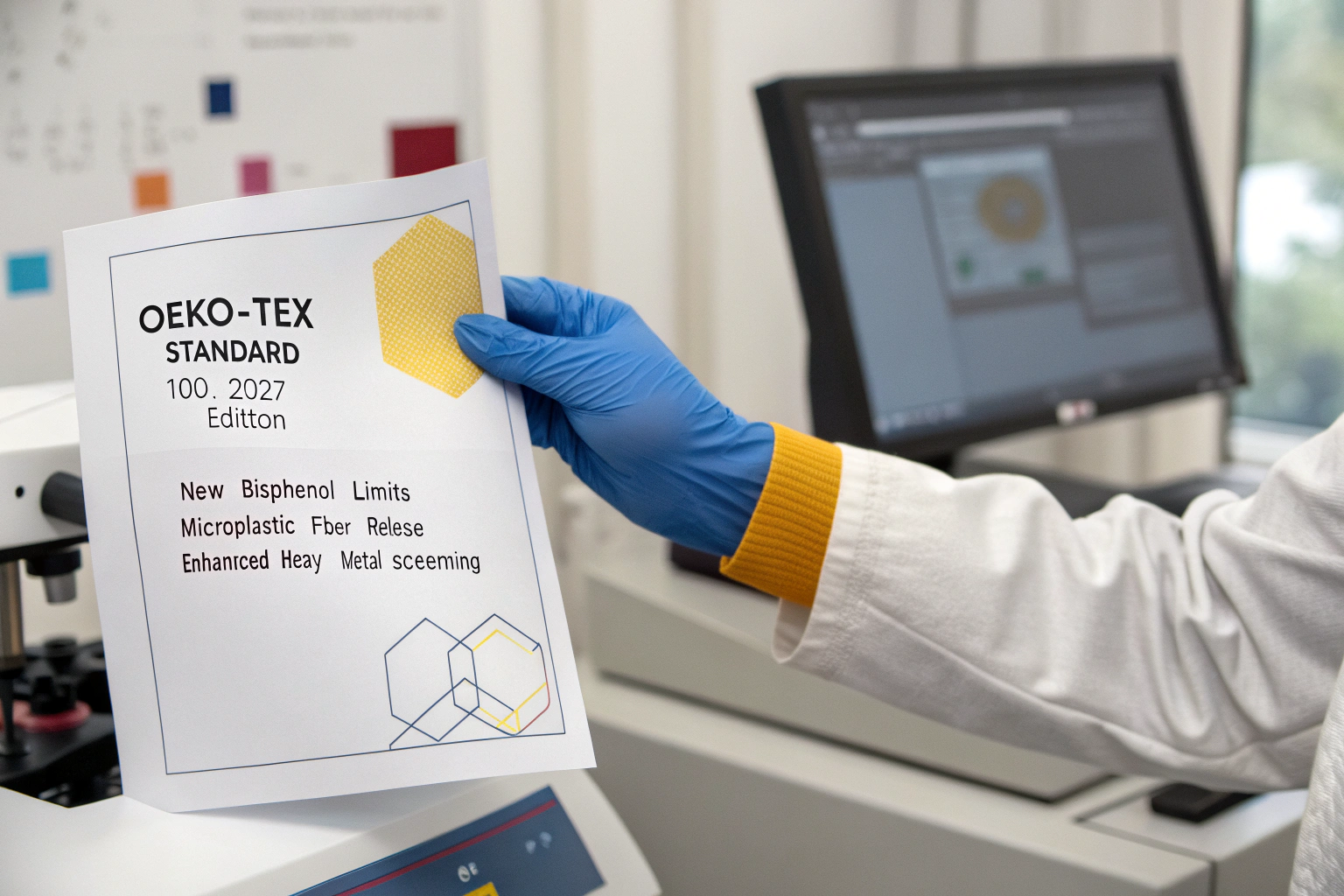
Our CNAS-accredited laboratory has added three new testing capabilities specifically to support the 2027 OEKO-TEX requirements. First, we installed a liquid chromatography-tandem mass spectrometry system capable of detecting bisphenol A and its analogues at the 1 mg/kg level—well below the proposed 10 mg/kg limit. This gives us a comfortable analytical margin. Second, we added an inductively coupled plasma optical emission spectrometer optimized for low-level antimony quantification in polyester, with a validated detection limit of 2 mg/kg. Third, we commissioned the new OEKO-TEX fiber release testing apparatus, which is now running standardized shedding assays on our synthetic fabric portfolio.
These investments total approximately ¥1.2 million, and they are a clear signal to our brand clients that we are serious about compliance leadership. The lab upgrades also support our DDP customs clearance service. When a container of our fabric arrives at a European or US port, and the customs authority questions the chemical safety documentation, our CNAS lab reports carry the evidentiary weight of an ILAC-accredited facility. The new 2027 parameters are already integrated into our digital QC system, and every bulk production lot is tested against them. The QR code on every fabric roll links to a live compliance dashboard that shows the test results for that specific lot, including the new 2027 parameters. A customs officer or a brand compliance manager can scan the code and verify, in real time, that the fabric meets the latest OEKO-TEX thresholds. This is how a Chinese textile mill with CNAS accredited laboratory prepares for and validates compliance with OEKO-TEX standard 100 2027 updates through upstream verification, process reformulation, and enhanced analytical testing capabilities in operational practice. It’s not a press release. It’s a lab full of machines running samples while I write this.
Conclusion
The 2027 OEKO-TEX updates are a meaningful tightening of the world’s most important textile safety standard. The new bisphenol limits will force polyester yarn spinners to reformulate their catalyst systems. The new antimony threshold will challenge the commodity polyester supply chain. The new fiber release testing will introduce a physical performance metric that brands have never had to consider before. And the tighter integration of Standard 100 with STeP and Made in Green will push the industry toward a more holistic definition of "safe and sustainable"—one that includes factory labor conditions and product recyclability alongside chemical content.
These changes are not a surprise. They are the predictable consequence of stronger chemical regulations in Europe, more sophisticated toxicological science, and a consumer market that increasingly equates "premium" with "proven safe." The brands that treat the 2027 updates as an administrative burden will find themselves scrambling to reformulate products, chasing paperwork, and potentially losing retail placements to better-prepared competitors. The brands that treat the updates as a strategic opportunity—an occasion to upgrade their supply chain, differentiate their marketing, and build consumer trust—will gain market share.
At Shanghai Fumao, we have already done the work. Our yarn supply chain is qualified against 2027 limits. Our dyeing and finishing processes have been reformulated. Our CNAS lab is testing to the new thresholds. Our QR code traceability system provides live compliance data for every roll we ship. When you source your 2027 collection fabrics from us, you are not hoping they pass the new standards. You are shipping fabric that was engineered to pass them from the yarn stage forward.
If you are planning your 2027 production and want certainty, not anxiety, about OEKO-TEX compliance, let’s have a technical conversation. Our Business Director, Elaine, can arrange a compliance consultation with our lab manager, share our 2027 test data for your specific fabric types, and provide sample submissions for your own third-party testing if you want independent verification. The standards are rising. Your fabric should rise with them.
Reach out to Elaine at elaine@fumaoclothing.com. Ask for the 2027 OEKO-TEX Compliance Readiness Package. Your customers are going to ask about chemical safety. Let’s make sure your fabric has the answer.