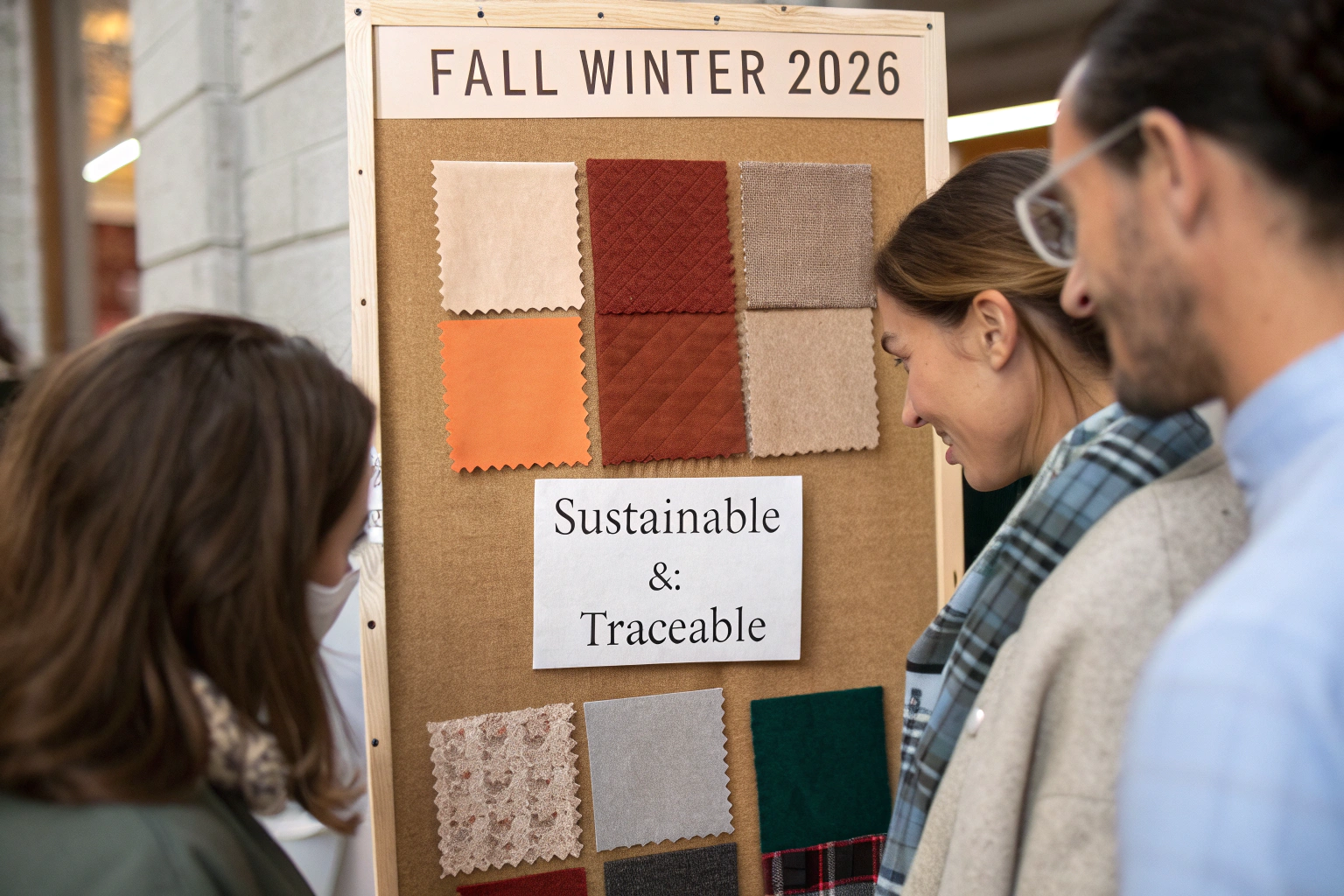
I track what buyers search for. Not what they say they want in a sustainability survey, but what they actually type into Google, into our website search bar, into the inquiry forms that land on my desk. The gap between stated preference and revealed preference in sustainable fabric sourcing is wide, and it closes in the winter months. When a brand is building a Fall-Winter collection, the stakes are higher. The garments are heavier, the price points are higher, the consumer expectations for durability and warmth are higher, and the environmental impact per unit is higher because more material goes into every coat, every sweater, every lined pant. The fabric choices made for Fall-Winter 2026 will define whether a brand’s sustainability claims hold up under the weight of actual product performance.
The search data tells a clear story. Four fabric categories are dominating sustainable sourcing inquiries heading into the Fall-Winter 2026 season. They aren’t the niche, experimental materials that populate sustainability panel discussions. They’re commercially viable, performance-proven fabrics that combine environmental credentials with the thermal, tactile, and durability properties that cold-weather apparel demands. At Shanghai Fumao, our development team has been building these fabrics for the last eighteen months in anticipation of exactly this demand shift. I’m going to walk you through what’s trending, why it’s trending, the technical details you need to evaluate these fabrics for your own collection, and the specific certifications and test standards that separate a genuine sustainable fabric from a greenwashed imitation.
Why Is Recycled Wool Coating Trending for Premium Outerwear?
Recycled wool coating is the sustainable fabric that doesn’t look sustainable. Unlike a recycled polyester fleece that broadcasts its eco-credentials through a textured, obviously-synthetic hand feel, a recycled wool melton or loden looks and feels like the classic, heritage wool coating that luxury outerwear has used for a century. It has the same dense, wind-resistant face, the same smooth milled finish, the same structured drape. The consumer gets the aesthetic and performance of traditional wool coating with the environmental narrative of circularity. This combination—traditional quality plus modern sustainability—is precisely what the premium outerwear market is demanding for Fall-Winter 2026.
The recycling process for wool is fundamentally different from polyester recycling. Recycled polyester is a chemical or mechanical breakdown of PET into polymer that is re-extruded into filament. Recycled wool is a mechanical re-spinning of pre-consumer waste—garment factory cutting scraps, yarn mill waste, and unsold inventory—back into yarn. The waste wool is sorted by color, mechanically shredded back into fiber, blended with a small percentage of virgin wool or recycled polyester for strength, and re-spun into yarn. The color of the recycled wool coating comes partially from the original colors of the waste fibers, which means no dyeing is required for dark shades like navy, charcoal, and black. This eliminates the water, energy, and chemical load of the dyeing process, which is one of the most environmentally intensive stages of textile production. At Shanghai Fumao, our recycled wool coating for Fall-Winter 2026 uses a 70% pre-consumer recycled wool, 25% recycled polyester, and 5% virgin polyamide blend. The fabric achieves a 550gsm weight with a smooth melton finish, suitable for structured overcoats and blazers. The recycled content is certified to the Global Recycled Standard (GRS), which provides chain-of-custody verification from waste source to finished fabric. The Global Recycled Standard certification requirements and verification process for recycled wool textile products ensures that the recycled content claim is audited and traceable.

How Does Recycled Wool Compare to Virgin Wool in Warmth and Durability?
The mechanical shredding process that breaks wool fabric back into fiber does shorten the fiber length. Virgin wool fibers can be 50mm to 100mm long. Recycled wool fibers, after shredding, average 15mm to 30mm. Shorter fibers produce a yarn with lower tensile strength and a fabric with slightly lower abrasion resistance. If you take a pure recycled wool yarn and weave it into a coating without any reinforcing fiber, the fabric will pill more and wear through at the elbows faster than an equivalent virgin wool coating.
The solution, and the industry standard for high-quality recycled wool coatings, is an intimate blend with a longer reinforcing fiber. Recycled polyester, typically 20% to 30% of the blend, provides the tensile backbone that the short recycled wool fibers lack. The polyester fibers are long, strong, and essentially indestructible in normal wear. They hold the shorter wool fibers in place, reducing pilling and increasing seam strength. The thermal performance of a recycled wool-polyester blend coating is functionally identical to virgin wool coating at the same weight. Wool’s warmth comes from the crimp structure of the fiber trapping air, and the crimp survives the mechanical recycling process largely intact. A 550gsm recycled wool coating will provide the same insulation as a 550gsm virgin wool coating, with perhaps a 5% to 10% reduction in breathability due to the polyester content reducing moisture vapor transmission. For the consumer wearing the coat, this difference is imperceptible. The thermal insulation and mechanical durability performance comparison of recycled wool versus virgin wool coating fabrics for outerwear applications provides the detailed material property data.
What Should a Buyer Ask for When Sourcing Recycled Wool?
The most important document is the GRS scope certificate, not just a transaction certificate. A scope certificate verifies that the specific mill and the specific production process are certified to handle and label recycled content. A transaction certificate verifies that a specific batch of material was sold by a certified entity to another certified entity. Both are necessary, but the scope certificate confirms the mill is audited and approved for the recycling claim, not just that they bought some certified fiber once.
Ask for the blend breakdown with percentages. "Recycled wool" can mean anything from 30% to 100% recycled content. A fabric labeled "recycled wool blend" might be 30% recycled wool and 70% virgin polyester—still technically true, but not the high-recycled-content narrative the brand might want to market. Ask for the specific pre-consumer versus post-consumer split. Pre-consumer recycled wool comes from factory waste—cuttings, yarn waste, unsold inventory—and is generally cleaner, more consistent in fiber quality, and more traceable. Post-consumer recycled wool comes from used garments collected through take-back programs, and it’s more variable in fiber quality, more challenging to sort and clean, but carries a stronger circular economy narrative. Both are valid, but the marketing claim and the fiber performance differ. Ask for the reinforcing fiber and its percentage. If the wool content is high but there’s no reinforcing fiber, expect pilling. If the polyester content is high, expect lower breathability. The recycled wool sourcing specification checklist for apparel brands and technical requirements for GRS certification verification provides the full documentation request list.
Is TENCEL™ Lyocell the New Staple for Heavyweight Sustainable Wovens?
TENCEL™ Lyocell has spent the last five years positioned as a lightweight, drapey alternative to viscose for women’s blouses, dresses, and summer shirting. That positioning is shifting rapidly heading into Fall-Winter 2026. Brands are discovering that TENCEL™ Lyocell in heavier weights—250gsm to 400gsm twills, sateens, and canvases—delivers a combination of drape, softness, and environmental credibility that no other cellulosic fiber can match at the same weight. It’s becoming the go-to fabric for the "soft tailoring" trend: unconstructed blazers, drape-front trousers, and fluid overcoats that sit between structured wool coating and unstructured linen.
The fiber properties that make TENCEL™ Lyocell compelling for heavyweight wovens are its tenacity, its fibrillation behavior, and its moisture management. Lyocell is the strongest cellulosic fiber—stronger than cotton, stronger than viscose, stronger than modal—both dry and wet. A heavyweight lyocell twill at 350gsm has better tear strength and seam strength than an equivalent-weight cotton twill, which means the garment lasts longer and resists stress at the seams. The fibrillation behavior—lyocell’s tendency to develop micro-fibrils on the surface when abraded in wet conditions—can be managed to produce either a clean, smooth surface or a soft, peach-skin texture depending on the finishing process. For Fall-Winter, the peach-skin finish is particularly popular because it adds a tactile warmth without adding weight. The moisture management is a sleeper advantage: lyocell absorbs moisture vapor from the body and releases it to the environment more efficiently than cotton or polyester, which means a lyocell blazer worn over a shirt in a heated office is less likely to feel clammy than a cotton or polyester-lined blazer. At Shanghai Fumao, we’ve developed a 320gsm TENCEL™ Lyocell twill with a peach-skin enzyme finish specifically for the Fall-Winter 2026 soft tailoring market. It’s priced between a premium cotton twill and an entry-level wool suiting, and it carries the full Lenzing certification package. The Lenzing TENCEL™ Lyocell fiber properties and performance characteristics for heavyweight woven apparel applications provides the technical data on tenacity, fibrillation control, and moisture management.

How Does Lyocell Compare to Cotton and Wool for Winter Wovens?
The comparison depends on which property you prioritize. Against cotton, lyocell wins on strength, drape, and environmental footprint. Lyocell has roughly 30% higher dry tenacity than cotton and retains more of that strength when wet, so a lyocell garment resists tearing better than an equivalent cotton garment. Lyocell’s drape is more fluid—it falls and moves more like a heavy silk than a stiff cotton—which is why it works well for the soft tailoring trend. The environmental footprint is dramatically lower: lyocell production uses a closed-loop solvent system that recovers 99.5% of the non-toxic amine oxide solvent, whereas conventional cotton production consumes enormous water volumes and often involves pesticide-intensive agriculture. Against wool, lyocell loses on natural thermal insulation and natural water repellency, but wins on price, weight-to-warmth ratio, and ease of care. A 320gsm lyocell twill is about half the cost of a comparable wool suiting, is machine-washable (wool coating typically requires dry cleaning), and is hypoallergenic (wool can irritate sensitive skin). For the consumer who wants a winter blazer that looks structured, drapes elegantly, and doesn’t require special care, lyocell is a compelling proposition. The cellulosic fiber performance comparison for heavyweight woven apparel applications evaluating TENCEL™ Lyocell against conventional cotton and virgin wool provides the quantitative property data for this comparison.
What Certifications Should I Verify When Sourcing TENCEL™ Lyocell?
TENCEL™ is a branded fiber from Lenzing AG, and the brand name is legally protected. A fabric can only be labeled and marketed as TENCEL™ if the fiber is genuine Lenzing lyocell, and if the mill is a certified Lenzing partner. There are generic lyocell fibers on the market from other producers—primarily Chinese manufacturers—that are chemically similar but are not TENCEL™ and cannot carry the TENCEL™ branding or the associated certification package. The price difference is significant, and some mills will offer "lyocell" fabric at a lower price without specifying that it’s generic lyocell, not TENCEL™. If the brand’s sustainability narrative depends on the Lenzing closed-loop process, the FSC or PEFC certified wood source, and the TENCEL™ brand recognition with consumers, the mill must provide a Lenzing-issued certification confirming that the specific fabric is made with authentic TENCEL™ fiber.
Request the Lenzing certificate, not just the mill’s internal fiber content label. A Lenzing certificate includes the mill’s Lenzing partner ID, the fiber type, and the product scope. Cross-check the certificate with Lenzing’s brand verification service. Additionally, if the lyocell is blended with other fibers—lyocell-cotton, lyocell-linen—the other fibers should carry their own sustainability certifications (organic cotton certification, European Flax certification for linen) for the blend to support a comprehensive sustainability claim. A fabric that is 50% TENCEL™ Lyocell and 50% conventional cotton is only 50% sustainable, and the marketing claim should reflect that honestly. The Lenzing TENCEL™ brand licensing and certification verification process for textile mills and apparel brands provides the official verification portal and documentation standards.
Why Are Hemp Blends Overtaking Organic Cotton for Casual Winter Separates?
Organic cotton has been the default sustainable casual fabric for a decade, and it’s hitting a ceiling. The consumer who once was satisfied with "made from organic cotton" now asks tougher questions: How much water did it consume? How long will the garment last? Does the fabric feel special, or does it feel like every other cotton casual pant on the market? Hemp blends answer those questions with better numbers and a more distinctive product. A hemp-organic cotton blend canvas for winter separates—pants, chore jackets, overshirts, structured hoodies—delivers higher durability, lower water consumption, and a unique tactile identity that organic cotton alone cannot match.
Hemp is an inherently sustainable crop. It grows quickly, requires minimal irrigation compared to cotton (hemp needs roughly one-third the water), requires no pesticides or herbicides in most growing conditions, and regenerates soil rather than depleting it. The fiber it produces is longer, stronger, and more abrasion-resistant than cotton. A hemp-cotton blend canvas at 300gsm will outlast an equivalent-weight pure cotton canvas in abrasion testing by a factor of roughly two to three times. The trade-off is hand feel. Pure hemp is stiff and coarse—too rough for next-to-skin casual wear. Blending hemp with organic cotton at ratios of 55% hemp / 45% cotton or 40% hemp / 60% cotton softens the hand feel while retaining most of the durability advantage. The blend also develops a unique aesthetic over time: the hemp fibers soften and mold to the wearer’s body with repeated washing, while the cotton provides immediate comfort. The garment looks better after six months of wear than it did new, which is a compelling quality narrative that fast fashion cannot replicate. At Shanghai Fumao, our Fall-Winter 2026 hemp blend program includes a 55/45 hemp-organic cotton canvas at 340gsm for chore jackets and structured pants, and a lighter 40/60 blend twill at 260gsm for overshirts and casual shirting. The organic cotton component is GOTS certified, and the hemp fiber is sourced from European hemp producers with European Flax certification compatibility. The European hemp fiber cultivation standards and environmental impact comparison of hemp versus conventional organic cotton for textile applications provides the agronomic data that supports hemp’s sustainability advantage.

What Are the Optimal Hemp-Cotton Blend Ratios for Durability and Comfort?
The blend ratio is a slider between durability and comfort. Moving the slider toward higher hemp content increases tensile strength, abrasion resistance, and the distinctive slubbed, textured surface aesthetic. Moving the slider toward higher cotton content increases initial softness, drape, and color saturation after dyeing—hemp fibers absorb dye differently than cotton and produce a slightly muted, heathered color effect that some brands love and others find limiting.
For a structured chore jacket or work pant that needs to hold its shape and survive hard wear, 55% hemp / 45% cotton is the sweet spot. The hemp dominates the fabric’s mechanical behavior, providing stiffness that breaks in beautifully over time, while the cotton provides just enough softness that the garment is wearable out of the box. For a casual overshirt or a relaxed-fit pant that needs more drape and immediate softness, 40% hemp / 60% cotton works better. The cotton content is high enough that the fabric feels familiar to a consumer used to cotton casual wear, but the hemp content is still high enough to provide a durability and sustainability narrative. Below 30% hemp, the durability advantage diminishes to the point where the hemp is primarily a marketing ingredient rather than a functional one. Above 70% hemp, the fabric becomes difficult to sew on standard garment machinery and the hand feel is too rough for all but the most hardcore workwear purists. The hemp-cotton blend ratio optimization for mechanical properties and consumer hand feel acceptance in casual apparel applications provides the quantitative data on property changes across the blend spectrum.
How Do I Source Traceable Hemp Fiber to Support My Sustainability Claims?
Hemp’s sustainability advantage is location-dependent. Hemp grown in China, which currently produces the majority of the world’s hemp textile fiber, has a different environmental footprint than hemp grown in Europe under EU agricultural regulations. Chinese hemp production has less transparent chemical input reporting and less established organic certification infrastructure than European hemp production. If the brand’s sustainability claim rests on "pesticide-free" or "organic" hemp, the fiber origin and the cultivation certification are critical.
European hemp, particularly from France, Belgium, and the Netherlands, is the gold standard for traceability. The European Flax certification, which also covers hemp, provides farm-level traceability and verifies that the fiber is grown without irrigation and without synthetic pesticides under EU agricultural regulations. A mill that offers "European hemp" should be able to provide the European Flax certificate or an equivalent farm-level audit for the specific fiber lot used in the fabric. For Chinese hemp, request organic certification from a recognized standard (GOTS or OCS) that covers the farm level, not just the processing level. A fabric labeled "organic hemp" where only the processing is certified but the farming is not doesn’t meet the full organic claim standard. The European Flax certification standard and farm-level traceability requirements for hemp and flax textile fibers in sustainable apparel supply chains provides the certification framework and the traceability documentation chain.
What Role Does ECOVERO™ Viscose Play in Affordable Sustainable Wovens?
ECOVERO™ viscose occupies a strategic price point in the sustainable fabric market that neither recycled wool, heavyweight TENCEL™ Lyocell, nor hemp blends can reach. It’s the sustainable alternative to conventional viscose for brands that need a drapey, fluid woven at a price that works for mid-market and accessible price points. For Fall-Winter 2026, ECOVERO™ is showing up heavily in three categories: printed dresses and blouses in fluid twills, lining fabrics for sustainable outerwear, and blended suiting with recycled polyester for affordable workwear.
The environmental case for ECOVERO™ over conventional viscose is specific and auditable. ECOVERO™ is produced from FSC or PEFC certified wood pulp, the manufacturing process generates 50% lower CO2 emissions and 50% less water impact compared to generic viscose, and the fiber is identifiable in the final fabric through a tracer technology that allows Lenzing to verify the fiber origin. This tracer technology is the differentiator. Generic viscose is indistinguishable from ECOVERO™ viscose in a burn test or a chemical dissolution test. Without the tracer, a mill could substitute generic viscose and the buyer would never know. With the tracer, Lenzing can test a finished fabric sample and confirm whether it contains genuine ECOVERO™ fiber. This verification capability makes ECOVERO™ a safer sustainability claim than generic "sustainable viscose" or "eco-viscose" from unverified sources. At Shanghai Fumao, our ECOVERO™ program for Fall-Winter 2026 includes a 180gsm twill print base, a 220gsm satin for dresses, a 120gsm lining fabric, and a 280gsm ECOVERO™-recycled polyester blend suiting. All carry the Lenzing ECOVERO™ certification and are traceable through the Lenzing verification system. The Lenzing ECOVERO™ viscose fiber environmental impact data and tracer-based verification technology for supply chain transparency provides the specific emissions and water impact reduction percentages and the tracer verification process.

How Does ECOVERO™ Compare to Generic Viscose in Performance and Price?
In performance, ECOVERO™ viscose is chemically and mechanically identical to generic viscose of the same specification. It has the same tenacity, the same elongation, the same dye affinity, the same susceptibility to wet strength loss, and the same tendency to fibrillate and pill if not properly finished. A garment made with ECOVERO™ viscose will look, feel, wear, and age identically to a garment made with generic viscose. The difference is entirely in the environmental footprint of the raw material production and in the traceability. This is both a strength and a weakness. It’s a strength because brands can substitute ECOVERO™ for generic viscose without any changes to their design, pattern-making, sewing, or care label specifications. The fabric performs exactly as the brand expects viscose to perform. It’s a weakness because the consumer cannot perceive the difference. The brand cannot make a "feel how much better this is" argument; they must make a data-driven environmental claim and back it up with certification.
In price, ECOVERO™ carries a premium over generic viscose of approximately $0.20 to $0.50 per meter at the fabric level, depending on the fabric weight and construction. This is a much lower premium than TENCEL™ Lyocell, which is typically $0.80 to $1.50 per meter more than generic viscose. For a brand producing 2,000 units of a printed viscose dress, the cost difference between ECOVERO™ and generic viscose might be $400 to $800 total—a manageable premium for a sustainability claim that is verifiable through Lenzing’s tracer technology and recognizable to consumers through the ECOVERO™ hangtag. The ECOVERO™ versus generic viscose cost differential analysis and consumer willingness to pay for verified sustainable viscose in mid-market apparel provides the market data on price premium acceptance.
What Blends with ECOVERO™ Are Emerging for Fall-Winter 2026?
The two most significant blend trends for Fall-Winter are ECOVERO™-recycled polyester and ECOVERO™-linen. The ECOVERO™-recycled polyester blend, typically at 65/35 or 70/30, combines the drape and softness of viscose with the crease resistance and durability of polyester, all within a fully sustainable fiber framework (both components are certified—ECOVERO™ by Lenzing, recycled polyester by GRS). This blend is targeting the affordable suiting and workwear market, where a 280-320gsm twill in this blend can replace a conventional poly-viscose suiting at a small cost premium with a much stronger environmental story.
The ECOVERO™-linen blend, typically at 70/30 or 80/20, combines the drape and color saturation of viscose with the texture and breathability of linen. This blend is targeting the "transitional layer" category—shackets, lightweight unstructured jackets, and relaxed trousers that sit between summer and winter weight. The viscose provides weight and fluidity; the linen provides the natural slub texture and the warm, dry hand feel that consumers associate with natural fibers. The sustainability narrative is strong—both fibers are cellulosic, both can be sourced with environmental certifications (Lenzing for the viscose, European Flax for the linen), and the blend avoids synthetic fibers entirely. The emerging ECOVERO™ viscose blend fabric constructions and market applications for sustainable mid-market fashion collections provides the fabric development data and market adoption trends.
Conclusion
The sustainable fabric market for Fall-Winter 2026 is maturing beyond the simple "recycled polyester and organic cotton" formula that dominated the last five years. The materials gaining search traction—recycled wool coating, heavyweight TENCEL™ Lyocell, hemp-organic cotton blends, and ECOVERO™ viscose—share a common profile. They combine verifiable environmental credentials with genuine performance properties that matter in cold-weather apparel: warmth, durability, drape, and tactile quality. They are not sustainable at the expense of function; they are sustainable because better materials and better processes produce better fabric, full stop.
What distinguishes these four fabric categories from the greenwashed alternatives is the availability of robust, third-party certification and traceability infrastructure. Recycled wool is verifiable through GRS. TENCEL™ Lyocell and ECOVERO™ viscose are verifiable through Lenzing’s certification and tracer systems. Organic cotton within hemp blends is verifiable through GOTS. The brand that sources these fabrics can make specific, auditable claims backed by a documentation chain that extends from the fiber source to the finished garment. The brand that sources generic "sustainable" alternatives without this infrastructure is making a marketing claim that a competitor, an investigative journalist, or a regulator can dismantle with a single certification check.
If you’re building a Fall-Winter 2026 collection and you’re evaluating sustainable fabric options, I want you to have the technical data, the certification documents, and the physical swatches in hand before you commit. At Shanghai Fumao, our sustainable fabric development program covers all four of the categories I’ve discussed here. We can send you a swatch pack with our recycled wool coating, heavyweight TENCEL™ Lyocell twill, hemp-organic cotton canvas, and ECOVERO™ viscose satin, each with the corresponding certification documentation and third-party test data. Reach out to our Business Director, Elaine, at elaine@fumaofabric.com. She can put together a Fall-Winter 2026 sustainable fabric sample kit tailored to your specific product categories and price points. Let’s build a collection that your customers will wear for years, not seasons.