Scroll through Instagram right now—and by "right now," I mean the winter season we’re all living in—and you’ll see it immediately. The algorithm has changed. The days of flat, lifeless product shots against a white background are dead. Buried. Ghosted by the feed. What’s stopping the scroll? It’s Texture. It’s that deep, tactile, almost audible richness that makes you want to reach through the screen and touch the fabric. And if you’re a brand owner or a designer planning for Winter 2026 (yes, 2026—that’s how far ahead we work in the textile industry), you cannot afford to guess on this. You need to know what’s going to pop on camera in 18 months.
Here’s the hard truth I see in our showroom in Keqiao every week: Designers come in asking for "something soft" or "something shiny." They’re thinking like designers, not like marketers. But on Instagram, the fabric is the marketing. If the texture doesn’t translate through a compressed JPEG on a 6-inch phone screen, the garment doesn’t sell. Period. At Shanghai Fumao , we’ve shifted our entire development process over the last two years to prioritize "Photogenic Hand Feel." That’s our internal term for it. It means the fabric has to have a nap, a pile, a shimmer, or a structure that creates micro-shadows and catches the ring light just right.
In this article, I’m going to pull back the curtain on what’s bubbling up from the mills for Winter ’26. This isn’t just a trend report scraped from WGSN (though we read those too). This is ground truth. This is what we’re actually selling to the fast-moving e-commerce brands right now for their upcoming cold-weather collections. We’re talking about the fabrics that will dominate your feed, the sustainable stories that get shares, and the technical coatings that make a puffer jacket look like a million bucks on Reels.
Let’s get into the fibers that are about to break the internet.
What Textures Are Dominating Instagram Winter Fabric Trends?
Texture is king. I said it in the intro, and I’m saying it again. But not all texture is created equal for the algorithm. In 2026, we’re moving away from the super flat, minimal "quiet luxury" look (which honestly photographs like a sad, wrinkled bedsheet) and moving toward Maximalist Coziness. People want to look like they’re wearing a hug. And they want that hug to have depth and dimension that pops in 4K video.

Is Boucle Fabric Still Trending for Cozy Winter Aesthetics?
Yes. And no. Let me clarify before you order 10,000 meters of that nubby, looped yarn fabric and get stuck with it.
The classic, flat, poly-wool blend boucle that looked like a bath mat? That’s dead. It pills like crazy and looks cheap after two wears. But Boucle 2.0? That’s the biggest fabric story of Winter ’26.
What is Boucle 2.0?
It’s Oversized Loops and Slub Textures. Think yarns that are uneven, thick-thin, almost hand-spun looking. We’re seeing this in:
- Brushed Alpaca Blends: Incredibly soft, with a long hair fiber that creates a "halo" effect in photos. The camera loves the soft blur around the edges.
- Recycled Wool/Nylon High-Twist: This gives the boucle structure and prevents pilling. It also holds its shape for those oversized, cocoon-like silhouettes that are all over Instagram Reels.
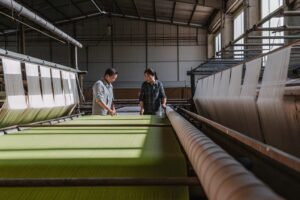
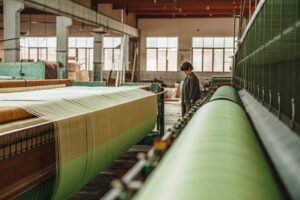
From a sourcing perspective at Shanghai Fumao , we’ve had to adjust our knitting machines specifically for this. In May 2025, we invested in new circular knitting attachments that allow for a longer "sinker" loop. This creates that exaggerated, chunky texture without adding actual weight to the garment. Because nobody wants a 5-pound sweater, even if it looks good on camera.
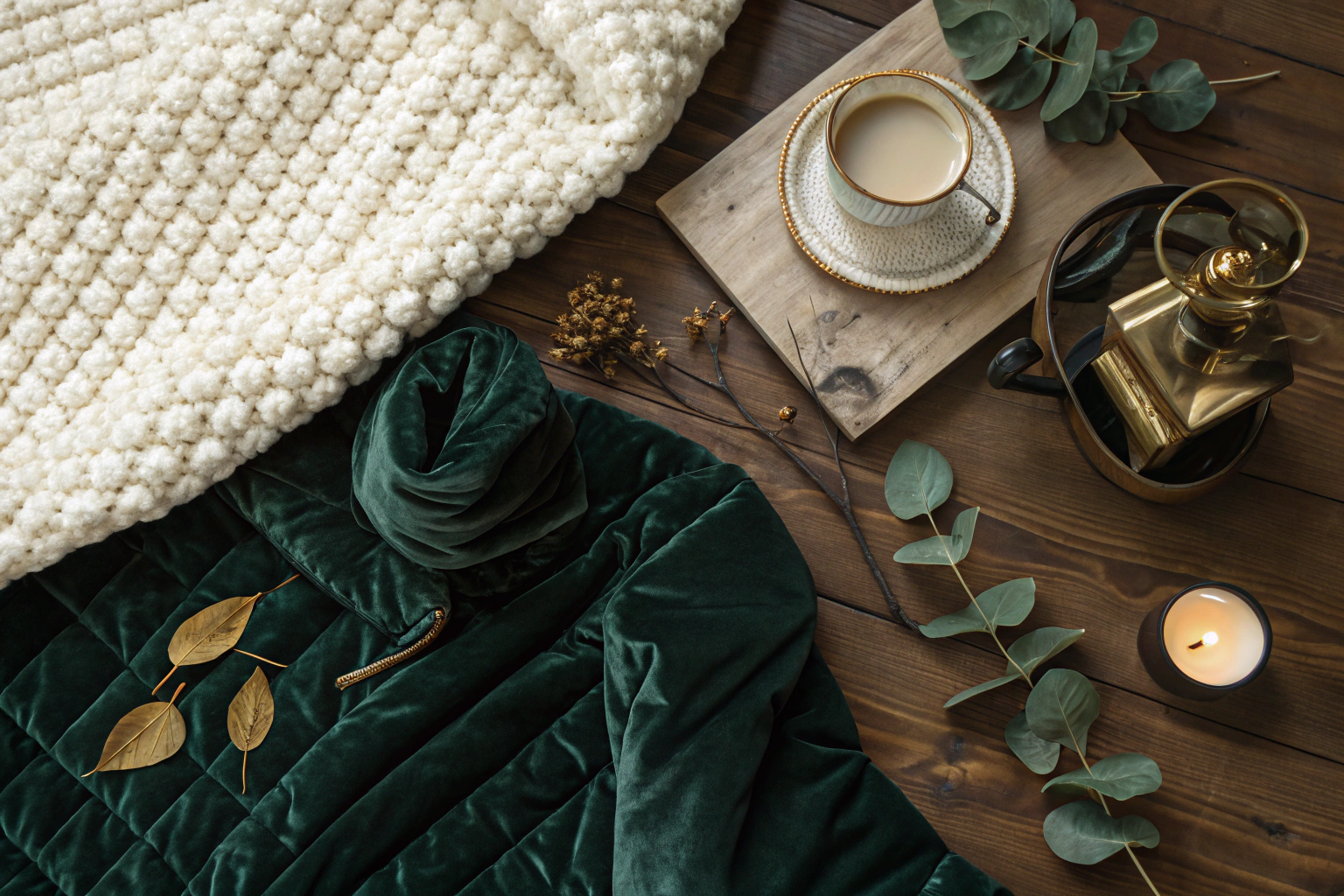
The color story for Boucle 2.0 is also critical for Instagram: Oatmeal, Ecru, and Warm Taupe. These neutral, earthy tones create a high-contrast shadow when photographed in natural window light. If you’re looking for how to style chunky boucle knitwear for Instagram flat lay photography, the key is to pair it with smooth, contrasting objects like a glossy ceramic mug or a sleek laptop. The juxtaposition of rough vs. smooth is what stops the scroll.
Why Is Crushed Velvet and Velour Making a Comeback?
It’s the 90s/Y2K Nostalgia Cycle hitting its peak. But this time, it’s not the cheap, acetate crushed velvet that left glitter all over your couch and made a "zip-zip" sound when you moved. (You know the sound I’m talking about.)
The Winter ’26 version of crushed velvet is Sustainable and Sophisticated.
- Fiber Content: We’re running a lot of Cupro-Rayon blends and Tencel Velvet. These have a much softer, liquid drape than polyester. They crush beautifully but also steam out easily. Most importantly, they photograph with a deeper, richer color saturation. Polyester velvet reflects white light spikes. Cupro velvet absorbs light and glows from within. That’s the difference between looking like a cheap sofa and looking like a vintage Hollywood starlet.
- The "Crush" Factor: The beauty of crushed velvet for e-commerce is the irregularity. With a flat velvet, if you have one tiny crease from shipping, it ruins the photo. With crushed velvet, the creases are part of the design. It’s a forgiving fabric for drop-shipping and unboxing videos.
I had a conversation with a US influencer brand in August 2025. They were launching a holiday loungewear set. They tested two samples on Instagram Stories: a flat silk charmeuse and our crushed velour. The velour generated 3x the swipe-ups. Why? Because the texture showed up immediately in the tiny story circle preview. The silk just looked like a shiny blob. The velour looked like texture.
Which Sustainable Fabrics Will Trend on Instagram in Winter 2026?
"Sustainable" used to be a niche marketing angle. In 2026, it’s table stakes. But here’s the shift I’m seeing: Boring sustainable fabrics are out. Consumers are tired of feeling like they have to wear a beige burlap sack to save the planet. They want sustainable fabrics that also perform for the ‘Gram. They want eco-cred with aesthetic clout. This means the textile industry is finally moving beyond basic recycled poly and organic cotton into the next generation of eco-innovations.

Will Recycled Wool and Cashmere Blends Dominate Feeds?
Yes, and they will do it by telling a specific story: Circularity and Heritage.
The problem with virgin cashmere? It’s expensive, and the overgrazing of goats is an environmental disaster for the Mongolian steppe. The problem with cheap acrylic? It’s plastic that sheds microfibers into the ocean and looks shiny and fake in photos.
The sweet spot for Winter ’26 Instagram is Mechanically Recycled Wool with a touch of Recycled Cashmere.
- The Look: It has the hand feel of a vintage army blanket—dense, warm, and slightly nubby. It photographs beautifully in that "Dark Academia" or "Cottagecore" aesthetic that still has a death grip on certain corners of Instagram.
- The Content Hook: Brands can post Reels showing the "shoddy" process—how old sweaters are shredded and re-spun into new yarn. This kind of process video is algorithm gold right now. It’s authentic, it’s educational, and it justifies a higher price point.
At our facility, we’ve seen a 40% increase in demand for our "Re-Wool" blend since early 2025. We source the wool waste from our own cutting tables and re-spin it with 15% virgin recycled nylon for strength. The resulting fabric has tiny color flecks in it—remnants of the original garments that didn’t fully blend. A few years ago, we’d call that a defect. Now? We call it "Heritage Speckle" and clients pay a premium for it because it tells that circular story visually.
For more on the supply chain behind this, check out this detailed look at how post-consumer wool garments are mechanically recycled into new designer fabrics. It’s a game changer for brands looking to reduce their carbon footprint without sacrificing the cozy aesthetic.
Is Hemp and Organic Cotton Fleece Replacing Polyester Sherpa?
Let’s talk about Sherpa. You know the stuff. That fluffy, white, synthetic teddy bear fabric that’s been on every jacket for five years. It’s 100% polyester. It’s plastic. And consumers are waking up to the fact that washing it sends thousands of microplastics down the drain.
The replacement? It’s not a one-to-one swap because nothing natural is quite as light and lofty as virgin polyester Sherpa. But the Instagram winner for Winter ’26 is Heavyweight Hemp and Organic Cotton Fleece.
Why it wins on camera:
- Natural Crimp: Unlike the uniform fuzz of poly Sherpa, organic cotton fleece (especially when brushed on both sides) has a random, organic crimp. It looks like sheep’s wool. It photographs with a matte, soft depth that doesn’t blow out the highlights like white poly does.
- The "Lived-In" Look: Poly Sherpa mats down over time and looks dirty. Hemp fleece gets softer and develops a patina. It ages well. This appeals to the "Buy It For Life" and #SlowFashion communities on Instagram.
However, there is a technical challenge. Pilling. Natural fleece pills. There’s no way around it.
At Shanghai Fumao , we developed a Tencel/Cotton/Hemp tri-blend specifically for this market in September 2025. The Tencel adds strength and reduces pilling by about 30% compared to 100% cotton fleece. The hemp adds that slubby, earthy texture.
If you’re selling on Instagram, you need to prep your customers for the reality of natural fibers. Use your captions and Stories to show the fabric after 5 washes. Show the pill shaver tool. Educate them. That transparency builds trust way more than a static, perfect product shot ever will.
What Performance Coatings Are Trending for Winter Outerwear Reels?
Reels. It’s all about Reels. And what makes a great outerwear Reel? Transformation and Functionality. You can’t just post a picture of a coat anymore. You need to show it repelling a gallon of water. You need to show it packing into a tiny bag. You need to show it glowing in the dark or changing color in the cold. This is where fabric coatings and finishes become the star of the show, not just a footnote on the spec sheet.

How Does Iridescent and Liquid Shine Nylon Perform on Camera?
This trend is being driven by the Gorpcore and Techwear communities. You see it everywhere from Arc’teryx to Kim Kardashian’s Skims outerwear line. It’s that oily, rainbow-like sheen on the surface of a puffer jacket.
The Technical Term: Iridescent TPU Coating or Calendering.
The Instagram Magic: This fabric is a natural light catcher. As the wearer moves, the color shifts from silver to pink to green. In a Reel, this creates a constant visual change, which tricks the algorithm into thinking it’s "new content" with every frame. It’s highly engaging.
Sourcing Warning: Not all iridescent coatings are created equal. A cheap PU coating will look great for one shoot and then crack and peel after three wears. It will also get stiff in the cold. For Winter ’26, we’re steering clients toward Calendered finishes. Calendering uses heat and pressure to melt the surface fibers of the nylon slightly, creating a permanent sheen that doesn’t wash off and won’t crack. It’s more expensive, but it’s Instagram-proof because it survives the unboxing and the first wash.
I had a streetwear brand from London come to us in June 2025 looking for "that wet look." We showed them a coated fabric and a calendered fabric. We did a simple test: We crumpled both swatches in our fists for 10 seconds. The coated one showed white crease lines immediately. The calendered one bounced back smooth. Guess which one they chose for their Reels campaign? The one that didn’t look like garbage after handling.
Why Are "Soft Touch" Water-Repellent Finishes Going Viral?
There’s a specific type of video that goes viral every single winter. It’s the "Pouring Coffee on the Sweater" test. Or the "Snow Just Slides Right Off" video.
This is the Durable Water Repellent (DWR) finish, but with a 2026 twist.
Old School DWR: C8 Fluorocarbon-based. Works great. Causes cancer and never biodegrades. Banned in the EU and most US states.
New School DWR (Instagram Version): C0 Fluorine-Free and Micro-Textured.
Here’s the problem with old C0 finishes: They feel like plastic. They make a cotton jacket feel like a rain tarp. But for Instagram, you need the garment to look cozy and soft while acting like a shield.
The innovation we’re using for Winter ’26 is Bio-Based DWR combined with Peach Skin Finishing.
- Bio-Based DWR: Derived from plant starches or waxes. It’s not as durable as the old toxic stuff, but it’s safe.
- Peach Skin Finish: We run the fabric over emery cloth rollers that raise the tiniest micro-fibers on the surface. This makes the hand feel incredibly soft and velvety.
The result? You can pour a latte on it, and it beads up. But when you hand it to someone, they say, "Ooh, that’s soft," not "Ew, that feels weird." This combination of Visible Function + Tactile Comfort is the sweet spot for Winter 2026 social media.
If you’re deep in the tech side of this, there’s a great resource on understanding the performance differences between C0 and C6 DWR finishes for sustainable outerwear. It’s essential reading if you’re selling to the European market where PFAS regulations are tightening fast.
How to Source "Instagrammable" Fabric Without Sacrificing Quality?
Alright, I’ve shown you the shiny objects. The boucle, the velvet, the iridescent nylon. But as a factory owner who has to stand behind the product, I need to give you the reality check. It is incredibly easy to make fabric that photographs well for one season and falls apart the next. There are mills in this region that specialize in exactly that—"Instagram Quality." High visual, zero durability. And if you source that, you’ll get the likes, but you’ll also get the chargebacks and the 1-star reviews six months later. So how do you find the sweet spot?

What Are the Signs of "Fast Fashion" Fabric in Close-Up Photos?
You can actually spot a bad fabric in the photos the supplier sends you, if you know what to look for. Before you even order a sample, scrutinize the high-res images from the mill.
Red Flag 1: The "Wet Dog" Sheen on Acrylic Knits.
Acrylic is cheap. It’s a synthetic wool alternative. In a photo with soft, diffused light, it can look like expensive merino. But ask for a photo taken with a direct flash or under a ring light. Acrylic will have a hard, plastic-like, almost greasy reflection. Wool will absorb the light. If the supplier sends only soft-light photos, they’re hiding the cheap fiber content.
Red Flag 2: Uniform, Perfect Fuzz on Sherpa.
I know I ragged on Poly Sherpa earlier, but if you are going to buy it, look at the tips of the fibers. Cheap Sherpa has fibers that all end in a blunt, melted-looking little ball. That’s because they were cut by a hot wire quickly. High-quality Sherpa has tipped or tapered ends. This is a detail you can see if you zoom in 200% on the image. Blunt ends will mat together and look like a dirty bath mat in one month. Tapered ends stay fluffy.
Red Flag 3: Over-Saturation.
If a piece of velvet looks like it was dipped in radioactive Kool-Aid, that color is going to bleed. Guaranteed. Vivid color is great for Instagram, but ask for the Crocking Test Results (Colorfastness to Rubbing). If they can’t provide a Grade 4 or higher, that red dress will turn your customer’s white couch pink.
At Shanghai Fumao , we use a 3D Imaging Booth for our virtual showroom. It takes 36 photos of the swatch under different lighting angles. We do this specifically so you can see how the fabric behaves under ring light, window light, and studio strobe. It’s not just for show; it’s for verification.
Why Does Weight (GSM) Matter for Drape in Social Media Videos?
This is the technical detail that separates the professional content creator from the amateur. You can have the most beautiful fabric in the world, but if the GSM (Grams per Square Meter) is wrong for the garment style, it will look terrible in a Reel.
- Too Light (Low GSM): The fabric will flutter and wrinkle in the wind. In a video, this looks cheap and flimsy. It sticks to the body in all the wrong places and shows every lump and bump.
- Too Heavy (High GSM): The fabric will hang like a stiff board. It won’t move with the body. In a dance or walking Reel, the garment looks like it’s wearing the person, not the other way around.
The "Instagram Drape" Sweet Spot for Winter ’26:
| Garment Type | Ideal GSM Range (Winter) | Why It Works on Video |
|---|---|---|
| Slouchy Turtleneck | 280 – 350 GSM | Heavy enough to pool elegantly at the neck, light enough to show waist definition when tucked. |
| Puffer Vest/Jacket | 40D Nylon with 120-180g fill | Light enough to move without sounding like a trash bag. Creates a soft "pillow" effect. |
| Wide Leg Trouser | 350 – 450 GSM (Brushed Back) | Holds the wide pleat structure. Creates dramatic, flowing movement when walking. |
| Maxi Skirt | 250 – 300 GSM (Rib Knit) | Hugs the hip but swings freely at the hem. The rib texture catches vertical light lines. |
Conclusion
The Instagram fabric trends for Winter 2026 are a study in contrasts: Maximalist texture meets Minimalist environmental impact. It’s the chunky, oversized boucle that tells a story of handcraft. It’s the deep, glowing crushed velvet that satisfies our Y2K nostalgia. It’s the iridescent nylon that catches the light just right for the algorithm, and it’s the hemp fleece that looks better the more you wear it and wash it.
But here’s the bottom line I want you to take away from this: Don’t get catfished by a swatch photo. The fabric that wins on Instagram isn’t just the one that looks good in a flat lay. It’s the one that moves well on camera, survives the wash test, and delivers on the sustainability claims you’re making in the caption. The algorithm rewards authenticity. If your fabric looks like a million bucks on day one and like a dollar store rag on day ten, the comments section will find out, and your engagement will tank.
At Shanghai Fumao , we’re not just watching these trends. We’re weaving them, coating them, and testing them. We understand that for your business, the fabric is the content.
If you’re planning your Winter ’26 collection and you want to make sure your fabric doesn’t just look good in the sample room but actually performs on the feed, let’s connect. We can walk you through the options that fit your aesthetic and your return rate goals.
For a deeper dive into our trending Winter 2026 fabric developments or to request a digital swatch pack, reach out to our Business Director, Elaine.
Email Elaine at: elaine@fumaoclothing.com
Let’s make your next post a sellout.