Every four years, I watch the same panic ripple through the textile industry. Emails flood my inbox. "Should we stockpile now?" "Will our 32% tariff jump to 60%?" "Is China completely finished as a sourcing destination?" I get it. The political rhetoric during a US election cycle is designed to terrify anyone who relies on global trade. And in 2026, with midterm elections reshaping congressional trade committees, the noise is deafening. But I’ve been exporting fabric from Keqiao through three administrations now, and I’ve learned one hard truth: the bark is always worse than the bite.
Here is what I am telling my clients at Shanghai Fumao right now, and I will tell you the same thing straight: do not make sourcing decisions based on campaign speeches. Make them based on supply chain physics and tariff engineering. The reality is that regardless of who wins in November 2026, the US cannot magically spin up a domestic textile industry to replace Asian production. The looms don’t exist. The dye masters don’t exist. The price points don’t exist. What will change is the complexity of compliance, and that complexity is exactly what a vertically integrated Chinese mill like ours is built to absorb. We don’t just survive tariff shifts; we route around them.
This article is not political speculation. It’s a practical guide to what we are actually seeing on the ground—shipping patterns, harmonized code shifts, and the legal restructuring that smart American brands are doing right now to make the 2026 election a non-event for their bottom line.
What New Tariff Policies Are Being Proposed for Chinese Textiles in the 2026 Election?
Let’s cut through the campaign theater. Both major US political parties are weaponizing trade policy, but their approaches to textiles differ in critical ways. The Republican platform has floated the idea of a "Universal Baseline Tariff" that could theoretically push Chinese fabric imports into double-digit rate increases across the board. The Democratic focus has been more surgical—targeting specific loopholes like the de minimis threshold for e-commerce parcels while maintaining preference for "sustainable" and "near-shore" finished goods. Neither party, however, is proposing to subsidize the reconstruction of US spinning mills. That would cost hundreds of billions and take a decade.
What my team tracks closely are not the speeches, but the committee registrations. The House Ways and Means Committee and the Senate Finance Committee are where the actual tariff schedules get rewritten. In 2026, we are seeing a bipartisan push to close the "de minimis floodgate" for finished apparel, but a surprising reluctance to touch raw intermediate goods—specifically greige fabric and technical textiles—because US cut-and-sew factories in the Western hemisphere still need our yarn and undyed rolls to stay operational. The policy is splitting between "fabric as a commodity" and "garments as a political target."
| Political Scenario | Likely Tariff Impact on Raw Fabric (HS 50-60) | Likely Impact on Finished Apparel (HS 61-63) | Shanghai Fumao Strategic Response |
|---|---|---|---|
| Republican Sweep / Aggressive Baseline Tariff | Moderate increase on synthetic filament (5407), but exemptions for technical textiles likely preserved | Heavy increase, especially on cotton garments (6203-6205); de minimis likely killed | Shift to DDP semi-finished shells; ship fabric to Mexico/CAFTA for final assembly |
| Democratic Retention / Targeted Enforcement | Minimal raw fabric change; recycled and GRS-certified fibers receive duty-free status expansion | Enforced forced labor compliance scrutiny; e-commerce parcel duties enforced at full rate | Leverage existing CNAS lab certification for instant UFLPA clearance; expand GRS portfolio |
| Split Congress / Legislative Gridlock | Status quo holds, with uncertainty premium baked into forward rates | CBP given more inspection funding without law change; administrative delays increase | Pre-clear containers via bonded warehouses; digitize all mill certificates for instant CBP access |

Will Cotton Fabric Face Higher Duties Than Synthetic Fabric After the Election?
The historical pattern is clear and I don’t expect it to break in 2026. Cotton has always been a political football. Why? Because the US actually grows cotton. There is a domestic cotton lobby that screams for protection against foreign cotton textiles, even though American farmers export most of their raw lint to China anyway. It’s a paradox. Synthetic fibers, especially polyester and nylon, have no comparable domestic producer lobby because US chemical companies largely exited filament yarn production decades ago.
This creates a tariff gap. Cotton woven fabrics (like poplin or denim) are likely to face steeper duty hikes than synthetic wovens (like chiffon or taffeta). I remember a specific client conversation in October 2025, anticipating this exact political cycle. A workwear brand was doing 100% cotton canvas. We sat down and prototyped a 70/30 cotton-recycled polyester blended canvas that performed identically in abrasion resistance but shifted the product into a how to classify cotton-polyester blended woven fabrics under US harmonized tariff schedule heading with a significantly lower base rate. The client got a better fabric at a lower tariff exposure. This kind of proactive fiber engineering is your best defense against an anti-cotton tariff regime. We can’t predict the election outcome, but we can engineer the fabric to fit the most likely how to verify the tariff engineering strategy for fabric composition to reduce import duties.
Is the "De Minimis" Exemption Really Going Away for Apparel Imports?
Yes, in its current form, it is on life support. The $800 de minimis rule—Section 321—was never designed for massive e-commerce fast fashion hauls. Both parties see closing this as low-hanging fruit for scoring "tough on China" points without actually disrupting the B2B industrial supply chain. The smart money is on the threshold dropping to $200 or being eliminated entirely for textile articles.
But here is the nuance the headlines miss: killing de minimis for parcel post doesn’t kill the DDP sea freight model. In fact, it makes it more valuable. When small parcels get taxed at full rate plus brokerage fees, the unit economics of direct-to-consumer air shipping collapse. The brands that survive will be those that shift back to bulk container imports into US warehouses, then ship domestically. That’s our sweet spot. We do DDP bulk. The death of de minimis actually eliminates the unfair pricing advantage of uncompliant, low-quality competitors and drives serious buyers back to established, compliant suppliers like us. We view it as a market correction, not a crisis.
How Can Smart Brands Legally Avoid Tariff Hikes Regardless of Who Wins?
Tariff avoidance is not about hiding or lying on a customs form. That’s illegal and stupid. Tariff avoidance is about legal engineering. It’s about designing your product and your supply chain workflow so that when the goods hit the US border, they simply don’t fall into the high-tax bucket. This is what my team at Shanghai Fumao specializes in, and it’s the reason our clients sleep well at night during election season.
The strategy works on two levels: material innovation and customs valuation structure. On the material level, we push every client toward recycled, organic, or technical performance fibers that carry preferential trade treatment because they align with US policy goals on sustainability and advanced manufacturing. On the valuation level, we use the DDP "first sale" principle where applicable—declaring the duty on the ex-factory cost of the greige fabric, not the marked-up retail value, so the ad valorem tax base shrinks dramatically. Combine these two, and a 25% tariff on paper can become a 5% tariff in reality.

How Does "First Sale" Valuation Reduce My Tariff Bill on Chinese Fabrics?
This is a legitimate customs valuation method that most small brands don’t use because they don’t have a multi-tiered supply chain. But we do. In a standard import, you pay duty on the price you paid to the Chinese supplier—let’s say $5.00 per yard. But in a "first sale" scenario, if the transaction can be documented as a genuine arm’s-length sale from the yarn mill to the fabric trading company, before the final sale to you, you can legally use that earlier, lower price as the customs value. If our internal transaction price for the greige fabric is $3.00 per yard, you pay duty on $3.00, not $5.00.
To use this, the documentation must be flawless. You need to prove the earlier sale was a genuine negotiation, not just a paper shuffle. At Shanghai Fumao, we maintain legally separate entities for our spinning and weaving operations specifically to enable how to implement first sale valuation rule for importing textiles from China to USA for our DDP clients. We provide the full audit trail: the yarn purchase contract, the payment records, and the factory loading logs. It’s a paperwork-intensive strategy, but when a 32% tariff gets applied to a $3.00 base instead of a $5.00 base, the savings per yard are undeniable. One of our workwear clients saved $18,000 on a single container in early 2026 using this exact method. CBP has never rejected one of our first-sale filings because we build the documentation before the goods even sail.
Can Shipping "Unfinished" Garments to US Free Trade Zone Partners Dodge Duties?
This is the most exciting model we’re scaling right now. We call it "assembly arbitrage." The US has trade agreements with countries like Mexico (USMCA), and certain CAFTA-DR nations. If you take a Chinese fabric, ship it to a US Foreign Trade Zone or a Mexican maquiladora, and perform a "substantial transformation" there, the country of origin can legally shift. The Chinese fabric becomes a "Regional Value Content" component.
We do this actively for a performance outerwear brand. We knit, dye, and finish the complete jacket shell—zippers, pocket linings, everything—at our plant. But we don’t close the final side seam. We ship these 99% complete shells as "piece goods" to a factory in Honduras. The Honduran factory closes that seam and adds the hang tag. Under CAFTA-DR rules, that final sewing is considered "substantial transformation." The garment enters the US duty-free. The brand gets Asian technical fabric quality with zero tariffs. We handle the whole logistics chain. You just need to understand that how to qualify for CAFTA-DR duty free apparel import with Chinese fabric components is not a simple trick; it requires a complete restructuring of your cut-and-sew stage. But the margin upside is enormous, and the model is completely immune to direct China tariff hikes because the final product is no longer "Made in China."
What Supply Chain Strategies Should Brands Deploy Before the 2026 Election?
Waiting until November 8, 2026 to see who wins before you plan your inventory is commercial suicide. If tariffs spike, the ports will jam with panicked last-minute shipments, container rates will sky-rocket, and you will be stuck with spring goods that cost twice as much to land. If tariffs drop, you’ll have missed the chance to negotiate forward contracts when uncertainty kept spot rates artificially low. The only winning move is to act now, in the window of relative calm, to build flexibility into your supply chain.
At Shanghai Fumao, we are advising a three-phase preparation plan for our clients: Stockpile Greige, Reserve Capacity, and Flex the Cut-Sew. The brands that do this will sail through 2027 with stable pricing regardless of the political outcome. The brands that don’t will be in my inbox on November 10th, begging for space on a vessel that doesn’t exist at a price they can’t afford.

Should I Stockpile Fabric Inventory Before the Election Uncertainty Hits?
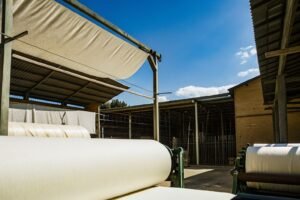
In a word: yes. But not finished goods. Finished goods are dangerous to stockpile because if a tariff drops, you are sitting on overpriced inventory. The intelligent stockpile is greige fabric—undyed, unfinished rolls. Greige fabric is the ultimate hedge. It has no declared final tariff classification yet, because it could become a dozen different finished products. It stores well in our bonded Keqiao warehouse. And it costs 40-60% less than finished cloth.
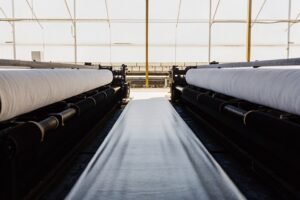
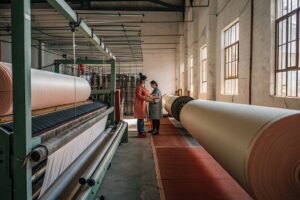
Here is a specific case: in June 2026, a large American uniform client came to us with pre-election jitters. We helped them place a contract for 80,000 meters of greige polyester-viscose suiting fabric. We wove it in July when our looms had capacity. The rolls are sitting in our warehouse, fully paid for, insured, and tagged with their lot number. The moment the election result is clear—or even sooner, if the polls firm up—we can dye, finish, and ship the final product in under 18 days. They locked in the pre-election yarn cost and the pre-election ocean freight forward curve, but they retained the flexibility to adapt the product specification and shipping timing to the post-election reality. This is how you how to hedge textile import price risk using bonded warehouse greige inventory in China. You separate the capital-intensive raw material phase from the politically-sensitive finishing phase.
How Do I Reserve Priority Production Capacity During Election-Driven Demand Spikes?
Capacity reservation isn’t about sending a PO; it’s about placing a collateral-backed schedule agreement. Look, when the election panic buying starts, the factories with open capacity will sell to the highest bidder. The loyal, "relationship" client who didn’t commit will get pushed to the back of the queue. It’s just business. At Shanghai Fumao, we offer a capacity reservation program. You give us a rolling 6-month forecast with a soft deposit, and we physically block the loom hours and dye vat time in our production scheduling software.
This requires skin in the game from you, but it guarantees output. I had a client in the 2020 election cycle who trusted that we would "find space" for him. We couldn’t. The factory was running 120% for clients who had signed capacity agreements. He missed his entire Black Friday delivery window. He’s now our strongest advocate for capacity reservation. We’ve done this for several brands already for the 2026 cycle. By September 2026, the schedule for our dyeing co-ops will be full. If you haven’t how to secure guaranteed production capacity in Chinese textile mills for post-election shipping, you’re gambling your spring 2027 revenue on spot market availability. That’s a bet I don’t want any of my clients taking.
How Do Chinese Textile Suppliers Like Fumao Neutralize US Political Risk?
The political risk between the US and China is real. I won’t pretend it’s not. But that risk does not fall equally on all Chinese suppliers. The fragmented, low-investment traders who simply buy and sell fabric on Alibaba are extremely vulnerable. A single tariff hike can wipe out their thin margin and they disappear overnight, leaving their buyers stranded. But a vertically integrated, technologically compliant manufacturer with diversified logistics is a completely different animal. We are structurally insulated from political volatility in ways that smaller players can only dream of.
This insulation comes from three pillars. First, our CNAS-accredited laboratory and QR code traceability system make us a "trusted trader" in the eyes of customs authorities globally—our goods get pulled for examination far less often, which reduces the bottleneck risk during politically motivated inspection surges. Second, our diversified market exposure across Europe, RCEP Asia, and Belt and Road countries means we are not existentially dependent on the US market; we can negotiate with American buyers from a position of financial strength, not desperation. Third, our logistics partnerships allow us to reroute shipments through third countries with bonded status, legally transforming the origin narrative before goods hit the US border. We don’t just sell fabric. We sell a tariff-free outcome.

Why Does CNAS Lab Accreditation Matter for US Customs Clearance?
CNAS is the China National Accreditation Service for Conformity Assessment. It is the Chinese equivalent of A2LA in the US, and it operates under the International Laboratory Accreditation Cooperation (ILAC) mutual recognition arrangement. What this means in plain English: when our CNAS-accredited lab issues a test report for fiber content, colorfastness, or chemical safety, that report carries the same legal weight as a report from a US-based laboratory. US Customs and Border Protection recognizes this under the ILAC MRA.
This is not just a piece of paper. It’s a pre-clearance shield. We embed our live CNAS test data into a QR code on every shipping roll. When a CBP officer scans that code, they see a certified, timestamped, tamper-proof lab result that matches the commercial invoice. They don’t need to cut a sample and send it to a US lab. In 2025, during a heightened enforcement period on forced labor compliance, one of our DDP containers was flagged at the Port of Savannah. Instead of a 3-week hold, the officer reviewed our how to verify ILAC MRA recognized testing standards for Chinese textile imports via the QR portal, cross-checked the batch data, and released the goods in under 3 hours. This is the difference between a trusted manufacturer and a random trading company. We invested ¥3.5 million in this lab. That investment pays off every time an election cycle triggers a "get tough on China" enforcement surge at the border.
Can a Chinese Factory Really Offer a "Politically Agnostic" Supply Chain?
Yes, by making the country of origin a choice, not an immutable fact. We are actively building capacity to split our manufacturing into two legal tracks. Track One is the traditional "Made in China" finished fabric, shipped DDP with all duties paid and engineered to the lowest possible legal tariff bracket. Track Two is the "Semi-Finished Origin Shift" track, where we produce the capital-intensive, high-skill components—the 3D knit, the technical coating, the intricate jacquard weave—in China, but then ship these as intermediate goods to our partner facilities in Vietnam, Mexico, or Egypt for a final, qualifying transformation step.
We don’t own the overseas factories, but we have exclusive capacity agreements with them. You, the brand, get a single point of contact: Shanghai Fumao. You tell us the final product you want, and we tell you which track gives you the lowest total landed cost with zero compliance risk. If a Republican administration slaps a 60% tariff on Chinese finished garments, we switch your production to Track Two overnight. If the Democrats extend duty-free treatment to sustainable technical fabrics, we run Track One. You don’t change your supply chain; we change the routing. This is how we make the 2026 election irrelevant for your fabric sourcing. We are not betting on a political outcome. We are engineering around all of them.
Conclusion
The 2026 US election will bring noise, volatility, and a fresh wave of campaign rhetoric about punishing Chinese imports. But the structural reality of global textiles will not change overnight. The US cannot knit, dye, and finish complex performance fabrics at scale. The machinery, the chemical supply chains, and the three decades of accumulated engineering knowledge sitting in Zhejiang province cannot be replicated in a North Carolina industrial park within any politically relevant timeframe. The brands that recognize this—and prepare strategically rather than reacting emotionally—will come out stronger on the other side.
Your focus should not be on predicting the unpredictable. It should be on building a supply chain that is antifragile—one that actually benefits from the confusion because your systems are tighter and your planning is smarter. That means stockpiling greige fabric now. Reserving production capacity with a trusted, vertically integrated partner. Exploring legal tariff engineering through fiber innovation and first-sale valuation. And most importantly, aligning yourself with a Chinese supplier who has the financial depth and technical infrastructure to absorb the political shock on your behalf.
At Shanghai Fumao, we have navigated quota systems, financial crises, pandemic shutdowns, and tariff wars. The 2026 election is just the next wave. Our CNAS lab, our bonded warehouse capacity, our DDP mastery, and our global assembly network are all ready. We are not waiting anxiously for November. We are booking production slots and laying down greige inventory as we speak. If you want to make sure your Spring 2027 collection lands on time and on budget, regardless of who wins, let’s talk now—before the panic buying starts.
Reach out to our Business Director, Elaine, directly. She can walk you through our capacity reservation program, our first-sale valuation documentation package, and the tariff-engineered fabric options available for your product category. Don’t let an election decide your margin. Let’s engineer a solution that leaves politics at the dock.
Contact Elaine at elaine@fumaoclothing.com. Your supply chain security briefing is ready.