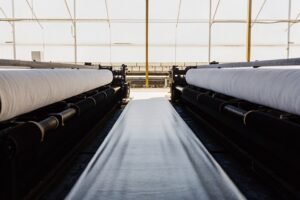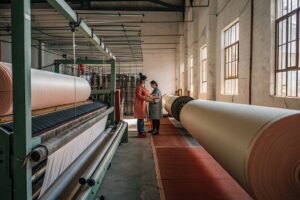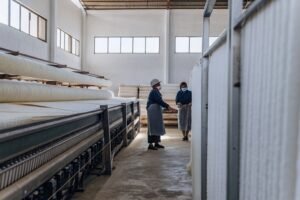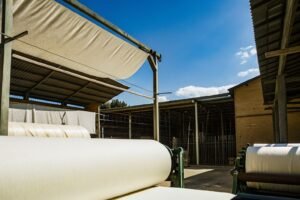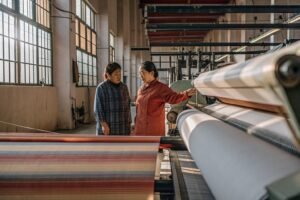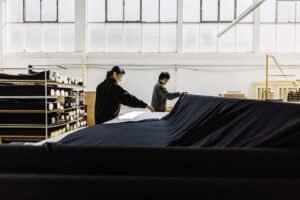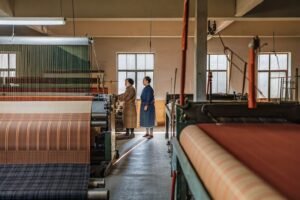
Let me share something that might make you uncomfortable. The fabric in that $300 "French-designed" dress hanging in a boutique in SoHo? It was very likely woven in a factory within 50 miles of my office in Keqiao, China. The "Italian" suiting that a menswear brand sells for $800? The greige fabric probably came from a mill in Jiangsu. This is not a secret, and it’s not a scandal. It’s the reality of the global textile industry. China produces roughly half of the world’s textile fibers and exports them to every fashion capital on earth. The quality is often world-class. The problem has never been the quality. The problem has always been the story.
I’m the managing director of Shanghai Fumao. For twenty years, I have watched Western brands do something remarkable with the fabric I sell them. They take it, cut it, sew it, brand it, and suddenly a $3.50 per yard polyester crepe becomes a $195 blouse with a premium label. The magic is not in the sewing. It’s in the positioning. And in 2026, with US consumers increasingly sophisticated yet still influenced by country-of-origin bias, the art of rebranding Chinese fabric as a premium US product is more relevant—and more achievable—than ever. The brands that master this are not lying to their customers. They are correctly identifying that "premium" is a function of design, quality control, finishing, and narrative, not of GPS coordinates.
This article is a practical guide to that transformation. I will walk you through the legal frameworks, the tariff engineering strategies, the physical finishing touches, and the storytelling techniques that turn Chinese-milled fabric into a premium American product that commands full retail price. I’ll share specific cases from our own clients who have done this successfully. And I’ll be honest about the line between clever positioning and consumer deception—because crossing that line will destroy your brand faster than any shipping delay.
What Are the Legal Rules for "Made in USA" Labeling When Using Chinese Fabric?
Before you think about branding and marketing, you must understand the legal guardrails. The US Federal Trade Commission enforces strict rules about "Made in USA" claims. A product labeled "Made in USA" must be "all or virtually all" made in the United States. That means all significant components and processing must be of US origin, with negligible foreign content. For a garment, the fabric is never a negligible component. It is the primary component. This means a dress cut and sewn in Los Angeles from Chinese fabric cannot legally bear an unqualified "Made in USA" label. Period.
But the FTC’s regulations are not a prohibition on selling premium American-cut garments made from imported textiles. They are a requirement for honest labeling. The qualified label "Made in USA of Imported Fabric" is perfectly legal, truthful, and, in my experience, entirely acceptable to the premium consumer when the overall product quality and brand story justify the price. The key legal concept you need to understand is "substantial transformation." Does your US-based activity—cutting, sewing, finishing, and quality control—substantially transform the imported fabric into a new and different article? If yes, the final product is a US-origin good for labeling purposes, provided you use a qualified claim that discloses the fabric origin. The FTC’s enforcement focus is on deception, not on the use of imported components per se. Be honest about the fabric’s origin, and you are legally safe. Try to hide it, and you are exposed to fines, competitor lawsuits, and consumer class actions.
| Labeling Claim | FTC Compliance Requirement | Consumer Perception Impact | Recommended Usage for Premium US Brands |
|---|---|---|---|
| "Made in USA" (Unqualified) | All or virtually all components and labor must be US-origin. Chinese fabric disqualifies this claim. | Highest trust; highest legal risk if non-compliant | Do not use if fabric is imported. Period. |
| "Made in USA of Imported Fabric" | Substantial transformation must occur in the US; fabric origin must be disclosed clearly and proximately. | Neutral to slightly positive; honesty is appreciated | Safest and most effective qualified claim for premium brands |
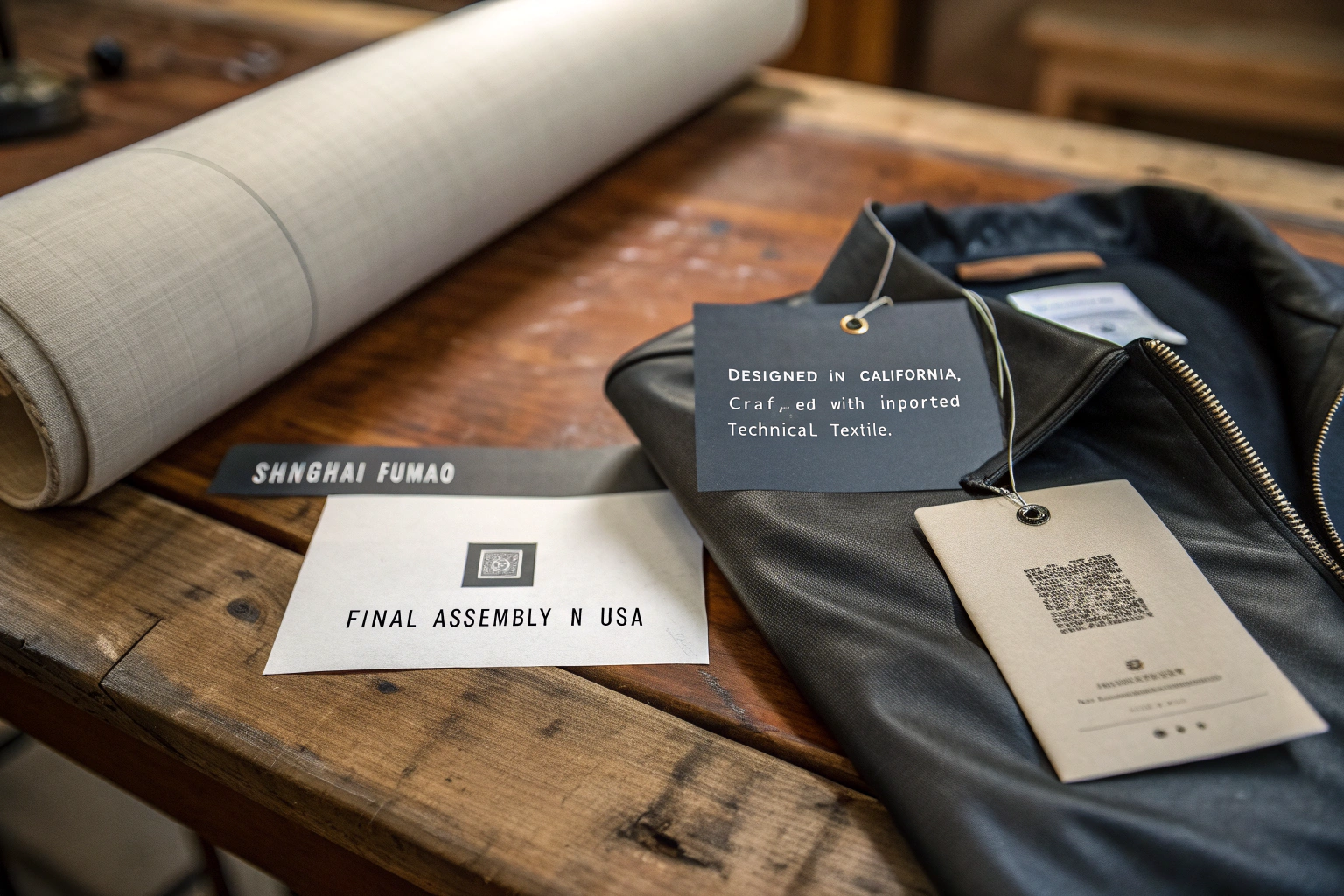
| "Designed in California. Crafted Responsibly." | No specific origin claim made; avoids FTC country-of-origin labeling triggers. | Premium narrative; shifts focus to design and ethics | Ideal for brands emphasizing design heritage over manufacturing location |
| "Assembled in USA from Globally Sourced Materials" | Transparent about multi-origin supply chain; assembly must occur in the US. | Educated consumers understand and accept; less premium than "Made in USA" | Suitable for technical outerwear or complex multi-material products |

Can I Legally Use "Designed in USA" If the Fabric Is Chinese?
Yes, and many premium brands do exactly this. The FTC’s labeling rules apply to unqualified "Made in USA" claims. A "Designed in USA" claim is not a country-of-origin claim for the physical product; it is a claim about the design process. It is legal, provided that the design work—the creative direction, the pattern-making, the tech pack development—genuinely occurred in the US. You cannot claim "Designed in USA" if you bought a finished design from a studio in Shanghai and merely approved it from New York. The design activity must be real and substantively US-based.
However, a "Designed in USA" claim does not eliminate your obligation to disclose the country of origin for customs purposes. The garment still requires a country-of-origin marking for import—typically "Made in China" or "Made in China of US-Designed Components." This marking is often on a removable sticker or an inside tag, while the outward-facing branding emphasizes "Designed in California." This is a common and legally accepted practice. I worked with a Los Angeles-based contemporary brand that sources all its woven fabrics from our mill. Their neck label says "Designed in Los Angeles" prominently, and the care label carries the legally required "Made in China" origin marking. Their customers focus on the design narrative. The origin marking is a compliance footnote, not a brand statement. If you want to pursue this strategy, consult a textile labeling attorney to review your specific labels before production. The how to comply with FTC Made in USA labeling rules for garments using imported Chinese fabric with qualified claims is an essential read before you print your first hang tag.
What Counts as "Substantial Transformation" in US Apparel Manufacturing?
Substantial transformation is a customs and FTC concept that determines whether a manufacturing process changes the identity of a component. For apparel, the general rule is that cutting fabric and sewing it into a finished garment constitutes substantial transformation. The fabric is transformed from a roll of textile into a wearable product. The country where this transformation occurs becomes the country of origin for the finished garment.
But there are nuances. Simple operations like hemming, labeling, or packaging are generally not considered substantial transformation. The US-based work must be meaningful—pattern cutting, sewing of major seams, attachment of components, and final pressing and inspection. If you merely import finished garments and replace the hang tag in a US warehouse, that is not substantial transformation, and claiming US origin is fraudulent. I advise my clients to ensure their US cut-and-sew facility performs all major assembly operations. Document these operations with photographs, work orders, and production records. One of our clients, a premium workwear brand, maintains a detailed "US Manufacturing Process Dossier" for each product, showing photographs of the fabric roll entering their Los Angeles factory, the cutting table, the sewing line, and the finished garment. This dossier exists not for marketing but for legal defense. If an FTC inquiry or a competitor challenge ever arises, they can demonstrate substantial transformation with evidence. The how to document substantial transformation in US garment manufacturing for FTC Made in USA labeling compliance with imported Chinese textiles is the operational backbone of a legally sound premium repositioning strategy.
How Can "Tariff Engineering" Make Chinese Fabric More Profitable for US Brands?
Tariff engineering is the most underused profit optimization strategy in the apparel industry. Most brands accept the tariff rate as a fixed cost. They source a fabric, they look up the HS code, they pay the duty, and they grumble. But tariffs are not charged on the brand or the garment; they are charged on the specific, objective characteristics of the fabric—its fiber composition, its weight, its knit or weave structure, its finishing. Change those characteristics legally, and you change the duty rate. Legally.
At Shanghai Fumao, we have developed a tariff engineering consultation service specifically for US brands who want to maximize their margin on imported fabric. The process works like this: you tell us the functional and aesthetic requirements of your fabric—the hand feel, the drape, the durability, the care instructions. We then propose alternative fiber blends or construction modifications that meet those requirements but fall into a lower-duty HS code classification. The result is the same garment performance, a legitimate new tariff classification, and a significantly lower landed cost. This is not a loophole. It is legal product design optimized for tax efficiency.

How Does Blending Recycled Fibers Into Fabric Lower the Import Duty?
Recycled fiber content can shift a fabric’s tariff classification into a lower-duty or even duty-free category under several mechanisms. First, some HS code subheadings specifically provide preferential rates for fabrics containing certified recycled content. Second, the mechanical recycling process can alter the fiber’s technical classification under customs nomenclature. For example, a fabric classified as a "polyester woven" might face a 25-32% duty, but a fabric with a high percentage of recycled polyester, certified to GRS standards, may qualify for a different subheading with a significantly lower rate.
The key is the certification. You cannot simply claim the fabric is recycled. You must provide a GRS transaction certificate that traces the recycled content from the bottle flake to the yarn to the finished fabric. Our blockchain traceability system provides this documentation seamlessly. A specific case from early 2026: a US activewear brand was sourcing a standard nylon-spandex warp knit for leggings, facing a 28% duty rate. We reformulated the fabric to use 55% recycled nylon, with full GRS certification. The recycled content shifted the classification into a subheading with an 8% duty rate. The fabric performance was identical. The hand feel was identical. The duty savings on a 10,000-yard order was approximately $17,000. The brand used those savings to invest in higher-end trims and packaging, further elevating the premium perception of the product. The how blending GRS certified recycled fibers into fabric lowers US import duty rates through legal tariff engineering for activewear and fashion brands is not a secret known only to giant corporations. Any brand can do it with the right mill partner.
Can Shipping "Unfinished" Garment Components to Mexico Reduce My Tariff Bill?
Yes, and this strategy, called "assembly arbitrage," is growing rapidly among sophisticated US brands. The United States-Mexico-Canada Agreement (USMCA) provides for duty-free treatment of garments assembled in Mexico from US or Mexican components. However, there is also a pathway for using Chinese fabric in a Mexican assembly operation. If the Chinese fabric is cut and sewn in Mexico, and that process meets the USMCA’s tariff shift rules, the finished garment can enter the US duty-free or at a reduced rate.
The strategy we help clients implement is the "semi-finished shell" model. We produce the capital-intensive, high-skill fabric components in our Keqiao mill—the knitted body fabric, the technical coatings, the jacquard patterns. We then ship these rolls to a maquiladora in Mexico. The Mexican factory cuts and sews the garment, attaches the trims, and finishes the product. Under USMCA, this assembly operation can qualify the garment for preferential tariff treatment. The brand gets premium Chinese fabric quality, lower Mexican labor costs, and significantly reduced or eliminated US import duties. A California outdoor brand we work with shifted their technical jacket production to this model in 2025. They source the 3-layer waterproof shell fabric from us, ship it to a factory in Tijuana for assembly, and import the finished jackets to their San Diego warehouse duty-free. The total landed cost is 22% lower than importing the finished jacket from China, and they can legally market the product as "Assembled in North America." This how to use USMCA assembly arbitrage with Mexican cut and sew operations to legally reduce import duties on garments made from Chinese technical fabrics model requires more complex logistics, but the margin improvement is transformative for premium outerwear brands.
What Physical Finishing Processes Elevate Chinese Greige Fabric to Premium Status?
The difference between a $2.50 polyester and a $7.50 polyester is rarely the yarn. It’s the finishing. Chinese greige fabric—undyed, unfinished cloth straight off the loom—is a commodity product, priced competitively and functionally identical across many mills. The transformation into premium fabric happens in the dyeing and finishing stages, where chemical treatments, mechanical processes, and quality control rigor add the tactile and visual properties that command higher prices.
Many of our most successful US brand clients don’t buy finished fabric from us. They buy greige fabric and then control the finishing themselves, either domestically or through a specialized finisher. This gives them two advantages. First, they can customize the hand feel, the drape, and the surface texture to their exact brand standard, creating a proprietary fabric that competitors cannot easily replicate. Second, the finishing process adds a layer of US-based value that further supports a premium positioning. The fabric’s origin becomes one component of a product that was "finished to our exacting specifications."

How Does a "Peach Skin" or "Silicon Wash" Finish Transform Perceived Value?
The consumer’s first interaction with a garment is tactile. Before they look at the label, before they check the price, they touch the fabric. The hand feel—the softness, the drape, the surface slip—creates an immediate, subconscious judgment of quality. A standard polyester crepe from a commodity finishing run can feel slightly stiff, with a faintly plastic surface. The exact same fabric, finished with a peach skin enzyme wash and a premium amino-silicone softener, feels like a fabric that costs three times as much.
The technical process involves micro-sanding the fabric surface with fine-grit emery rollers to create a soft, fuzzy "peach fuzz" texture, then applying a silicone-based softener that coats the individual fibers with a lubricating film. The result is a fabric that feels dry, soft, and luxurious—like the skin of a peach. We produce this finish for a New York-based contemporary brand that markets their dresses as "Italian-heritage fabric." The fabric is woven in our Keqiao mill, finished at our cooperative finishing plant with the peach skin treatment, and shipped DDP to their US cutting facility. Their customers rave about the "incredible hand feel" and happily pay $275 for a dress. The fabric cost is $4.80 per yard, including the premium finish. The perceived value is entirely in the finishing. If you want to understand how peach skin enzyme wash and amino silicone softener finishing processes transform standard polyester woven fabric into premium tactile luxury apparel textiles, talk to a finisher who specializes in high-end womenswear, not commodity home textiles. The difference is in the details—the mesh of the sanding roller, the concentration of the softener, the dwell time in the enzyme bath.
Can Custom Dyeing and Color Matching Make Fabric "Exclusive"?
Absolutely, and this is one of the simplest and most effective ways to rebrand a commodity fabric as a premium product. Standard fabric is dyed to standard colors—the generic black, navy, white, and beige that every brand has access to. Premium fabric is dyed to a proprietary color palette that is exclusive to your brand. When you develop a custom color with a specific dye recipe, and you own that recipe, your fabric is no longer interchangeable with a competitor’s product. It is unique.
At Shanghai Fumao, we offer custom lab dip development with a 48-hour turnaround. You send us a Pantone reference, a thread snip, or a color concept, and our dyeing lab produces a series of precision-matched lab dips for your approval. Once approved, the dye recipe is stored as your exclusive formula. No other client can access it. A single custom color can transform a standard rayon challis from "generic floral dress fabric" into "the signature sapphire blue of [Brand Name]." One of our clients, a direct-to-consumer brand, built their entire brand identity around three exclusive colors that we dye for them. Customers recognize the brand by the color before they see the logo. The fabric base is a standard viscose crepe. The color is the intellectual property. This is how to develop exclusive custom lab dip color matching for proprietary brand fabric dye recipes with Chinese textile mills in action. It costs almost nothing to develop a custom color. The value it creates is enormous.
How Should a Brand Tell the Story of Its Chinese-Milled Fabric Without Deception?
The final and most important element of rebranding Chinese fabric is the narrative. Consumers are not naive. They know that most clothing is made in Asia. What they resent is not the origin itself, but the sense of being deceived. A brand that hides its Chinese supply chain behind a vague "imported" label or a fictional European heritage story is building its premium positioning on a foundation of sand. When the truth comes out—and it always does, eventually—the reputational damage is severe and often permanent.
The brands that successfully position Chinese-milled fabric as premium are not the ones who lie about the origin. They are the ones who tell a compelling, honest story about it. They talk about the multi-generational expertise of the weavers. They talk about the technical capabilities of the mill. They talk about the sustainability certifications and the ethical production standards. They reframe "Made of Chinese Fabric" from a liability into an asset—a story of global craftsmanship, of partnership with the world’s most advanced textile region, of fabric that is engineered to perform, not just produced at the lowest possible cost. This narrative shift is the final, essential step in the rebranding process.

How Do You Frame "Chinese Fabric" as a Quality Signal Instead of a Cost Signal?
The answer is specificity. Vague origin claims create suspicion. Specific, detailed origin claims create credibility. Don’t say your fabric is "imported." Say it is "milled in Keqiao, China, the historic center of the global textile industry, by a family-owned mill with twenty years of expertise in sustainable fiber innovation." The first statement sounds like you are hiding something. The second statement sounds like you are sourcing from the best possible partner on the planet—which, if you are working with a mill like Shanghai Fumao, you actually are.
The tools that European distributors demand—blockchain traceability, QR code verification, digital product passports—are also powerful marketing tools. A US consumer who scans a QR code and sees the complete, transparent journey of their garment, from the organic cotton farm to the dye house to the cutting table, is not horrified that the fabric came from China. They are impressed that the brand had nothing to hide. The transparency itself becomes the premium signal. One of our brand clients includes a "Fabric Provenance" page on their product detail pages, with a scannable QR code and a short documentary video shot in our Keqiao facility. The page is one of the most visited sections of their website. Customers spend an average of two minutes on it. The conversion rate on products with the provenance page is 18% higher than products without it. The fabric origin is not hidden. It is celebrated. This is how to use fabric provenance storytelling and blockchain QR code transparency to position Chinese-milled textiles as a premium quality signal for US fashion consumers in practice. The consumer does not want a generic "Made in Italy" fantasy. They want an authentic, verifiable, human story. China’s textile industry has that story. You just have to tell it properly.
Should I Create a "House Fabric" Brand Name for My Chinese-Milled Textile?
This is a sophisticated branding strategy that several of our most successful clients employ. Instead of describing the fabric generically—"stretch cotton poplin"—you develop a proprietary name for the fabric that you use across your marketing. "Our signature AirWeave™ cotton, developed in partnership with a specialist mill in Zhejiang." The fabric becomes a branded component, like Gore-Tex is for outerwear or Lycra is for stretch. The consumer develops a relationship with the fabric name, not the fabric origin.
Creating a house fabric brand requires a genuine product development partnership with your mill. The fabric should have some unique characteristic—a specific blend, a proprietary finish, an exclusive weight—that justifies the branding. You cannot simply rename a stock fabric and call it proprietary. The consumer will eventually notice, and the deception will backfire. But if you work with us to develop a truly exclusive fabric construction, and you brand it with a memorable name, you create a competitive moat. Competitors cannot copy your product because the fabric is yours. A Los Angeles-based brand we supply developed their own branded performance suiting fabric with us, called "FlexForm™." It’s a cotton-nylon-spandex blend with a specific mechanical stretch and recovery profile that we engineered to their specifications. They market it as "FlexForm™ suiting, milled exclusively for us in China’s technical textile corridor." The fabric brand is now a recognized quality signal among their wholesale buyers. The how to create a proprietary house fabric brand with exclusive Chinese mill partnership for premium US apparel market differentiation strategy works because it shifts the consumer’s attention from the geographic origin to the branded performance attribute. The fabric is not "from China." It’s "FlexForm™." That’s a story you can sell at full price.
Conclusion
Rebranding Chinese fabric as a premium US product is not an act of deception. It is an act of recognition. The Chinese textile industry, and specifically the cluster in Keqiao where Shanghai Fumao operates, is the most advanced, efficient, and innovative fabric production ecosystem on earth. The yarns, the looms, the dyeing technology, and the finishing chemistry are world-class. The idea that "premium" must originate in Italy or Japan is a historical artifact, not a technical reality. The brands that succeed in the US premium market in 2026 will be the ones who recognize this and build their positioning around the genuine quality of their supply chain, not a fictional geography.
The path to successful repositioning runs through four gates. First, legal compliance—use qualified "Made in USA of Imported Fabric" labels, document your US-based substantial transformation, and never mislead about origin. Second, tariff engineering—work with your mill to legally minimize duty exposure through recycled fiber blends, USMCA assembly arbitrage, and intelligent HS code classification. Third, finishing excellence—invest in premium hand feel treatments, custom color development, and proprietary finishing processes that create tactile differentiation no competitor can replicate. Fourth, honest storytelling—tell the real story of your fabric’s origin, with specificity, transparency, and pride. Use QR codes, provenance pages, and branded fabric names to turn your supply chain into a marketing asset.
At Shanghai Fumao, we don’t just sell you fabric. We partner with you to engineer a fabric that supports your brand’s premium positioning—from the fiber blend to the tariff classification to the finishing chemistry to the blockchain QR code that tells the story on the retail floor. We understand that our fabric will carry your label, not ours, and we are committed to making that label stand for quality that consumers will pay full price for.
If you are building a premium US brand and want a fabric partner who understands the full picture—legal, financial, technical, and narrative—let’s start a conversation. Our Business Director, Elaine, can share samples of our peach skin finishes, walk you through a tariff engineering analysis for your current product line, and demonstrate our blockchain traceability system that can power your brand’s provenance storytelling. Your premium brand deserves a premium supply chain. Let’s build it together, transparently.
Reach out to Elaine at elaine@fumaoclothing.com. Ask for the Premium Brand Partner Consultation and a sample pack of our signature finishes. The fabric is world-class. The story is ready. All that’s missing is your label.