
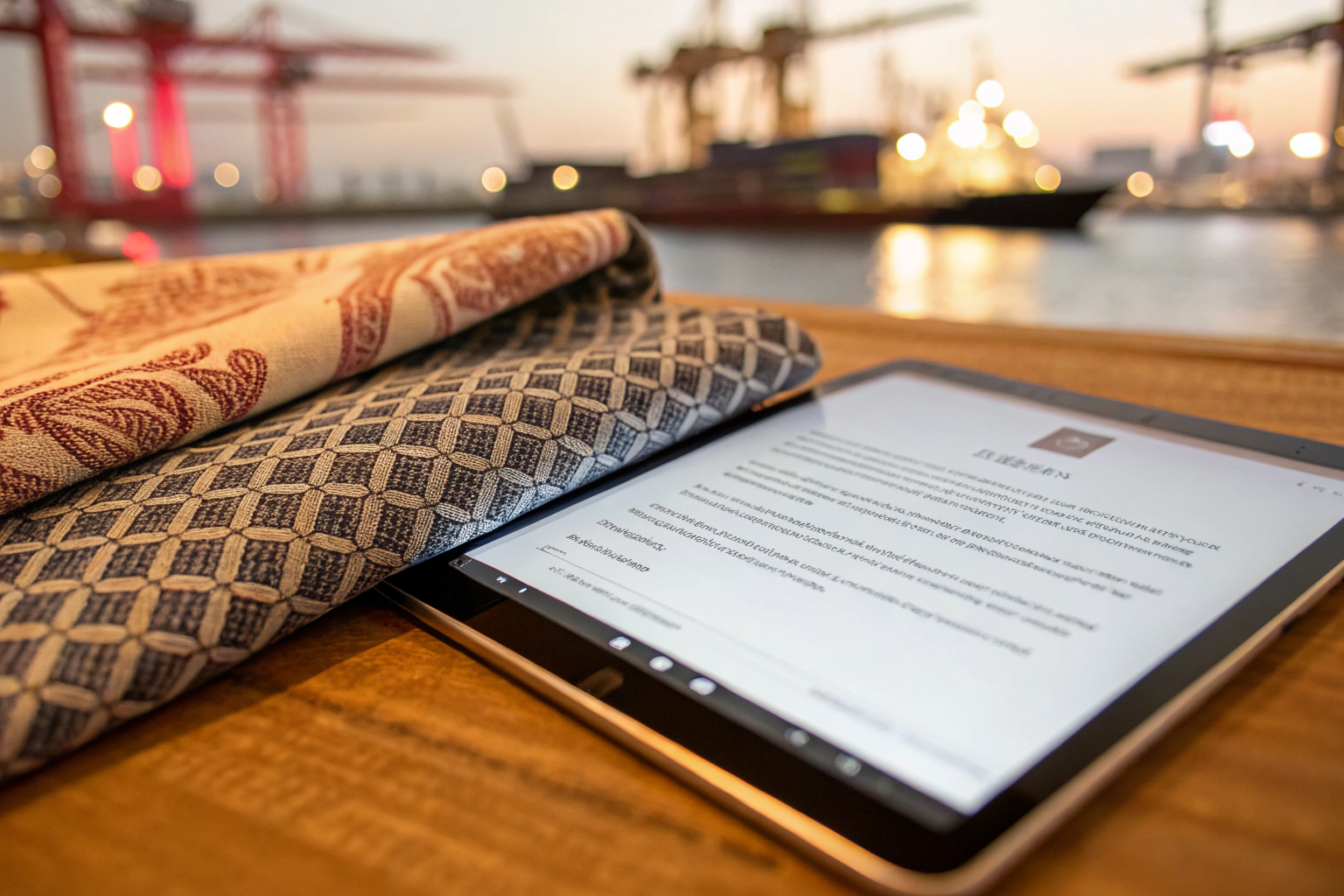
You sit at your desk, staring at a proforma invoice from a supplier you have never met in person. It is a big order—maybe five thousand meters of custom-dyed Tencel twill for your new collection. Your finger hovers over the mouse. You read the payment terms: 100% upfront. Your stomach tightens. You know that sending a wire transfer halfway around the world with zero leverage is a gamble. You have heard the horror stories. Fabrics arrive with shading issues, the shipment gets delayed by two months, and your emails suddenly go unanswered. The fear is real, and frankly, a healthy dose of paranoia in this business keeps you out of trouble.
The safest way to structure a payment for a first fabric order is not to avoid paying a deposit but to build a system of trust-infused milestones that protect both you and the supplier. After managing shipments for over 20 years here at Shanghai Fumao, I can tell you that the "30/70" model—30% deposit to start production, 70% balance against the copy of shipping documents—is the industry gold standard. It aligns the interests of both parties. You secure your place in the production queue, and we guarantee our workmanship before you release the final payment. It is that simple balance that turns a nerve-wracking first deal into a long-term partnership.
But here is the nuance: standard templates only work if the trust is already there. For a first order, you need to weave a safety net into that template. I want to walk you through exactly how we bridge the trust gap with new partners, sharing the real mechanics we use so that by the end of this guide, you will feel equipped to negotiate a deal that does not make you lose sleep at night. And trust me, after two decades in the game, I have made every mistake in the book so you do not have to.
What Are the Safest Payment Terms for Textile Sourcing in China?
I remember a nerve-wracking deal back in the autumn of 2022 with a new buyer from Italy. He was launching a luxury linen line and needed 3,000 meters of enzyme-washed, pre-shrunk linen. We had not worked together before, and the trust balance was at absolute zero. I could hear the hesitation in his voice on our video call. To break the ice, we moved away from the risky "100% advance payment" some small workshops demand and built what I call a visual trust trail.

Why Does 30% Deposit with 70% Against Documents Remain the Gold Standard?
The classic 30/70 split endures for a very good reason: it forces a shared risk. You pay 30% to cover the raw materials (yarn, greige fabric, dyes). We take on the labor, the energy costs, and our reputation. Your 30% proves you are a serious buyer, not just window shopping. Our acceptance of the 70% later proves we are confident the goods will pass inspection.
Can You Negotiate a Letter of Credit for a Small Initial Fabric Run?
This is a tricky one. Many small-to-medium buyers ask for an L/C at sight during their first order. And while an L/C is the most secure paper instrument a bank can offer, it is rarely practical for orders under $50,000. Why? The banking fees eat up the profit margin fast. Plus, fabric is a subjective game. If a bank clerk finds a slight discrepancy in how a color is written on a document (say, "Navy Blue" vs. "Dark Navy"), they can refuse payment even if the fabric is perfect. We usually guide our first-time smaller buyers away from L/Cs unless the order hits a high six-figure value. For those smaller runs, a transparent inspection protocol combined with the 30/70 model is actually faster and safer.
Let me break down the cost-benefit of different payment structures based on recent deals we have handled at Shanghai Fumao:
| Payment Structure | Buyer Risk Level | Supplier Flexibility | Best For Order Value |
|---|---|---|---|
| 100% Upfront | High | Low (Low motivation to fix issues) | Very small samples (<$500) |
| 30/70 (T/T) | Medium | High (Balanced risk) | $3,000 – $80,000 |
| L/C at Sight | Low | Low (Strict doc requirements) | $50,000+ |
| 50/50 Split | Medium-High | Medium | Custom high-tech finishes |
(Here I have to interrupt myself—the 50/50 split is something we do a lot for high-stretch recycled nylon blends where the raw yarn cost is absurdly high. It keeps us from going bankrupt buying raw materials, and the buyer shares that initial burden.)
How Does an Escrow Service Protect Against Production Defects?
Beyond traditional banking, escrow services have become a great equalizer. Think of it like this: using an escrow agent is like hiring a neutral referee who holds the ball until both teams agree it is a fair goal. We have successfully used platforms where the buyer deposits the full amount with the service. We see the money is "locked," so we confidently start production at Shanghai Fumao. We ship, you inspect, and only then do you release the hold. It solves the "ghost supplier" problem completely. The only downside is the fee, which is usually around 3-5%, but for a first order with a fabric development company you have only met on Google Meet, that 5% is a great insurance policy. It proves we are not afraid of inspection, which brings me to the next critical stage: proving the fabric actually exists and matches your swatch.
How to Verify Production Progress Before Wiring the Balance Payment?
This is the moment of truth. The deposit is sent. The calendar pages flip. And then the silence starts to feel loud. I often tell my buyers: "A seller who hates giving updates is a seller who is hiding something." In 2021, I lost a potential client from Australia because a competitor took the deposit and sent a photo of someone else’s stock fabric as "production proof." The buyer could not tell the difference until the wrong polyester arrived. Since then, I have become obsessive about verification. You should not just ask "Is it ready?" You need to ask "Prove it."

What Live Documentation Should You Demand During the Dyeing Stage?
The dyeing stage is where the magic—and the risk of disaster—happens. You approved a Pantone 19-4052 Classic Blue, but under certain lights, it looks purple. To prevent this, we push buyers to demand a "First Dye-Lot Video." I never just send a static photo; I take a 15-second reel of the fabric running over the inspection table under our D65 daylight lamp. We compare the batch to your approved lab dip right on camera. It is not just about color. We also record the GSM weight scale right there on the video, zeroing out the scale to show we are not cheating the grams per square meter. If you are buying a fabric that requires performance, say a waterproof breathable softshell, we take the video into the lab and pour water on the fabric in front of the camera to show the beading effect. If you are unsure about how to verify these details, you can check out how to conduct a remote fabric inspection using video calls on a popular sourcing forum.
How Can a Third-Party Inspection Service Replace a Personal Visit?
Look, flying to China for a 500-meter order makes zero economic sense. A round-trip ticket plus hotel costs more than the profit margin on that small run. This is where third-party inspectors save the day. I always recommend that first-time buyers who cannot afford a sourcing agent to hire a company like AsiaInspection or SGS for a "During Production Check." Here is a pro tip: tell the inspector to random-sample the selvage. Check the weave density against the spec sheet. I actually prefer when a client hires an inspector because it confirms my quality in black and white. In a deal I handled last March, the client’s inspector found a minuscule 2% shading issue on a 10,000-yard cotton-spandex poplin run. We caught it during the DUPRO inspection, re-dried the fabric, and saved the entire order. If the client had just paid the balance without that step, they would have received 10,000 yards of trash. The inspector acts as your eyes, but you need to check the report for three specific things: colorfastness to crocking rating, shrinkage test results, and fabric width consistency. Those three numbers tell you more about fabric health than a thousand words.
But technology is also changing how we prove location and time. I have started using blockchain timestamped photos. When we send a picture of your greige fabric being loaded onto the tenter frame, the metadata is encrypted on a server. You can verify the date, time, and GPS location of the photo. It proves the fabric is not just stock laying around; it is being actively processed. This digital evidence chain makes the payment of that next milestone fee feel less like a leap of faith and more like a calculated business expense.
Pre-Production Sample Approval to Ensure Quality Consistency
Let me tell you about a disaster I narrowly avoided in the summer of 2019. A UK buyer ordered 8,000 meters of a heavy denim-look canvas for upholstery. He emailed me a photo of a decade-old sofa and said, "Match this." I pleaded with him to let me send a physical handloom sample. He refused, rushing to beat the Christmas lead time. We produced the lot, shipped it, and he hated it. It was too stiff, the grain was wrong, and he swore our hand feel was "scratchy" compared to his old sofa. We ended up in a discount negotiation that cost us both. Since that burning hot August, I have refused to start production on any custom woven or dyed fabric without a signed-off physical sample. It is the contract. It is the reference point that stops "he said, she said" arguments before they start.

Why is the "Pre-Production Approval" Step Non-Negotiable for Custom Dye Lots?
This step is non-negotiable because monitors lie. A screen cannot transmit texture, drape, or the subtle crinkle of a crepe de chine. When we deal with custom dye lots, we follow a strict protocol called "Lab Dip to Bulk Transition." First, we mix small beakers (lab dips) and send you three variations of the target color. You pick one. But that is a tiny piece of metal. Next, we move to a "Sample Yardage." This is a 10-15 meter piece dyed in a small production machine, not a beaker. The difference between a lab beaker and a 500kg dyeing vessel is like cooking a single egg versus catering a wedding breakfast. The physics of the dye bath is totally different.
How Does the "Sealed Sample" Process Secure Your Final Shipment Release?
The sealed sample is your legal shield. Once you approve that sample yardage, we cut it in half. You sign one half with a permanent marker, maybe scribble a date or a secret phrase, and mail it back to us. The other half stays in your office. We then place our half in a vacuum-sealed bag in the inspection room. During the final inspection, we do not compare the bulk fabric to a digital photo; we break the seal and lay your signed swatch next to the production roll. If the bulk matches the sealed sample, you have absolutely no grounds to reject the goods based on "hand feel" or "shade." It is an objective standard. In a certified lab, we use a spectrophotometer to read the Delta E (the mathematical difference in color). We guarantee our jacquard and satin lots to a Delta E of <1.0, which means the human eye cannot distinguish the difference. Only then do we give the green light for shipping. This is how we protect your final payment balance and ensure you get exactly what you paid for.
Managing Delivery Delays and Penalty Clauses in Fabric Contracts
Time kills fashion. If your summer linen arrives in September, you have not bought fabric; you have bought clearance stock. I have seen the crushing look on a designer’s face when their trendy polyester georgette shipment missed the window because the factory underestimated the dyeing backlog. Supply chain volatility in China is a reality, but most delays are actually predictable if you know the seasonal rhythms. We operate on what I call a "buffer mindset." If you are a brand selling on a strict retail calendar, the penalty clause is your most useful tool, but it must be realistic. If your penalty is too harsh, no good factory will accept the order; if it is too soft, you get no priority.

How to Build a Realistic "Force Majeure" Clause Beyond Just Natural Disasters?
The standard boilerplate force majeure is useless. It usually covers earthquakes and wars. But what shut down the textile sector in recent years? Energy rationing and sudden policy changes. Your fabric supply agreement needs a specific addendum that covers "Government-Ordered Production Restrictions." In the past, we have faced "Double Control" energy policies where the government tells the dyeing house, "You can only run 3 days a week to save electricity." We are not at fault, but your fabric stops moving. A smart buyer will negotiate a clause that says: "If a government-mandated shutdown exceeds 7 days, the buyer may extend the delivery date by the same duration, but the seller must provide official documentation within 48 hours."
How to Calculate "Late Delivery Penalty" to Motivate Without Killing the Deal?
This is the art of the penalty sweet spot. Do not ask for 10% per day; that is absurd and will make any reputable fabric supplier delete your email. The market standard for fabric penalties falls between 0.5% and 1% of the invoice value per week of delay, capped at 5-10% of the total order value. But I suggest a "Grace Period" model. When I sign a contract with a new client, I often write: "7-day grace period (flex), then 0.5% per week capping at 5% total." Why? Sometimes a truck breaks down on the highway to the port. A grace period builds goodwill. If I hit the grace period, I usually upgrade the shipping from sea freight to air freight for the first few rolls out of my own pocket just to fix the timeline. It shows the buyer that Shanghai Fumao is a partner, not just a vendor.
Mitigating the "Chinese New Year Cliff" with Accelerated Production Schedules
This is the big one. If your payment terms are sluggish, you miss the window. Every year, the textile belt shuts down for nearly a month. If your 30% deposit clears on January 5th, the machines are already cold. Your fabric will not start until late February. You just lost 50 days before a meter is woven. To fight this, we use a "Pre-CNY Raw Material Reservation." Send a token "holding deposit" of 5% in December. We use that to buy and stock the yarn before the holiday crush. Even if the factory is silent in January, your yarn is sitting on the shelf, ready to run the second we reopen. I remember a Norwegian sustainable activewear brand that did this with us for a Tencel Merino blend. By using the holding deposit strategy, we started weaving on February 1st while their competitors were still queueing for yarn supply. They hit the shelves in May, and the rest was history.
Conclusion
I want you to walk away from this guide understanding that securing payment terms for a first fabric order is not about finding a magical bank document. It is about designing a workflow that builds certainty at every single milestone. You start by anchoring the financial structure with a balanced 30/70 split or an escrow service that holds both sides accountable. You then bridge the communication gap not with casual emails but with hard evidence—live videos of the dyeing vat, timestamped photos of the greige loading, and Delta E readings from a spectrophotometer that mathematically prove the color matches your sealed sample. You also must accept that the global textile calendar, with its fixed holidays and sudden energy policies, is a beast you must tame with smart penalty clauses that motivate rather than punish.
The truth is, fabric is a relationship business. You are trusting a team of weavers, dyers, and finishers halfway around the globe with your creative vision and cash flow. My team at Shanghai Fumao has spent over two decades fine-tuning these protocols, from that first crucial lab dip to the final shipping document, specifically so that your first order does not feel like a gamble but like the start of a smooth partnership. We understand that every meter counts, and we build our inspection and communication standards to prove it before you pay it.
If you are ready to source high-end woven or functional knit fabrics without the stress of guessing about payment safety, I would like you to reach out directly to our Business Director, Elaine. She has navigated thousands of these first-order transactions and can walk you through a custom schedule that aligns with your specific launch dates and budget requirements. Just drop her an email at elaine@fumaoclothing.com. Tell her your target price point and the feel you are chasing, and she will send you a digital lookbook plus a sample of our transparent milestone-based payment agreement. Let us get your fabric right on the first shot.








