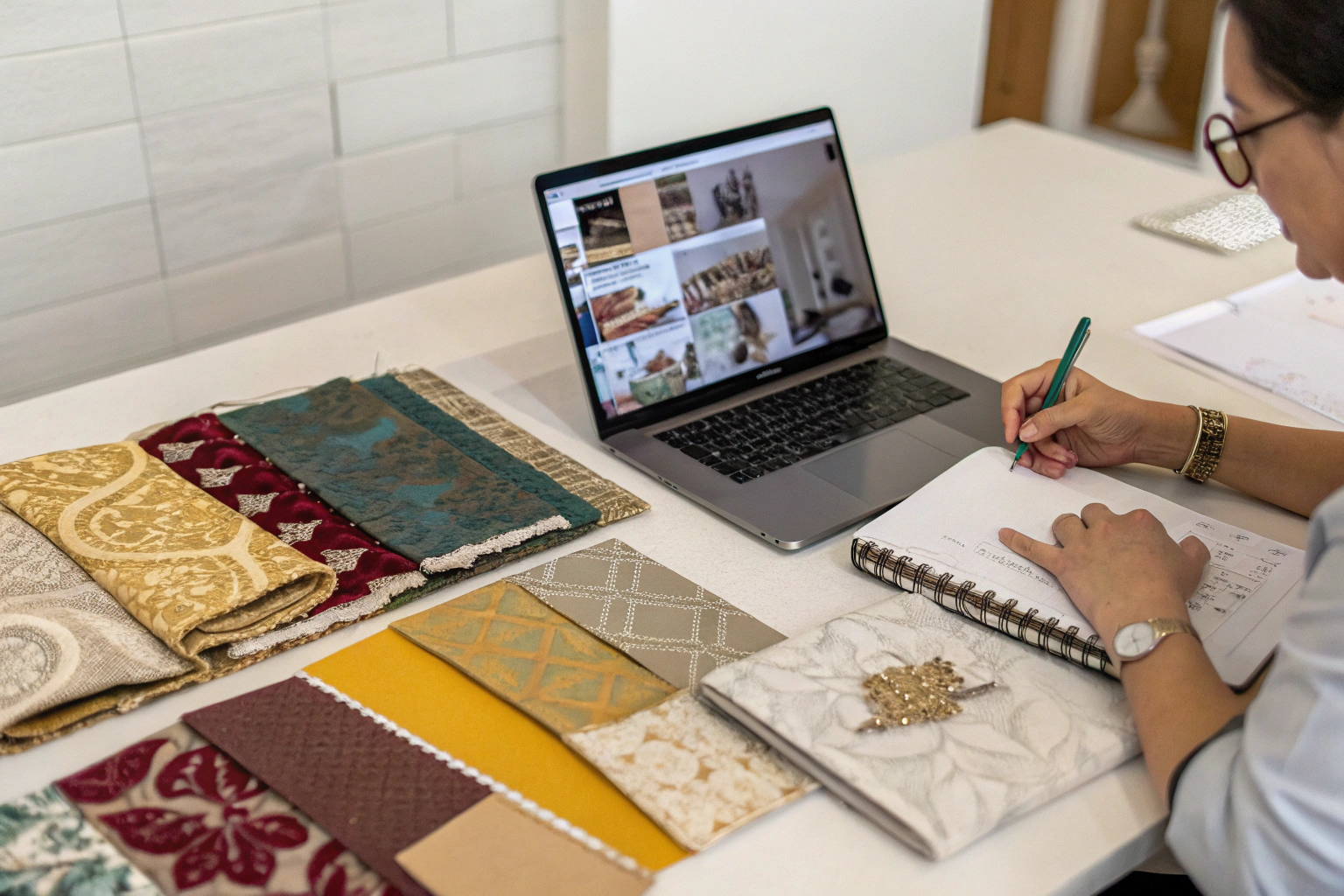
You’re a designer at a premium occasionwear brand. Your Spring collection calls for a specific fabric—a midnight blue burnout velvet with a metallic underlay, something ethereal, something you’ve never seen in a stock catalog. The last time you sourced something like this, you flew to Paris for Première Vision, spent three days walking the halls, collected sixty swatches, and found exactly one mill that came close. The trip cost $8,000 in flights, hotels, and time away from the studio. Now you need a similar rarity, and you need it in four weeks, not four months. But you’re not getting on a plane. So how do you find that needle-in-a-haystack fabric without walking the haystack yourself?
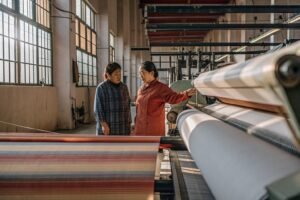
Remote sourcing of rare and specialty fabrics is not about replacing the trade show with a website search. Alibaba’s search bar will not find you a genuine hand-loomed khadi with natural indigo dye or a recycled polyester sequin mesh with OEKO-TEX certification. Rare fabrics are rare precisely because they’re not mass-listed on commodity B2B platforms. They live in the development rooms of specialist mills, in the sample blankets of technicians who’ve spent thirty years refining a specific jacquard technique, and in the private WhatsApp galleries of factory owners who don’t even have an English-language website. Finding them remotely requires a completely different playbook—one that combines digital investigation, direct factory communication, and a specific vocabulary of technical specifications that signals to a mill that you’re a serious buyer, not a student with a mood board. At Shanghai Fumao, we specialize in exactly this kind of development-driven sourcing. Our embroidery division alone runs over sixty multi-head Barudan machines and produces jacquards, laces, and embellished nets that you’ll never find in a stock catalog. I’m going to show you how to reach specialists like us, how to describe what you’re looking for in a way that gets results, and how to get a genuine rare fabric sample into your hands without buying a plane ticket.
How Can I Find Specialist Fabric Mills Without Attending a Trade Fair?
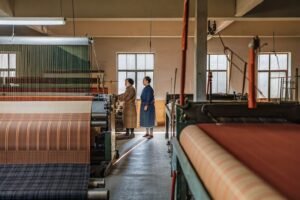
Rare fabrics are made by rare machines. A mill that produces double-layer jacquard brocade has a specific type of electronic jacquard loom—probably a Staubli or Bonas head mounted on a rapier frame. A mill that does burnout velvet has a specific chemical printing setup for the devoré paste, plus a steaming and washing line calibrated to dissolve the cellulose fibers without damaging the silk or polyester ground. These are not generalist factories. They’re specialists with specific capital equipment, and that equipment leaves a digital trace. Your job as a remote sourcer is to follow the equipment, not the fabric description. A mill that shows a Staubli jacquard head in a social media post is a mill that can produce complex figural weaves, whether or not they’ve ever used the words "brocade" or "damask" in their English-language marketing.
Start with a Google Maps satellite search of known textile industrial zones—Keqiao in Shaoxing, Shengze in Jiangsu, Tiruppur in India, Bursa in Turkey. Zoom in until you can identify factory roofs. Specialized mills often have distinct infrastructure: a textile dyeing plant has a water treatment facility and steam boilers visible from the air. A weaving shed has a sawtooth roof for north-facing light. Cross-reference the factory name visible on the Google Maps label with a search on Chinese social platforms if the mill is in China—WeChat, Douyin (China’s TikTok), and Xiaohongshu often contain factory-floor videos that never appear on English-language platforms. Use Mandarin search terms via a translator tool: jacquard factory, burnout fabric,laser cutout. The results will surface content from factory owners and technicians documenting their production, often with their contact details visible in the video. A buyer who can send a WeChat message in translated Mandarin to a specialist mill’s production manager has just bypassed the entire trade show infrastructure and opened a direct line to capability. The Google Maps and satellite imagery analysis techniques for identifying and verifying specialized textile manufacturing facilities in Asian industrial zones provides a systematic protocol for this digital reconnaissance.

Why Should I Search for the Machine Type Instead of the Fabric Name?
Textile terminology is not globally standardized. A fabric one mill calls "burnout velvet" another calls "devoré" and a third calls "etched pile fabric." If you search for the fabric name, you only find mills that use the exact English-language marketing term you’ve chosen—which is a tiny fraction of the mills that actually produce the fabric. If you search for the machine or process that creates the fabric, you find every mill that has that capability, regardless of their marketing vocabulary.
For burnout velvet, search for "devoré printing machine" or "chemical etching fabric production line." For metallic jacquard, search for "Staubli jacquard loom" or "electronic jacquard weaving manufacturer." For laser-cut lace, search for "laser cutting machine fabric" or "CO2 laser textile cutting factory." The machine name is invariant across languages—a "Staubli jacquard" is a "Staubli jacquard" whether the factory owner speaks English, Mandarin, Turkish, or Italian. By searching for the equipment, you access the global installed base of that capability. You’ll discover specialist mills in unexpected locations—a family-run jacquard weaver in Portugal, a laser-cutting specialist in Poland, a burnout velvet dye house in Turkey—that would never surface in a search for the English-language fabric name. We’ve received inquiries from buyers who found us by searching "multi-head Barudan embroidery machines Keqiao" and discovered our embroidery division, which runs sixty heads of precisely that machine. They didn’t search "embroidery fabric supplier." They searched the machine, found our factory-floor video, and reached out directly. The specialized textile machinery databases and manufacturer directories for locating production capabilities globally lists the major equipment brands and machine types that can anchor your search strategy.
How Do I Use LinkedIn to Connect with Specialist Textile Technicians?
LinkedIn is not the first platform that comes to mind for fabric sourcing, but for finding rare specialty capabilities, it’s the most underutilized tool available. Specialist mills are run by specialist people—jacquard designers, dyeing technicians, finishing chemists—who list their skills, their machine competencies, and their career history in their LinkedIn profiles. These people are more accessible than the sales director or the general manager, and they are often more willing to engage in a technical conversation about their specific process.
Search LinkedIn for job titles like "Jacquard Designer," "Textile Development Engineer," "Dyeing Technician," "Lace Designer," or "Embroidery Production Manager." Filter by location to the textile manufacturing hubs. Review their profiles for specific machine mentions—"Staubli LX3202," "Barudan BEKY-Z1506," "MS Printing Solutions digital printer." Send a connection request with a note that is technically specific: "Hi [name], I saw your profile mentions expertise in electronic jacquard weaving. I’m a designer working on a complex figural brocade project and would value your technical perspective. Would you be open to a brief conversation?" This message signals that you understand what they do and you’re not a generic cold outreach. Technicians respond to technical interest.
The conversation that follows is not a sales call; it’s an information-gathering expedition. Ask about their process, their machine capabilities, the types of designs they specialize in. Ask if they can recommend any mills or designers who might take on a development project of your type. Specialists know specialists. A jacquard technician in Italy might not be able to produce your order, but they might recommend a former colleague who now runs a mill in Turkey that has exactly the capability you need. The textile specialist community is small, globally connected, and surprisingly generous with technical referrals when approached with genuine interest. The LinkedIn networking strategies for connecting with textile manufacturing professionals and identifying niche production capabilities offers specific search query structures that surface specialist profiles effectively.
What Information Do I Need to Describe a Rare Fabric Remotely?
A vague description produces a wrong sample. "I need a soft, shiny fabric with a pattern" could describe a printed satin, an embossed velvet, a metallic jacquard, a foil-printed mesh, or any of a hundred other constructions. The mill receives this description, guesses what you meant, and sends a sample that misses the mark. You’re disappointed, the mill is frustrated, and everyone has wasted time. Precision in remote fabric description is not optional—it’s the only substitute for the physical showroom experience where you can pick up the fabric and say "something like this, but lighter, and with a smaller pattern repeat."
At Shanghai Fumao, our development team can work from a verbal description, but we work faster and more accurately when the buyer provides a structured spec that covers five dimensions of the fabric: fiber composition and yarn type (what the fabric is made of), weave or knit structure (how the yarns are arranged), weight and thickness (how heavy the fabric feels), surface finish and texture (what the fabric surface does to light and touch), and pattern or embellishment detail (what decorative technique is applied). A description that hits all five dimensions—"a jacquard woven with a 75D polyester warp and a 30S cotton weft, approximately 220gsm, with a sand-washed soft hand and a small-scale geometric repeat"—enables the mill’s development team to mentally assemble the fabric before they’ve touched a yarn. They can assess whether their equipment can produce it, estimate the development time, and pull reference samples from their archive that approximate the described fabric. A structured remote fabric specification template for specialty textile development with mills via digital communication provides a fillable format that ensures you communicate all five dimensions in your initial inquiry.

How Do I Describe a Hand Feel or Drape Without Physical Touch?
Hand feel is the hardest dimension to communicate remotely because the vocabulary is subjective and culturally variable. A Japanese buyer’s "soft" might mean a dry, papery, low-friction surface. An American buyer’s "soft" might mean a silicone-coated, lubricated, cool-to-the-touch slickness. The solution is to reference a common, globally available physical standard and describe the deviation from that standard.
The most effective method we’ve seen is the "reference fabric plus delta" description. The buyer identifies a widely available fabric that approximates the target hand feel—"the softness of a standard H&M cotton-modal jersey tee, but with more body and a slightly drier surface." The reference fabric anchors the conversation in a shared physical experience, even if the buyer and the mill are in different countries. The delta—"more body," "drier surface," "more drape," "less slipperiness"—provides the directional adjustment.
For drape, use a simple descriptive scale: "fluid drape like a silk charmeuse," "structured drape like a cotton poplin shirting," "bouncy drape like a heavy scuba knit," "limp drape like a washed rayon challis." These comparisons to familiar archetypes bridge the physical gap more effectively than adjectives alone. A video of a fabric being draped over a curved form and moved is worth a thousand words—if you have a reference fabric in your studio that approximates the hand feel you want, film a short video of it being handled, draped, and scrunched, and send it to the mill with your spec. The descriptive language frameworks for remote communication of textile hand feel and drape properties in digital fabric development provides a standardized vocabulary that reduces ambiguity.
What Reference Images Actually Help a Mill Understand My Request?
A mood board image of a haute couture gown tells the mill nothing about the fabric construction. It’s an aspirational image, not a technical reference. Effective reference images for remote fabric sourcing are close-up, high-resolution photographs of the fabric surface that reveal the weave structure, the yarn texture, and the surface finish. The ideal reference image is a macro shot of the fabric taken at a 45-degree angle to the light source, with a common object like a coin or a ruler in the frame for scale. This angle reveals surface texture through shadows. A flat scan of the fabric is second-best but loses the depth information that shows pile height, embossing depth, or surface irregularity.
Include reference images at three scales: a macro shot showing the individual yarn interlacement (reveals weave type, yarn twist, and fiber texture), a mid-distance shot showing the pattern repeat or surface texture across a 10cm area (reveals scale, repeat size, and overall visual effect), and a full-garment shot showing how the fabric drapes and behaves on a body (reveals weight, fluidity, and silhouette behavior). Together, these three scales give the mill’s development team a comprehensive visual brief that they can interpret technically. A buyer who sends a blurry Instagram screenshot of a celebrity in a dress as their sole reference is asking the mill to guess. A buyer who sends a macro photo of the weave, a scaled shot of the pattern, and a garment shot of the drape is communicating like a product developer. The visual reference material best practices for remote textile development communication between designers and mills explains why multi-scale imagery produces more accurate first samples than inspiration-only references.
How Do I Get a Custom Sample Made Without an In-Person Meeting?
The remote sample development process mirrors the in-person process, but it requires explicit structure where in-person meetings rely on implicit understanding. In a physical development meeting, you sit with the mill’s technician, point to a yarn in a sample blanket, say "this, but thicker," and the technician immediately understands because they can see what you’re pointing at. Remotely, you must replace the pointing finger with exact specification, the sample blanket with digital reference, and the verbal "like this but different" with a structured feedback loop.
At Shanghai Fumao, our remote custom sample development process follows a four-stage sequence. Stage one is the digital brief: the buyer submits structured specifications as described above, plus reference images at three scales, plus any physical reference swatches by courier if available. Stage two is the capability confirmation: our development team reviews the brief against our machine capabilities, yarn inventory, and finishing technologies, and responds with either a "can do, here’s the timeline and development fee" or a "cannot achieve exactly this because [specific technical reason], but here is the closest approximation we can produce, would you like a sample of that?" Stage three is the first sample: a physical sample is produced, measured against the spec, photographed under D65 lighting and in natural light, and dispatched by courier with a digital report of the achieved specifications (actual weight, actual fiber content, actual color readings). Stage four is the feedback loop: the buyer receives the physical sample, evaluates it against their target, and provides structured feedback for the next iteration. A remote custom textile sample development process workflow and communication protocol for buyer-mill collaboration lays out the stages and feedback loops that prevent miscommunication.

What Is a Fair Development Fee for a Custom Rare Fabric Sample?
Custom development costs the mill real money. A technician spends time setting up a sample loom or a dye beaker. Yarn is consumed. Machine time is occupied that could be running production. The mill will charge for this, and a buyer who expects free custom development on a rare specialty fabric signals inexperience. The development fee is not a penalty—it’s a mutual commitment. The buyer demonstrates seriousness by paying for the mill’s time, and the mill commits to producing a genuine development sample, not a close-enough stock substitute.
Development fees for rare specialty fabrics vary widely by complexity. A custom color lab dip on an existing stock fabric might be $50 to $100. A custom jacquard weave development, requiring new CAD design, punch file creation, and a sample loom setup, might be $300 to $800. A burnout velvet development sample, requiring screen engraving, devoré paste formulation, and a trial run through the chemical line, might be $500 to $1,500. These are ballpark figures that vary by mill and region. The important principle is that the development fee should be credited against the first production order. If the sample leads to a bulk order, the development cost is deducted from the bulk invoice. If the sample doesn’t lead to an order, the mill keeps the development fee as compensation for the work performed. This aligns incentives: the buyer invests in development because the fee is recoverable if the project proceeds, and the mill invests in quality development because a successful sample leads to a production order. Always ask for the "development fee credited against first bulk order" clause in your development agreement. The custom textile sample development pricing structures and fee models for specialty fabric mills serving international brands outlines typical cost ranges by fabric type and development complexity.
How Long Should I Expect a Rare Fabric Development Sample to Take?
Rare specialty development takes longer than stock fabric sampling. A standard stock fabric sample can ship within 48 hours. A custom rare fabric sample involves processes that cannot be rushed: yarn sourcing if a specialty yarn is required, CAD design for a new weave pattern, trial weaving or knitting to test the construction, and finishing trials to calibrate the hand feel and appearance. Each of these stages is a physical process that occupies a machine and a technician for a fixed minimum time.
For a complex custom jacquard, expect 3 to 5 weeks from final specification confirmation to physical sample dispatch. For a burnout velvet, 4 to 6 weeks. For a custom lace or embroidery pattern, 2 to 4 weeks for digital pattern creation plus 2 to 3 weeks for the physical sample. These timelines assume the mill has the necessary base yarns in inventory and doesn’t need to order specialty dyed yarns, which can add 2 to 3 weeks. Communicate your timeline requirements upfront. If you need a sample in 10 days for a collection presentation, say so in your initial inquiry. The mill will tell you whether they can meet that timeline with an existing stock development or whether your rare fabric concept requires a timeline that won’t fit your presentation. A buyer who asks "What is possible in my timeline?" rather than demanding the impossible gets better solutions. The realistic development lead time estimates for custom specialty textile sampling across different fabric categories breaks down typical durations by process.
Can I Inspect Rare Fabric Quality Through a Live Video Call?
The rarest fabric in the world is worthless if it arrives with a weaving defect you didn’t catch. For stock fabrics, a buyer can request a standard AQL inspection. For a rare, developed-from-scratch specialty fabric, the entire production might be a single lot of 500 meters, and every meter matters. A post-production defect discovered at your cutting table means you have no replacement fabric because there is no more of this custom development in existence. The pre-shipment inspection for a rare fabric is not a formality—it’s a critical gate.
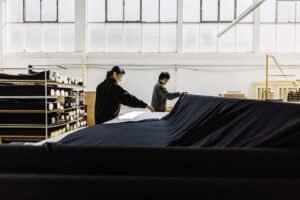
Live video inspection, the same technology we use for color approvals, extends naturally to surface inspection of rare fabrics. The mill’s QC technician sets up the inspection machine with the fabric running under a D65 or D50 light source. The buyer joins via video call and watches the fabric pass over the inspection table in real time. The buyer can ask the technician to stop the machine, zoom in on a specific area, check a selvedge detail, or rotate the fabric to assess luster under different angles. The inspection is interactive, not passive. For metallic jacquards, the buyer can check that the lurex thread is laying correctly across the pattern. For burnout velvet, the buyer can verify that the devoré paste has eaten through the ground fabric consistently without damaging the pile. For laser-cut lace, the buyer can confirm that the cut edges are clean with no singe marks. These are visual checks that a standard third-party AQL inspector might not be trained to assess because rare fabrics have rare quality criteria. The buyer, who designed or specified the fabric, knows exactly what to look for. Live video puts the buyer’s eyes on the fabric before the container door closes. The live video quality inspection protocols for specialty and custom-developed textile lots before international shipment describes the setup, lighting, and camera requirements for effective remote inspection.

What Specific Defects Should I Look for in Rare Fabric Constructions?
Rare fabrics have rare defects. A general textile defect list—holes, stains, broken yarns, shade variation—applies to all fabrics, but each specialty construction has its own characteristic failure modes that a buyer needs to specifically request the inspector to check. For burnout velvet, the key defect is incomplete devoré: areas where the chemical paste didn’t fully eat through the ground cellulose fibers, leaving a partially transparent, unevenly etched surface. The inspector needs to hold the fabric against a backlight and look for inconsistent light transmission across the pattern. For metallic jacquard, the key defect is broken lurex filaments: the metallic yarn snaps during weaving but the surrounding polyester yarns hold the structure together, so the break is invisible from the face but creates a weak point that will open into a hole during garment sewing or wearing. The inspector needs to examine the fabric back under magnification to spot these hidden breaks. For laser-cut lace, the key defect is edge browning: the laser heat chars the polyester edge slightly, leaving a brownish rim that’s visible against white or pastel fabrics. The inspector needs to examine cut edges against a white background under magnification.
When you schedule a live inspection for a rare fabric, send the inspector—or tell the mill’s QC technician during the video call—the specific defect list for that construction. Don’t rely on a standard AQL checklist. You developed this fabric; you know its potential failure modes better than anyone. Communicate them explicitly before the inspection begins. The defect identification guide for specialty textile constructions including burnout velvet, metallic jacquard, and laser-cut lace provides an illustrated reference for these construction-specific quality issues.
How Do I Verify the Color Consistency of a Rare, Multi-Component Fabric?
A burnout velvet has two fiber components—a polyester ground and a viscose pile—that take dye differently. The ground might be a solid navy while the pile is a contrasting pale blue. The color of each component must be assessed separately because a dye lot variation in the ground color might shift the overall fabric appearance even if the pile color is correct. A metallic jacquard has a base weave in cotton or polyester and a lurex metallic yarn that reflects light differently than the base. The perceived color of the fabric changes with viewing angle, so a single flat measurement won’t capture the visual experience.
For multi-component rare fabrics, request multi-angle spectrophotometer readings during the live inspection. The technician takes a Delta E reading of the ground fabric against the standard, a separate reading of the pile or metallic component against its respective standard, and readings at two or three angles to capture any color flop or metamerism. The numerical data anchors the visual assessment. For metallic fabrics, request a goniophotometric measurement if the mill has the equipment—this quantifies the reflectance at different angles and confirms consistency of the metallic effect across the lot. If the mill doesn’t have this equipment, rely on the video inspection with the technician rotating the fabric under the D65 light while you observe the luster consistency visually. A multi-angle spectrophotometry and color consistency verification methods for complex multi-component textile fabrics with metallic or differential-dye effects explains the technical measurement approach for fabrics that can’t be characterized by a single color reading.
Conclusion
Sourcing rare fabrics without traveling to trade shows is not about finding a digital replica of the show experience. It’s about building a completely different sourcing skillset—one that replaces physical serendipity with digital investigation, replaces showroom touch with structured remote specification, and replaces the in-person approval handshake with live video inspection and spectrophotometer data. The buyer who masters this skillset is not disadvantaged relative to the buyer who travels; in many ways, they’re advantaged. They can source from specialist mills in five countries in a single afternoon. They can discover capabilities through machine-type searches that trade show directories would never surface. They can inspect their fabric on the production floor in real time without a plane ticket.
The rare fabrics are out there. The jacquard mill in Bursa that still runs mechanical looms from the 1960s and produces a brocade with character that no electronic loom can replicate. The burnout specialist in Keqiao whose technician has thirty years of devoré paste formulation experience and can etch a pattern into velvet with surgical precision. The embroidery studio in Como that has a library of 10,000 stitch patterns and can develop a custom lace that will appear in exactly one collection, yours. These specialists are not at the trade shows. They’re in their factories, running their machines, and some of them are now, like us at Shanghai Fumao, reachable through a well-crafted inquiry that shows you understand what they do and respect the complexity of their craft.
If you have a rare fabric concept that you’ve been carrying in your head or on your mood board—something that isn’t in any catalog, something you haven’t seen at any show, something that might need to be developed from the yarn up—I want you to send it to us. Not a one-line description. Send the structured spec: the fiber components, the weight target, the reference images at three scales, the hand feel reference, the timeline. Our development team reviews every technical inquiry that comes through our Business Director, Elaine. She’s at elaine@fumaofabric.com. We’ll tell you honestly whether we can make it, what it will cost to develop, and how long it will take. And if we can’t make it, we might know the specialist who can. The rare fabric you’re imagining probably already exists in a technician’s head somewhere in the world. Let’s find it together, without the airfare.