I’m going to start with a nightmare scenario that keeps me up at night, and it should keep you up too. Imagine this: You’ve built a beautiful brand. You’ve got 5,000 units of children’s pajamas or trendy sheer dresses sitting in an Amazon FBA warehouse in California. The Instagram ads are running. The sales are coming in. Then you get the letter. It’s from the CPSC (Consumer Product Safety Commission) . They’ve tested your fabric. It doesn’t meet 16 CFR Part 1610 or, God forbid, 16 CFR Part 1615/1616. They issue a Recall. You are now legally required to refund every customer, pay to have the product destroyed, and your brand name is listed on a government website next to "Hazardous Product." I’ve seen this happen. Not to me—we test everything—but to young brands who thought "polyester is fine" or "the factory said it was safe."
Here is the cold, hard truth: "Fire Retardant" in Chinese manufacturing slang does not mean the same thing as "US Flammability Compliant." It’s a translation gap that has cost American importers millions of dollars. At Shanghai Fumao , we ship thousands of meters to the US every month, and I can tell you that understanding the difference between Class 1, 2, and 3 fabrics is not optional. It’s the price of admission to the US market. You can’t outsource this liability to Alibaba. You can’t assume the freight forwarder checks it. This is your responsibility as the "Manufacturer" or "Importer of Record" under US law.
This guide is your survival kit. I’m going to walk you through the actual tests, the specific fiber traps that cause failures, and the documentation you need to demand from a factory like mine before you wire that deposit. Because when that container hits the Port of Long Beach, it’s too late to fix a Class 3 burn rate.
Let’s talk about fire safety. It’s boring. It’s bureaucratic. And it’s the only thing standing between you and a lawsuit.
What Is the Difference Between US and EU Flammability Standards?
This is the first trap. You find a beautiful fabric. The Italian or French mill gives you an OEKO-TEX certificate and an EU REACH compliance report. You think, "Great, Europe has strict laws. If it’s safe for a baby in Paris, it’s safe for a baby in Pittsburgh." Wrong. Dead wrong. The US and the EU approach fabric fire safety from completely different philosophical and technical angles. Mixing them up is like putting diesel in a gasoline engine.

Why Does 16 CFR Part 1610 Differ from European EN Standards?
The core difference lies in the Test Method and the Pass/Fail Criteria.
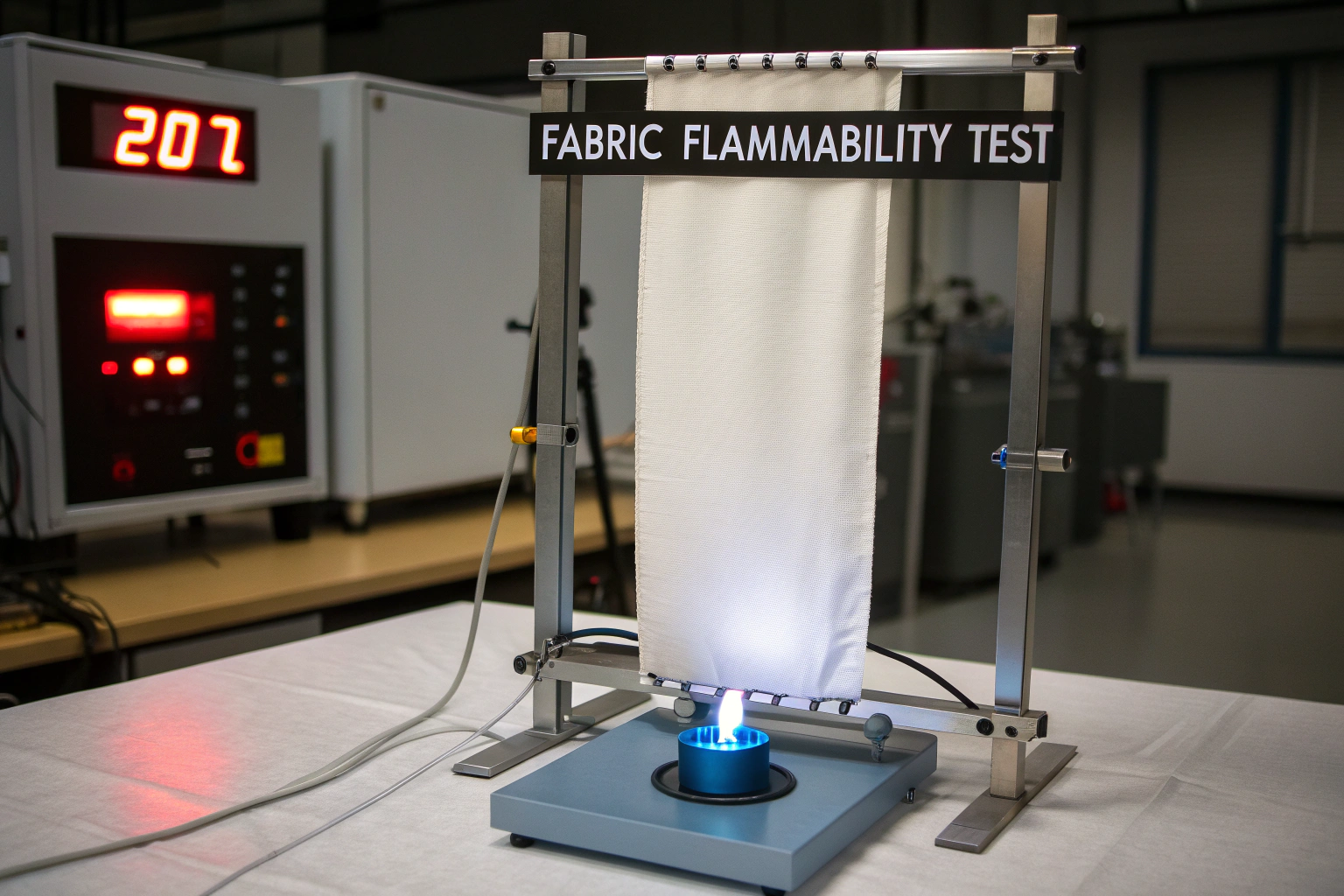
- US Standard (16 CFR Part 1610): This is the "45-Degree Angle Test." We take a strip of fabric, mount it at a 45-degree angle, and touch a specific flame to the bottom edge for 1 second. We measure how fast the flame travels up the fabric. It simulates a garment brushing against a candle or a stove burner.
- EU Standard (EN 1103 for Apparel / BS 5722 for Nightwear): This often involves a "Surface Flash Test." The fabric is laid flat or hung vertically, and a flame is applied to the face of the fabric. They are looking for rapid surface spread.
The Killer Discrepancy: Brushed Fleece and Raised Fibers.
This is the biggest "Gotcha" for my American clients sourcing from China.
In the EU, a brushed cotton fleece hoodie is generally acceptable if it doesn’t flash intensely.
In the US, that exact same brushed cotton fleece will Fail 16 CFR Part 1610 with a Class 3 (Rapid and Intense Burning) rating.
Why? Because those tiny raised fibers on the surface of the fleece act like kindling. In the US 45-degree test, that "fuzz" catches fire immediately and races up the fabric strip in under 3.5 seconds. The EU test might not catch it because the flame is applied differently.
If you are importing Brushed Cotton, Sherpa, or Chenille, you must test to US standards. You cannot rely on a European certificate. There’s a very detailed technical paper on understanding the specific differences in test methodology between 16 CFR 1610 and ISO 6941 available on the ASTM website that breaks down the flame impingement time differences.
How Does CPSC Regulate Children’s Sleepwear Differently?
This is the section you need to read three times if you make anything for kids. Children’s Sleepwear (Sizes 9 months to 14) is not covered by 16 CFR Part 1610. It is covered by 16 CFR Part 1615 (Sizes 0-6X) and 1616 (Sizes 7-14) . These are MUCH STRICTER.
Under 1610, a fabric can pass if it burns slowly (Class 1).
Under 1615/1616, the fabric MUST SELF-EXTINGUISH. The flame cannot travel more than a certain distance, and the average char length must be very short.
The Two Paths to Compliance for Kids Sleepwear:
- Inherently Flame Resistant Fabric: This is usually Polyester. Not all polyester, though. It has to be a specific type that melts and shrinks away from the flame rather than igniting. We use a lot of Treated Polyester Knits for this.
- Tight-Fitting Garments: The CPSC allows an exemption. If the pajamas are Tight-Fitting (meeting specific dimensional requirements for wrist, ankle, and chest) AND carry a Yellow Hangtag Warning that says "For child’s safety, garment should fit snugly. This garment is not flame resistant. Loose-fitting garment is more likely to catch fire." THEN you can use regular cotton (Class 1).
I had a client from Texas in April 2024 who wanted to make loose-fitting, flowy cotton nightgowns for 8-year-old girls. Beautiful design. She showed me the EU certification. I had to be the bad guy. I told her, "You cannot ship these to the US. They are loose-fitting sleepwear made of cotton. They are illegal. The CPSC will seize them at the border." She was devastated. We switched her to a snug-fit design and added the hangtag. That saved her business.
Which Fabrics Automatically Fail US Flammability Tests?
Let’s cut through the complexity. You don’t need a lab for the initial gut check. There are certain fabric constructions that I can look at in our showroom and tell you, with 99% certainty, "That will fail US Flammability." It’s not about the fiber content alone. It’s about Weight, Weave, and Nap. Let’s look at the two biggest offenders we see in the import world.

Why Does Brushed Cotton Fleece Often Fail 16 CFR Part 1610?
I mentioned this earlier, but let’s dig into the why so you can explain it to your product development team.
The Physics of Failure: The "Candlewick Effect."
The surface of a brushed fleece is essentially millions of tiny, loose cotton fibers standing straight up. Air surrounds these fibers. When a flame touches the bottom, it doesn’t just burn the base fabric. It jumps from fiber tip to fiber tip. This is called Surface Flash. The flame races across the top of the nap faster than a lit match dropped in gasoline.
Testing Reality:
- Unbrushed Cotton Jersey (T-shirt): Usually Class 1 (Normal Flammability). Burns like a piece of paper. Slow enough to be legal.
- Brushed Cotton Fleece (Sweatshirt inside): Usually Class 3 (Rapid Flammability). ILLEGAL for apparel.
How do we fix it at Shanghai Fumao ?
If a client insists on the fleece look, we have two options:
- Synthetic Blend: We add at least 35-40% Polyester to the yarn. When the flame hits, the polyester melts and shrinks away from the flame, collapsing the "fuzz" structure and stopping the surface flash. A 60% Cotton / 40% Polyester fleece is much safer.
- Chemical FR Treatment: We can apply a Proban or Pyrovatex treatment to the cotton. This is expensive and changes the hand feel (makes it stiffer). It’s usually only done for industrial workwear or specific hospitality contracts.
If you’re developing loungewear and want that soft, vintage feel, stick to French Terry. French terry has loops on the back, not a cut nap. It usually passes 1610 Class 1 because there is no loose fuzz to carry the flame.
Are Sheer Rayon and Viscose Fabrics a High Risk for Ignition?
Yes. And this is a trap that catches the "Boho" and "Festival Wear" brands every single summer.
The Problem: Lightweight + Cellulose.
- Rayon/Viscose is a regenerated cellulose fiber. It’s made from wood pulp. It burns like paper. Fast, clean, and hot.
- Sheer Weight: A fabric that weighs less than 2.6 oz per square yard (approx 90 GSM) has very little mass. There isn’t enough material to slow the flame down. It just vaporizes.
If you combine Lightweight (under 90 GSM) + 100% Viscose + Open Weave (like a gauze) , you have created the perfect tinderbox. It will burn faster than the 3.5 seconds allowed for a Class 3 failure. It will likely be classified as "Rapid and Intense Burning."
Real-world case: In February 2025, a Florida-based resort wear brand sent us a swatch of the most beautiful printed viscose voile (70 GSM). They wanted tiered maxi dresses. We ran it through our lab. Burn time: 1.8 seconds. Flames shot up the strip. It failed spectacularly.
The Solution:
We re-engineered the fabric. We added a Silk/Cotton warp and kept the viscose weft. The addition of the protein fiber (Silk) slows the burn rate because silk shrinks from the flame and is naturally self-extinguishing. We also increased the GSM to 105. The new fabric passed Class 1 and still had a beautiful drape.
For more specific data on burn rates, you can look at the CPSC database of fabric flammability testing results for lightweight textiles. It’s a public resource, though sometimes hard to navigate.
How to Request and Verify a US Flammability Test Report?
So you’ve told the factory, "I need US Flammability." They reply, "Yes, yes. We have test." Then they email you a blurry PDF with Chinese characters and the word "PASS" on it. Is that enough? Absolutely not. You need to know exactly what to ask for and how to spot a fake or, more commonly, a misapplied test report.

What Information Must a Valid 16 CFR Part 1610 Report Include?
A valid report is a legal document. If the CPSC comes knocking, this is your "Get Out of Jail Free" card. If the report is missing key elements, the CPSC will throw it out and hold you liable.
Here is the checklist we use at Shanghai Fumao to audit our own lab reports before we send them to US clients:
Mandatory Fields on a Valid Report:
- Testing Laboratory Name and Accreditation: Is it CPSC-Accepted? Look for labs like SGS, Intertek, Bureau Veritas, UL Solutions. If it’s a random "Shenzhen Quality Check Co." with no ISO 17025 accreditation, it’s worthless.
- Fabric Identification: Must match your PO exactly. "100% Cotton Flannel" is not good enough. It needs Construction (Woven/Knit), Weight (GSM or Oz/sq yd), and Color/Print ID.
- Test Method: Must state "16 CFR Part 1610 (Standard for the Flammability of Clothing Textiles)" . If it says "ISO" or "EN," it’s the wrong test.
- Sampling Procedure: Did they test 5 specimens in the original state AND 5 specimens after dry cleaning/laundering (Refurbished State)? This is critical. Some fabrics are treated with a temporary finish that washes out. The test MUST include the washed state.
- Results: The Average Burn Time for each direction (Warp/Fill or Wale/Course). And the final Classification: Class 1, 2, or 3.
- Date of Test: Flammability reports are generally good for 1-2 years as long as the fabric construction hasn’t changed. If the report is 5 years old, demand a new one.
If a supplier sends you a report with any of this missing, reject it. Tell them you need a full report from a CPSC-accepted third-party lab. It costs about $150-$250 USD. If they won’t pay for it, you pay for it. It’s the cheapest insurance you’ll ever buy.
Can You Trust Factory-Provided "Self-Certification" for Flammability?
No. Next question.
Okay, I’ll elaborate. A factory "Self-Certification" is usually a document called a General Certificate of Conformity (GCC) . This is a legal document that you, the US Importer, are required to issue. You can base it on the factory’s test report, but you sign it. You are taking responsibility.
If a factory says, "We guarantee it passes, we have been doing this 20 years," that is not a valid defense in US Federal Court.
I’ve seen factories confuse "Flame Retardant" (Chemical Treatment) with "Flame Resistant" (Inherent Fiber Property) with "Normal Flammability (Class 1)." They will show you a video of a polyester fabric melting away from a flame and say, "See! Safe!" But that’s Polyester. If you ordered Cotton Fleece, that video is irrelevant.
The Only Verification That Matters:
Ask for the Lab Test Report Number and call the lab to verify it.
Or, Send a pre-production sample to a US lab yourself. We always recommend our US clients do a "Pre-Shipment Flammability Spot Check" when the bulk fabric is 80% complete. We cut a yard from the middle of the roll, ship it via DHL to a US lab, and have results in 48 hours. If it fails, we stop production and adjust the finish. If it passes, we ship the container.
How to Navigate Flammability Compliance for Blended Fabrics?
Blends are the wild card. You can’t just average the burn rates of Cotton and Polyester. The way fibers interact when exposed to heat changes the game completely. This is where we see the most surprising failures. A fabric that is 80% safe fiber and 20% dangerous fiber might be more dangerous than a fabric that is 100% dangerous fiber. Let’s look at the two most common blend scenarios for US importers.

Does a Cotton-Polyester Blend Burn Slower Than 100% Cotton?
This is the number one question I get from streetwear and basics brands. They want the softness of cotton and the durability of polyester. They assume the plastic in the blend will act like a fire extinguisher.
The Truth: The "Scaffolding Effect."
Yes, in most cases, a blend with 50%+ Polyester will burn slower or shrink away from the flame better than 100% Cotton Fleece.
BUT… there is a danger zone: The 40% Cotton / 60% Polyester Fleece.
Why? Because there is just enough cotton to form a charred scaffold. When the flame hits, the polyester melts away, but the cotton remains behind as a rigid, black, carbon skeleton. This skeleton holds the fabric in place so the flame can keep burning the remaining cotton, rather than the fabric dripping away to safety (which is what 100% poly does). This can cause a slower, smoldering burn that is still too fast to pass Class 1.
The Safer Bet for US Apparel:
- Under 30% Cotton / Over 70% Poly: Usually passes Class 1 easily. The poly dominates and drips.
- Heavyweight Cotton (Over 6.0 oz): Usually passes Class 1 even at 100% cotton because the mass resists ignition. Think heavy denim or canvas.
We had a US workwear brand in October 2024 test a CVC Fleece (60% Cotton / 40% Poly) . It failed Class 1. We flipped the ratio to 80% Poly / 20% Cotton (with the cotton in the core of the yarn, not on the surface), and it passed easily. The surface was mostly poly fuzz, which melted away instantly.
Why Does Adding Spandex to Rayon Increase Flammability Risk?
This is a hidden danger in the activewear and "soft dressing" categories. You see a lot of Rayon/Spandex Jersey and Modal/Spandex Ribs. The spandex is there for stretch. But spandex is Polyurethane. It is highly flammable and burns with intense heat.
The Mechanism:
- The Rayon/Modal provides the cellulose fuel source (burns like paper).
- The Spandex melts into a hot, sticky, burning liquid that adheres to the skin. This is called Melt-Drip Burn. It’s one of the most severe types of burn injuries.
The Solution for Stretch Fabrics:
If you need a soft, drapey, stretch fabric for the US market, avoid Rayon/Spandex blends for loose-fitting styles.
Instead, use:
- Polyester/Spandex: The poly will shrink and drip, but the spandex content is usually low (5-8%), so it’s manageable under 1610.
- Cotton/Modal/Spandex with a tighter knit: A heavy, tight jersey (over 200 GSM) passes much easier than a thin, open rib.
For a deeper understanding of how fiber composition and blend ratios affect textile flammability and melt-drip behavior, the NFPA (National Fire Protection Association) has some excellent technical bulletins, though they are geared more toward firefighter gear than fashion. The physics is the same.
Conclusion
Sourcing fabric that meets US Flammability Standards is not a "nice-to-have" feature. It is a federal mandate. It is the baseline requirement for selling a single garment legally in the United States of America. We’ve walked through the landmines: the deceptive safety of EU certificates, the tinderbox nature of brushed cotton fleece, the scaffolding effect of certain blends, and the absolute necessity of a third-party CPSC-accepted lab report.
You cannot delegate this responsibility to a trading company or a factory sales rep who has never set foot in a US courtroom. You, as the brand owner or importer, own the compliance. The good news is that this is a solved problem. It’s not a mystery. It’s a matter of specifying the right fiber blends, checking the right boxes on the test report, and paying the $200 for the lab test before you cut 5,000 units.
At Shanghai Fumao , we approach this from the ground up. When we develop a new fabric for the US market, the first question we ask isn’t "What’s the hand feel?" It’s "Will this burn?" We test our greige. We test our finished goods. We keep a library of certified reports because we know that your business depends on our diligence.
If you’re feeling overwhelmed by the CPSC regulations or you’re unsure if the fabric sample in your hand is a Class 1 or a Class 3 lawsuit waiting to happen, don’t guess. Reach out. We can guide you through the fiber selection process or point you toward the right testing lab.
For a compliance consultation on your next US-bound fabric order, contact our Business Director, Elaine. She handles the documentation and can ensure you have the paperwork to back up your product.
Email Elaine at: elaine@fumaoclothing.com
Stay safe, stay compliant, and let’s keep the fire in the design, not in the fabric.