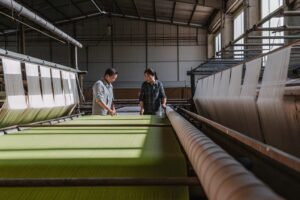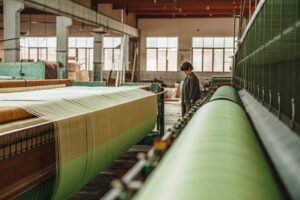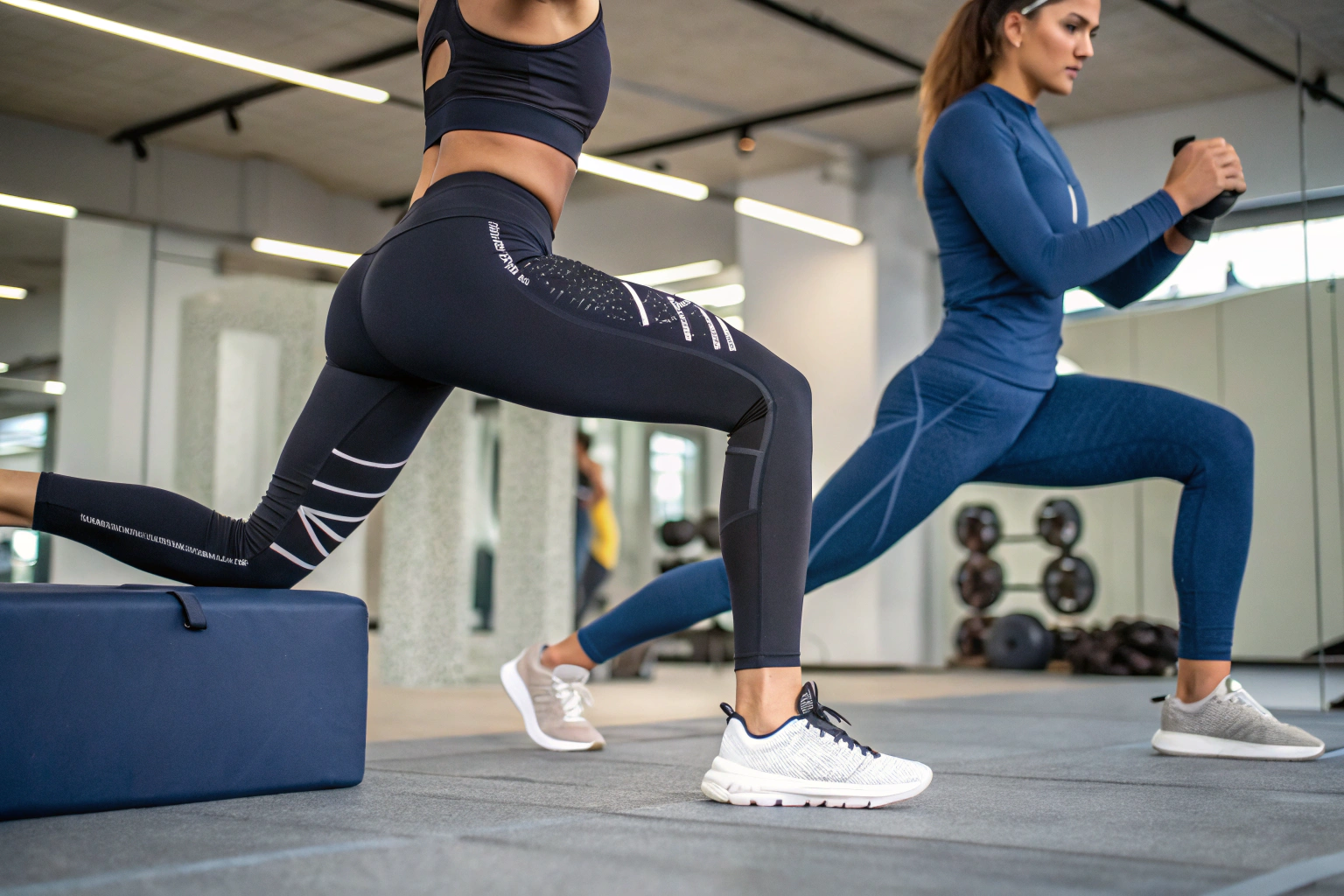
Here’s a scene I’ve witnessed a hundred times in our fabric showroom in Keqiao. A young, ambitious athleisure brand founder comes in, holding a pair of Lululemon Aligns in one hand and a cheap Amazon dupe in the other. They ask me, "Michael, what’s the difference? They’re both Nylon/Spandex. Why does this $98 pair look brand new after 50 washes, and this $25 pair looks like a saggy, pilled diaper after three spin classes?"
The answer isn’t just "brand markup." The answer is Shape Retention Engineering. And it’s the single most expensive and difficult problem to solve in textile manufacturing. You can make fabric that feels like butter. You can make fabric that wicks sweat. But can you make fabric that does both of those things and snaps back to its original shape after being stretched over a knee for an hour-long yoga class? That’s the holy grail.
At Shanghai Fumao , we supply fabric to brands competing in the most saturated market in fashion. The return rate on athleisure is brutal. If the knees bag out, the customer returns it. If the waistband loses its grip, she returns it. If the fabric "shines" or shows white stress marks when she bends over, she leaves a 1-star review that haunts your Amazon listing forever. You can’t fake performance. The fabric either has the "snap" or it doesn’t.
This guide is for the brand builders who are tired of guessing. I’m going to break down the exact fiber chemistry, the knit construction techniques, and the lab tests we use to guarantee that your leggings don’t become a saggy, shapeless mess by lunchtime. Let’s talk about the science of the snap.
What Fiber Blends Offer the Best Stretch and Recovery?
This is where it all starts. You can’t fix a bad fiber blend with a good finish. The raw materials dictate the ceiling of your performance. And in the world of shape retention, not all spandex is created equal. Not all nylon is created equal. You need to know the specific "brand names" and chemistries inside the yarn.

Why Does Nylon 66 Outperform Polyester in High-Friction Zones?
Let’s get nerdy for a second. There are two main types of Nylon used in textiles: Nylon 6 and Nylon 66.
- Nylon 6: Cheaper. Softer hand feel initially. Used in a lot of fast fashion activewear.
- Nylon 66: More expensive. Slightly crisper hand feel. Significantly higher melt point and abrasion resistance.
The "Inner Thigh Rub" Test:
Think about what happens to a pair of leggings over time. The inner thighs rub together. This friction generates Heat and Abrasion. Nylon 6 has a lower glass transition temperature. Over time, the friction heat actually softens the polymer structure of Nylon 6. It loses its "memory." That’s why cheap leggings get thin and baggy in the crotch and inner thigh—the fiber itself is collapsing.
Nylon 66 (think Invista Tactel or Cordura) has a tighter polymer chain. It withstands that friction heat much better. It retains its spring-back property even after hundreds of hours of wear.
The Polyester Problem:
Polyester is great for moisture-wicking (it’s hydrophobic—it hates water). But for Shape Retention, polyester is inferior to Nylon 66. Polyester tends to "creep." That means if you stretch it and hold it under tension (like across a bent knee), the fibers slowly slide past each other. When you release the tension, they don’t slide back fully. You get Permanent Set (Baggy Knees).
Our Recommendation at Shanghai Fumao:
For any high-compression or high-abrasion garment (leggings, bike shorts), we spec Minimum 70% Nylon 66. The price difference per meter is about $0.50 – $1.00, but the reduction in returns is worth 10x that.
How Does Spandex Denier Impact Garment "Snap Back"?
This is the secret sauce that cheap factories hope you don’t ask about. You look at a spec sheet, it says "80% Nylon, 20% Spandex." You think, "Great! Lots of stretch!" Wrong. That 20% could be a thin, weak noodle of a fiber or a thick, powerful spring.
What is Denier? It’s the weight/thickness of the yarn. Higher Denier = Thicker, Stronger Spandex.
The Cheap Factory Trick:
They use 20D or 30D Spandex. It’s thin. It stretches easily on the knitting machine (faster production, fewer needle breaks). It feels soft initially. But it has very little Modulus (power/compression). It stretches out and stays stretched.
The Premium Factory Spec:
We use 40D, 70D, or even 105D Spandex for high-retention zones (like waistbands).
- 40D: Standard for "Naked Feel" leggings. Good recovery, light compression.
- 70D: Standard for "Compression" leggings. Excellent recovery. Holds you in.
- 105D: Used in waistbands only. Like a firm elastic belt.
The "Stretch Test" You Can Do at Home:
Take a swatch of fabric. Mark a 10cm line on it. Stretch it to 20cm and hold it for 1 hour. Let it rest for 30 minutes. Measure the line.
- Good Fabric: The line measures 10.3cm (3% growth).
- Bad Fabric: The line measures 11.5cm (15% growth).
At Shanghai Fumao , we require our spandex suppliers (we use Lycra or Creora brands specifically) to provide the Denier and Draft Ratio on every batch. We don’t buy generic "spandex" from the spot market.
For a deeper technical dive, you can look into the specific performance differences between Lycra T400 fiber and generic spandex for shape retention. It explains the chemistry of why some elastics just last longer.
How to Prevent Bagging and Sagging in High-Movement Garments?
Fiber choice is step one. But you can take the best Nylon 66 and Lycra in the world, and if you knit it on a loose, sloppy machine, it will still bag out. Knit Construction is the architect of recovery. The tighter the structure, the less room the yarns have to "creep" and slide. It’s like the difference between a loose haystack and a tightly coiled spring.

Why Is High-Gauge Knitting Essential for Leggings and Biker Shorts?
Gauge refers to the number of needles per inch on the knitting machine.
- Low Gauge (18-24 gauge): Fewer needles. Looser, thicker, chunkier knit. Good for sweaters. Terrible for shape retention.
- High Gauge (36-44 gauge): More needles. Tighter, denser, finer knit. Essential for athleisure bottoms.
The "See-Through" Test Correlation:
You know that "squat test" everyone does on TikTok? That’s not just about opacity; it’s about Stitch Density. A low-gauge fabric has gaps between the stitches. When you stretch it over a knee or a glute, those gaps open up. Not only can you see skin, but those open gaps allow the yarns to shift permanently. They move to a new, stretched-out position and don’t come back.
A high-gauge fabric (like 40gg or 44gg) has almost no gaps. The yarns are packed so tightly together that they support each other. When you stretch it, the entire fabric structure expands and contracts as a unit. It’s like a Roman phalanx of yarns working together. One soldier can’t break rank and cause a baggy spot.
Real World Data:
We ran a trial for a US fitness influencer brand in October 2024. We made the exact same legging pattern in:
- Sample A: 28gg Nylon/Spandex (Standard market quality)
- Sample B: 40gg Nylon/Spandex (Shanghai Fumao premium spec)
After 30 wash/dry cycles and 20 wear tests, Sample A had 12% fabric growth in the knee area. Sample B had 4% growth. The difference in cost? About $0.80 per meter. The brand switched to Sample B and removed "Baggy Knees" from their list of return reasons entirely.
What Role Does Heat-Setting Play in Fabric Memory?
This is the Invisible Step that separates premium athleisure fabric from the cheap stuff. You can’t see it. You can’t feel it until you wash it. But it’s the single most important finishing process for shape retention.
What is Heat-Setting (or Pre-Shrinking)?
After the fabric is knitted and dyed, it’s full of tension and stress from being pulled through machines. If you cut that fabric and sew a garment immediately, the first time the customer washes it (or even sweats in it), that tension releases. The fabric Shrinks and Distorts.
The Process:
We run the fabric through a Stenter Frame (a giant oven on rails). We stretch it width-wise to a specific, calibrated width and overfeed it length-wise (push it forward so it’s relaxed). Then we bake it at 190-200 degrees Celsius for 1-2 minutes.
What this does to the molecules:
It "locks" the spandex and nylon into their final, relaxed state. It’s like annealing glass. You’re removing the internal stress.
The "Wash Test" Lie:
If a factory says, "Don’t worry, the fabric will shrink 5% in the first wash, so we cut the pattern bigger," RUN AWAY. That means they didn’t heat-set it properly. Uncontrolled shrinkage means uneven shrinkage. The leg might shrink lengthwise but not width-wise. The seams will pucker. The shape is ruined.
At Shanghai Fumao, our standard for athleisure fabric is Maximum 2% residual shrinkage after 5 home launderings. We test every batch. If it’s over 2%, we re-run the heat-setting process.
Which Moisture-Wicking Fabrics Maintain Compression Over Time?
This is the tightrope walk. The market demands Wicking. You add a chemical finish to the fabric to make sweat spread out and evaporate. But many of these finishes actually damage the spandex and reduce shape retention. You have to choose your chemistry carefully.

Does Polyester Spandex Hold Shape Better Than Nylon Spandex When Wet?
This is a counter-intuitive truth that surprises a lot of designers.
Nylon Spandex: When it’s dry, it has superior recovery. It’s the king of compression.
Polyester Spandex: When it’s Wet (sweaty) , it holds its shape better than Nylon.
Why? Hydrophobic vs. Hydrophilic.
- Nylon absorbs a small amount of water (about 4% of its weight). When it gets wet, the fibers swell slightly. This swelling can relax the knit structure just enough to cause a 5-10% temporary loss of compression. You feel the leggings getting "looser" as you sweat.
- Polyester absorbs almost zero water (0.4%). It is hydrophobic. It does not swell. It does not relax. The compression you feel at minute 1 of your workout is the same compression you feel at minute 60.
The Solution for Hybrid Performance:
If you want the abrasion resistance and soft feel of Nylon and the wet-shape stability of Polyester, you need a Bi-Component Yarn or an Intimate Blend with Polyester on the face (touching skin) and Nylon on the back (for durability).
We developed a Nylon/Poly Hybrid Interlock for a Canadian training brand in January 2025. The face is Polyester for zero water absorption and print clarity. The back is Nylon 66 for softness and durability. It’s the best of both worlds, but it’s a complex and expensive knit to run.
Why Do Some "Performance" Finishes Ruin Elastic Recovery?
This is the dark side of textile chemistry that most fabric sales reps won’t tell you about.
To make fabric "Wicking," we apply a Hydrophilic Finish (usually a silicone-based softener). This breaks the surface tension of the water so sweat spreads out instead of beading up.
The Problem: Some cheap, cationic softeners act like Lubricants for the Yarn. They make the yarns too slippery inside the knit structure. Remember the "haystack" analogy? If you oil the haystack, the straws slide all over the place and never lock back into place. The fabric loses its "snap."
The Solution:
We use Nano-Filament Polyester (inherent wicking) rather than heavy chemical finishes. The wicking property is built into the shape of the fiber itself (it has channels), not coated on the outside. This means we don’t need to use the "slippery" softeners that kill recovery.
If you’re testing a fabric, wash it 5 times before you test the stretch. If the recovery is worse after washing than before, it means the factory used a temporary finish to make it feel good in the showroom, and that finish washed out (or washed in and lubricated the yarns).
For a better understanding of this, reading about the impact of silicone softeners on the tensile strength and recovery of spandex blends is quite eye-opening. It’s a known issue in the dyeing and finishing industry.
How to Test Fabric Shape Retention Before Bulk Production?
You can’t rely on the factory’s word. You can’t rely on the spec sheet. You need to do a Destructive Physical Test on the pre-production sample. This doesn’t require a $50,000 lab machine. It requires patience, a marker, and a washing machine. Here is the exact protocol we recommend our clients use before they cut 5,000 units.

What Is the "Stretch and Hold" Home Test for Fabric Memory?
This is the poor man’s Instron Tensile Tester. It’s not perfectly scientific, but it’s 99% accurate for predicting baggy knees.
The Protocol:
- Cut a Swatch: Cut a piece of fabric exactly 10cm x 10cm from the bulk sample. Use a sharpie to trace the exact outline on a piece of cardboard or paper. Important: Cut one piece with the stretch going lengthwise (grain) and one with the stretch going widthwise (cross-grain).
- Mark It: Draw a 5cm line in the center of the swatch with a ballpoint pen, following the grain direction.
- The Stretch: Pin one end of the swatch to a corkboard or heavy book. Stretch the fabric until that 5cm line measures 10cm (100% stretch). Hold it there. Use a clamp or a heavy book to keep it stretched.
- The Wait: Leave it stretched for 4 hours. (Simulates a half-day of wear).
- The Release: Unpin it. Let it rest flat on a table for exactly 30 minutes. Do not touch it. Do not steam it.
- The Measure: Measure the line again.
Pass/Fail Criteria:
- Excellent (High Compression Legging): Line measures 5.0cm – 5.2cm (Less than 4% growth).
- Good (Everyday Athleisure): Line measures 5.2cm – 5.5cm (4-10% growth).
- Fail (Do Not Use): Line measures over 5.5cm (Over 10% growth). This fabric will bag out at the knees and elbows.
At Shanghai Fumao , we do this test with a 1.5kg weight and a 24-hour hold time for our premium compression fabrics. We aim for under 3% growth.
How Many Wash Cycles Reveal True Elastic Performance?
A fabric can pass the "Stretch and Hold" test right off the loom, but Washing and Drying is the real enemy. Heat and agitation are murder on spandex.
The 5-Wash Rule:
Never approve a bulk fabric based on a greige or freshly finished sample. Demand a sample that has been Laundered 5 Times according to care label instructions (usually cold wash, tumble dry low).
What to look for after 5 washes:
- Curling Edges: Does the edge of the fabric roll up? This indicates Internal Stress that was not relaxed during heat-setting. It will cause seams to twist in the final garment.
- Loss of Compression: Do the "Stretch and Hold" test again on the washed sample. If the growth rate jumped from 5% to 12%, the spandex was damaged by the dyeing chemicals or the heat-setting was insufficient.
- Pilling: Check the surface. Especially on the back (inside) of the fabric. If it’s pilling after 5 washes, it will look like a rat’s nest after 20 wears.
I had a US client in March 2024 who fell in love with a sample because it was "so soft." I made them wash it 5 times. The fabric pilled so badly it looked like a wool sweater. The softness came from a Peach Skin Finish that was not durable. We switched to a Brushed Nylon 66 that actually got softer with washing but didn’t pill. The 5-wash test saved them from a catastrophic launch.
Conclusion
Sourcing athleisure fabric that retains its shape is a fight against entropy. It’s a constant battle against the natural tendency of polymer chains to relax and fibers to slide. But it’s a battle you can win if you know what to look for. You need the Molecular Spring of Nylon 66 and High-Denier Lycra. You need the Disciplined Structure of a High-Gauge Knit. And you need the Thermal Lock of Proper Heat-Setting.
You can’t fake this. The consumer is too smart. She wears the leggings for a 5K run, then sits in them for a two-hour coffee meeting. She knows within one wear if the fabric has her back (literally). If you cut corners on fiber quality or knit density, she will feel it by noon, and she will never buy from you again.
At Shanghai Fumao , we don’t sell "activewear fabric." We sell Shape Retention Guarantees. We test our greige, we test our finished rolls, and we stand behind the recovery of our knits because we know your brand’s reputation lives and dies in the squat rack.
If you’re ready to upgrade your activewear line with fabric that snaps back as hard as your customers work out, let’s talk specifics. We can send you a wash-tested swatch pack that shows the difference between "standard" and "premium" recovery.
To discuss your specific stretch and recovery requirements, reach out to our Business Director, Elaine. She can help you spec the right fiber blend and gauge for your performance needs.
Email Elaine at: elaine@fumaoclothing.com
Let’s keep those knees tight and that confidence high.