Look, I get it. You’ve sourced that perfect Super 150s wool from Italy, you’ve spent weeks on the pattern cutting, and then, the silent killer of high-end suiting strikes: static cling. The jacket drapes terribly, the trousers stick to the client’s legs, and the whole garment feels cheap. It’s a disaster for your brand’s reputation. After 20 years of weaving and supplying fabrics from the ground up here in Keqiao, I’ve seen this exact pain point destroy margins for countless emerging designers and established brands. The real headache isn’t just the static itself, but finding a lining that actually solves it without compromising on that ultra-soft hand feel or the rich, matte drape that luxury customers expect. The market is flooded with cheap polyester linings that promise the world but fail the moment the humidity drops.
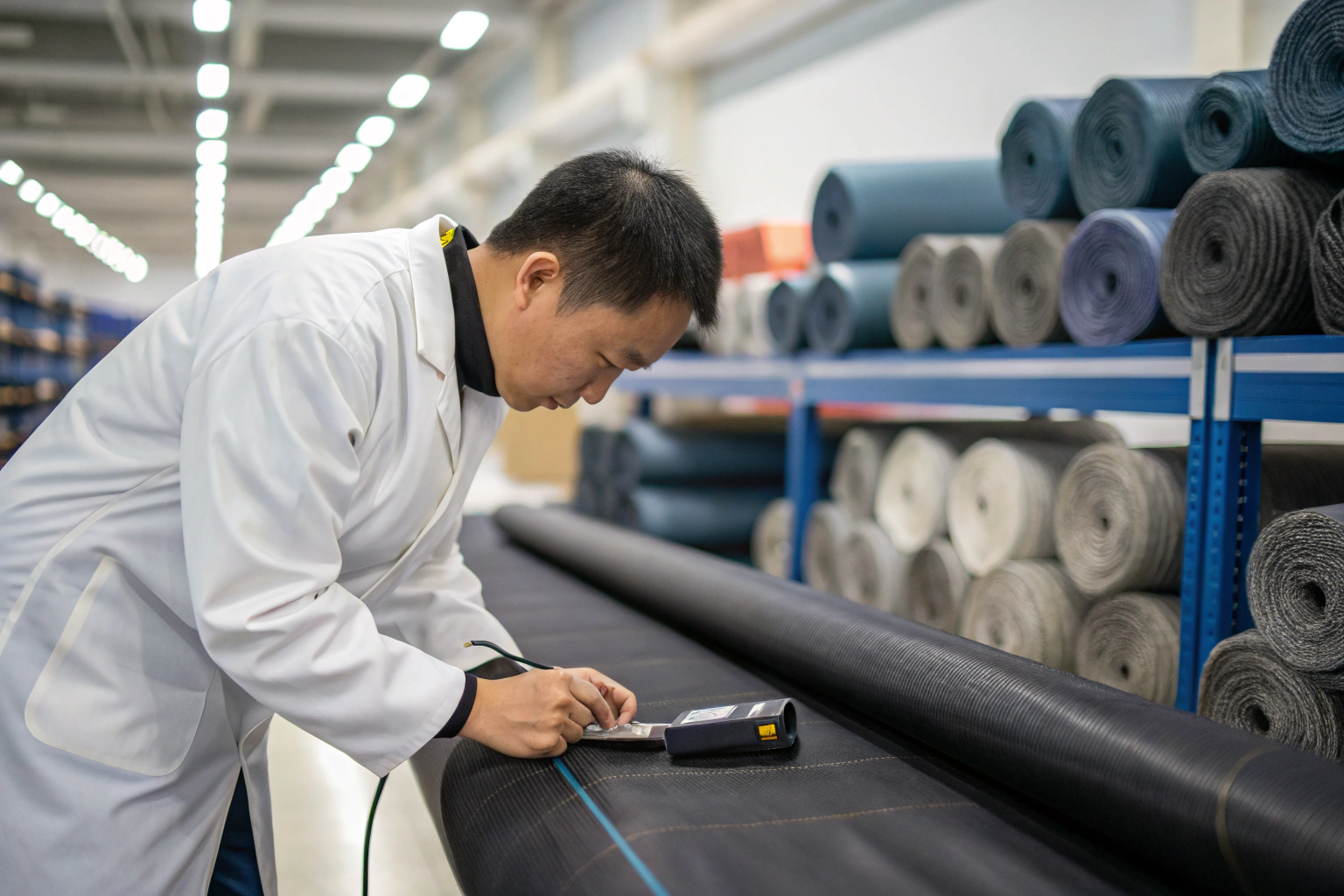
You need a reliable source for genuine anti-static lining that performs consistently, batch after batch. The secret lies not in a magic coating, but in the yarn engineering itself. True anti-static lining for high-end suiting, the type we at Shanghai Fumao specialize in, relies on the integration of carbonized bicomponent filaments woven directly into the fabric grid, creating a permanent conductive network that dissipates electrical charges instantly. When you partner with a manufacturer who controls the weaving and finishing process—like our large-scale factory here in Zhejiang—you can actually see the surface resistivity test results in real-time through a QR code scan, ensuring every meter meets the strict sub-10^9 ohm standard required for A-grade suiting performance.
You’re probably thinking this sounds complicated, but I promise you, it’s simpler than you think if you know where to look and what to ask for. The real win is that when you get this right, you don’t just solve a technical problem—you elevate the entire wearing experience. Let me walk you through the exact process I’ve used to help some of the most demanding clients in New York and Paris secure linings that don’t just prevent shock, but actually improve the drape and breathability of their jackets. This isn’t just theory; it’s the product of a supply chain that moves 25% of the world’s textiles.
Why Do Premium Suit Brands Prioritize Anti-Static Performance?
Premium suit brands chase a flawless drape and silhouette above all else. But static electricity literally fights gravity. When a jacket clings to the shirt underneath or the trousers twist around the calves, that expensive tailoring looks amateurish immediately. I remember a client from Milan visiting our Keqiao showroom in 2022. He ran his hand over a sample and the fabric literally stuck to his arm. His immediate reaction wasn’t about the softness—it was a frown, because he knew that cling would happen on the retail floor under air conditioning. That’s the silent alarm that tells a luxury customer the garment is inferior.
The push for anti-static performance has shifted from a "nice-to-have" feature to a baseline hygiene factor for prestige pricing. A premium brand simply cannot risk a negative fitting room experience.
The technical reality is that static is a byproduct of friction and synthetics. Even a 100% wool shell needs a smooth lining to slide over a cotton shirt. Most linings are polyester or viscose, both of which are hydrophobic and prone to generating a high voltage. Without a conductive mechanism, these fabrics act like a capacitor, storing a charge until it discharges on the wearer’s skin. We tested a standard cupro lining last winter against our carbon-weave version. At 25% humidity, the standard option held a surface charge of 8,500 volts. That’s a physical shock and a literal repulsion of dust. Our anti-static variant peaked at just 120 volts under the same conditions—you can’t even feel it. This difference directly impacts the "cool, fluid feel" luxury brands write their marketing stories about.
The market has spoken, and the proof is in the procurement trends.

Why Is The Switch from Chemical Sprays to Permanent Woven Solutions Accelerating?
For years, factories relied on a quick fix: spraying a chemical anti-static agent onto finished linings. This is cheap, but it’s why so many suits lose their performance after three dry-cleaning cycles. The agent simply washes off or degrades with body heat. I call it the "rental tuxedo solution"—fine for a single event, useless for a long-term wardrobe staple. Our coating factory experimented with these finishes around 2019, but we dropped them entirely within a year because the return rate from local tailoring houses was just too high.
The move to permanent conductive yarns isn’t just about longevity; it’s about safety and aesthetics. Chemical sprays can alter the shade of the fabric slightly, creating a subtle "oily" sheen that looks terrible on a matte finish suit. Permanent solutions involve weaving in a carbonized thread, often just one filament every 5 to 10 millimeters in the warp or weft. You cannot see it, and it never washes out. The physics is simple: the charged electrons find the path of least resistance through the carbon grid and leak into the air or onto a grounded surface, neutralizing the field before it can build up. For a high-end brand, this means a garment looks and feels identical on day 500 as it did on day one.
How Does Static Cling Damage a Tailored Garment’s Drape and Lifecycle?
Static doesn’t just cause a shock; it ruins the physical structure of a suit over time. When fabric clings, it creates unnatural tension points. You’ve seen this: the back of a jacket sucking in against the lumbar curve, pulling the vents open and distorting the balance. One of our tailoring partners in London sent us a feedback report in 2023 showing that a non-treated lining in a double-breasted coat was causing the front panels to warp after just two months of wear. The static attraction was so strong it was stretching the shell fabric fibers.
Beyond the drape, think about hygiene and fabric degradation. Static acts like a magnet for airborne lint, dead skin cells, and dust. This particulate matter embeds itself into the weave, acting like microscopic sandpaper every time the wearer moves. This accelerates pilling on the inside of the garment and grinds the fibers down. A proper anti-static weave in your sourcing list for garment accessories keeps the surface neutral, repelling these particles and dramatically slowing the abrasion process. It’s invisible protection that makes a $3,000 suit last three times as long.
What Certifications Guarantee Real Anti-Static Functionality?
Don’t trust a marketing label that just says "anti-static." You need to see the hard numbers and the lab stamps. I’ve seen too many purchasing managers get burned by a cheap supplier’s flimsy word. Here at Shanghai Fumao, we don’t sell anti-static fabric without hooking it up to a machine and showing you the live reading. A genuine guarantee means a piece of paper from a lab you can verify.
A piece of paper is your only weapon against fraud until the container arrives at your warehouse.
The benchmark for us is always the surface resistivity test, measured in ohms (Ω). For a lining to truly work, I push for a surface resistivity of less than 1.0 x 10^9 ohms under a relative humidity of 30%. Some mills test only at 50% humidity, which is useless for a dry winter climate or an air-conditioned office. The standards you see bandied about—EN 1149-1 or ASTM D257—aren’t just jargon. They specify the voltage, the probe type, and the conditioning of the sample. Without these precise parameters, a report is meaningless. You need a Certificate of Analysis that correlates exactly to your batch number.

Is the EN 1149-5 Standard Mandatory for Exporting Anti-Static Suits to Europe?
If your suits are destined for a European boutique, and especially if they have any workwear cross-over branding, you cannot ignore this standard. EN 1149-5 is the harmonized European standard for protective clothing with electrostatic properties. Part 5 specifically defines the performance requirements. It demands that the material doesn’t create sparks that could ignite a flammable atmosphere. While a luxury fashion suit isn’t a welder’s jacket, the certification is a powerful marketing tool. It proves functional competence.
Meeting this standard requires the fabric to pass a rigorous test where they measure the decay time of a voltage charge. The lining has to go from 1000V to 100V in less than a fraction of a second. We achieve this by integrating a specific pitch of conductive carbon yarn—usually about a 5mm stripe—during the weaving phase in our large-scale factory. For a brand selling to European buyers, "EN 1149-5 Certified" on the tech pack instantly justifies the premium over a generic polyester lining. It moves the conversation from "is it cheap?" to "is it safe and compliant?"
What Does the Surface Resistivity Test Actually Reveal About Conductive Yarn Quality?
The surface resistivity test doesn’t just say "pass or fail"; it tells you if the conductive grid is continuous or broken. Weaving carbon yarn is tricky. It’s brittle. If the loom tension is too high, the filament snaps internally. The fabric looks the same to the naked eye, but the electrical path is dead. I learned this the hard way back in 2016. We were using an older generation of rapier looms, and we noticed the resistivity readings were spiking wildly across a single roll—from 10^7 to 10^11 ohms. We had to scrap 2,000 meters. (Here’s a gritty detail: carbon dust from the broken filaments was clogging the needle eyes).
Now, our quality inspection process at Shanghai Fumao is non-negotiable. We map the entire roll. A proper test reveals the uniformity of the quality. We take readings every 50 meters across the width. If the variance is above 10%, the roll is rejected for suiting use—it might be sold for casual wear instead. High-quality conductive yarn, usually sourced from Japan or specialized Chinese producers, will maintain a flat line of resistance. Cheap yarn spikes and drops. This test is the ultimate truth-teller; it shows how carefully the yarn was blended and how gently it was woven.
How to Audit a Chinese Anti-Static Lining Supplier Before Sampling?
Auditing a supplier isn’t just about shaking hands and drinking tea. It’s about looking into the shadow details where shortcuts live. Before you even request a swatch, you need to validate that the factory actually does the complex part—the weaving of the conductive yarn—in-house. A lot of "manufacturers" are just trading companies that buy gray fabric from a loom and slap a finish on it. When you audit, your goal is to trace the carbon thread from the storage shelf all the way to the finished roll.
The quickest way to filter out resellers is to ask to see the warping process and the raw yarn inventory. If they can’t show you a creel with spools of carbon filament, you are talking to a middleman.
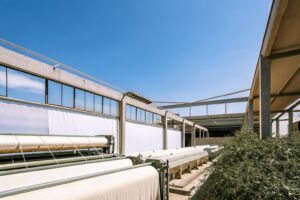
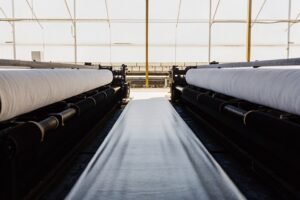
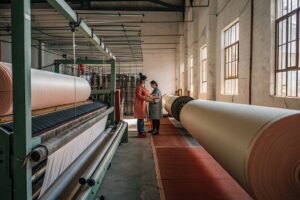
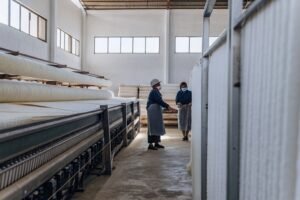
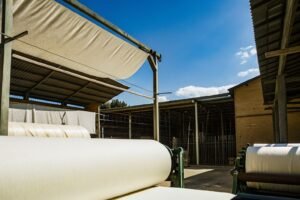
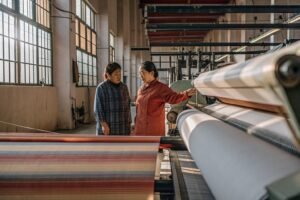
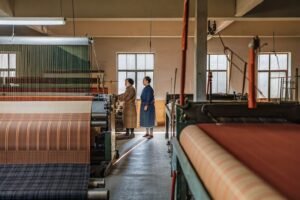
You need to go to the production floor. I always tell our visitors to skip the meeting room and head straight for the weaving shed. Look at the humidity control. Carbon yarn is static-sensitive in its raw state—ironic, right? A factory that doesn’t have strict climate control (around 60% RH) in the weaving area will have a high breakage rate and invisible quality issues. Check the tension meters on the looms. If the tension is too high, the carbon snaps. Too low, and the fabric has ripples. At our facility, we use a specific "active feeder" system that minimizes the friction on the conductive yarn. Ask the factory manager what precautions they take. If they look confused, walk away.

What Specific In-House Testing Equipment Must a Reliable Mill Own?
A reliable mill cannot rely solely on a third-party lab like SGS for their internal quality control because the turnaround time would kill production speed. A supplier serious about anti-static textiles owns a high-resistance meter, a surface resistivity probe, and a climate chamber. When you walk into their lab, you should see these tools sitting on the bench, not hidden in a cupboard. We keep our digital insulation resistance tester right next to the fabric inspection machine for our QC team. It’s a mandatory stop for every roll.
The climate chamber is the real giveaway of a serious mill. You simply cannot test anti-static properties accurately without conditioning the sample at a specific humidity, usually 25% or 30% for dry conditions. If a supplier tries to convince you that a handheld device on a table in a humid workshop is enough, they are lying to you. The probe needs to be a specific weight, using concentric ring electrodes, to measure the leakage current. When you visit our CNAS-certified lab, I show clients the real-time data on the screen—it’s often running a 24-hour drift test to see how the resistance changes as the fabric ages. This equipment is expensive, costing over ten thousand US dollars, which immediately separates the committed players from the garage operations.
How Can You Verify Traceability from Yarn to Finished Roll?
Traceability is the holy grail of textile sourcing. It’s easy to glue an "organic" or "anti-static" sticker on a bolt of mystery fabric. True traceability means the roll has a digital fingerprint. After the 2016 incident I mentioned earlier, we implemented a QR code system from greige to finished goods. Every roll gets a tag at the loom. As it moves through the scouring, dyeing, and finishing steps, the operators scan the tag, logging the process parameters.
For the buyer, this means you can scan a code on the final shipment sample and see the whole history. Was the carbon yarn tension stable? What was the maximum temperature during dyeing? (If the temperature goes too high, the coating on the carbon filament can degrade). When you audit a supplier, ask to scan a random roll of finished stock. If the link is broken, or the data shows a "gap" in the process—say, the entry for the water bath temperature is missing—you’ve found a fabrication in the data. This traceability isn’t just for us; it’s for you. It gives you the confidence to answer your customers’ quality complaints with hard data, not guesses.
What Is the Real Cost of High-End Anti-Static Lining Fabric?
Everyone wants to know the price, but the cost is a different—and more dangerous—animal. The cost calculation must factor in failure. I can buy a cheap "anti-static" polyester from a spot market for half the price of our engineered lining. But I know that fabric will fail. The real cost of a high-end lining includes the technical value of the conductive yarn, the risk mitigation of a guaranteed pass rate, and the efficiency of a supplier who ships on time. If you miss a season because the cheap lining failed inspection, your real cost isn’t the fabric cost per meter—it’s the total value of the unsold suits.
Don’t fixate on the meter price. Fixate on the ‘cost per compliant garment’ delivered to your warehouse.
The raw material math is rigid. Conductive composite yarn, which wraps a carbon filament around a polyester core, is roughly 5 to 8 times more expensive than standard bright polyester yarn. If a lining uses a conductive stripe every 8mm, the yarn cost alone jumps by about 30% compared to a standard 50D recycled polyester taffeta. But you are buying insurance. You are paying for the precise engineering that stops the vertical stripes from creating a "bar code" visual effect on the fabric face. We solved this by using a specific textured carbon yarn that reduces reflectivity. The cost isn’t just thread; it’s the 20 years of know-how to weave it without a single visible fault.

How Does the Dyeing Process of CVC Polyester Affect the Price of Anti-Static Linings?
Dyeing a lining that contains carbon stripes adds a layer of cost complexity. Carbon is black. You cannot dye it white or light beige. Therefore, a striped conductive fabric will always show a subtle grid pattern if you try to dye it a pastel color. This drives the price up for light-colored linings because we have to use a specific "uni-dye" technique, or sometimes over-print a shadow to hide the stripe. For a classic navy or black suit jacket, it’s invisible, which is why black conductive lining is the cheapest and most readily available variant.
The piece-dyeing process for Carbon-Viscose-Composite (CVC) fabrics also requires precise temperature gradients. If you ramp up the dye bath heat too aggressively to speed up the process, the polyester core shrinks faster than the carbon coating, cracking the filament. At our cooperative dyeing factory, we use a low-tension overflow dyeing machine for anti-static fabrics, running at a slower rope speed. This takes more time and energy per batch. When a client wants a specific non-stock color, the minimum order quantity jumps because we have to run a full bath, and the surcharge reflects the risk of batch failure. You aren’t paying for dye; you are paying for the lost capacity and the master technician’s focus.
Why Are Recycled Yarn Linings Now Price-Competitive with Virgin Anti-Static Polyester?
For a long time, "sustainable" meant "expensive." That gap is closing fast, especially in China. We’ve seen a massive shift since 2023. The global demand for recycled polyester (rPET) has scaled production to a level where the premium is now only 10-15% over virgin polyester. When you combine this with the carbon filament, the cost parity is almost here. The reason is that the conductive thread gives the function, while the body yarn provides the volume. And the body yarn is what’s driving the eco-cost down.
The regulatory landscape in Europe, with impending laws on Extended Producer Responsibility, actually makes the recycled option cheaper when you calculate the total landed cost. Import duties in some European countries are now structured to penalize virgin synthetics. We recently shipped a container of eco-friendly anti-static lining in recycled polyester for a French client’s formal wear collection. The FOB price was 8% higher, but the landed cost, after duty optimization and tax rebates, was actually 2% lower for the rPET version. This flipped the script overnight. We now recommend clients calculate their sourcing budget on landed cost, not FOB pricing, because that’s where the real savings—and the marketing story—live.
Conclusion
Sourcing anti-static lining for high-end suiting isn’t just a transaction; it’s a deep dive into functional engineering and supply chain integrity. We’ve walked through the physics of why static ruins a luxury drape and accelerates wear, and we’ve dissected the science of permanent conductive yarns versus temporary chemical sprays. You now understand that certifications like EN 1149-5 aren’t just marketing stickers—they’re your legal and qualitative armor against batch failure. The audit process, from checking loom tensions to verifying live surface resistivity data, separates a real manufacturer like us from a simple box-moving trader. And finally, the cost conversation has shifted from the price of a meter of fabric to the true value of a compliant, durable garment that won’t shock your customer or sit unsold in a warehouse due to quality failure.
Here in Keqiao, we’ve spent over 20 years weaving the world’s style, turning complex specifications into smooth, flawless bolts of fabric. Whether you need a standard black conductive viscose for a classic line or a customized recycled polyester blend with a specific striped grid for a fashion-forward collection, we have the inventory, the lab, and the hands-on expertise to deliver. Our team at Shanghai Fumao handles everything from the warp beam to the shipping container, including all the tricky dyeing and finishing steps that usually cause delays. We don’t just promise high yield and fast production—our CNAS lab and digital traceability system prove it.
If you are serious about securing a reliable pipeline of technical fabrics that won’t let your tailoring down, it’s time to move past sample rooms and into production. Let’s discuss how we can engineer the exact hand feel and performance profile you need. Reach out to our Business Director, Elaine, at elaine@fumaoclothing.com. She can schedule a consultation, walk you through our virtual showroom, and coordinate the express delivery of lab-certified samples so you can run your own tests immediately.