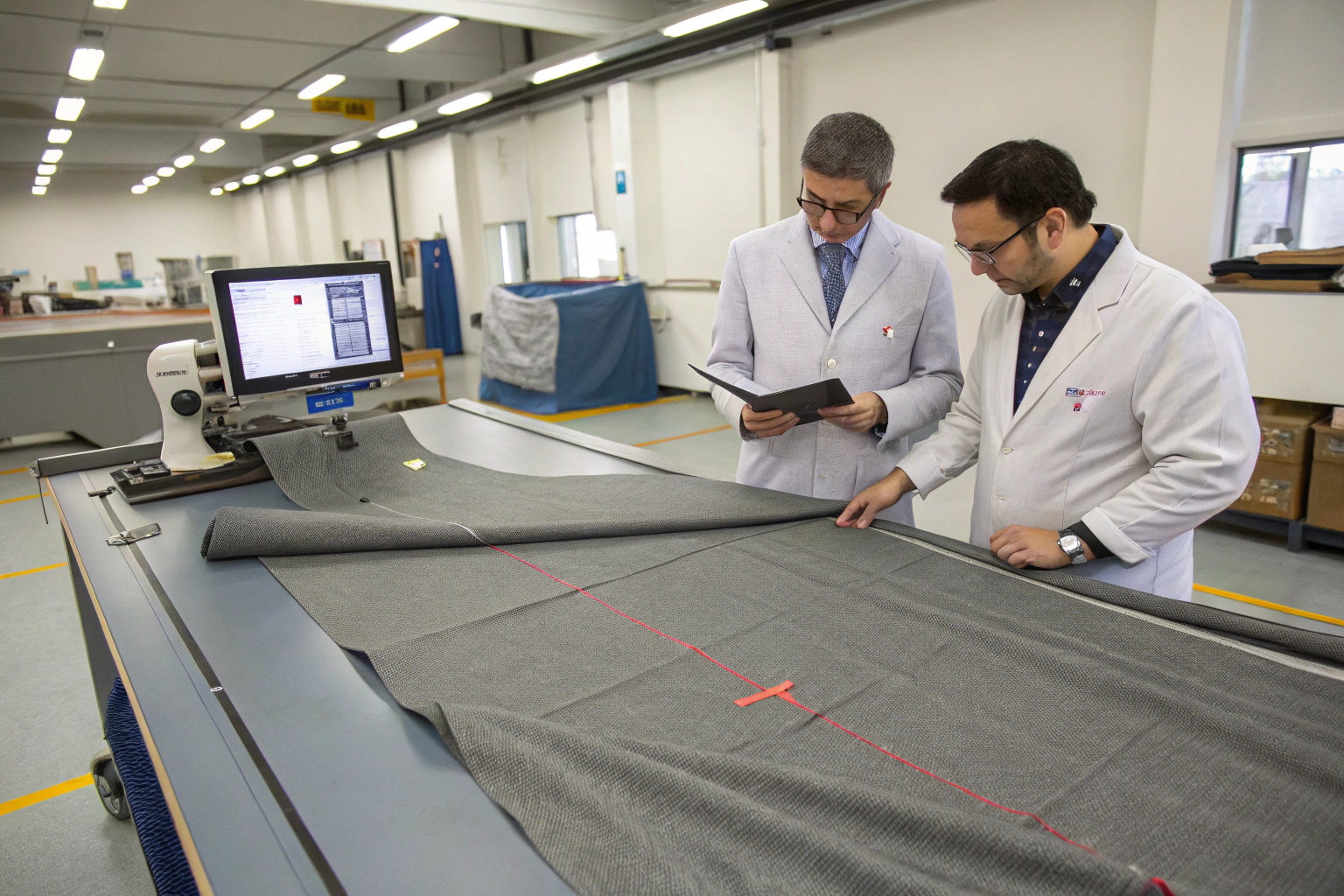
I ruined a supplier relationship once by firing off an angry email at 11 PM after a bad inspection report came in. The fabric was 800 meters of navy cupro lining, and the shrinkage test showed 5.2% when the spec said maximum 3%. I was furious. I’d already promised the fabric to a client, the cutting deadline was three days away, and the numbers on the report looked like a betrayal. So I typed out a blistering message accusing the supplier of cutting corners, demanded a full refund, and threatened to cancel our entire purchase agreement. The supplier went silent for four days. When they finally responded, their tone was cold and legalistic, and it took us six months to rebuild enough trust to do business again. The fabric issue was solvable. The relationship damage from how I handled it was the real loss.
Professional quality dispute resolution starts with one principle: separate the person from the problem and anchor the conversation in objective data. When a third-party inspection report shows a deviation from specifications, your first move isn’t a demand letter—it’s a structured notification with the test data attached, an invitation for the supplier to review the same evidence you’re looking at, and a clear statement of what remedy would make you whole. The goal isn’t to "win" the argument. The goal is to get usable fabric to your cutting table or to get compensated fairly enough that you can source a replacement without losing your production slot. The supplier isn’t your adversary in this process; they’re the party who can fix the problem, if you give them a path to do it without losing face or money unnecessarily.
I’ve been on both sides of this table for two decades. I’ve filed disputes as a buyer, and I’ve received them as the manufacturer. The disputes that resolve cleanly, quickly, and with the relationship intact share a common structure: specific evidence, a specific ask, a specific deadline, and a specific consequence if the deadline passes. The disputes that spiral into litigation or ghosting share the opposite structure: vague complaints, emotional language, unrealistic demands, and ultimatums issued before the supplier has even seen the data. Let me walk you through the exact framework I use now, after learning the hard way, to turn a quality failure into a problem solved rather than a partnership destroyed.
What Evidence Do You Need Before Initiating a Quality Dispute with a Supplier?
You cannot walk into a dispute with your opinion and expect a resolution. You need a folder of objective, verifiable evidence that any reasonable third party—including the supplier—would accept as proof of the problem. The standard I use is this: if the evidence wouldn’t convince an Alibaba Trade Assurance mediator to rule in your favor, it’s not strong enough to initiate the conversation.
The evidence package has five core components. First, the original approved quality specifications—this is the contract reference sample or the signed-off spec sheet that defines what "acceptable" means. Without this, there’s no standard to measure against, and the dispute is just two opinions colliding. Second, the third-party inspection report with the specific failed parameters highlighted—not just the summary page, but the full report showing the sampling methodology, the test methods used, and the individual roll-level data. Third, photographic evidence of the defects with a scale reference—a ruler in the frame, a color calibration card, clear lighting that doesn’t exaggerate or hide the issue. Fourth, a sealed reference sample if one was agreed upon at the order stage—the physical piece of fabric that both parties signed off as the quality target. Fifth, a quantification of the deviation: not "the color is off" but "the Delta E measurement against the reference standard is 2.8, exceeding the agreed tolerance of 1.5."
Evidence isn’t about proving the supplier is wrong. It’s about giving them the information they need to accept the problem without feeling attacked.
When Shanghai Fumao receives a quality complaint from a client, the first thing I ask is "send me the data." If the client sends me photos with no measurements and no reference to the spec sheet, I’m in a difficult position. I want to help, but I don’t know what standard to measure against, and I can’t authorize a remedy based on a subjective assessment. When a client sends me the full SGS report with the failed test circled, a photo of the defect with a measurement scale, and a clear statement of which clause of the purchase agreement was breached, I can make a decision within hours. The data package does the heavy lifting. It depersonalizes the issue and turns a confrontation into a joint review of facts.

How Do You Document a "Hand Feel" Defect When It Cannot Be Lab Tested?
Hand feel is the most subjective quality parameter in textiles, and it’s also one of the most common sources of disputes. A fabric can pass every lab test—weight, tensile strength, colorfastness, shrinkage—and still feel wrong. Too stiff. Too slippery. Not enough drape. The client expected a soft, peachy finish and received something crisper and more papery. This is a real quality issue, but it’s notoriously difficult to prove because there’s no standard ASTM hand feel test that produces a definitive number.
The documentation approach for hand feel disputes combines physical references with comparative testing. First, produce the sealed reference sample that was approved at the pre-production stage. Place it next to the production sample on a flat surface under consistent lighting and photograph them side by side. Second, perform the ring drape test or cantilever drape test, which measures how far a fabric strip extends before bending under its own weight. Even a simple video showing the two fabrics draped over the edge of a table can communicate a stiffness difference more powerfully than any description. Third, if possible, have a third-party inspector physically handle both samples and include their qualitative assessment in the inspection report—"Production sample is noticeably stiffer than reference sample and does not recover from compression with the same speed." This isn’t a lab number, but it’s a documented professional observation from an independent party. When I’ve received hand feel complaints, these three elements—reference comparison photo, drape test video, and inspector notes—give me enough to go back to the finishing factory and diagnose whether the softener was under-dosed or the heat setting was too aggressive. If you’re interested in learning more about how professional inspectors evaluate fabric hand feel objectively, textile testing forums often have detailed discussions on adapting standard tests for subjective quality parameters.
Why Is a Sealed Reference Sample More Powerful Than a Specification Sheet in Disputes?
A specification sheet defines tolerances in numbers: weight 85 GSM plus or minus 5%, width 150 cm plus or minus 2 cm, colorfastness to washing grade 4 minimum. These are essential, but they don’t capture the gestalt of a fabric—the way the color shifts under different light, the subtle texture of the weave, the specific luster level that makes a lining look luxurious rather than cheap. A sealed reference sample captures all of that implicitly.
The legal power of a sealed reference sample comes from the fact that both parties physically signed off on it before production began. It’s not a document that can be interpreted or disputed; it’s a physical artifact. When a dispute escalates to a platform mediation or a legal claim, the sealed sample is often the deciding piece of evidence. The mediator can hold it next to the production sample and see the difference with their own eyes. At Shanghai Fumao, we cut two identical reference samples for every custom order—one for the client and one for our QC file—and both are sealed in tamper-evident bags with dated signature labels. If a dispute arises, we open both bags simultaneously on a video call and compare the samples live. This process eliminates the "you sent me a different reference" argument because both bags were sealed at the same moment with both parties’ approval. The sealed sample isn’t just documentation; it’s the physical embodiment of the mutual agreement, and it’s worth more in a dispute than any spec sheet. For further reading on how to use sealed reference samples as part of a legally enforceable quality assurance protocol, small business legal forums often share practical contract clauses that incorporate physical standards into purchase agreements.
How Should You Structure the Initial Complaint Communication to Keep the Door Open?
The first message you send after discovering a quality issue sets the tone for the entire resolution process. If you lead with accusation, you’ll get defensiveness. If you lead with data and a problem-solving invitation, you’ll get collaboration. The structure I recommend has four paragraphs in sequence: the purpose statement, the evidence summary, the impact statement, and the remedy request with a response deadline.
Start with the purpose statement. "I’m writing to share the results of the third-party inspection for PO#2026-0421 and discuss a deviation we need to resolve together." This signals immediately that you’re approaching this as a joint problem, not an attack. The supplier’s guard doesn’t go up because you haven’t accused them of anything—you’ve stated a fact and invited collaboration. Second paragraph: the evidence summary. "The SGS inspection conducted on June 3rd shows the surface resistivity at 1.8 x 10^9 ohms, exceeding our agreed maximum of 1.0 x 10^8. The full report is attached, and the relevant data is on page 4." Be specific and reference the report rather than paraphrasing. Third paragraph: the impact statement. "Our cutting is scheduled for June 18th. If this fabric doesn’t meet the anti-static specification, our client cannot accept the finished garments, and we face a production slot loss." This isn’t emotional—it’s factual business impact that gives the supplier context for why this matters. Fourth paragraph: the remedy request. "We’re asking for a replacement production to be expedited, or a 15% discount on this shipment with a written guarantee that the anti-static performance will not cause garment-level complaints. Can you review the report and let me know your proposed solution by June 6th?"
The first message either opens a negotiation or starts a fight. The difference is whether you lead with the problem or the accusation.
The deadline in the request is important—it creates urgency without being an ultimatum. You’re asking for a response, not threatening action if you don’t get one. The consequence for missing the deadline is implied by the business context you’ve already provided, so you don’t need to state it explicitly. If the supplier doesn’t respond by the deadline, your follow-up message escalates slightly: "I haven’t heard back on the inspection findings for PO#2026-0421. Our production deadline is approaching, and I need your input to decide whether to proceed with this lot or arrange an alternative. Please respond today." This sequence preserves the relationship while applying appropriate pressure.

What Three Phrases Should You Never Use in a Quality Dispute Email?
I’ve learned this through painful trial and error. The words you choose in a dispute email don’t just communicate information—they communicate intent and emotion, and certain phrases trigger an almost automatic defensive response that makes resolution harder regardless of how strong your evidence is.
Never use the phrase "you failed to." It’s accusatory and it frames the entire situation as a personal failure rather than a process deviation. Replace "you failed to meet the shrinkage spec" with "the shrinkage test result is 5.2% against our agreed maximum of 3%." The data does the work. Never use the word "unacceptable"—it’s a closed door. It tells the supplier that you’re not interested in discussion, only capitulation. Replace "this quality is unacceptable" with "this deviation creates a problem for our production timeline that we need to solve." Never threaten legal action in the first communication. The phrase "we will pursue legal remedies" or "our lawyer will contact you" doesn’t motivate faster resolution—it motivates the supplier to stop communicating with you directly and route everything through their own legal counsel, which slows everything down and adds cost. Legal threats are a last resort, not an opening gambit. If you genuinely need legal leverage, have your lawyer send the letter, but don’t mix legal threats into a problem-solving conversation. The two modes of communication are incompatible. There are some excellent resources on cross-cultural business negotiation blogs that break down how specific English phrases are interpreted by Chinese suppliers and what alternative wording preserves relationships while still communicating urgency.
How Do You Set a Firm but Reasonable Response Deadline Without Sounding Threatening?
The deadline needs to be justified by a real business constraint, not manufactured as a power play. When you explain why the deadline matters, the supplier understands that it’s the calendar that’s creating the pressure, not you. "Our cutting window opens on June 18th, and I need three days before that to arrange alternative fabric if we can’t use this lot. That means I need your proposed solution by June 6th." The deadline isn’t arbitrary—it’s a simple timeline calculation that any reasonable supplier will accept.
The tone around the deadline matters as much as the deadline itself. "Please let me know by June 6th" is an invitation. "You must respond by June 6th or else" is a threat. The first preserves the relationship. The second damages it. I also recommend acknowledging that the supplier needs time to investigate. "I understand you’ll need a couple of days to review the test data and check your production records. Please let me know by June 6th what resolution you can offer." This shows you’re reasonable about their internal process and not demanding an instant answer to a complex technical question. If the deadline passes without a response, your escalation is a natural consequence of the timeline you already explained, not a sudden punishment. "The June 6th review deadline has passed, and I need to make a decision on this lot today to protect our production schedule. I’ll need to proceed with an alternative plan if I don’t hear from you by end of business." This is firm and clear, but it’s not hostile—it’s the logical next step in a timeline you both understood from the beginning. If you want to see real-world examples of dispute escalation sequences that successfully balanced firmness with relationship preservation, supplier management communities often share anonymized email threads with analysis of what worked.
What Are the Five Standard Remedy Options and When Should You Propose Each?
When you initiate a quality dispute, don’t make the supplier guess what you want. Propose a specific remedy that fits the severity of the deviation and your production constraints. There are five standard remedy structures in textile disputes, and knowing which one matches your situation is half the battle.
The five remedies are, in order of severity: acceptance with waiver, where you accept the goods as-is and release the supplier from the deviation because the impact on your production is negligible. Price adjustment, where you keep the goods but receive a discount proportional to the value reduction caused by the defect. Re-work, where the supplier fixes the issue—over-dyeing to correct shade, re-finishing to fix hand feel, re-rolling to correct packaging—at their cost and within an agreed timeline. Replacement, where the supplier produces new fabric to the original specification and bears all costs including the return or disposal of the rejected lot. And finally, cancellation with full refund, where the order is voided and the supplier returns all payments, typically reserved for cases where the defect is unfixable and the fabric is commercially unusable.
Match the remedy to the gap between what you received and what you can still use. A 2% width variance might warrant a 5% price reduction. A complete fiber content failure warrants replacement or refund.
The remedy you propose should be proportional to the real business impact, not to your emotional frustration. I had a client in 2023 who received a batch of anti-static lining where the conductive stripe spacing was 7mm instead of the specified 5mm. The anti-static performance still passed the resistivity test because the stripe was slightly thicker, but the visual appearance was different. The fabric was usable—the suits would function perfectly—but the aesthetic wasn’t what the client approved. They asked for a 20% discount. I offered 10%, which was roughly the value difference for a visually non-conforming but functionally compliant lot. We settled at 12%. The key was that the remedy request matched the actual loss in value. If they’d asked for a full refund and replacement, they would have been overreaching, and the negotiation would have been much harder. Propose the remedy that makes you whole, not the remedy that punishes.

When Is a Price Adjustment More Practical Than Demanding a Full Replacement?
Replacement seems like the obvious demand when the fabric doesn’t match the spec, but replacement has a hidden cost: time. A replacement production for custom-dyed anti-static lining takes 3 to 5 weeks minimum, plus shipping. If your cutting schedule can’t absorb that delay, a replacement that arrives on time is worth less than a slightly imperfect fabric that’s in your warehouse right now.
Price adjustment becomes the practical choice when three conditions are met. First, the defect is cosmetic or minor rather than functional—the anti-static performance still passes, the colorfastness still meets the standard, but the shade is slightly off or the hand feel is a bit different. Second, you can use the fabric in production without compromising the finished garment quality. Third, the cost of waiting for a replacement exceeds the value reduction from the defect. Calculate it: if a two-month delay costs you a season of sales and the price adjustment is 15%, the 15% is almost certainly the cheaper path. I’ve processed price adjustments ranging from 5% for minor visual deviations up to 25% for fabrics that required re-cutting or additional processing to use. The negotiation should reference the actual cost you’ll incur to work with the imperfect fabric—the extra labor to sort rolls, the additional cutting waste from width variations, the potential discount your customer might demand. When the supplier sees that the price adjustment is based on real numbers rather than an arbitrary demand, the negotiation becomes a math problem rather than a fight. To see how other importers calculate fair price adjustment percentages based on specific defect types, trade finance and importing forums often have detailed threads with actual negotiation outcomes and the formulas they used.
How Can Re-Work Be Structured So Both Parties Share the Risk Fairly?
Re-work is the trickiest remedy because it extends the transaction timeline and introduces new quality risks. The fabric goes back through a finishing process, and every additional process creates an opportunity for new defects. The structure that works best splits the risk in proportion to each party’s responsibility.
The supplier should bear the full cost of the re-work itself—the chemicals, the machine time, the labor—and the cost of any additional testing to verify the re-work fixed the issue. The buyer shares the timeline risk. If the re-work takes three weeks and the buyer’s production schedule can absorb it, the deal works. If the re-work fails and the fabric is damaged beyond use, the supplier provides a full replacement or refund. This risk split acknowledges that the supplier caused the original defect but the buyer chose the re-work path over the replacement path for speed reasons, so the buyer accepts the delay risk. At Shanghai Fumao, when we agree to a re-work for hand feel issues, we provide the client with a pre-re-work sample, a post-re-work sample from a test run, and a guaranteed completion date. If we miss the date, the client can switch to the replacement option without penalty. This structure gives the client confidence that the re-work path has a clear exit if it doesn’t work. The key is documenting the re-work agreement with the same specificity as the original order—before and after spec targets, acceptance criteria, and the consequence if the re-work doesn’t meet the target. You can find practical templates for re-work agreements on textile manufacturing community websites, where production managers share the exact clauses they include to ensure both parties are protected during the re-process.
How Do You Escalate a Dispute Without Destroying the Long-Term Supplier Relationship?
Escalation is necessary when the supplier is unresponsive, dismissive, or offering a remedy that’s wildly inadequate. But escalation doesn’t have to be a bridge-burning event if you frame it as a logical next step rather than a personal betrayal. The escalation ladder has clear rungs, and you should climb them one at a time, transparently.
Rung one: the direct negotiation phase. You’ve sent the structured complaint with evidence and a proposed remedy. The supplier has responded, but the response is unsatisfactory—they’re denying the evidence, offering 5% when the defect warrants 20%, or stalling past the deadline you set. Before escalating, give them one clear chance to adjust their position. "I understand your perspective, but I don’t think the proposed 5% discount addresses the impact of a 5.2% shrinkage rate on our production. Based on our cutting calculations, the additional fabric waste will cost us approximately 18%. Can you adjust your offer to reflect that?" This is still negotiation, not escalation.
Rung two: the management escalation. If the negotiation stalls, move the conversation up the hierarchy. "I appreciate the time you’ve spent on this, but we seem to be at an impasse. Could we schedule a call with your production manager or factory director to review the inspection data together?" The person you’ve been emailing may not have the authority to approve a 20% discount or a replacement. Their manager often does. The management escalation isn’t a threat—it’s giving the supplier’s organization a chance to solve the problem at the right decision-making level.
Escalation isn’t a threat. It’s moving the conversation to the person who actually has the authority to say yes.
Rung three: the third-party intervention. If the supplier’s management also fails to offer a reasonable resolution, you bring in the platform or inspection body that’s linked to the transaction. For a Trade Assurance order, this means filing a formal dispute on the platform. For a non-platform transaction, this might mean requesting the inspection company to mediate or issue a formal finding that can be used in arbitration. Frame this to the supplier as a mutual protection, not a hostile act. "Since we haven’t been able to reach agreement directly, I’m filing a Trade Assurance dispute so an independent mediator can review the evidence from both sides. This protects both of us by getting a neutral third-party assessment." The supplier may not like it, but you’ve given them ample opportunity to resolve it directly, and you’re transparent about the step you’re taking. This approach maintains professional respect even as you escalate the procedural pressure.

How Does Alibaba Trade Assurance Mediation Actually Adjudicate Fabric Quality Disputes?
Trade Assurance mediation is not a court, and the mediator is not a textile expert. The process is designed for document-based adjudication, which means the party with the clearest, most specific contract documentation and the most objective inspection evidence wins most disputes. Understanding this reality should shape how you build your order contracts from day one.
The mediator will look at three things in sequence. First, was the defect parameter specified in the contract? If the contract says "good quality" with no measurable standards, you’ve already lost. The mediator has no basis to determine what "good" means. If the contract says "surface resistivity less than 1.0 x 10^8 ohms per ASTM D257," the mediator has a clear standard. Second, does the evidence demonstrate that the standard was breached? A third-party inspection report from SGS, Bureau Veritas, or Intertek carries far more weight than photos taken by the buyer. The mediator has no way to verify that your photos weren’t manipulated or that the fabric in the photo is actually the fabric from the shipment. A professional inspection report with chain-of-custody documentation solves that problem. Third, is the remedy requested proportional to the breach? The mediator is looking for a commercially reasonable resolution, not a punitive one. If the anti-static performance is 10% off spec and you’re demanding a 100% refund, the mediator will likely find your request disproportionate. The outcomes I’ve seen in Trade Assurance disputes involving fabric quality tend to split the difference when both sides have partial evidence, or rule strongly in favor of the party with the ironclad documentation and a reasonable remedy request. If you want to learn from real cases where buyers successfully won fabric quality disputes on Alibaba, e-commerce seller communities often share detailed breakdowns of what evidence the mediator found persuasive and why.
What Role Can a Third-Party Inspection Company Play as a Neutral Arbiter?
Inspection companies like SGS, Bureau Veritas, and Intertek offer a service that goes beyond standard pre-shipment inspection. They can act as a neutral technical arbiter when a dispute is at an impasse. The process involves both parties agreeing to accept the inspection company’s findings as binding or as a basis for final negotiation, and the inspector conducts a joint examination with representatives from both sides present or via video link.
This approach has several advantages over platform mediation or legal action. The inspector is a textile professional who understands the technical aspects of the defect—they know whether a 5.2% shrinkage rate is a serious functional failure or a borderline deviation that most cutting rooms can accommodate. They can perform additional tests on the spot to clarify issues that the original inspection report may not have covered. And their reputation as a neutral global brand gives their opinion weight that neither party can easily dismiss. The cost of this service is typically $500 to $1,500 depending on the location and scope, and the parties can agree to split it or have the losing party pay it. In a 2024 dispute we had with a European buyer over a color consistency issue across 20 rolls, we jointly hired SGS to conduct a shade banding analysis. The SGS report showed that the shade variation was within commercial tolerance for the product type, and the buyer accepted the finding. The $800 inspection fee saved us from a $12,000 discount demand that would have been based on a subjective visual assessment. For a comprehensive comparison of arbitration services offered by the major inspection companies, quality assurance industry portals often have guides that outline the specific procedures, turnaround times, and cost structures for textile-specific dispute resolution services.
Conclusion
Resolving a quality dispute with a fabric supplier professionally isn’t about who’s right—it’s about getting to a solution that works for your production schedule while preserving a relationship that took time and effort to build. The framework I’ve laid out works because it replaces emotion with evidence, accusation with structured communication, and ultimatums with a clear escalation ladder that gives the supplier multiple opportunities to solve the problem before facing consequences.
We started with the evidence package: the approved specifications, the third-party inspection report, the sealed reference sample, and the quantified deviation data that turns subjective complaints into objective facts. We walked through the initial communication structure that leads with collaboration rather than confrontation, including the specific phrases to avoid and the deadline-setting technique that creates urgency without threat. We mapped the five remedy options from acceptance to full refund, with guidance on when a price adjustment beats a replacement and how to structure re-work to share risk fairly. And we built the escalation ladder from direct negotiation to management intervention to third-party mediation, preserving the relationship at each rung by framing escalation as a logical next step rather than a hostile act.
The truth I’ve learned from managing disputes from both sides of the table is that most suppliers genuinely want to fix quality problems. A defect that reaches the buyer is a failure in their own QC process that they’re often embarrassed about and motivated to correct. When you approach them with data instead of anger, a specific request instead of a vague complaint, and a deadline justified by business reality instead of a power play, they usually step up. The relationships that survive disputes become stronger because both parties have seen how the other handles adversity.
At Shanghai Fumao, we’ve built our quality system to prevent disputes before they happen—CNAS-certified lab testing, sealed reference samples, QR code traceability, and 98% client inspection pass rates. But we’re realistic enough to know that in textile manufacturing, variation is inherent and disputes will occasionally arise. When they do, our standard process is to acknowledge receipt of the complaint within 24 hours, review the inspection data against our internal production records within 48 hours, and present a remedy proposal within 72 hours. We’ve been on the receiving end of the angry late-night email, and we’ve also received the perfectly structured, data-driven complaint that made resolution easy. The difference in outcomes is dramatic, and I wrote this guide because I want more buyers to experience the second kind.
If you’re dealing with a quality issue on a current order, or if you want to put preventative documentation structures in place for your next order, reach out to our Business Director, Elaine, at elaine@fumaoclothing.com. She can discuss our quality assurance protocols, share a sample specification template that makes disputes easier to resolve, or coordinate a sealed reference sample process for your upcoming production.