
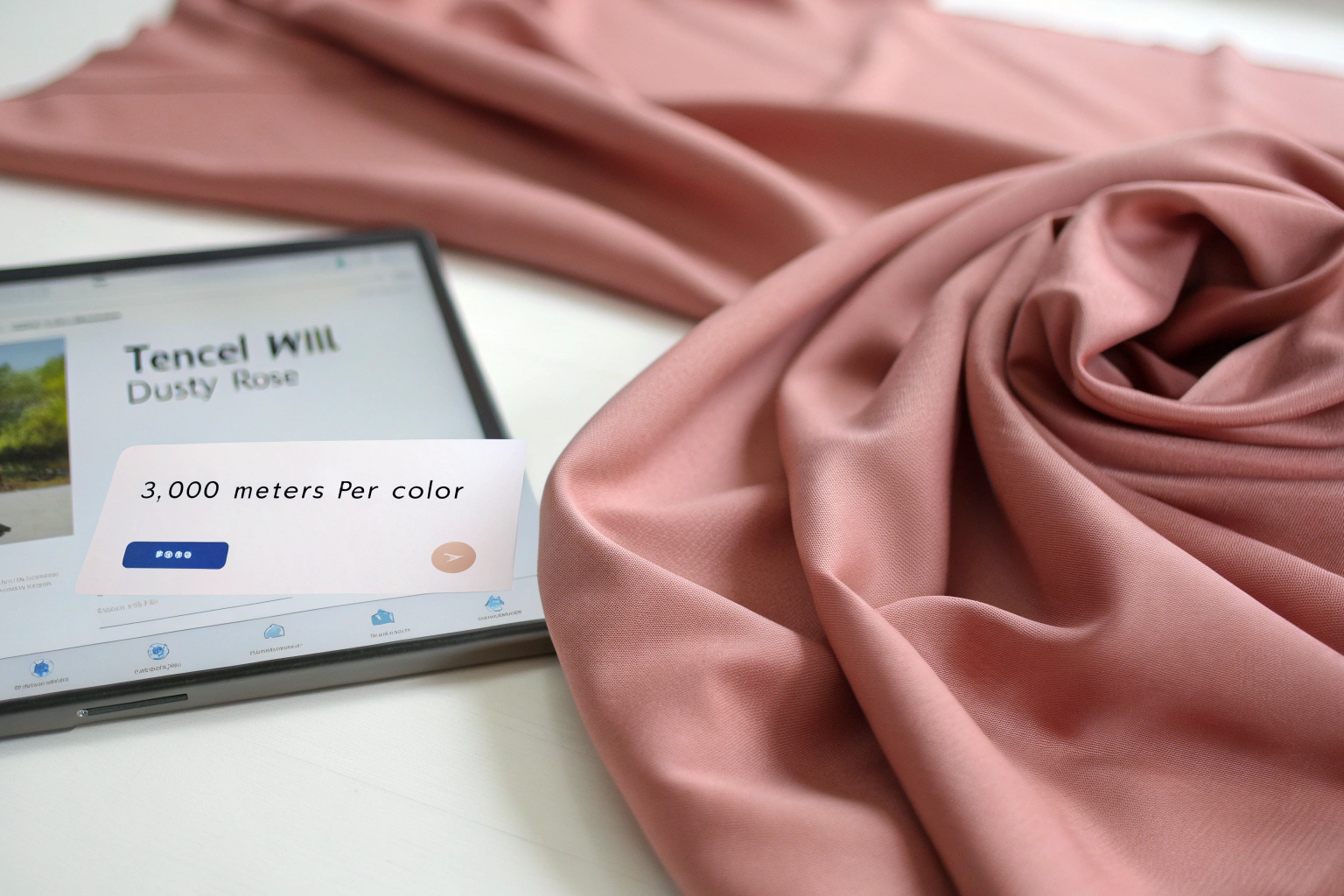
You found the perfect fabric. A 100% Tencel twill with a buttery soft hand, draped beautifully, dyed in the exact dusty rose your collection needs. The mill sends the spec sheet. Everything is perfect—until you scroll to the bottom. Minimum Order Quantity: 3,000 meters per color. You need 300 meters. You email the sales rep, politely asking if they can lower it. The reply is a one-liner: "Sorry, MOQ is fixed." You feel the door slam shut. That fabric, that color, that collection piece you built your mood board around—gone, because you’re not big enough yet to play in their league.
I’ve sat on the other side of that email thread for twenty years. I know why mills set high MOQs, and I also know how to get around them without the rep losing face, without the production manager cursing your name, and without paying a crippling surcharge that blows your margin. The MOQ is not a brick wall; it’s a negotiation lever with a specific set of pressure points. In this article, I’m going to give you those pressure points—the exact language, the timing, the order structures, and the relationship plays that have turned a 3,000-meter MOQ into a 300-meter trial order at Shanghai Fumao. You don’t need to be Zara to get a mill’s attention. You just need to speak their language.
Why Do Chinese Textile Mills Set High MOQs?
You have to understand the economics of a weaving beam to understand the MOQ. A warp beam on a standard rapier loom holds thousands of individual yarn ends, each one threaded through a heald wire and a reed dent. Setting up that beam—called "warping" and "drawing-in"—takes between 4 and 8 hours of skilled labor, depending on the fabric density. That’s 4 to 8 hours where the loom is not earning money. The mill makes profit on running meters, not on setup time. If you order 300 meters, the loom runs for maybe 30 minutes after an 8-hour setup. The math doesn’t work. The mill loses money on that order unless they charge you a surcharge that covers the idle time.
Dyeing has a parallel economics issue. A dyeing vessel at a cooperative dye house like the one we partner with holds a minimum liquor volume to properly circulate the dye solution through the fabric. If you load 200 meters of fabric into a machine designed for 1,500 meters, the liquor ratio is wrong. The dye distributes unevenly, the fabric can float incorrectly in the machine and develop crease marks, and the entire dye batch becomes a quality risk. The dye house charges the mill a minimum dyeing fee regardless of how few meters are in the vessel, because the energy, water, and chemical consumption are nearly fixed per batch. So the MOQ is not greed. It’s the physical minimum at which the process can run reliably and profitably. At Shanghai Fumao, our standard MOQ for a custom-dyed woven is 1,500 meters per color. But we’ve done 300-meter runs. We just need the circumstances to be right.

What Are the Real Setup Costs That Drive Minimums?
Let me give you the actual cost breakdown. For a standard 58-inch width, 20S cotton poplin woven on a rapier loom, the warping and drawing-in labor costs about ¥1,200 to ¥1,800 (roughly $160 to $250). The yarn waste from the initial loom startup—the first 3 to 5 meters of weaving where the tension is stabilizing and the weft insertion isn’t perfect—is about 2% to 3% of the total warp length. That waste is cut off and sold as scrap at a fraction of the yarn cost.
If you order 300 meters, the setup labor of ¥1,500 amortizes to ¥5 per meter. If you order 3,000 meters, it amortizes to ¥0.50 per meter. The cost structure fundamentally penalizes short runs. The mill’s gross margin on woven fabric is typically only 10% to 15% on the FOB price. A short run can easily push that margin negative. Many mills deal with this by applying a "small-order surcharge" of 20% to 30% on orders below the MOQ, which covers the amortization gap. But even then, the production planner may refuse because the scheduling disruption—stopping a long-run repeat order to squeeze in a short trial—costs more in lost efficiency than the surcharge recovers. This is why textile mill production planning and setup cost amortization models for small batch orders reveal the hard truth: small orders are often charity, not commerce, unless you structure the deal differently.
How Do Yarn Minimums Affect the Entire Supply Chain?
You don’t just face the fabric mill’s MOQ. Behind every meter of fabric is a spinning mill that produced the yarn, and that spinning mill has its own minimums. A spinning mill producing a specialty yarn—say, a 60S compact-spun organic cotton with a specific twist factor—may have a minimum production lot of 500 kilos of yarn. That 500 kilos of yarn yields about 1,800 meters of the woven fabric you want. If your order is 300 meters, the spinning mill has 420 kilos of excess specialty yarn that has no other buyer. The fabric mill either eats that dead stock cost or builds it into your price.
This is why greige stock fabrics (undyed, finished fabric already woven and sitting in the mill’s inventory) are your best friend for low-MOQ orders. If the mill has already woven the greige for a previous large order and has surplus rolls in their warehouse, they can draw from that stock, dye a smaller batch, and finish it for you. You bypass the yarn minimum and the weaving minimum entirely. At Shanghai Fumao, we maintain an active greige inventory of our top 200 fabric articles. For a stock article, the custom-dye MOQ drops from 1,500 meters to as low as 300 meters because the yarn and weaving minimums have already been absorbed by the original production run. This is the number one strategy I recommend to small brands: ask the mill what they have in greige stock, not what they can custom-weave. The textile yarn minimum order requirements for specialty spun fibers and their impact on fabric production scalability explains the upstream constraint that most fabric buyers never see.
Can I Offer to Pay a Surcharge for a Smaller Trial Run?
The fastest way to turn a "no" on MOQ into a "yes" is to offer more money per meter. I know that sounds obvious, but most buyers approach MOQ negotiations as if they’re asking for a favor. They frame it as: "Can you do me a favor and lower the minimum?" That framing invites a rejection because the mill has no incentive to do a favor for a stranger. The better framing is: "I understand your cost structure doesn’t work at 300 meters. What price per meter would make it work?" Now you’re not asking for a concession—you’re inviting a business conversation where both parties can win.
We accept surcharge-based small orders at Shanghai Fumao under specific conditions. The surcharge covers the unamortized setup cost, the dye house minimum fee, and the incremental handling labor. On a standard 1,500-meter-MOQ article, a 300-meter trial order typically carries a 20% to 30% surcharge on the per-meter price. For a fabric quoted at $3.50/meter at full MOQ, the 300-meter surcharge price might be $4.55/meter. The brand pays an extra $315 total for the trial run. That’s the cost of market entry. If the design sells well and they re-order at full MOQ, the $315 was a cheap investment in demand-testing. If it bombs, they lost $315 in surcharge instead of $5,250 in dead stock. Framed that way, the surcharge is actually risk mitigation for the buyer, not just a penalty.

What Is a Reasonable Surcharge Percentage for a Low-MOQ Order?
There is no industry-standard surcharge percentage, but there is a logic to calculating it. The surcharge should roughly cover the per-meter setup cost differential. If the mill’s setup cost is ¥1,500 and they normally amortize it over 1,500 meters (¥1/meter), and you order 300 meters, the unamortized gap is ¥1,500 spread over 300 meters, or ¥5/meter. That’s an additional ¥4/meter over the standard amortization. If the standard FOB price is ¥25/meter, the ¥4 surcharge is 16%. That’s a defensible number.
Anything above a 40% surcharge is usually a signal that the mill doesn’t actually want the order but will do it if you make it extremely profitable for them. At that level, you’re better off looking for a mill that has a lower base MOQ or buying stock fabric. When a buyer asks me for a 300-meter run and I quote a 25% surcharge, that’s a genuine offer. When I quote 50%, I’m politely telling you that this fabric is a pain to produce in small lots and I’d rather you picked something else from our stock range. A buyer who knows the market can read the surcharge as a signal. Ask your rep: "Can you break down what the surcharge covers?" If they can itemize it into setup, dye house minimum, and handling, they’re being transparent. If they say "it’s just our policy," they’re applying a blanket penalty and not thinking about your repeat potential. The industry context for this pricing strategy is explained well in small-batch surcharge negotiation frameworks for textile mills and emerging fashion brands, which covers how to structure the conversation so the mill sees you as a long-term investment, not a one-off nuisance.
How Do I Frame the Surcharge as an Investment, Not a Penalty?
I’ve had buyers say to me, "I’ll pay the surcharge for this first run, and if the style sells, I’ll be back for 3,000 meters in three months, full MOQ, no surcharge." That sentence changes my calculation. Now the 300-meter loss-making run is not a loss—it’s a customer acquisition cost. If I believe the buyer’s re-order potential is real, I might even waive part of the surcharge or split the difference.
Your job in the negotiation is to credibly signal your growth trajectory. Don’t bluff. If you’re a brand with a track record—a website with real products, a social media following, a wholesale account list—share that data. Tell the mill: "Our last three fabric developments each re-ordered at 2,000+ meters within six months. We expect this one to follow the same pattern, but we need a 300-meter trial to test the color in the market first." This is a data-backed argument that frames the small order as a trial, not a hobby. If you’re a startup with no track record, you can still signal commitment by offering to pay 100% upfront for the trial order, or by ordering multiple colors at the same low MOQ so the total meterage is higher. A startup fashion brand’s guide to building supplier relationships for scalable fabric procurement emphasizes that small brands who communicate like future big brands get treated differently. The language matters.
Does Ordering Greige Stock Reduce the MOQ for Custom Dyeing?
This is the single most powerful MOQ-reduction strategy that nobody tells small brands about. A fabric mill’s real MOQ is driven by the weaving economics—the warp beam setup, the yarn spinning minimum, the loom scheduling. If the fabric is already woven and sitting in the greige stock warehouse, those costs are sunk. They’ve already been paid for by a previous large production run, or they’re part of the mill’s basic stock inventory. The only remaining processes are dyeing and finishing.
At Shanghai Fumao, our greige stock program is the gateway for small and emerging brands. We keep approximately 50,000 to 80,000 meters of our top-selling woven and knit constructions in greige inventory. A buyer can walk into our stock catalog, pick a construction—say, a 2/1 twill in 65/35 poly-cotton at 245gsm—and we can custom-dye as little as 200 to 300 meters per color. The MOQ drops from 1,500 meters to 300 meters because the weaving minimum has been decoupled from the dyeing minimum. The dyeing minimum itself is still there—the dye vessel has a physical minimum fill volume—but a standard atmospheric jig dyeing machine can handle 300 meters of medium-weight woven fabric without quality issues. The color accuracy, the fastness, the finish—they’re all identical to a full-custom production. The only limitation is the stock width, weight, and construction are fixed. You don’t get to specify a custom yarn twist or a modified weave density. But for a brand that needs 300 meters of a good-quality, commercially proven base fabric in their signature green, it’s a perfect solution.

How Do I Ask a Mill About Their Stock Fabric Availability?
Don’t ask "Do you have stock fabrics?" That’s too vague and the rep will just send you their standard line sheet. Ask this instead: "Which of your woven constructions do you currently hold in greige stock, and what are the available widths and weights? I’m looking to custom-dye at 300 meters per color." This question signals that you understand the supply chain. You’re not asking for a favor; you’re asking to access an existing inventory that the mill has already financed.
The mill’s response to this question tells you a lot about their business model. A mill that primarily does custom production will say "We don’t hold stock, everything is made to order." A mill that serves both large and small customers will send you a list of stock articles with their specs. That list is your new sourcing catalog. Work within it. Don’t try to get a stock article modified—you’ll trigger a custom-weaving MOQ. A buyer from a small Canadian womenswear label used this approach with us in early 2024. She needed 400 meters of a soft drape woven for a capsule dress collection. She asked for our greige stock list, picked a 16mm silk charmeuse we already had in inventory from an overproduction, and ordered four colors at 100 meters each. The order was under our normal MOQ, but because the greige was already there, we ran it without a surcharge. She got a luxury fabric at stock-access pricing, and we turned slow-moving inventory into cash. The textile greige inventory management and stock program benefits for low-MOQ custom dye lots explains why mills are often motivated to move this inventory.
What Are the Color Limitations on Greige Stock Dyeing?
Greige stock dyeing is fast and low-MOQ, but it has a color gamut limitation. The greige fabric has already been prepared—scoured, bleached, and possibly mercerized—to a specific base-white standard. That preparation determines which colors the fabric can accept cleanly. A greige that was prepared for medium and dark shades (not fully bleached to optical white) will not take a pale pastel or a bright optic white cleanly. The undertone will be creamy, not brilliant. Conversely, a greige prepared for whites and pastels will take any color, but it’s more expensive because the full bleach prep has already been applied.
When you’re picking a stock fabric, ask the mill: "What color range was this greige batch prepared for? Is it pastel-capable, or is it intended for medium-to-dark shades?" The answer tells you your available palette. For a Spring-Summer collection full of pale lavenders and mint greens, you need a pastel-capable base. For a Fall-Winter collection of burgundies, navies, and forest greens, a medium-dark base is perfect and slightly cheaper. Don’t try to dye a dark-base greige into a pastel—you’ll get a muddy, dull result that looks like it’s been washed fifty times. The lab dip will reveal this immediately, so always request a lab dip on the actual stock greige before committing to the dye lot. A resource on pre-treatment bleaching levels for greige cotton and their effect on pastel dye shade brightness and consistency clarifies why the base-white matters so much.
Can I Share a Production Run with Another Brand to Meet MOQs?
This is an advanced strategy that I’ve seen work brilliantly for non-competing brands. The logic is simple: the MOQ for a custom-dyed fabric is 1,500 meters of a single color. You need 500 meters in Navy. Another brand needs 800 meters in Navy. A third needs 200 meters. None of you individually meet the MOQ, but your combined order is exactly 1,500 meters. The mill dyes one bulk batch of Navy and splits the finished fabric among the three brands. Everyone gets their fabric at the standard MOQ price, with no surcharge. The mill runs one efficient batch instead of three surcharge-laden small ones or losing the business entirely.
The trick is finding the partner brands and structuring the arrangement so the mill doesn’t get caught in the middle of a dispute. Most mills will not act as your matchmaker—that’s a logistical headache and a commercial confidentiality risk. But if you come to the mill with a consolidated order already arranged, with one entity acting as the primary buyer who will handle the distribution, the mill treats it as a single 1,500-meter order. The primary buyer issues one purchase order, receives the full shipment, and splits it internally. I’ve facilitated this at Shanghai Fumao for two Australian brands who shared a fabric base—one a womenswear workwear label, one a menswear chef-uniform brand. They both needed the same 65/35 twill in black. Neither needed 1,500 meters. Together, they ordered exactly 1,500 meters, we ran one dye lot, and they split the rolls based on a pre-agreed ratio. The per-meter price was 22% lower than if either had ordered alone with a surcharge. Their brands were not competitors, so there was no conflict.

How Do I Find Partner Brands for a Co-Op Production Run?
This works best within a community of non-competing, geographically compatible brands. Think about brands that serve completely different market segments but need similar technical fabrics. A workwear brand and a school uniform brand. A yoga wear brand and a maternity wear brand. A restaurant apron brand and a gardening smock brand. They don’t fight for the same customer, but they might both need a sturdy, stain-resistant, 250gsm cotton-poly canvas in dark green.
You can initiate this conversation through your sourcing network. Ask your mill’s sales rep (off the record): "Do you have any other smaller brands buying this same fabric in the same color? Could you introduce us, or would you be open to us organizing a consolidated order?" Some reps will be hesitant because of confidentiality, but others will see the commercial logic and facilitate a connection if you sign a non-compete acknowledgment. Alternatively, use industry Slack groups, LinkedIn fashion-sourcing communities, or local fashion incubator networks to post a co-op inquiry: "Looking to split a 1,500-meter MOQ on 100% organic cotton twill, 250gsm, in Olive. Based in Los Angeles. Seeking 1-2 non-competing brands to share the dye lot. Target FOB $4.20/meter." The specificity attracts serious partners and filters out tire-kickers. A collaborative manufacturing and co-op production models for small fashion brands to meet fabric minimums outlines how to set up the legal and financial structure so everyone’s interests are protected.
What Are the Risks of Sharing a Dye Lot with Another Brand?
The benefit is price. The risk is shade dependence. When you share a dye lot, you and your partner brand are permanently linked on that color. If you re-order individually next season, the new dye lot will be a slightly different shade. Commercial dyeing cannot perfectly replicate the previous batch’s exact spectral fingerprint; there will be a Delta E shift, usually between 0.5 and 1.5, which is visible to a trained eye if you put the old and new garments side by side on a rack. If your brand sold through 500 meters and needs a replenishment, your new batch won’t perfectly match your partner brand’s old batch either. You’ve essentially coupled your color continuity.
Mitigate this by agreeing upfront with your partner brand that the shared lot is a "one-time only" collaboration. Do not promise your customers that this exact Navy will be restocked indefinitely. Sell it as a limited capsule, or order enough in the first run to cover your full season demand so you don’t need a replenishment. Keep a control swatch from the shared dye lot in a dark, climate-controlled drawer for future color matching reference. And if you and your partner brand both re-order the same color later, you can re-share the next dye lot too, maintaining consistency within your co-op relationship. The technical reality of dye lot shade variation control and delta E CMC tolerance expectations in textile batch dyeing explains why perfect reproductions are physically impossible and how to set realistic continuity expectations with your buyers.
How Do I Time My Order to Hit a Mill’s Slow Season?
Timing is leverage, and most small brands completely overlook it. The Chinese textile production calendar has pronounced seasonal waves. The peak production months—March through May, and August through October—are when every mill is running at full capacity for the major global fashion seasons. During these peaks, a production planner will not entertain a small order. They don’t need to. Their machines are fully booked with high-margin, long-run orders from established brands. A 300-meter inquiry in late March is an annoyance, not an opportunity.
But June and July? The peak has passed. The Autumn-Winter orders have shipped. The Spring-Summer orders for next year haven’t yet been confirmed. The looms and dye vessels are still running, but the pressure is off. The production planner is looking at a 60% capacity utilization week and seeing red ink. That planner is suddenly very interested in a 300-meter order that can fill a scheduling gap. Similarly, November and December, before Chinese New Year, can be slower, though the weeks just before the holiday shutdown are a chaotic rush to finish everything before the factory closes for three weeks. January and February are dead—Chinese New Year. Don’t contact a mill with a new order during Chinese New Year. Just don’t. The seasonal capacity fluctuation cycles in Chinese textile manufacturing and how they affect MOQ flexibility maps out the calendar in detail, and it’s a resource I recommend every importer study.

What Specific Months Offer the Best Negotiation Leverage?
Based on twenty years of watching our order book ebb and flow at Shanghai Fumao, the magic months are June and July. The European and American brands have placed their Fall-Winter bulk orders by late May. Those orders are running through June, but by mid-June, the production floor starts to see gaps. The Ramadan ordering rush (for markets like the Middle East and Southeast Asia) has already finished. The Christmas peak production hasn’t started yet—that usually kicks in around late August.
In June and July, we actively look for smaller orders to fill capacity gaps. A 300-meter order that I would have quoted a 25% surcharge for in March, I might run at standard price in June because I need the margin contribution to cover my fixed overhead costs during a soft month. The same logic applies to late November and early December, after the Christmas shipping rush has cleared. The other negotiation sweet spot is early October—right after the Golden Week holiday. The factory has been idle for a week. The workers are back, refreshed, and the machines need to restart. A small order that can be processed immediately during the restart period is welcome because it helps bring the production line back to steady-state operation.
You can use this knowledge directly in your inquiry email. In June, write: "We’re planning a small trial order of 300 meters and hoping to take advantage of your mid-season production availability. Is this a good time for a flexible MOQ discussion?" This language signals that you understand the seasonality and positions you as a solution to their capacity gap, not a problem to be squeezed into a full schedule. The negotiation psychology shifts completely.
Should I Offer Flexible Ship Dates to Get a Lower MOQ?
Yes. Time flexibility is a currency you can trade for MOQ flexibility. If you tell the production planner, "I need 300 meters, but I’m not in a rush—can you slot this into any open window you have in the next 6 to 8 weeks?", you’ve just given them an operational gift. They can run your small order during a gap between two big ones, on a day when the dye vessel would otherwise sit idle. That has real value to the mill, and they’ll often reciprocate with a surcharge reduction or an MOQ waiver.
The worst thing you can do is combine a low-MOQ request with a rush delivery demand. "I need 300 meters, custom color, and I need it in 14 days." That is three aggravating factors stacked on top of each other. The planner sees that email and thinks, "This buyer wants special treatment on quantity, pricing, and timeline, and they’re ordering a tiny volume. Hard pass." If you separate the requests—"I can work with your standard lead time, I just need flexibility on the quantity"—you’ve signaled that you’re reasonable and you respect the mill’s operational reality. A textile production lead time management and scheduling trade-offs for small-batch fabric orders in Chinese mills details how planners think about job sequencing, and it’s well worth understanding before you send that inquiry.
Conclusion
A high MOQ is not a rejection of your brand. It’s a reflection of the machine that makes your fabric. Warp beams take hours to set up. Dye vessels have physical minimum volumes. Spinning mills have batch sizes. These are not arbitrary hurdles; they’re the physics of the process. But physics can be negotiated. You can pay a transparent surcharge that covers the setup cost gap and turns a loss-making short run into a break-even trial. You can ask the right question—"What do you have in greige stock?"—and unlock a catalog of dye-ready fabric with a fraction of the minimum. You can find a partner brand, combine your order, and meet the MOQ together at standard pricing. And you can time your inquiry for June or late November, when capacity hunger makes a mill far more receptive to a small, flexible order.
The buyers who successfully negotiate with large Chinese mills don’t do it by being the loudest or the most demanding. They do it by understanding the mill’s cost structure and seasonality, and then structuring their request as a solvable equation rather than a favor. They say, in effect: "I know this order doesn’t fit your standard model. Here’s how we can make it work for both of us." That language—the language of mutual problem-solving—turns a transaction into a relationship, and a relationship is what gets your 300-meter order run with care, not resentment.
If you’re a small or emerging brand and you’re staring at an MOQ that feels impossible, don’t assume the answer is no before you’ve asked the right question. At Shanghai Fumao, we work with brands of all sizes. We keep a deep greige stock, we accept surcharge-based trials, and we plan our production calendar to accommodate the startups who might become our biggest accounts in five years. Send your target fabric specs to our Business Director, Elaine, at elaine@fumaofabric.com. She’ll check what’s available in stock, what a trial surcharge would look like on a custom-weave, and whether there’s a production window coming up where we can flex the minimums. Let’s find a path to your first 300 meters.








