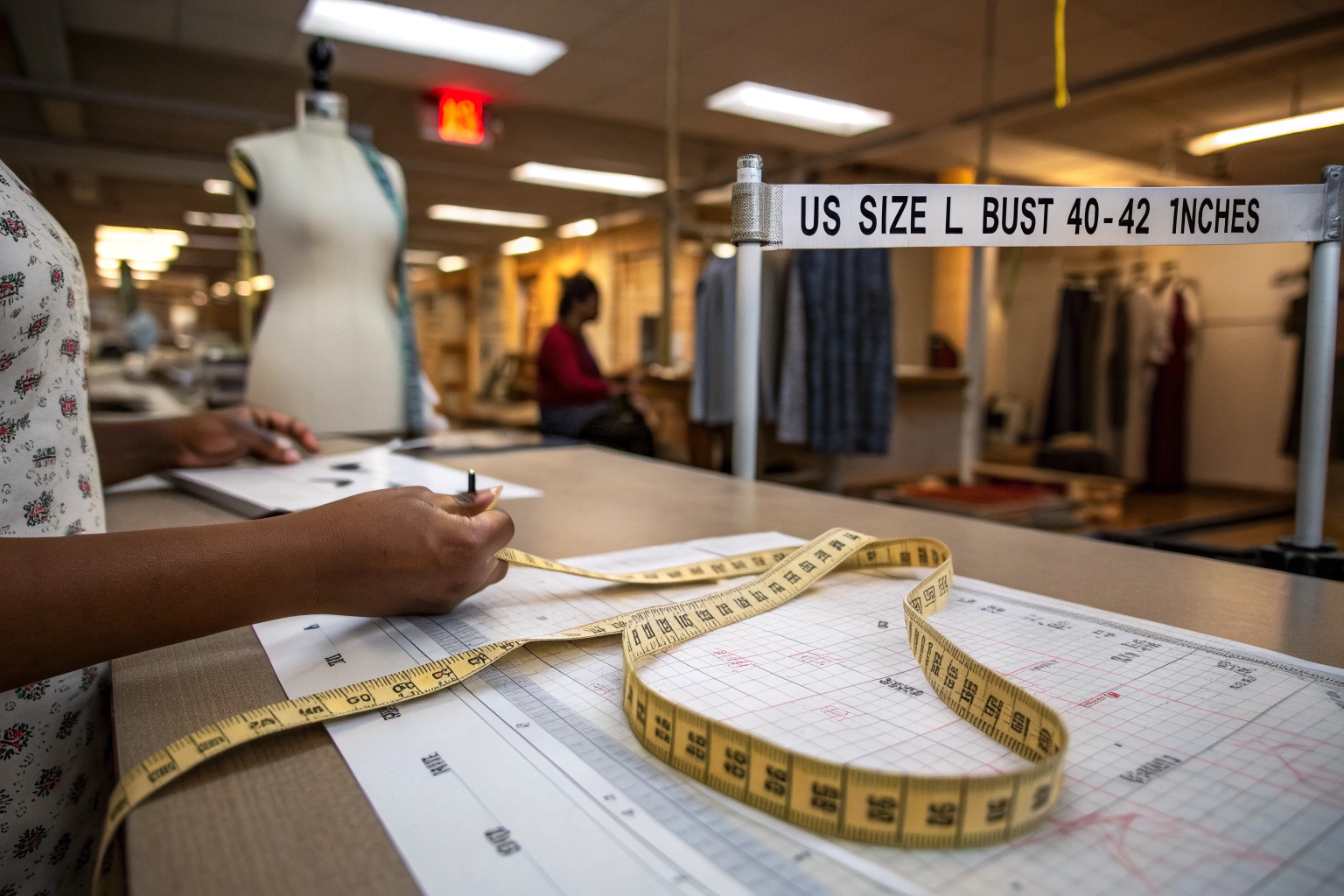
I’m going to say something that might sound harsh, but it needs to be said: Most Chinese and Southeast Asian factories have absolutely no idea what a size 12 or a size 36 waist actually looks like on a human being from Texas or Toronto. They aren’t being lazy. They aren’t trying to ruin your brand’s return rate. They’re simply working with a different set of biometric data that has been ingrained in them since they started sewing. I’ve walked through our sample room in Keqiao a thousand times. The dress forms are small. The shoulders are narrow. The armholes are cut high. That’s the standard "Asian Fit." And if you’re a brand selling to the US or Canadian market, that standard is a return rate time bomb waiting to explode in your Shopify analytics.
You can have the most beautiful fabric in the world. You can have perfect stitching and flawless print alignment. But if that size Large hoodie fits your customer like a size Small, or if those size 8 jeans can’t get past her calves, you’ve failed. You’ve lost the customer. And you’ve lost a ton of money on return shipping and restocking fees. At Shanghai Fumao , we don’t just sell fabric; we partner with factories and brands to bridge this massive gap. We’ve seen the tears, the angry emails, and the chargebacks. And I’m here to tell you that finding a supplier who truly understands the North American silhouette is a different kind of vetting process. It’s not just about asking "Do you do US sizing?"
This guide is your checklist. It’s the exact same framework I use when I’m auditing a new cut-and-sew partner for our own private label clients. We’re going to talk about grade rules, POMs (Points of Measure), and the specific technical questions you need to ask before you place a single bulk order. Because if you get this wrong, the fabric doesn’t matter.
Let’s fix the fit.
Why Do Asian Factory Samples Often Fit Smaller Than US Sizing?
This is the foundational problem that leads to every other issue. You receive your pre-production sample. It’s labeled "Medium." You try it on (or your fit model does), and you can barely zip it up. Or the sleeves feel like they’re cutting off circulation in your armpits. You email the factory: "This runs small." They reply: "No, this is correct US Medium." Who is right?
Technically, neither of you. You’re both operating on different definitions of "Medium." Let me pull back the curtain on why this happens, from someone who sits in between the US market and the Chinese production floor.

What Are the Key Differences in Anthropometric Body Data?
Anthropometric data is just a fancy term for "body measurements of the population." The Chinese government has a national sizing standard called GB/T 1335. The US market uses ASTM D5585 (for adults) or relies heavily on proprietary brand data from fit tech companies like Alvanon.
Here is the brutal truth in numbers. This is based on the average measurements we use when programming our automated cutting machines for different markets:
| Measurement Point | Standard "Asian Large" (Approx) | Standard "US Medium" (Approx) | The Disconnect |
|---|---|---|---|
| Chest/Bust | 92-96 cm (36-38 in) | 96-101 cm (38-40 in) | 2-4 inches smaller |
| Waist (Women’s) | 68-72 cm (27-28 in) | 76-81 cm (30-32 in) | 3-4 inches smaller |
| Hip (Women’s) | 94-98 cm (37-38 in) | 99-104 cm (39-41 in) | 2-3 inches smaller |
| Shoulder Slope | Steeper angle (Square) | More sloped angle | Causes neck drag lines |
| Armhole/Sleeve Cap | Higher, tighter cut | Lower, roomier cut | Restricts movement |
| Thigh Circumference | Narrower | Fuller (Especially athletic builds) | Pants don’t pull up |
When a factory samples a "Medium" using their local fit model (usually a young woman who is 5’4" and 110 lbs), they are sewing for a US Size Small or Extra Small. They aren’t trying to trick you. They just genuinely do not have access to a size 10 dress form from Alvanon. Those forms cost $1,500+ to import.
I recall an incident in March 2023 with a Canadian activewear startup. They ordered yoga leggings in size L/XL. The factory used their standard Asian grading. The thigh measurement came out 2.5 inches too narrow. The fabric was a beautiful compression knit, but it physically could not stretch enough to fit the average North American thigh without becoming completely see-through. We had to scrap 500 units and re-cut the pattern with a new grade rule that added 15% to the thigh circumference.
How Do Cultural Fit Preferences Impact Garment Ease?
Beyond the raw numbers, there’s a cultural difference in "Ease." Ease is the extra fabric added to a garment so you can move and breathe.
- Asian Market Preference: Slim Fit. Close to the body. Minimal ease. Even in casualwear, there’s a cultural emphasis on neatness and a fitted silhouette.
- North American Market Preference: Relaxed Fit. More ease. Comfort is king (and queen). People want to lift their arms, drive a car, and eat a burger without feeling like a stuffed sausage.
If you ask a Chinese factory for a "Regular Fit T-Shirt," they will often give you something that a US customer would call a "Slim Fit." Why? Because to them, that is regular.
This is why you see so many "Asian Size" warnings on Amazon and AliExpress. They’ve been burned by the ease issue. You need to specify ease numerically. Don’t say "loose fit." Say "Chest measurement must be Finished Garment Measurement (Body Measurement + 6 inches of ease)." That specific language ("+6 inches of ease") translates perfectly across language barriers.
For more insight into how to spec garment ease for different North American fit types like relaxed versus athletic cut, this pattern-making forum thread is gold. It breaks down the exact inch allowances for different sleeve caps and armholes.
What Questions Should You Ask to Verify US Sizing Capabilities?
So you’re on a Zoom call or exchanging emails with a potential new factory in China, Vietnam, or Bangladesh. They say, "Yes, yes, we know US size. We do for American brands." That’s not enough. You need to test their knowledge. You need to hear them speak the language of Tech Packs and Tolerances. If they can’t answer these three questions with specific, confident answers, you should not proceed with a bulk order without a heavy dose of caution and third-party inspection.

Can You Provide a Graded Spec Sheet for a US Size 2 to 18?
This is the acid test. This single question will weed out 70% of the "we do US sizing" factories instantly.
What you should expect to hear:
"Yes, we can. Please send us your brand’s base size measurements (usually Size M or 8) and we will apply standard ASTM grading rules to generate a full size run spec sheet. Or, if you have your own grading rules, please attach them to the Tech Pack."
What a bad answer sounds like:
"We just need size S, M, L chest measurements."
"We will follow sample size."
"No problem, we make bigger."
A Graded Spec Sheet is a table that shows the incremental change between sizes. For example, if the bust goes from 38" (M) to 40" (L), that’s a 2-inch grade. A factory that understands North American sizing knows that grading is not linear across all sizes. The jump from a Size 2 to a Size 4 (2 inches) is often different proportionally than the jump from a Size 14 to a Size 16 (maybe 2.5 inches).
At Shanghai Fumao , when we develop a new fabric for a brand, we often see the pattern maker’s notes. I’ve watched our partner factory’s pattern room. A good pattern maker will look at a US size 16 spec and physically adjust the armhole curve, not just "scale up" the size 8 pattern. If they just scale it up, the armhole becomes a giant, gaping hole that shows the bra. A factory that specializes in US mass market knows this intuitively.
What Are Your Standard Tolerance Levels for Cut and Sew?
If the graded spec sheet is the map, Tolerances are the guardrails. No factory cuts and sews perfectly to the exact millimeter every time. There is variance. A professional supplier will tell you upfront what their acceptable variance is.
Here is the industry standard for the North American mid-to-high-end market vs. what we often see in untrained factories:
| Measurement Point | North American Standard Tolerance | Typical "Cheap" Factory Variance | Why It Matters |
|---|---|---|---|
| Chest/Bust (1" below armhole) | +/- 1/2" (1.27 cm) | +/- 1" or more | A 1" difference on a bust is the difference between a comfortable fit and a pulled button. |
| Body Length (HPS) | +/- 1/2" (1.27 cm) | +/- 3/4" | Cropped tops become belly shirts. |
| Sleeve Length | +/- 1/4" (0.6 cm) | +/- 1/2" | Critical for long-sleeved shirts. Even 1/2" is noticeable when arms are down. |
| Waist (Pants) | +/- 1/2" (1.27 cm) | +/- 1" | The difference between buttoning your jeans and needing a belt (or vice versa). |
If a factory says, "Tolerance is no problem, we make very exact," that’s a red flag. An honest factory says, "We hold a tolerance of +/- 1/2 inch for main body points. For smaller details like cuff width, we hold +/- 1/4 inch." That is the language of a professional who has been audited by a US retail compliance team.
How to Ensure Accurate North American Size Grading from Overseas?
Getting the base size correct is step one. But if you’re launching a full collection from XS to XXL or 0 to 20, Grading is where the wheels fall off the wagon. Grading is the art and science of making a size 2 fit like a size 2 and a size 16 fit like a size 16—maintaining the same proportions and look of the design. I’ve seen beautiful size 8 samples turn into comically distorted size 18 garments because the factory used a cheap, automatic "grade and go" software algorithm.

Why Do Plus Size Grading Rules Differ from Straight Sizes?
This is a non-negotiable piece of knowledge if your brand is inclusive and offers extended sizing. You cannot grade a size 22 from a size 2 using the same increments you used to grade a size 6 from a size 2. Bodies don’t grow that way.
Let me give you a specific, real-world example from our work with a US plus-size label in January 2024.
The Fabric: A structured woven linen blend for a summer blazer.
The Problem: They graded the size 20/22 from a size 8 base spec using a standard 2-inch chest grade and a 1/2 inch armhole drop.
The Result: The size 22 blazer had a gaping, massive armhole that exposed the entire side bra and armpit area. The shoulder seam was also 2 inches too wide, hanging off the edge of the shoulder and making the wearer look slouchy instead of tailored.
The Fix: We worked with our pattern team to implement Plus-Size Specific Grade Rules:
- Reduced Shoulder Grade: We only added 1/4 inch to the shoulder width per size, not 1/2 inch. Plus size shoulders do not widen at the same rate as the bust.
- Adjusted Armhole Curve: We raised the underarm point up and in by 3/8 inch for the plus sizes to prevent gapping.
- Front Waist Dart Manipulation: We increased the dart intake to accommodate a fuller bust without adding a huge "tent" of fabric.
If your supplier doesn’t know that "Armhole Grade" needs to be managed separately from "Bust Grade," you’re going to have a fit disaster. You need to ask: "Do you use a different grading table for plus sizes (14W+) than for straight sizes (0-12)?" This is a critical question for how to properly grade plus size apparel patterns for better fit and reduced returns, and there are some excellent technical resources on the Alvanon website that discuss this intersection of body shape and grading.
What Role Does a Fit Model Play in Size Verification?
I’m a fabric guy. I can tell you if the cloth is good. But I can’t tell you if a pair of jeans makes your butt look weird. That’s where the Fit Model comes in. And this is the step that budget-conscious startups skip—to their own peril.
The Mistake: "I tried on the sample and it fit me great! Proceed with bulk."
The Problem: You are not a standard size. No one is. You might have narrow shoulders but a long torso. Your fit model (you) is a sample size of one. It does not validate the grading for the other 5 sizes you’re ordering.
The Professional Method:
- Base Size Fit Model: Hire a professional fit model who measures exactly to your base size spec (usually a Size 8 or Medium). She tries on the sample. You pin and adjust the sample on her body.
- Secondary Fit Model (Crucial): Before cutting bulk for the entire size run, cut and sew just one unit in the largest size you offer (e.g., 2XL/Size 20) and one unit in the smallest (e.g., XS/Size 2) . Hire fit models for those sizes. Test the extreme ends of the grade rule.
In September 2023, a Los Angeles streetwear brand we supply fabric to did this with our help. They tested the 2XL hoodie on a fit model. They discovered the neck opening was smaller on the 2XL than on the Medium! Why? Because the factory’s automated grading software simply scaled the neckline inward (following the torso curve) instead of keeping the neck opening consistent across all sizes. It was a software glitch. They caught it because they tested the extreme grade. Without that test, they would have had 300 hoodies that plus-size customers couldn’t pull over their heads.
How to Transition from Asian Factory Samples to US Fit Standards?
You’ve found a factory that says they can do it. They’ve sent a sample, and it’s… close. But not quite there. Maybe the armhole is tight. Maybe the body length is too short. How do you communicate the necessary changes without confusing them or causing a 6-week back-and-forth email chain that makes you want to scream? This is where the process breaks down for many small brands. Let me give you the playbook we use to manage this transition smoothly.

How to Provide Detailed Points of Measure (POM) Feedback?
Do not send an email that says, "The sleeve feels tight. Please make it looser." That is useless. That is noise. That guarantees a second sample that is either a tent or still too tight.
You must use POM (Points of Measure) language. This is a visual, numeric language that overcomes translation issues.
Here is the exact format of a good POM Feedback email:
"Ref: Sample #2 – US Size Medium Hoodie
Issue 1: Bicep Circumference too tight.
Spec on Tech Pack: 14 inches (Measured 1" below armhole)
Actual Measurement of Sample: 12.5 inches
Requested Correction: Increase Bicep Circumference to 14.5 inches on next sample. (+2 inches total width). Please adjust sleeve pattern piece #4 accordingly."
By including the Pattern Piece Number, you show them you are looking at the construction details. By giving a Specific Numeric Target, you remove all ambiguity.
At Shanghai Fumao , we encourage our clients to use a free tool like Google Drawings to take a photo of the sample and draw lines on the photo showing where the measurement should be taken. For example, draw a red line from HPS (High Point Shoulder) to the bottom hem and write "26.5 INCHES NEEDED."
This method is foolproof. It’s how we helped a UK brand adjust the crotch depth on woven pants in just two rounds of sampling. By showing them the "Front Rise" measurement needed to be 12 inches instead of 10.5 inches, they immediately understood the change needed for the North American "mid-rise" preference versus the Asian "high-rise" preference.
Why Are Wear Tests Essential Before Bulk Production?
You cannot just measure a garment flat on a table. You have to put it on a moving, breathing human being. Specifically, a human being who fits the demographic of your actual customer.
I cannot stress this enough: A Flat Measurement is a Lie.
A fabric might measure 15 inches across the chest on the table. Great. But does it stretch to 18 inches when someone with a 36B bust puts it on? Does the side seam swing forward? Does the neckline choke you when you sit down?
The 24-Hour Wear Test Protocol:
Before we release a new fabric or a new garment style, we have a few staff members (and sometimes their spouses/friends who are Western expats in Shanghai) do a wear test.
- Wear it for 8 hours. Not 5 minutes for a selfie.
- Move. Reach up high. Bend over to tie shoes. Sit in a car seat.
- Check the "Drag Lines." After wearing, look at the fabric on the body. Diagonal lines pointing to the bust or the rear indicate that the fabric is pulling and the pattern is too small in that dimension.
I remember a specific case with a Canadian workwear brand using our heavy-duty cotton twill. The sample measured perfectly to spec on the table. But the wear test revealed a problem: When the wearer bent over, the back waistband gapped open by 2 inches. Why? Because the back rise was cut too straight for a curvier North American backside. The flat measurement didn’t catch it. The wear test did. We added 1.5 inches to the back rise curve, and the problem vanished.
This is the level of detail you need. And this is why we always recommend a professional third-party fit consultation before finalizing a bulk order. There are some great guides online about how to conduct a professional garment wear test to identify fit and pattern issues. It’s a step that costs a few hundred dollars and saves thousands in chargebacks.
Conclusion
Finding a supplier that truly understands North American sizing is about more than just finding a factory that owns a tape measure with inches on it. It’s about finding a partner who respects the data—the anthropometric reality of a broader shoulder, a fuller hip, and a longer torso. It’s about vetting their knowledge of grading tables, their willingness to use actual fit models, and their ability to interpret POM feedback with precision.
You can’t assume that "US Size" means anything universal. You have to define it for them. You have to lead with the Tech Pack, enforce the Tolerances, and validate the extremes of the size run. The factories that can do this successfully are not the cheapest ones on Alibaba. They are the ones who have invested in pattern-making software, who have worked with US and Canadian compliance teams, and who understand that a 3-inch difference in the hip measurement is the difference between a loyal customer for life and a 1-star review that haunts your brand.
At Shanghai Fumao , our core business is fabric, but our value is in the network. We know which cut-and-sew partners in our orbit can handle the complexities of the North American silhouette, and we know which ones are better suited for the Asian domestic market. We can help you navigate that conversation.
If you’re struggling with a fit issue or you’re looking to source fabric for a brand that demands a perfect US fit, let’s talk. We can connect you with the right technical resources and supply chain partners to make sure your garments look as good on your customers as they do on the hanger.
For a conversation about how to align your fabric sourcing with the right production partners, reach out to our Business Director, Elaine.
Email Elaine at: elaine@fumaoclothing.com
Let’s get the fit right the first time.