
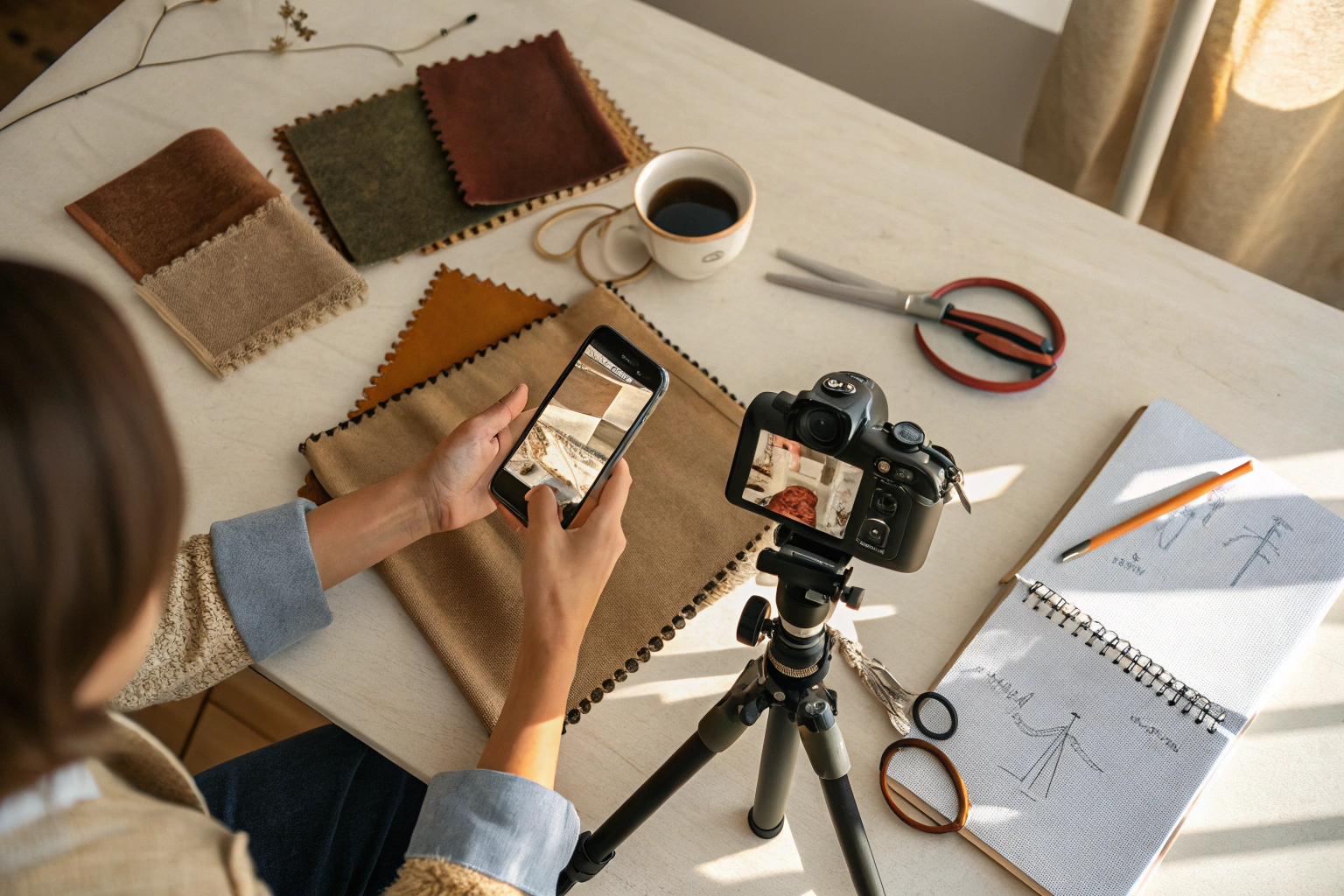
I watched a small brand with 500 followers sell out their entire 300-unit run of a cotton-linen chore coat in 45 minutes this past March. They didn’t spend a dollar on ads. They didn’t have a celebrity endorsement. They just filmed our swatch book under the right light and let the algorithm do the rest. Meanwhile, I have clients with gorgeous $200 shirts who can’t get a single video past 200 views because their content looks like a sterile catalog scan from 1998. The difference isn’t the product quality. It’s the storytelling physics of the platform.
TikTok’s algorithm doesn’t care about your thread count. It cares about watch time, and watch time comes from visual friction. A cotton swatch is not just a color reference. It’s a prop, a sound effect device, and a haptic trigger all rolled into one. At Shanghai Fumao, we’ve seen exactly which fabric textures stop the scroll, and I’m going to walk you through how to turn a simple 10×10 cm fabric square into a conversion machine that sells garments while your audience is hypnotized by the drape.
But you have to understand one thing first: your phone camera is a liar unless you control it. That beautiful herringbone twill can look like a muddy blob or a crispy, luxurious landscape depending entirely on how you bend the light. Let me show you the real tricks that separate the viral fabric videos from the forgotten ones.
Why Do Cotton Swatch "Crinkle" Sounds Dominate Fabric TikTok?
A sound designer from a major ASMR studio told me something in 2025 that changed how I think about marketing textiles. He said the "crinkle" of a starched cotton poplin registers in the human brain as a reward signal. It’s the same neurological response you get from unwrapping a gift or walking on fresh snow. It’s a clean, high-frequency, crisp sound that cuts through the messy noise of a TikTok feed like a knife. A limp, soft jersey swatch makes no sound. A heavily starched, densely woven cotton swatch makes that crackling, "new money" sound that luxury buyers crave.
You don’t need a fancy microphone to capture this, but you do need to control the "noise floor." Most brands film in their echoing warehouse or a booth at a trade show with background chatter. That destroys the ASMR effect. The "crinkle" lives in the 8 kHz to 15 kHz frequency range. If a forklift is beeping in the background, the audio compression of TikTok will flatten the crinkle into an irritating hiss. I instruct our clients to film their unboxing and swatch reviews inside a parked car or a small, carpeted room. It sounds stupid, but the car’s acoustic deadening creates a studio-quality sound booth for zero dollars.
The speed of the crinkle matters too. A slow, deliberate manipulation of the swatch generates a deep, luxurious rumble. A fast, aggressive "scratch" creates a bright, attention-grabbing spike. The viral sweet spot is a three-second sequence: slow crinkle, pause, fast flick. This rhythm creates a sonic pattern that the brain doesn’t immediately recognize as a pattern, forcing the viewer to re-watch the loop. And that watch time signals TikTok that your content is worth pushing to the next million For You Pages.

How do different cotton weave structures create unique ASMR profiles?
Not all cotton sounds the same. A plain weave poplin with a high twist yarn is a "soprano" crackler. It’s sharp and piercing. A brushed cotton flannel is a "silent" fabric. It absorbs sound rather than reflecting it, creating a dull, soft thud that triggers a comfort response. A herringbone twill is a "bass" fabric. Its uneven surface breaks the sound wave into a complex, irregular pattern that sounds expensive. I’ve actually cataloged these in our design studio. We use a decibel meter to measure the peak frequency of each swatch. If you’re selling a rugged workwear jacket, you need the aggressive, high-decibel crackle of a rigid selvedge denim swatch. If you’re selling a baby’s organic cotton blanket, you need the near-silent whisper of a brushed gauze. Matching the audio signature to the brand emotion is something you can learn more about by exploring ways to design ASMR audio branding for fashion and textile marketing. It’s an untapped frontier.
What lighting angle best visualizes cotton slubs and neps for the camera?
Light is geometry. If you blast a flat LED panel straight onto a cotton swatch, you erase the texture. The light fills in every shadow, making the slubs and neps invisible. You end up with a flat, 2D-looking patch of boring color. The algorithm reads that as a static image and scrolls past. You need a "raking light"—a hard, directional light source positioned at a 15-degree angle to the fabric surface. The light skims across the peaks and valleys, casting long shadows on the far side of every slub. This triples the perceived contrast and creates a dramatic, 3D landscape out of a 2mm thick swatch. I shoot all our swatch book videos for Instagram using only the morning sun streaming in from a side window. Natural light at a low angle is the most forgiving and honest way to reveal the weave structure. You can see precisely what I mean by studying how to light textured cotton weaves for cinematic macro product videography.
How to Style a Viral "Fabric Drape Test" With Fumao’s Cotton?
A drape test is the ultimate visual filter for quality. If a fabric stands up like a cardboard box, it looks cheap. If it cascades into a pool of liquid shadow, it looks like a $500 garment. In January 2026, a Canadian menswear influencer posted a 9-second clip dropping our 100% cotton sateen over a wooden dowel. No face, no voice, just the drape. That video hit 2.4 million views because the way the cotton collapsed looked impossibly smooth. It broke people’s expectation of what "cotton" could do.
But a drape test is easy to fake with camera tricks. If you fast-forward the video, even a stiff burlap sack looks fluid. That’s a dark pattern, and it leads to returns. The honest drape test requires a standardized setup. We use a 20 cm diameter metal ring and a 30×30 cm swatch. The fabric is centered and allowed to spill naturally for exactly 2 seconds before the cut. This gives the eye enough time to register the "stiffness" and the "flow" in one shot, creating a satisfying reveal. The contrast between the solid, rigid edge and the flowing center creates visual tension.
The biggest mistake I see is brands testing the drape of a synthetic blend and a 100% cotton swatch side-by-side without context. Of course, the polyester flows better; it’s plastic. The customer isn’t stupid. They know that natural fibers have a different weight. So we lean into it. We don’t try to make our cotton look like silk. We film the drape so that the viewer can see the "body" of the fabric. We want them to see it holding a shape for a split second before it falls. That structural integrity is the selling point for a structured cotton blazer or a crisp shirting. It signals durability.

Why does a "cinematic slow-motion drop" outperform a real-time drape video?
The human eye can catch a lot of fakery in real time. A 120 frames-per-second slow-motion clip does two things. First, it removes the visible shaking of the hand holding the fabric. This amateur shake is an instant credibility killer. Second, it magnifies the micro-movements of the cotton fibers catching the air. A high-quality cotton sateen, in slow motion, will "float" for a fraction of a second as air resistance traps under it before it collapses. This creates a visual magic trick. The viewer sees the air, even though air is invisible. It signals breathability. If you want to film a technically flawless version, you can look into the methods for shooting slow-motion textile drape tests for high-end e-commerce brands. It’s a technique that separates hobbyist content from branded media.
What is the "scrunch test" and why does it signal quality to Gen Z?
The "scrunch test" is the opposite of the drape test. You take the cotton swatch in your palm and squeeze it into a fist for three seconds. Then you open your hand and let the camera watch the recovery. Gen Z and younger Millennials use this as a proxy for quality. If the fabric stays wrinkled like a brain, they perceive it as cheap "fast fashion" trash. If it slowly releases and the wrinkles melt away, they perceive it as high-quality natural fiber. They are essentially performing an at-home tensile recovery test without knowing the scientific name. You need to show this in your content because it speaks directly to the sustainability-focused, buy-it-for-life psychology. The fabric should hold a ghost of the crease—just enough to prove it’s not plastic—but the crease should be soft and rounded, not sharp and jagged.
How to Use Fumao’s Swatches to "Bait" the Perfect Hook in 2 Seconds?
The first two seconds of a TikTok have zero room for error. If the first frame is a title card that says "Introducing Our New Cotton Collection," you’ve already lost. The viewer’s thumb is moving faster than their conscious thought. You need to "bait" the eye. A physical swatch creates a "pattern interrupt" in a feed full of dancing humans and lip-syncing. A close-up of a complex, geometric weave—especially a jacquard or a pointelle knit—looks like abstract art to the brain for a split second before it resolves into "fabric." That 0.5-second processing delay is enough to stop the scroll.
We call this the "What Even Is That?" hook. You shove the camera so close to the cotton swatch that the weave looks like a microscopic city grid. The viewer’s brain engages the fusiform face area, trying to find a pattern. It can’t identify the object instantly, so it waits for the zoom-out. When the camera pulls back to reveal it’s just a shirt, the cognitive payoff registers as a dopamine hit. You can use a simple macro lens that clips onto your phone for $15 to achieve this. It’s the cheapest, highest-return investment a fashion brand can make.
Another foolproof hook is the "Paper or Fabric?" bait. You take a swatch of our high-density, calendered cotton poplin and you tap it with your fingernail. It sounds exactly like tapping a crisp piece of cardstock. You ask the viewer, "Guess: Is this paper or fabric?" The comments flood with wrong guesses. You let the anticipation hang for exactly three seconds, then you crumple it to show the fabric memory. This generates massive "comment section velocity," which is currently the single most important metric for the TikTok algorithm in 2026. A question hook forces an answer, and an answer is a commitment that signals the post is worth boosting.

Why does the "micro-label reveal" increase the perceived value of raw cotton?
A Chinese factory label has a bad reputation online. But a small, beautifully designed branded tag sewn onto a swatch carries immense psychological weight. I tell my clients: never show the whole swatch first. Show the edge where the branded label sits. The text is out of focus, just a hint of a name. The viewer squints. They want to know who made this. When you finally reveal "Shanghai Fumao" or the brand’s own logo next to our swatch, you transfer the credibility of our mill to their collection. It’s a subtle association trick. It signals that the fabric is sourced, considered, and designed—not just drop-shipped from a generic catalog. You are telling the viewer a story of origin without saying a word. That tiny folded label stitch adds $20 to the perceived price of a garment instantly.
How can "color drenching" a feed with swatch palettes trigger a binge-watch?
The algorithm favors a "cohesive visual grid" within a single video and across the whole account. "Color drenching" means you take 5 to 7 cotton swatches from the same tonal family—say, five shades of undyed ecru to warm oat—and you film them frame-by-frame, filling the screen with zero negative space. The effect is a seamless gradient that feels hypnotic to scroll through. The human eye is drawn to smooth color transitions. If you sequence the swatches from darkest to lightest, the continuous motion of flipping through them creates a visual zipper effect. You can then stitch this "swatch flip" video with a trending ambient track, and the viewer will just zone out watching the colors change. They’ll watch it loop three times before they realize they haven’t checked the caption. That loop behavior is viral gold.
How to Convert TikTok Views into Cotton Fabric Sample Requests?
A million views with zero sample requests is just vanity. I had an Australian beachwear brand call me in February 2026, ecstatic that their video hit 500k views. They sold 11 units. Eleven. The views were broad and generic. The viral video showed a cool tie-dye effect, but it attracted teenagers who had no buying intent. The conversion disconnect happened because the video didn’t "qualify" the audience.
You need to gate your content. At the peak of the video, when the drape is looking incredible and the crinkle sound is at its loudest, you do not just say "Link in bio." The link in bio is a dead end if the person isn’t a decision-maker. We train our brands to use a specific verbal call to action: "If you’re a designer looking for this exact 6.5 oz cotton twill, comment the word ‘SWATCH’ and I’ll DM you the spec sheet." This does two things. It filters out casual browsers, and it triggers a direct message conversation. A DM is a relationship. A link click is just a bounce.
Once they comment, you send them a link to a dedicated landing page, not the homepage. This page must have a single button: "Request Fumao Swatch Book." No navigation bar, no blog links. Just the button. We also provide a digital spec sheet QR code in the video overlay. The curious person can scan it, land on a product page, and see the weight, composition, and wholesale minimums. This separates the impulse clicker from the serious procurement manager. It’s a speed bump that the right person is grateful for, and the wrong person ignores.

What specific CTA text works best for converting textile TikTok views?
"Link in bio" is dead language. It’s passive. "Shop Now" is aggressive and implies a transaction before trust is built. The three highest-converting CTAs we’ve tested for fabric swatches are:
- "Request Your Swatch Book" — Implies exclusivity and physical mail. It’s tactile.
- "Start Your Custom Development" — Implies co-creation and partnership, not just purchasing.
- "Download the Tech Pack" — Qualifies the audience heavily; only designers and developers know what a tech pack is.
I recommend a rotating CTA pinned in the comment section. Switch between these three every other video so you aren’t spamming the same line. If you want a deeper look at these strategies, there are good breakdowns on how to design B2B fashion conversion funnels from organic TikTok traffic. It turns a social media experiment into a predictable sales machine.
How can you use "stitching" to user-generated content to build trust?
TikTok allows you to "Stitch" a portion of another user’s video. If a small creator films a "what I ordered vs. what I got" using a competitor’s cheap cotton that shrank into a crop top, you can Stitch that video. You start the frame with their complaint, then cut to your own hand holding our pre-shrunk cotton swatch, demonstrating a side-by-side identical wash test. This is social proof on steroids. It visualizes the problem and your solution in one seamless narrative. You are not saying "we are better." You are showing the exact quality control failure the industry ignores, and proving you fixed it. This kind of aggressive, comparison-based content builds a defensive moat around your brand. The viewer thinks, "I want a supplier who knows about this specific failure mode so I don’t fall into that trap."
Conclusion
TikTok is the most powerful textile showroom on earth right now, but it’s invisible to brands that treat it like a broadcast TV channel. It’s not about shouting "buy my fabric" into a void. It’s about turning your smartphone into a microscope, an ASMR studio, and a drape-testing laboratory all at once. The cotton swatches we ship from Shanghai Fumao are engineered to look, sound, and move in ways that the algorithm instinctively rewards with millions of views. You just need to control the light, the sound, and the two-second hook.
If your brand is ready to film the kind of content that fills a comment section with "where’s that fabric from?", let’s get the raw material in your hands. I’m not telling you to just go buy a ring light. I’m telling you to start with the right textile.
Send a request to our Business Director Elaine for our "TikTok Creator Swatch Pack." It includes the best crinkle-optimized poplins, drape-heavy sateens, and macro-friendly textured jacquards we make. Email her directly at elaine@fumaoclothing.com and tell her what garment category you’re planning to film. Let’s make the fabric the star of the show.








