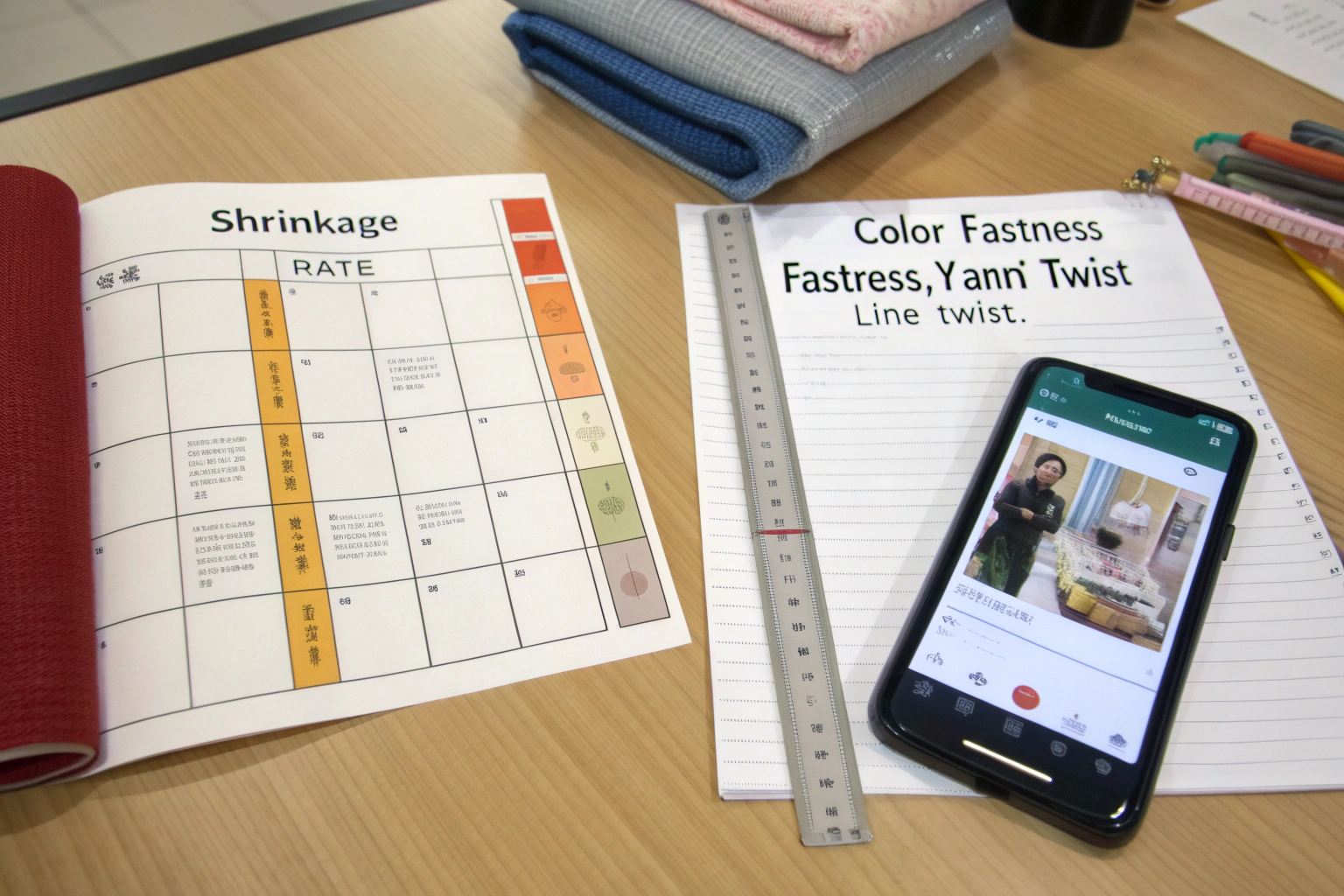
A buyer sends a detailed fabric specification to a new mill in Keqiao. The spec is beautifully written: "The hand feel should be dry and papery with a slight grain, not slick or silicone-coated. The drape should be fluid but not limp, with a lively recovery snap." The mill’s sales representative reads the English, runs it through a translation app, and sends back a one-line response: "OK, we understand." Four weeks later, the sample arrives. The hand feel is slick and silicone-coated. The drape is limp and dead. The mill followed exactly what they understood from the translated text. The problem wasn’t competence. It was communication design. The buyer wrote a specification for an English-speaking textile engineer and hoped the translation would carry the nuance. It didn’t.
Communicating technical specifications across language barriers is a design problem, not a language problem. The solution is not to hire a bilingual agent or to learn Mandarin. The solution is to structure the communication so it survives translation with minimal information loss—using standardized test numbers instead of descriptive adjectives, visual references instead of verbal descriptions, and a structured specification format that the receiving mill recognizes regardless of what language they speak. At Shanghai Fumao, our merchandising team handles specifications in Mandarin, English, and several other languages daily, and I’ve seen exactly what works and what fails. In this article, I’ll share the specific communication techniques that bridge the language gap and get you a first sample that actually matches what you asked for.
Why Do Standardized Test Numbers Work Better Than Descriptive Adjectives?
Adjectives are the enemy of accurate translation. The word "soft" in English translates to a concept that different languages map to different physical properties. A Mandarin-speaking textile technician might interpret the translated word for "soft" as referring to fabric compression, bending resistance, surface friction, or all three. The resulting fabric will be soft in some dimension, but not necessarily the dimension the buyer meant. The buyer who wrote "soft" and received a fabric with low bending resistance might have meant low surface friction. The fabric meets the translated instruction but fails the buyer’s intent.
Standardized test numbers eliminate this ambiguity. "ASTM D4032 bending rigidity maximum 15 micro-Newton meters" is a specific, measurable, physically verifiable property. The test standard number tells the mill exactly which machine to use, which specimen size to cut, which jaw speed to set, and which calculation to apply. The limit value tells them the acceptable range. There is no translation ambiguity. A bending rigidity of 15 µNm means exactly the same thing in Shanghai, Dhaka, Istanbul, and New York because it’s tied to a physical measurement procedure, not a linguistic concept. The ISO, ASTM, and AATCC standards are internationally recognized, and any competent textile mill anywhere in the world can read a standard number and know exactly what test to run and what the result means. At Shanghai Fumao, when a buyer sends us a spec that says "soft, fluid drape," we immediately respond with a request for the specific test standards and values they want us to target. The conversation that follows—buyer researching test standards, mill providing guidance on achievable values—is the conversation that produces an accurately matched sample. The standardized textile testing methods as a universal language for cross-border technical specification communication in fabric sourcing provides the framework for replacing adjectives with test numbers across all major fabric properties.

What Are the Essential Test Standards Every Buyer Should Know?
You don’t need to memorize a hundred ASTM numbers. Six core test standards cover the properties that most frequently cause specification miscommunication. For fabric weight, the standard is ISO 3801 or ASTM D3776, measuring grams per square meter. Instead of "heavy fabric," specify "ISO 3801, 280gsm ±5%." For dimensional stability, the standard is AATCC 135 or ISO 6330, measuring shrinkage percentage after a specified number of wash and dry cycles. Instead of "doesn’t shrink," specify "AATCC 135, 3 cycles at 40°C, maximum 3% warp and weft shrinkage." For color fastness to washing, the standard is ISO 105 C06, with specified temperature and test condition, measuring color change and staining on a grey scale. Instead of "color doesn’t bleed," specify "ISO 105 C06 A2S at 40°C, color change minimum Grade 4, staining minimum Grade 3-4." For color fastness to crocking, the standard is AATCC 8 or ISO 105 X12, measuring dye transfer under dry and wet friction. Instead of "color doesn’t rub off," specify "AATCC 8, dry crocking Grade 4 minimum, wet crocking Grade 3-4 minimum." For pilling resistance, the standard is ISO 12945-2 or ASTM D4970, Martindale method, measuring pilling grade after a specified number of rub cycles. Instead of "doesn’t pill," specify "ISO 12945-2, 2000 cycles, minimum Grade 4." For seam slippage, the standard is ASTM D1683 or ISO 13936-2, measuring seam opening at a specified load. Instead of "seams don’t gape," specify "ASTM D1683 Procedure D, 200N load, maximum 2.5mm opening." These six standards, with appropriate values for your product, will communicate 90% of what most buyers need to specify about fabric quality. The essential textile testing standards reference guide for apparel buyers communicating specifications to international mills provides the full reference with acceptance criteria by product category.
How Do I Find the Right Test Standard for a Property I Can Only Describe?
You know the performance you want, but you don’t know which standard measures it. You want "a fabric that doesn’t wrinkle easily." You want "a fabric that dries quickly." You want "a fabric that feels cool against the skin." These are consumer-relevant properties, not standard test names, and you need to map them to the correct standard. The mapping is not always obvious. "Wrinkle resistance" is tested by AATCC 128, which measures the wrinkle recovery angle—the fabric is creased under controlled conditions, and the angle at which it recovers determines the grade. "Quick drying" is tested by AATCC 199 or the simpler line-dry method, which measures drying time under controlled temperature and humidity. "Cool touch" is measured by a Qmax test using a thermal effusivity instrument, which quantifies the instantaneous heat flux when the fabric contacts a warm surface—higher Qmax means cooler initial touch sensation.
The way to find the right standard is to describe the end-use performance need to the mill’s technical team and ask them to recommend the appropriate test standard. A well-managed mill wants to deliver what you need and will help you identify the right measurement method. At Shanghai Fumao, we maintain a property-to-standard mapping document that we share with clients who are building specifications from functional requirements rather than from existing test knowledge. The conversation goes: "I want a fabric that feels cool when you first put it on." We respond: "That’s thermal effusivity, tested by the Qmax method. We can target a Qmax above 0.15 W/cm² for a noticeable cool-touch effect. Would that meet your requirement?" The buyer learns the standard, the mill confirms the achievable value, and the specification becomes objective. The consumer-relevant fabric performance properties and their corresponding standardized test methods for technical specification communication provides the property-to-standard mapping for the most common functional requirements.
What Visual Communication Methods Bridge the Language Barrier?
A picture is worth a thousand words, and in cross-language technical communication, a picture is worth ten thousand translated words. Visual references bypass the translation layer entirely. A technician in a Chinese dye house doesn’t need to read English to understand a Pantone TCX color chip. They just need the chip itself and the instruction to match it. A weaving technician doesn’t need to understand "dry, papery hand feel with a subtle grain" if you send them a physical reference swatch and the instruction "make it feel like this." The physical reference is unambiguous. It can be touched, compared, and measured directly against the developed sample.
Visual communication goes beyond physical references. For properties that can’t be captured in a static swatch—drape, recovery, movement—a short video is the most effective communication tool. A 15-second video of a reference fabric being scrunched in a hand and released, draped over a curved form and moved, or stretched and allowed to recover, communicates drape, hand feel, and recovery behavior more accurately than any written description. The mill technician watches the video and develops a sample that reproduces the observed behavior. They don’t need to read a description of the behavior; they saw it. At Shanghai Fumao, we encourage all our development clients to send physical reference swatches and short video references with their specifications. The combination of written specification with test standards plus physical reference plus video reference produces the highest first-sample accuracy rate we see—well above 80% match on the first submission, compared to around 50% for text-only specifications. The visual communication tools and physical reference standards for cross-language technical specification in international textile sourcing provides the toolkit and method for building a visual specification package.

How Do I Create an Effective Physical Reference Swatch Package?
A single swatch is good. A structured swatch package is better. The package should include the reference fabric itself—enough fabric for the mill to handle, measure, and test, not just a tiny snippet—plus a simple annotation card attached directly to the swatch. The annotation card uses minimal language and maximum visual information. A photo or diagram showing the weave structure with a measurement scale. An arrow pointing to the fabric surface with a note: "Surface: dry, not slick." An arrow pointing to the fabric edge with a note: "Thickness: approx 0.8mm." A small graph or simple icon indicating the target drape level—a simple line drawing of a fabric draped over a bar with the amount of drape indicated. The annotation card should be laminated or placed in a protective sleeve so it survives handling on the production floor.
If multiple properties need to be communicated, create a "touch sequence" video showing your hand interacting with the reference fabric. Start with the fabric flat, scrunch it to show compression recovery, smooth it out, drape it over your wrist to show fluidity, stretch it to show elasticity, and hold it up to a light source to show opacity. Narrate the video in simple, slow English even if the mill’s team doesn’t speak English—the visual demonstration carries the meaning, and the tone of your voice conveys emphasis. Send this video as a WeChat or WhatsApp message directly to the mill’s development contact, along with the physical swatch package by courier. The combination of physical reference that can be touched and video reference that shows dynamic behavior is the most complete specification you can send without being in the same room. The physical reference swatch preparation and annotation methodology for international textile development communication provides the detailed package assembly instructions.
What Should I Show in a Reference Video to Communicate Hand Feel and Drape?
The video should demonstrate four specific interactions with the reference fabric, performed in a consistent sequence that the mill technician can later replicate with the development sample for comparison. Interaction one is the scrunch test. Hold the fabric in one hand, scrunch it into a tight ball, hold for two seconds, then release. Film the fabric as it recovers. Does it spring back instantly, recover slowly, or stay scrunched? This communicates compression recovery and resilience. Interaction two is the drape test. Hold the fabric by one corner or over the back of your hand and let it hang. Move your hand slowly side to side. Film how the fabric flows and swings. This communicates bending rigidity and fluidity. Interaction three is the surface stroke. Lay the fabric flat and stroke your fingertips across the surface, first with the grain, then against it. Film the fabric surface as it catches or releases your fingers. This communicates surface friction and smoothness. Interaction four is the stretch test. Pull the fabric in the crosswise direction to a moderate extension—don’t stretch to the limit—and release. Film the recovery. This communicates elasticity and recovery snap.
Film each interaction for about five seconds, in a continuous sequence, with good lighting and a neutral background. A light grey or white tabletop works well. Avoid dark backgrounds that make the fabric color hard to see and textured backgrounds that distract from the fabric surface. Keep your hand in the frame throughout so the mill technician can see the scale of the fabric relative to your hand and the force you’re applying. The video reference recording protocol for communicating textile hand feel, drape, and mechanical behavior to international mills during fabric development provides the step-by-step filming guide with example frames.
What Should a Language-Proof Fabric Specification Sheet Include?
A language-proof specification sheet is structured so that even if all the explanatory text is stripped away by a bad translation, the numbers, codes, and values remain intelligible. The sheet relies on standardized codes, numeric values with units, and a consistent format that any textile technician anywhere in the world can parse. It uses minimal prose and maximal structured data. The goal is a specification that can be understood correctly even if the recipient only reads the numbers and standard codes.
The essential sections of a language-proof spec sheet are: product identification with a unique development reference number, fiber composition expressed as percentages with fiber names using internationally recognized generic names or trademarked brand names, yarn count expressed in Ne or metric count with a note indicating single or plied, fabric weight in grams per square meter with tolerance, fabric width in centimeters or inches with tolerance, weave or knit structure using standard notation, color specification with Pantone TCX code or physical standard reference number, and a test requirements table with columns for property, test standard, test condition if applicable, target value, and acceptance tolerance. Each row in the test table is a complete, self-contained specification that doesn’t depend on surrounding text for meaning. At Shanghai Fumao, we provide all our development clients with a standardized specification template that follows this format, and we receive it from buyers in English, Mandarin, and other languages without translation issues because the structure and the standard codes are universally recognized. The language-proof textile specification template and structured data format for cross-border fabric development communication provides the downloadable template with bilingual section headers for English-Mandarin communication.

How Should I Format Color Specifications to Avoid Translation Errors?
Color communication is the most translation-sensitive part of any specification. "Navy blue" means different things to different people in different cultures. A Chinese dyer’s "navy" might be redder or duller than an American buyer’s "navy." The solution is to specify color using a physical standard from an internationally recognized system, referenced by its unique code, plus a numerical tolerance. "Pantone 19-4029 TCX Navy Peony, Delta E CMC 1.0 maximum under D65" is a color specification that survives translation because the Pantone code is a physical chip that the mill can purchase and the Delta E tolerance is a numerical value measured by a spectrophotometer. No adjectives, no color names, no cultural interpretation.
The specification should also address metamerism—the phenomenon where colors match under one light source but not another. A simple addition to the color specification line solves this: "Pantone 19-4029 TCX, Delta E CMC 1.0 maximum under D65, A, and TL84. Metamerism index below 1.0." This tells the mill that the color must match under daylight, incandescent, and fluorescent retail lighting, and that the recipe must be formulated to minimize metamerism. The dyer understands this requirement regardless of what language they speak because the light source codes and the numerical values are standard. The color specification language for international textile sourcing including Pantone coding, spectrophotometric tolerances, and multi-illuminant metamerism requirements provides the full specification format.
What Are the Most Commonly Mistranslated Technical Terms in Textile Sourcing?
Certain English textile terms have no direct equivalent in other languages, or have equivalents that carry different connotations. "Hand feel" is a classic example. In English, it’s a specific term of art in the textile industry. In Mandarin, the closest term might be translated back as "touch feeling," which a non-specialist translator might render as "the sensation of touching." A specification that says "hand feel must match reference" becomes "the sensation of touching must match reference," which loses the specific meaning that "hand feel" is an industry-standard quality parameter encompassing surface friction, compression, bending, and thermal properties. The solution is to use "fabric hand" or "fabric handle," which are more standardized terms, or better yet, to specify the individual mechanical properties with test standards rather than using the umbrella term "hand feel."
"Drape" is another problematic term. In English textile usage, it specifically means the manner in which a fabric hangs under its own weight. In many other languages, the translated term might encompass any aspect of how fabric falls, including dynamic movement, which is technically "swing" or "fluidity," not "drape." "Recovery" is ambiguous—it can mean wrinkle recovery, stretch recovery, or compression recovery, which are three completely different tests. The specification should always use the full term: "stretch recovery," "wrinkle recovery," or "compression recovery." "Shrinkage" is often confused with "relaxation" in translation. A fabric that "relaxes" during washing—changing dimensions due to the release of processing tensions—is not the same as a fabric that "shrinks" due to fiber property changes. The test standard eliminates this confusion by defining exactly what is measured and how. The commonly mistranslated textile technical terms in English-Mandarin specification communication and their correct standardized alternatives provides the glossary of problematic terms and their test-standard-based alternatives.
How Do I Confirm the Mill Has Understood My Specification Correctly?
Sending a specification is the first step. Verifying that the specification was understood correctly is the critical second step that most buyers skip. They send the spec, receive an "OK" or "understood" response, and assume alignment. The assumption is dangerous. The mill’s representative may have understood the words but not the intent, or may have assumed a different standard condition than you intended, or may have mentally substituted a similar but different test method. The only way to confirm understanding is to ask the mill to repeat the specification back to you in their own output—a simple summary of the key parameters as they’ve understood them, ideally with a note of the test values they intend to target.
The confirmation request should be specific: "Please confirm the following specifications as you understand them for this development. Target fabric weight and tolerance. Target shrinkage after 3 washes. Minimum crocking fastness grades. Minimum seam slippage opening at 200N." This request asks the mill to demonstrate understanding, not just acknowledge receipt. When the mill replies with the numbers they plan to target, compare them to your specification. If the numbers match, you have confirmed understanding. If the numbers differ—if the mill writes "shrinkage max 5%" when you specified "max 3%"—you’ve caught a misunderstanding before any production has occurred, and you can clarify. At Shanghai Fumao, we always provide a confirmation summary back to the buyer after receiving a new development specification, listing the key parameters and target values as we’ve understood them. This simple confirmation loop catches discrepancies early and prevents wasted development time. The specification confirmation and verification protocol for cross-border textile development communication to prevent misinterpretation and misalignment provides the confirmation request template and the alignment checklist.

What Should a Sample Evaluation Report Look Like When It Comes Back?
When the development sample arrives, the mill should send a report with it that is structured to enable direct comparison against the original specification. The report should be organized in the same sequence as the original spec sheet, with the specification value, the achieved value, and the test standard used for each property. A property that meets specification is clearly marked. A property that deviates is clearly marked with the deviation amount and the mill’s comment on whether it can be improved in the next iteration or whether it’s an inherent limitation of the fiber, yarn, or construction.
A good sample evaluation report doesn’t just say "sample is ready for your review." It says: "Weight: spec 220gsm ±5%, achieved 218gsm, PASS. Shrinkage: spec max 3%, achieved warp 2.4% weft 1.8%, PASS. Wet crocking: spec Grade 3-4 min, achieved Grade 3-4, PASS. Dry crocking: spec Grade 4 min, achieved Grade 4-5, PASS. Bending rigidity: spec ≤15 µNm, achieved 18 µNm, ACTION REQUIRED. We can adjust softener to reduce bending rigidity; please advise if hand feel change is acceptable." This report format allows the buyer to immediately see which properties match the spec, which ones require discussion, and what the mill proposes to do about the deviations. The conversation about the sample is focused on the specific issues, not a vague "it doesn’t feel right." The sample evaluation report format and content standards for textile development submissions in international sourcing relationships provides the report template and the process for systematic sample review.
How Do I Give Feedback on a Sample That Isn’t Quite Right?
Feedback on a near-miss sample is the most communication-sensitive moment in the development process. The sample is close but not correct. The feedback must clearly identify what needs to change, by how much, and in what direction. Vague feedback like "make it softer" or "the color needs to be warmer" will generate a second sample that is also wrong, just differently wrong. The feedback loop repeats, the timeline stretches, and both sides get frustrated.
Effective feedback uses the same objective framework as the original specification. "The bending rigidity measured 18 µNm. The specification target is 15 µNm maximum. Please reduce bending rigidity by approximately 20%. Confirm if this requires softener adjustment or construction change." This feedback names the specific measured property, states the current value, states the target value, and asks for the mill’s proposed method to close the gap. It is clear, measurable, and actionable. For color feedback, "The current sample measures Delta E 1.8 against the standard. The specification requires Delta E 1.0 maximum. The deviation is primarily in the b value—the sample is too yellow by approximately 0.6 units. Please reformulate to reduce yellowness while maintaining L and a values." This feedback tells the dyer exactly which direction to move in the CIELAB color space, which turns an artistic adjustment into a mathematical one. The structured sample feedback methodology for iterative textile development across language barriers including quantitative property adjustment requests provides the feedback framework and example language for each major fabric property.
Conclusion
Communicating technical specifications to a mill that doesn’t speak your language is not about becoming bilingual. It’s about designing your communication to be translation-resistant. Replace adjectives with standardized test numbers. Replace verbal color descriptions with Pantone codes and Delta E tolerances. Replace written hand feel descriptions with physical reference swatches and video demonstrations. Structure your specification sheet so that the numbers and codes carry the meaning even if the prose is mangled in translation. And always, always close the loop by asking the mill to confirm the specification back to you in their own output before they start production.
The mills that succeed in international custom development are the ones that have built their internal processes to handle these communication methods. They maintain bilingual technical staff, they own the standard reference materials—Pantone books, grey scales, standard abradant fabrics—and they use the same test standards that international buyers specify. A mill that pushes back on standardized testing or doesn’t understand the Pantone system is not equipped for cross-border custom development, regardless of their price or their production capability. The communication infrastructure is as important as the weaving and dyeing equipment.
If you’re developing a custom fabric and you want to work with a mill that understands technical communication across languages, or if you’ve been struggling with samples that never quite match what you asked for, reach out to us. At Shanghai Fumao, our merchandising team handles technical specifications in English and Mandarin daily, and we have the in-house testing lab to confirm specifications against the same standards you’re using. Our Business Director, Elaine, can share our specification template and walk you through the development communication process. She’s at elaine@fumaofabric.com. Let’s get your specification understood correctly the first time, and your first sample closer to the target than you thought possible.